
Trellis Bioscience Inc. closed a $9 million Series C financing on July 16, 2026 to support completion of its fully enrolled Phase 2 trial of calpurbatug, also known as TRL1068, in people with chronic prosthetic joint infections of the knee or hip. The investigational human monoclonal antibody is being evaluated alongside debridement, antibiotics and implant retention, known as DAIR, with topline results expected in the second quarter of 2027.
The financing is important because the study is attempting to answer a clinically meaningful question rather than simply measuring whether the antibody reaches an infected joint or changes a laboratory biomarker. Trellis Bioscience is testing whether disrupting bacterial biofilm can make a less invasive implant-retention procedure sufficiently effective to avoid the two-stage exchange surgery frequently used for chronic prosthetic joint infection in the United States.
That is also where the development risk becomes more demanding. Encouraging Phase 1 pharmacokinetic and biofilm findings established a reason to continue, but they did not show that calpurbatug can reliably preserve an infected implant, prevent recurrent infection or produce outcomes comparable with established surgical management. The Phase 2 readout will provide the first substantive test of that proposition.
Why does a $9 million Series C matter when the Phase 2 trial is already fully enrolled?
Existing investors New Science Ventures and Easton Capital participated in the financing, alongside new investors including AMR Action Fund, The Doctor Group and orthopaedic surgeons with experience managing prosthetic joint infections. Junjun Gao, a principal at AMR Action Fund, has joined the Trellis Bioscience board in connection with the investment.
The company said the transaction increased its cumulative equity financing to approximately $35 million. Trellis Bioscience has also received a broadly similar amount of non-dilutive support from the National Institute of Allergy and Infectious Diseases and CARB-X, giving the programme an unusual mixture of venture capital and antimicrobial-development funding.
For an enrolled trial, fresh capital is less about accelerating recruitment and more about protecting execution through follow-up, data collection, trial-site payments, drug supply, analysis and regulatory preparation. The Phase 2 primary endpoint is assessed at day 365, meaning the company must continue funding trial operations long after the final participant receives treatment.
Trellis Bioscience did not disclose the financing valuation, investor ownership, remaining cash balance or expected runway. It also did not provide a detailed allocation of the $9 million between clinical operations, manufacturing and corporate expenses. The raise therefore appears to address the immediate objective of reaching the Phase 2 readout, but it should not be interpreted as financing a registration programme or commercial launch.
The participation of AMR Action Fund adds strategic significance because funding antimicrobial development has historically been difficult. Antibiotic stewardship, limited treatment duration and uncertain reimbursement can constrain revenue expectations even when the medical need is substantial. Calpurbatug may have a different commercial profile because it is a biologic designed for use alongside antibiotics and a surgical procedure, but it will still need to demonstrate value within a cost-sensitive hospital setting.
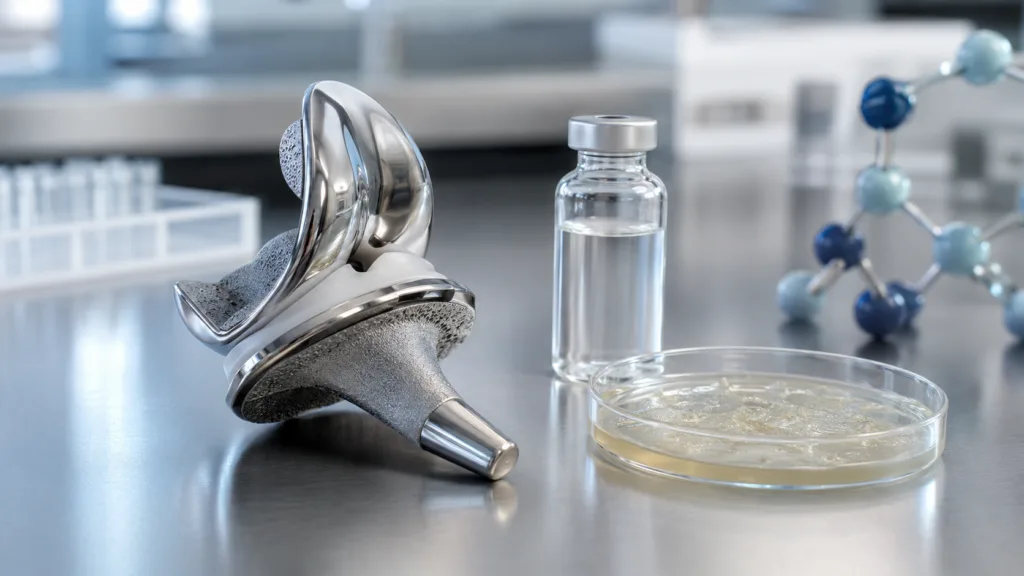
How is calpurbatug designed to weaken bacterial biofilms without replacing antibiotics?
Calpurbatug is a human immunoglobulin G1 monoclonal antibody targeting a conserved epitope within the DNABII family of bacterial DNA-binding proteins. These proteins help stabilise extracellular DNA within the structural framework of bacterial biofilms.
Biofilms allow bacteria to attach to implanted surfaces and persist inside a protective matrix. Organisms within that environment can be less accessible to immune cells and less responsive to antibiotics than free-floating bacteria, contributing to the difficulty of eradicating chronic implant-associated infections.
Trellis Bioscience’s therapeutic strategy is to disassemble part of that protective structure, exposing the bacteria to the immune system and making them more susceptible to conventional antibiotics. Calpurbatug is therefore being developed as an adjunct rather than as a substitute for pathogen-directed antimicrobial treatment.
That distinction is central to understanding both the opportunity and the limitations of the programme. Participants in the Phase 2 trial must have bacteria that remain susceptible to the planned antibiotic regimen. The study excludes fungal infections and infections caused by organisms that cannot be adequately treated once released from the biofilm.
The trial also excludes several complicated clinical presentations, including prosthesis loosening, osteomyelitis and certain draining sinus characteristics. Positive results would consequently apply first to a defined group of chronic knee or hip prosthetic joint infections, rather than every implant-associated infection or every drug-resistant pathogen.
Preclinical studies have supported activity against biofilms produced by several Gram-positive and Gram-negative organisms. However, broad laboratory activity does not establish that calpurbatug will deliver similar clinical outcomes across pathogens, anatomical sites or infection types.
What did the small Phase 1 study establish, and what questions did it leave unanswered?
The first-in-human study enrolled 15 people with chronic prosthetic joint infections of the knee or hip. Eleven received a single intravenous infusion of TRL1068 at one of three ascending doses, while four received placebo. All participants also received targeted antibiotics before undergoing the planned first stage of a two-stage exchange procedure.
The peer-reviewed study reported no adverse events attributed to TRL1068. The antibody had a serum half-life of approximately 15 to 18 days, while its concentration in synovial fluid seven days after infusion reached about 60% of the corresponding blood concentration. The measured joint-fluid exposure was reported to remain substantially above the threshold associated with biofilm disruption in laboratory testing.
Bacteria were eliminated from the explanted implant cultures of three of the 11 antibody-treated participants. The study also reported no recurrence of the original infection among TRL1068 recipients through day 169.
These observations supported biological activity and helped establish dosing for further study, but the evidence remains preliminary. The trial was small, contained only four placebo recipients and was designed primarily to evaluate tolerability and pharmacokinetics. It was not adequately powered to establish comparative efficacy.
Every participant also proceeded to implant removal and received antibiotic treatment. The absence of relapse therefore cannot be attributed to calpurbatug alone, and the trial did not answer the commercially important question of whether the antibody could enable successful retention of an infected prosthesis.
The Phase 1 programme nevertheless achieved something useful for a biofilm-directed therapy. It showed that intravenously administered TRL1068 could reach infected joint fluid at measurable concentrations and produced an initial pharmacodynamic signal on explanted implants. Those findings justified a trial with a more clinically consequential endpoint.
Can the Phase 2 design show that calpurbatug plus DAIR can avoid implant exchange?
The ongoing Phase 2 study is a randomised, parallel-group and open-label trial with an estimated enrolment of 60 adults. It compares calpurbatug plus DAIR and targeted antibiotics with standard two-stage prosthetic joint replacement.
Participants assigned to the experimental group receive calpurbatug at 15 milligrams per kilogram intravenously on day one, followed by 7.5 milligrams per kilogram on days 15, 29 and 43. The DAIR procedure is scheduled between days 15 and 22, and participants receive approximately ten weeks of pathogen-directed antibiotic treatment.
The primary outcome measures the incidence of resolved prosthetic joint infection at day 365. Resolution requires completion of the planned surgical intervention without subsequent systemic antibiotics for prosthetic joint infection, chronic antibiotic suppression or another planned intervention to treat the infection.
This is considerably more relevant than a short-term change in bacterial count. To succeed, the experimental strategy must control infection for a year without falling back on prolonged suppressive treatment or additional surgery. Secondary measures include recurrent infection, reinfection, adverse events, physical functioning, hospitalisation, rehabilitation requirements and other healthcare-resource use.
The study’s size and open-label design will still require careful interpretation. Surgical technique, pathogen type, baseline infection severity and antibiotic selection can affect outcomes. The selected eligibility criteria may also produce a population more suitable for implant retention than the broader chronic prosthetic joint infection population encountered in routine practice.
Patient-level durability will be particularly important. A reduction in early bacterial burden would be clinically insufficient if infections return after treatment ends or if patients subsequently require exchange surgery.
How much do the FDA designations reduce regulatory risk for an unapproved antibody?
Trellis Bioscience reported that TRL1068 has received Orphan Drug, Fast Track and Qualified Infectious Disease Product designations from the United States Food and Drug Administration. The first-in-human and Phase 2 studies have proceeded under an active Investigational New Drug application.
These designations can improve communication with the regulator, facilitate aspects of development and potentially provide additional exclusivity following approval. They do not establish that calpurbatug is effective, confirm an acceptable benefit-risk profile or guarantee an expedited approval.
The eventual regulatory pathway will depend heavily on the Phase 2 findings, the proposed indication and whether the evidence package is considered sufficient to support a larger confirmatory study or another development strategy. Trellis Bioscience will also need an adequate safety database for a systemically administered monoclonal antibody used in patients who may have substantial comorbidities and active infections.
Manufacturing will become increasingly important if the programme advances. Consistent antibody production, potency testing, formulation stability and commercial-scale supply must accompany the clinical evidence. The present financing advances the trial, but the company has not disclosed whether it covers later-stage manufacturing work or additional studies.
Would positive efficacy data be enough to change surgical practice and hospital purchasing?
Chronic prosthetic joint infections are difficult and expensive complications of knee and hip replacement surgery. Trellis Bioscience estimates that the condition affects more than 25,000 people annually in the United States, representing approximately 1% to 2% of joint-replacement recipients.
Two-stage exchange can require removal of the infected prosthesis, placement of an antibiotic-containing spacer, extended antimicrobial treatment and a later operation to implant a new joint. The process can bring prolonged immobility, rehabilitation and substantial hospital costs.
DAIR is less extensive because the implant is retained, but success can be less predictable in established chronic infections. Calpurbatug’s commercial proposition therefore rests on improving the reliability of DAIR in an appropriately selected population.
Positive Phase 2 results would still need to be translated into a workable clinical pathway. Orthopaedic surgeons, infectious-disease specialists, microbiology laboratories and infusion teams would need to coordinate patient selection, pathogen identification, antibody administration, surgery and antibiotic management.
Hospitals and payers would also want evidence that any additional drug expenditure is offset by fewer exchange procedures, shorter hospital stays, reduced rehabilitation and lower recurrence-related costs. The trial’s resource-utilisation and quality-of-life measures could consequently be almost as important commercially as its microbiological findings.
Could the biofilm mechanism support broader indications beyond prosthetic joint infection?
Trellis Bioscience sees potential for calpurbatug in other biofilm-associated infections, including osteomyelitis, infective endocarditis and diabetic foot infections. The conserved DNABII target provides a scientific rationale for evaluating multiple bacterial species and clinical settings.
The prosthetic joint infection trial cannot validate those broader uses. Bloodstream infections, cardiac infections, chronic wounds and bone infections differ in disease progression, drug penetration, supportive treatment, patient risk and acceptable endpoints. Each indication would require its own development strategy and evidence.
For now, chronic prosthetic joint infection offers a practical test of the platform because the affected implant provides a defined biofilm-associated setting and surgical samples can support microbiological assessment. A successful implant-retention outcome could strengthen the case for expanding the programme, while a negative result would require Trellis Bioscience to determine whether the problem arose from the mechanism, dosing, patient selection or the DAIR strategy itself.
Which 2027 results will determine whether the financing genuinely de-risks calpurbatug?
The central milestone is the Phase 2 topline readout expected in the second quarter of 2027. The most informative disclosure will go beyond announcing whether the primary endpoint was met and show how many participants remained free from infection-related intervention, systemic antibiotics and suppressive therapy at one year.
Recurrence and reinfection rates, serious adverse events, treatment discontinuations, anti-drug antibodies and consistency across major pathogen groups will also shape interpretation. Quality-of-life and resource-use results will indicate whether successful implant retention translates into a meaningful advantage for patients and hospitals.
The $9 million Series C reduces the immediate financing risk surrounding completion of the study. It does not remove the clinical, regulatory or commercial risks that follow.
Calpurbatug’s value will ultimately depend on whether biofilm disruption produces durable infection control in a setting where early improvement can be misleading and recurrence can carry serious consequences. Trellis Bioscience now has additional capital to reach that test, but the day-365 outcomes will determine whether TRL1068 advances from an intriguing biological strategy into a credible alternative within chronic prosthetic joint infection care.