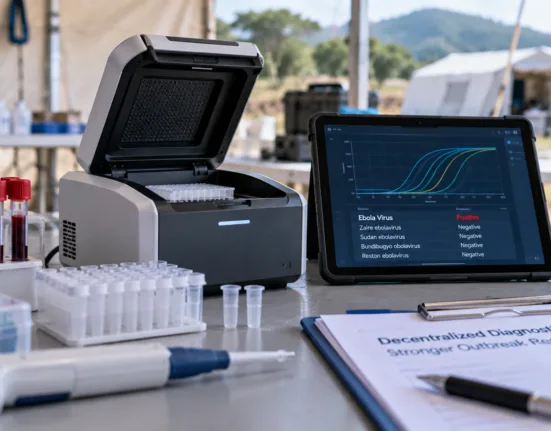
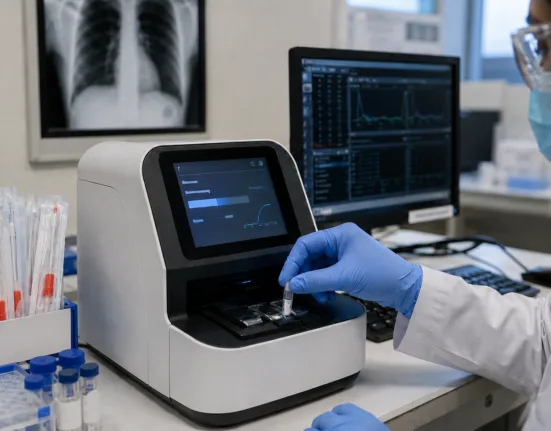
Co-Diagnostics, Inc. has advanced its CoMira Diagnostics LLC joint venture by finalizing a lease for a planned molecular diagnostics manufacturing facility in Sudair Industrial City, Saudi Arabia. The facility is intended to support localized production of diagnostic instruments, laboratory testing equipment, medical consumables, and future Co-Dx PCR platform-related activities, subject to regulatory and operational approvals.
The lease turns an earlier industrial land allocation into a more concrete development step, giving the diagnostics-focused company a clearer pathway from regional planning to physical manufacturing readiness. For a molecular diagnostics developer still working to commercialize its Co-Dx PCR platform, the Saudi move is less about immediate revenue and more about positioning within a healthcare market where localization, procurement access, and domestic manufacturing capacity are becoming increasingly important.
Why the CoMira lease matters for Saudi Arabia’s diagnostics localization strategy
The Sudair Industrial City lease gives CoMira Diagnostics a 14,400-square-foot industrial facility within one of Saudi Arabia’s established manufacturing hubs. That matters because Saudi Arabia’s Vision 2030 strategy is pushing healthcare localization beyond hospital infrastructure and into medical technology, diagnostics, supply chains, and domestic production capacity.
For Co-Diagnostics, the strategic value lies in matching its molecular diagnostics platform ambitions with a market that is actively trying to reduce reliance on imported healthcare products. Molecular diagnostics became a more visible priority after the pandemic exposed the risks of external dependence for testing capacity, consumables, and equipment. A local manufacturing footprint could therefore become a procurement advantage if Saudi institutions continue to favor domestic production in healthcare sourcing.
The risk is that localization is not the same as commercialization. A leased facility creates a physical base, but it does not automatically create regulatory clearance, validated manufacturing processes, customer adoption, reimbursement support, or sustained demand. CoMira Diagnostics will still need to move through execution milestones that are less visible than a lease signing but far more important for long-term value creation.

How the facility could support the Co-Dx PCR platform’s broader market ambitions
The planned facility is intended to support approved manufacturing activities, including diagnostic instruments, laboratory testing equipment, and medical consumables. That aligns with the broader Co-Dx PCR platform strategy, which includes PCR Home, PCR Pro, mobile app integration, and associated molecular tests, although those products remain subject to regulatory review and are not yet available for sale.
This distinction is crucial. The Saudi facility could eventually help Co-Diagnostics localize parts of its molecular diagnostics ecosystem, but the commercial impact depends heavily on whether the Co-Dx PCR platform secures the necessary regulatory clearances. If the platform advances successfully, the facility could become a regional manufacturing and distribution node for Saudi Arabia and the wider Middle East and North Africa region.
However, platform readiness remains the central unresolved question. Diagnostics manufacturing requires quality systems, regulatory documentation, supply reliability, technical training, and post-market support. For a platform intended to operate closer to patients or decentralized testing environments, operational discipline becomes even more important because errors in manufacturing, workflow design, or user adoption can slow acceptance among clinicians and health systems.
Why localized diagnostics manufacturing is becoming a strategic procurement issue
Co-Diagnostics’ Saudi move reflects a broader industry shift in which diagnostics companies are no longer competing only on test sensitivity, specificity, turnaround time, or menu breadth. They are increasingly competing on supply-chain resilience, local production credibility, regulatory alignment, and ability to support national healthcare priorities.
That shift could work in Co-Diagnostics’ favor if Saudi procurement frameworks continue to prioritize locally manufactured healthcare solutions. A domestic manufacturing presence may make CoMira Diagnostics more relevant to public health agencies, hospitals, and regional distributors than a purely export-based model. It may also help the joint venture respond faster to local demand patterns, especially if Saudi Arabia expands molecular testing capacity across infectious disease, genetic screening, or other nucleic acid-based applications.
The limitation is that domestic presence can raise expectations. Local manufacturing partners must often demonstrate not just capacity, but consistency, pricing competitiveness, technical service, and local workforce development. If CoMira Diagnostics cannot scale production efficiently or if demand develops more slowly than expected, the facility could remain a strategic asset without becoming a meaningful revenue contributor in the near term.
What this reveals about Co-Diagnostics’ capital-efficient expansion model
The turnkey nature of the Sudair Industrial City facility is strategically relevant because it may reduce the time, capital burden, and execution complexity associated with ground-up development. For a clinical and molecular diagnostics company with platform commercialization still ahead, avoiding heavy infrastructure spending can preserve flexibility while still creating a regional operating base.
This is consistent with Co-Diagnostics’ broader use of localized partnerships, including its CoSara Diagnostics joint venture in India. The model suggests that Co-Diagnostics is trying to expand internationally without building every market from scratch on its own balance sheet. Instead, the diagnostics developer appears to be using joint ventures to align with local manufacturing, distribution, and regulatory conditions.
The trade-off is control. Joint venture models can reduce capital intensity, but they also introduce partner execution risk, governance complexity, and dependency on local regulatory and procurement dynamics. Investors and industry observers are likely to watch whether CoMira Diagnostics can progress beyond facility setup into validated production, clear market access, and recurring commercial demand.
Can Saudi regulatory pathways accelerate Co-Diagnostics’ commercial timeline?
Co-Diagnostics has indicated that once relevant U.S. Food and Drug Administration clearances are obtained, the Co-Dx PCR platform may be introduced into the Saudi market through a potentially more streamlined regulatory pathway compared with some other international jurisdictions. If that plays out, Saudi Arabia could become an early market for the platform as the facility moves toward operational readiness.
That possibility gives the lease added strategic weight. A manufacturing facility developed in parallel with regulatory progress could shorten the gap between clearance and regional commercialization. It could also allow CoMira Diagnostics to align product introduction with domestic supply-chain priorities rather than relying entirely on imported systems.
Still, the pathway remains conditional. Regulatory timing for molecular diagnostics platforms can be unpredictable, especially when products involve at-home, point-of-care, digital, or decentralized workflows. Any delay in U.S. regulatory clearance could slow Saudi commercialization. Any mismatch between platform capabilities and Saudi clinical workflows could also limit adoption even if regulatory pathways are favorable.
How investors may read the CoMira milestone for Co-Diagnostics stock sentiment
For Co-Diagnostics shareholders, the lease is likely to be viewed as an execution milestone rather than a near-term financial catalyst. Nasdaq-listed Co-Diagnostics has long needed to convince investors that its molecular diagnostics platform can move from development promise to sustainable commercial markets. The Saudi facility gives the story a tangible international expansion angle, but the market will likely demand clearer evidence of regulatory progress, production readiness, and commercial traction.
The positive interpretation is that Co-Diagnostics is positioning early in a region where healthcare localization could create procurement advantages. The more cautious interpretation is that facilities, joint ventures, and regional strategies do not by themselves resolve the main investor question around product approval and adoption. In other words, the lease helps build the runway, but the aircraft still needs clearance for takeoff.
Investor sentiment may therefore remain milestone-driven. Regulatory updates on the Co-Dx PCR platform, progress at the CoMira facility, procurement signals in Saudi Arabia, and any early distribution agreements across the Middle East and North Africa region will matter more than the lease announcement alone.
What clinicians, regulators, and diagnostics industry watchers will monitor next
Clinicians will be watching whether Co-Diagnostics can demonstrate that its molecular diagnostics platform supports accurate, reliable, and clinically useful testing in real-world workflows. Regulators will focus on validation, quality controls, intended use, labeling, and risk management. Procurement teams will likely evaluate cost, domestic production credentials, service reliability, and compatibility with Saudi healthcare infrastructure.
For diagnostics industry observers, the CoMira lease raises a broader question about whether emerging molecular diagnostics companies can use localization to compete with larger incumbents. Multinational diagnostics groups already have scale, menus, installed bases, and procurement relationships. Co-Diagnostics’ opportunity lies in using a more focused platform and local manufacturing model to gain relevance in markets where healthcare self-sufficiency is becoming a national priority.
The next meaningful phase will be operational rather than symbolic. CoMira Diagnostics needs to convert the leased space into a compliant manufacturing environment, align production with applicable approvals, and show that domestic manufacturing can translate into market access. Until then, the Sudair Industrial City facility should be seen as a strategic bridge, not a finished commercial engine.