The U.S. Food and Drug Administration (FDA) has granted 510(k) clearance to Vesalio for pVasc NET, a peripheral mechanical thrombectomy device that combines a self-expanding clot retriever with a fine-pore, dual-layer filter positioned at its distal end.
The FDA classified the device as substantially equivalent through the Special 510(k) pathway on August 5, 2026. Vesalio announced the decision on August 13 and said it plans to begin a controlled US commercial introduction later in 2026. The device is designed for vessels measuring approximately 2 to 6 millimeters in diameter and is not currently CE marked.
That launch timeline makes the clearance more than an incremental regulatory update. It gives the privately held company an opportunity to test whether integrated clot filtration can address one of the persistent concerns in peripheral thrombectomy: fragments escaping downstream while a thrombus is being retrieved through small, stenotic or otherwise diseased vessels.
The design is technically appealing, but clearance does not establish that pVasc NET improves limb salvage, eliminates distal embolization or outperforms aspiration and other mechanical thrombectomy technologies. Vesalio did not report device-specific clinical outcomes, comparative data or filter-capture rates with the announcement. Its early commercial experience will therefore carry unusual importance.
Why could an integrated distal filter matter during peripheral thrombectomy?
Peripheral artery occlusions can abruptly reduce blood flow to an arm or leg, creating a time-sensitive threat to tissue viability. In acute limb ischemia, the clinical objective is not simply to open the largest visible artery. Physicians must also preserve blood flow through smaller downstream vessels that supply the affected tissue.
Mechanical thrombectomy can remove an obstructing clot without the delay and bleeding exposure associated with prolonged catheter-directed thrombolysis in selected patients. It can also offer a minimally invasive alternative to surgical embolectomy. However, retrieving a friable or partially organized clot may cause pieces of thrombus to separate and travel into more distal arteries.
Those fragments can obstruct runoff vessels even after the original blockage has been treated. The angiogram may show improvement at the principal lesion while residual or newly embolized material continues to limit tissue perfusion farther downstream. Additional aspiration, retrieval passes, thrombolytic therapy or other bailout treatment may then be required.
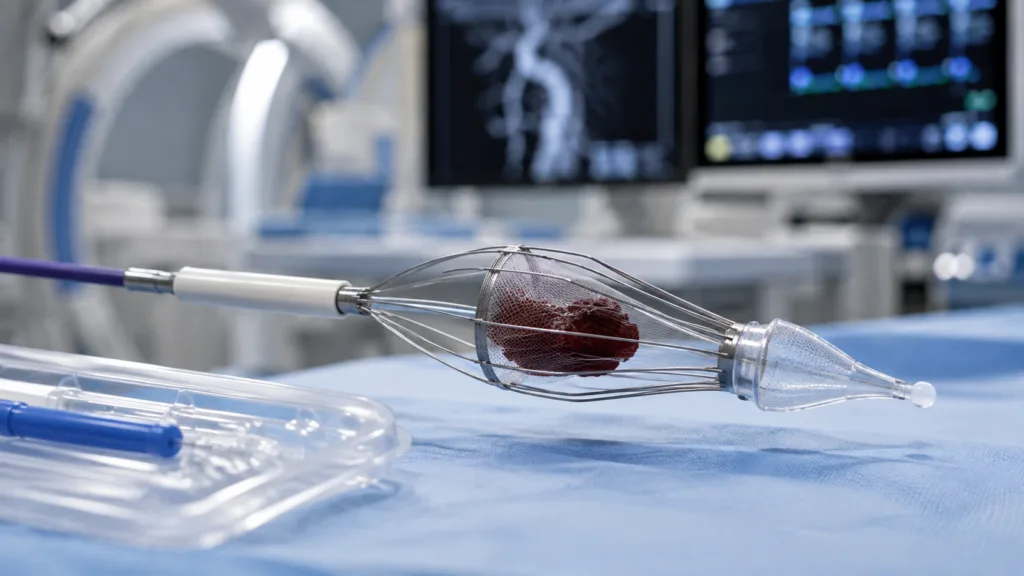
Vesalio designed the distal portion of pVasc NET as a fine-pore, dual-layer filter intended to capture and retain fragments during retrieval. The concept is to make clot containment part of the thrombectomy device rather than adding a separate embolic-protection component to the procedure.
The wording remains important. The filter is designed to capture fragments, but that does not mean every particle will be retained or that distal embolization has been eliminated. Vessel anatomy, clot composition, device sizing, retrieval technique and adjunctive aspiration can all influence the result.
How does Vesalio pVasc NET capture and remove peripheral blood clots?
pVasc NET builds on Vesalio’s existing pVasc platform. The device uses a self-expanding nitinol structure delivered through a low-profile catheter. Once positioned across an occlusion and unsheathed, the expandable portion engages thrombotic material so that the device and captured clot can be withdrawn.
The platform incorporates Vesalio’s Drop Zone architecture, which creates openings through which thrombus can enter the device lumen. Instead of relying exclusively on surface contact between a clot and a conventional mesh structure, the design is intended to receive and retain material within the retriever.
The new filter is incorporated into the distal portion of that architecture. It is intended to collect fragments that move toward the downstream end during engagement and extraction. Radiopaque features provide visualization under fluoroscopy, while compatibility with aspiration allows physicians to combine mechanical retrieval with suction when clinically appropriate.
The 2 to 6 millimeter vessel range is potentially relevant for procedures extending from larger peripheral arteries into smaller distal anatomy. The predecessor pVasc platform has been positioned for locations including iliac, femoropopliteal, tibial, brachial and distal upper-extremity arteries, depending on vessel diameter and the individual case.
Low-profile delivery may be especially useful below the knee or in patients with diffuse peripheral artery disease, where stenosis, tortuosity and calcification can make device navigation difficult. Yet deliverability is only one part of procedural performance. The retriever must also expand properly, engage the target material, retain the clot and withdraw without excessive force or vessel injury.
Which peripheral vascular cases could be considered for pVasc NET?
Vesalio describes pVasc NET as a device for the nonsurgical removal of emboli and thrombi from peripheral blood vessels. The platform can be used temporarily during a peripheral vessel occlusion and in conjunction with aspiration or the delivery of contrast media and other fluids.
The company is positioning it principally for peripheral arterial thrombectomy, including occlusions associated with acute limb ischemia. These cases can arise from an embolus that travels from another location, thrombosis within a diseased native artery, failure of a prior vascular intervention or clot formation around a narrowed segment.
Not every peripheral occlusion is an appropriate mechanical thrombectomy target. The existing pVasc instructions exclude vessels below 2 millimeters or above 6 millimeters and list calcified or fibrous material, infected vessels, extreme tortuosity, nickel or nitinol hypersensitivity, pregnancy and coronary or neurovascular use among the contraindications.
Clinicians will need to follow the final pVasc NET labeling rather than assume that the new filter broadens those boundaries. In particular, a clot-retrieval device should not be treated as a tool for dilating a fixed plaque obstruction or extracting calcified atherosclerotic material. Patients with peripheral artery disease frequently have mixed lesions, making imaging and lesion assessment essential before selecting a thrombectomy strategy.
The device also should not be interpreted as a treatment for every form of peripheral vascular disease. Chronic claudication caused by stable atherosclerotic narrowing is different from an acute thromboembolic occlusion. Treatment decisions depend on the urgency of ischemia, neurologic findings in the limb, clot location, duration of symptoms, underlying stenosis and the patient’s bleeding and surgical risks.
What does the Special 510(k) clearance establish about pVasc NET?
The FDA received Vesalio’s submission on December 29, 2025, and issued its substantially equivalent decision on August 5, 2026. The agency reviewed the device through its cardiovascular panel and did not use a third-party reviewer.
A Special 510(k) is generally used when a manufacturer modifies its own legally marketed device and established evaluation methods can assess the change. The pathway relies on design controls, risk analysis, verification and validation to support substantial equivalence.
For pVasc NET, the classification indicates that the integrated-filter version remains sufficiently connected to Vesalio’s legally marketed thrombectomy platform in intended use and technology to proceed through the 510(k) system. It should not be described as an FDA approval, and it is not evidence that the agency found the device clinically superior to competing systems.
Vesalio did not announce a randomized trial, pivotal clinical study or head-to-head comparison supporting the clearance. The company also did not disclose the filter’s pore dimensions, the proportion of particles captured in bench testing, first-pass clot-removal rates or comparisons between pVasc NET and the original pVasc device.
The absence of those details does not mean the filter lacks value. It means the commercial and clinical claims should remain proportional to the evidence currently available.
Could pVasc NET simplify the peripheral thrombectomy workflow?
Peripheral thrombectomy technologies approach clot removal in different ways. Aspiration systems use suction through a catheter, often supported by a pump and specialized tubing. Rheolytic systems use high-velocity fluid jets to disrupt and evacuate thrombus. Other devices mechanically macerate, engage or retrieve the clot, while catheter-directed thrombolysis dissolves it pharmacologically over time.
pVasc NET belongs to the retriever category but can be paired with aspiration. Its possible workflow advantage is the combination of clot engagement, extraction and distal filtration within one low-profile device.
An integrated filter may reduce the need to introduce and manipulate a separate distal-protection device in appropriate cases. It could also provide containment when anatomy does not offer enough room for an independent filter beyond the lesion. These are plausible procedural benefits, not yet demonstrated clinical advantages.
The predecessor pVasc platform does not require proprietary capital equipment, which may help smaller hospitals or catheterization laboratories avoid committing to another console. A device that can be stocked as a single-use component and incorporated into familiar catheter workflows could lower the operational barrier to trial.
Adoption will still depend on practical details such as catheter compatibility, device preparation, inventory requirements, retrieval force, visibility and the ability to recapture or reposition the system. The controlled introduction gives Vesalio an opportunity to refine training and collect structured feedback before pursuing a broader rollout.
How will pVasc NET compete with established thrombectomy systems?
The peripheral thrombectomy market already includes well-established products from Penumbra, Boston Scientific, Inari Medical and other vascular-device manufacturers. Those companies benefit from broader sales organizations, existing hospital contracts and large installed bases of complementary products.
Penumbra’s Indigo platform has made computer-assisted aspiration a central part of peripheral clot-removal strategies. Boston Scientific’s AngioJet technology offers rheolytic thrombectomy across multiple vascular indications. Other mechanical and aspiration systems address deep vein thrombosis, pulmonary embolism or larger peripheral vessels with different catheter profiles and clot-removal mechanisms.
Vesalio is not attempting to compete solely through suction power or thrombus maceration. Its differentiation rests on a low-profile self-expanding retriever, the Drop Zone structure and an integrated distal filter. That could be particularly relevant in smaller arteries where protecting limited runoff is a priority.
The competitive question is whether the added filter produces a measurable procedural benefit. Hospitals will want to see fewer retrieval passes, limited need for bailout treatment, effective removal across different clot morphologies and acceptable rates of vessel injury, blood loss and distal embolization.
Pricing will matter as well. Even a clinically interesting device can struggle if its acquisition cost is materially higher than familiar alternatives without reducing procedure time, accessory use or complications. Vesalio has not disclosed commercial pricing or contracting plans.
What clinical evidence does Vesalio still need to produce?
Vesalio initiated a prospective, single-arm, multicenter US study of the original pVasc system in 2024 to collect real-world evidence in peripheral arterial occlusions, including cases that may lead to acute limb ischemia. Publicly available information has focused on the study’s initiation rather than completed results.
The company’s wider Drop Zone technology has accumulated clinical experience in neurovascular thrombectomy, and Vesalio says its product portfolio has been used in more than 20,000 patients across over 60 countries. Those figures cover multiple products and vascular territories. They should not be interpreted as pVasc NET exposure or evidence specific to peripheral procedures with the new filter.
Device-specific evidence should document technical success, first-pass removal, changes in runoff, captured clot volume, distal embolization, procedure duration, adjunctive therapy, vascular complications and the need for surgery. Longer follow-up should examine reintervention, amputation-free survival and functional recovery.
A useful comparison would evaluate pVasc NET against the original pVasc device under similar clinical conditions. That could help isolate whether the distal filter provides an advantage beyond the existing closed-basket and Drop Zone design. Comparative evidence against aspiration-based treatment would be more challenging but more influential for hospital adoption.
What could limit adoption after the controlled US launch?
The same anatomy that makes a low-profile retriever attractive can increase procedural risk. Small, stenotic arteries may be fragile. A device that is incorrectly sized, advanced against resistance or withdrawn through heavily diseased anatomy can contribute to dissection, perforation, vasospasm, device deformation or fracture.
Existing pVasc labeling also identifies embolus migration, distal embolization, continued occlusion, hemorrhage, recurrence of thrombosis and emergency surgery among possible complications. An integrated filter may be intended to address part of that risk profile, but it does not remove the need for appropriate sizing, aspiration strategy and careful retrieval.
Mixed thrombotic and calcified lesions present another challenge. A retriever may remove the thrombus while exposing an underlying stenosis that still requires angioplasty, stenting or another therapy. Successful clot extraction therefore may be only the first stage of revascularization.
The controlled rollout should reveal whether physicians can integrate pVasc NET without adding meaningful complexity. Repeat use will depend less on the novelty of the filter than on whether operators consistently see cleaner runoff, fewer secondary interventions and reliable performance across real-world clot types.
Why is the clearance strategically important for Vesalio?
Vesalio has been building a thrombectomy portfolio across the cerebral, coronary and peripheral circulations. Its NeVa products target neurovascular clot retrieval, enVast addresses coronary thrombectomy, and pVasc serves the peripheral market.
pVasc NET extends a filtration concept previously developed within Vesalio’s neurovascular platform into peripheral intervention. That gives the company a shared technological theme across vascular territories while allowing each product to address different anatomy, procedural techniques and clinical risks.
The clearance also arrives after the original pVasc system entered US commercialization in 2024. Vesalio can now introduce the filtered version to physicians already familiar with its retriever-based workflow rather than building an entirely new market category.
The next test will occur outside the regulatory database. A controlled US launch, transparent reporting of early cases and publication of device-specific outcomes will determine whether the integrated filter becomes a meaningful point of differentiation or remains primarily an engineering feature. For a peripheral thrombectomy device designed around clot retention, the most consequential evidence will be what reaches the retrieval catheter and what does not escape downstream.