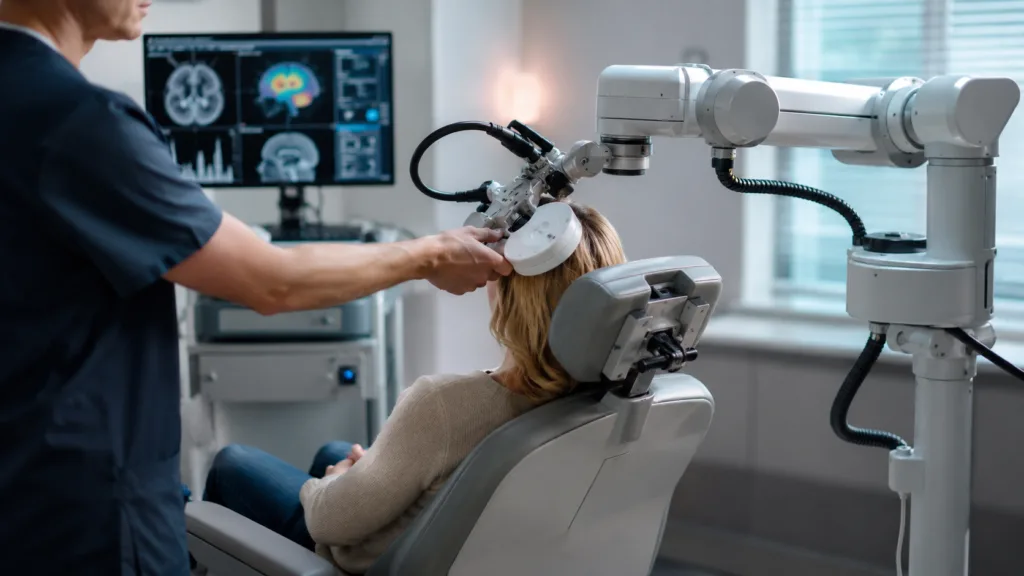
Zeta Surgical has received U.S. Food and Drug Administration 510(k) clearance for the Zeta TMS Robotic System, a Class II stereotaxic instrument combining real-time navigation, robotic coil positioning and automatic motion compensation. The regulatory milestone moves the Boston medical technology company beyond image-guided navigation into active robotic control of transcranial magnetic stimulation coil placement, where accurate and repeatable targeting is an important part of treatment delivery.
The clearance is commercially significant because transcranial magnetic stimulation is normally administered across repeated treatment sessions, creating a need to reproduce coil location, angle and contact conditions over time. Even when a treatment target has been selected accurately, patient movement and differences in operator technique can affect whether the coil remains aligned with the intended brain region throughout a session.
Zeta Surgical is positioning the robotic system as a way to reduce that operational variability. The platform is designed to track patient movement continuously and reposition the treatment coil automatically, potentially allowing clinics to maintain alignment without requiring an operator to make repeated manual corrections.
The distinction between engineering precision and clinical benefit remains important, however. Zeta Surgical has disclosed accuracy and usability testing conducted with Harvard Medical School and the University of Cambridge, but the clearance announcement did not include patient outcome data demonstrating that robotic positioning improves response, remission, durability or tolerability compared with conventional TMS delivery.
Why does robotic coil positioning matter when TMS clinics already use navigation tools?
Navigation and robotic positioning address related but different parts of the TMS workflow. A neuronavigation system can help clinicians identify a planned target and show whether a coil is aligned with that location. A robotic positioning system can go further by physically controlling the coil and making adjustments when the patient changes position.
That difference becomes more relevant during repeated treatment sessions. A patient may move slightly because of discomfort, fatigue, conversation or natural postural changes. A manually held or mechanically supported coil can consequently drift away from its original position or orientation unless the operator notices the movement and intervenes.
The Zeta TMS Robotic System is intended to automate part of that correction process. Zeta Surgical says the platform provides submillimeter-level positioning accuracy, dynamically tracks movement and adjusts the coil to help preserve on-target stimulation. The company also says the system can be prepared for use in less than a minute, although actual setup times in commercial clinics will depend on imaging availability, registration procedures, room configuration and staff familiarity.
Automatic correction could be particularly valuable where clinics are seeking to standardize TMS delivery across multiple technicians or locations. A system that records planned targets, controls coil orientation and compensates for motion may reduce dependence on individual operator experience, making the treatment process easier to reproduce across a growing network.
Robotic control does not remove the need for clinical oversight. Staff must still confirm the patient, protocol, target, stimulation parameters and compatibility of the coil and stimulator. Clinics will also need procedures for pausing treatment, overriding the robotic arm and responding to tracking errors or unexpected movement.
What does the FDA 510(k) clearance establish, and what remains clinically unproven?
The Zeta TMS Robotic System was cleared under the FDA’s 510(k) pathway as a Class II stereotaxic instrument. This pathway allows a medical device to be marketed when the manufacturer demonstrates that it is substantially equivalent to a legally marketed predicate device, including consideration of intended use, technological characteristics and performance.
The clearance therefore represents an important regulatory and commercialization milestone, but it should not be interpreted as evidence that the system produces better psychiatric outcomes than other TMS positioning approaches. The system is a positioning and guidance technology, not a newly authorized treatment for depression, obsessive compulsive disorder, post-traumatic stress disorder or addiction.
This distinction matters because the announcement discusses several behavioral health applications in which TMS is used or being investigated. Regulatory clearance of the positioning platform does not independently expand the indications of a connected TMS stimulator. Treatment claims remain governed by the labeling and FDA clearances of the underlying stimulation system and protocol.
The evidence disclosed for the robotic system has focused on accuracy and usability. Those measures are relevant because a positioning system must first demonstrate that it can locate, orient and maintain the coil reliably. They do not answer whether reducing positioning variability produces a meaningful improvement in response rates, remission, treatment durability or patient experience.
The next evidence step is likely to involve prospective clinical use showing how the system performs during complete treatment courses. Investigators will need to examine not only average targeting accuracy but also tracking interruptions, registration failures, time lost to troubleshooting, operator overrides and differences between controlled evaluations and routine outpatient care.
Could automatic motion compensation improve consistency across high-volume TMS clinics?
The strongest commercial argument for the Zeta TMS Robotic System may be consistency rather than novelty. TMS clinics must manage repeated patient visits, room utilization, technician schedules, documentation and quality controls. Small inefficiencies at the beginning of each session can accumulate when a centre treats several patients daily.
A system that reduces setup time and keeps the coil aligned automatically may help staff manage those demands more predictably. Robotic positioning could also support a model in which trained technicians oversee treatment under appropriate medical supervision while the platform handles part of the physical positioning workload.
Whether those operational benefits justify the acquisition cost will depend on pricing, service contracts, installation requirements and treatment volume. Zeta Surgical has not publicly disclosed the system’s price, recurring software costs, maintenance arrangements or expected return on investment for clinics.
Procurement teams will therefore need to compare the platform against less automated alternatives, including manual coil supports, conventional neuronavigation systems and integrated TMS platforms with their own positioning capabilities. A clinic treating a small number of patients may value accuracy but struggle to justify a robotic system if the financial benefit depends on high utilization.
Larger networks may view the economics differently. Standardized robotic positioning could make it easier to establish common treatment procedures across sites, monitor adherence to targeting plans and reduce variation between operators. Those capabilities may become more valuable as TMS providers expand geographically or adopt shorter, more intensive treatment schedules.
Reliability will be central to that business case. A robotic system that saves several minutes during setup but introduces software interruptions or maintenance downtime could create a different set of workflow problems. Commercial evaluations will need to measure total room turnover and system availability, not only the speed of initial registration.
How does the clearance strengthen Zeta Surgical’s position in precision neuromodulation?
The latest clearance builds on the company’s earlier Zeta TMS Navigation System, which received FDA clearance in October 2025. That product provided image-guided positioning using patient imaging and real-time tracking but did not represent the same level of active robotic coil control described in the new platform.
Zeta Surgical subsequently began commercial deployment of the navigation system at HOPE Therapeutics in Florida. The robotic clearance gives the company an opportunity to deepen that relationship and approach other TMS providers with a broader automation proposition.
The company is not entering an empty category. The TMS market already includes established stimulation manufacturers, independent neuronavigation platforms and robotic positioning technologies. Axilum Robotics has developed a collaborative robotic system for TMS coil positioning, while Nexstim offers navigated brain stimulation systems that integrate targeting, stimulation and supporting hardware. Localite also supplies TMS navigation technology and served as the predicate for Zeta Surgical’s earlier navigation clearance.
Zeta Surgical’s differentiation will depend on whether it can combine compact deployment, fast registration, image guidance and automatic movement compensation in a system that fits routine outpatient environments. Operating-room-style precision sounds attractive, but clinics will judge the product on ease of use, compatibility, uptime and clinical workflow rather than positioning specifications alone.
The company’s wider portfolio may provide another advantage. Zeta Surgical has developed navigation and robotics technologies for neurosurgical and neurotherapeutic applications, allowing it to reuse computer vision, tracking and image-registration capabilities across different products. A common technology foundation can reduce development duplication and create opportunities for shared software, training and service infrastructure.
It also introduces execution risk. Building products for both neurosurgical procedures and outpatient neuromodulation requires different commercial channels, clinical training models and support capabilities. Success in one environment does not automatically guarantee adoption in the other.
Which integration and reimbursement barriers could slow robotic TMS adoption?
Compatibility will be one of the first questions raised by potential customers. The earlier Zeta TMS Navigation System was cleared for use with specified MagVenture stimulators and a particular magnetic coil. The latest announcement did not provide a detailed list of compatible stimulators, coils or treatment protocols for the robotic system.
A narrow initial compatibility range could limit the addressable customer base, especially among clinics that already own equipment from other TMS manufacturers. Expanding compatibility may require additional engineering validation, regulatory submissions and commercial agreements with stimulation-system suppliers.
Physical integration also matters. Clinics will need to know how much floor space the robot occupies, whether rooms require modification, how the arm interacts with treatment chairs and head supports, and whether the system can be moved between rooms. A product described as rapidly deployable must still fit safely into environments that were not designed around robotic equipment.
Training will extend beyond learning the user interface. Staff will need to understand image registration, robotic boundaries, patient movement detection, emergency release procedures, cleaning, calibration and the circumstances in which manual intervention is required. Service support must be responsive because a failure could interrupt a multiweek treatment schedule.
Reimbursement presents a separate challenge. Clinics should not assume that the addition of robotic positioning will automatically produce a separate payment above reimbursement for the underlying TMS treatment. The economic argument may therefore need to rely on improved throughput, reduced setup variability, staff efficiency or stronger treatment documentation.
Payers may eventually become interested if clinical evidence shows that more consistent targeting reduces retreatment, improves outcomes or lowers total care costs. Those claims will require comparative data. Engineering accuracy alone is unlikely to settle reimbursement discussions.
What should clinicians and investors watch as Zeta Surgical moves into commercial proof?
Zeta Surgical is a privately held medical technology company, so there is no public share-price reaction through which to measure immediate investor sentiment. For existing and prospective private investors, the clearance nevertheless reduces one element of regulatory risk and expands the company’s commercially addressable product portfolio.
The most important next disclosure will be the commercial launch strategy. Industry observers will watch whether the first installations occur at existing navigation customers, large psychiatric treatment networks, academic centres or independent TMS clinics. The mix will indicate whether Zeta Surgical is initially pursuing evidence generation, reference sites or faster revenue growth.
Customers will also look for pricing, service terms and compatibility details. A robotic positioning system can deliver impressive technical performance but still face slow adoption when budgets, room constraints or equipment integration create friction.
Clinical evidence will ultimately determine whether the platform becomes an important part of TMS delivery or remains a premium workflow accessory. Useful studies would compare robotic and conventional positioning across complete treatment courses, measuring targeting stability, setup time, operator workload, treatment interruptions and patient outcomes.
The FDA 510(k) clearance gives Zeta Surgical permission to move from development into broader commercial execution. It does not remove the need to prove that automated positioning delivers enough clinical and operational value to change purchasing decisions. The next phase will be decided less by the robot’s ability to follow a target in controlled testing and more by its performance through hundreds of ordinary sessions in busy clinics.