iHealthScreen has received United States Food and Drug Administration 510(k) clearance for iPredict-DR, artificial intelligence-powered software designed to detect more than mild diabetic retinopathy in adults with diabetes who have not previously been diagnosed with the condition. The July 2, 2026 decision, recorded under K253704, allows the privately held healthcare artificial intelligence developer to market the software for automated diabetic retinopathy screening in the United States.
The clearance moves iPredict-DR from regulatory development into a far more demanding commercial phase. The software analyzes color retinal fundus images captured with the iCare DRSplus camera and is intended to make screening available in primary care practices, diabetes clinics, community health centers and other settings where ophthalmology expertise may not be immediately available.
That proposition addresses a persistent gap in diabetes care. Diabetic retinopathy can progress without noticeable early symptoms, yet many people with diabetes do not complete recommended eye examinations. Moving image acquisition and automated analysis closer to routine diabetes appointments could help identify patients who need specialist referral before avoidable visual impairment develops.
The commercial opportunity, however, cannot be measured by clearance alone. Autonomous retinal screening products must fit into busy clinical workflows, generate usable images across varied patient populations, connect patients with follow-up services and produce economics that work for both providers and payers. iHealthScreen has crossed the regulatory threshold, but implementation will determine whether the technology reaches meaningful scale.
Why does the iPredict-DR clearance matter in an increasingly competitive artificial intelligence screening market?
iPredict-DR joins a relatively small group of FDA-cleared systems developed to automate diabetic retinopathy detection. Established participants include Digital Diagnostics with LumineticsCore, Eyenuk with EyeArt and AEYE Health with AEYE-DS. Their presence validates the clinical and regulatory category, while also making it harder for a new entrant to rely on artificial intelligence performance as its only differentiating claim.
The significance of the iHealthScreen clearance is therefore not that automated diabetic retinopathy screening is new. The more important development is the widening range of vendors attempting to move retinal screening beyond specialist eye clinics. Additional competition may give hospitals, primary care networks and federally qualified health centers greater flexibility over cameras, software contracts, deployment models and referral workflows.
Competition is also likely to shift toward operational performance. Providers will want to know how frequently the system returns an actionable result, how often images must be retaken, whether pharmacological dilation is required, how performance varies across demographic and clinical subgroups, and how quickly staff can become proficient. A strong algorithm can still struggle commercially if image acquisition is unreliable or if the workflow creates more administrative work than it removes.
iHealthScreen will consequently need to demonstrate that iPredict-DR is not merely another cleared algorithm. Its commercial position will depend on installation costs, software pricing, technical support, electronic health record integration, reporting quality and the ability to establish referral relationships with eye care providers. Those less glamorous details often decide whether diagnostic artificial intelligence remains a pilot project or becomes part of routine care.
What does the FDA 510(k) decision establish and which evidence questions remain unanswered?
The FDA classified iPredict-DR as a Class II diabetic retinopathy detection device under the ophthalmic review category. The traditional 510(k) decision found the product substantially equivalent to a legally marketed device, providing the regulatory basis for United States commercialization.
That distinction matters because FDA clearance is not the same as a broad endorsement of every potential use of the software. iPredict-DR is designed for a defined screening population and a specific clinical purpose. It identifies more than mild diabetic retinopathy in adults with diabetes who have not already received a diagnosis, rather than functioning as a general eye examination or a system for managing every stage of retinal disease.
iHealthScreen said the submission was supported by a clinical validation trial evaluating diagnostic performance, safety and usability. However, the clearance announcement did not disclose the trial’s final enrollment, sensitivity, specificity, imageability rate, subgroup analyses or confidence intervals. The FDA’s public entry for K253704 also did not initially provide the detailed 510(k) summary or cleared labeling needed to examine those results fully.
This does not weaken the fact of clearance, but it limits independent interpretation of how iPredict-DR compares with other systems. Hospitals and clinical buyers will need the complete performance package, including the characteristics of participants, prevalence of disease in the validation population, handling of ungradable images and results across age, race, ethnicity, lens status and diabetes type.
Imageability deserves particular attention. A system may perform well on images it can analyze while still producing a meaningful proportion of insufficient-quality results in routine care. Older patients, small pupils, cataracts, operator technique and camera positioning can affect fundus image quality. Buyers will therefore look beyond headline accuracy and examine the proportion of patients who receive a usable result during an ordinary visit.
Can the iCare DRSplus workflow make automated retinal screening practical in primary care?
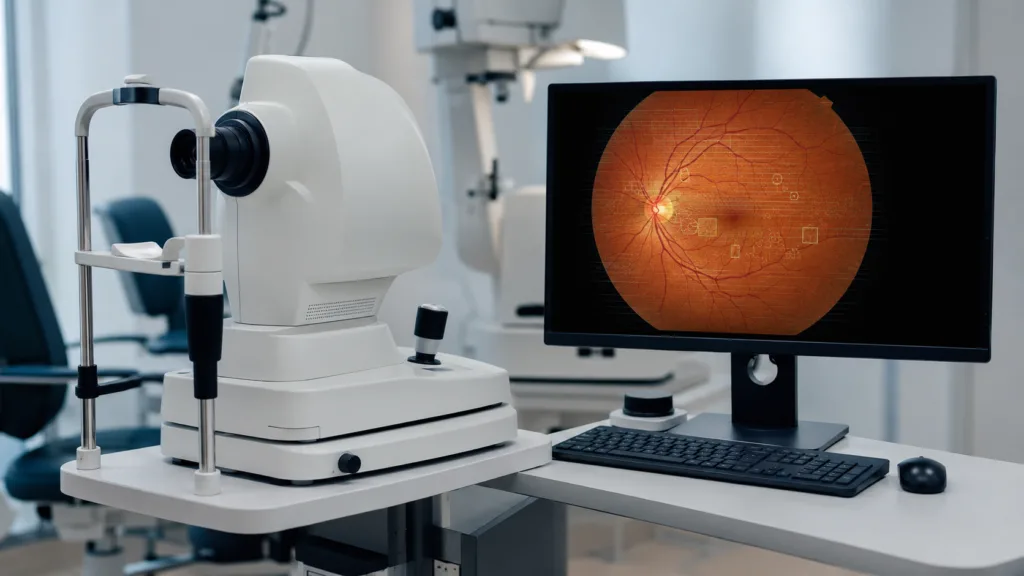
iPredict-DR analyzes images captured using the iCare DRSplus color fundus camera. iHealthScreen has positioned the system for operation by a nurse or healthcare worker with limited specialist imaging experience, potentially allowing screening to be incorporated into diabetes appointments without requiring an ophthalmologist at the point of care.
That workflow could be valuable for primary care practices and community clinics serving patients who face transport, scheduling or specialist-access barriers. Instead of asking a patient to arrange a separate eye appointment, a clinic could capture retinal images during an existing visit, run the automated analysis and initiate a referral when the software detects disease requiring further evaluation.
Yet the camera requirement also shapes the addressable market. Healthcare organizations that already use a different fundus camera may face additional capital expenditure or workflow disruption if compatibility is limited to the iCare DRSplus platform. Camera availability, maintenance, staff training and physical space will therefore influence adoption alongside the cost of the software itself.
Minimally skilled operation should not be interpreted as training-free operation. Clinical sites will need consistent image acquisition protocols, quality assurance procedures and escalation pathways for patients whose images cannot be assessed. They must also decide who communicates results, tracks referrals and follows up when a patient does not attend an ophthalmology appointment.
This is where implementation can become more complex than the technology demonstration. Automated screening may reduce dependence on specialist interpretation at the initial stage, but it does not eliminate the need for clinical governance. A positive result must lead somewhere, while an ungradable result cannot simply disappear into an electronic inbox.
Why will reimbursement, workflow integration and referral completion decide commercial adoption?
iHealthScreen said iPredict-DR is commercially available across the United States and is targeting hospitals, health systems, diabetes clinics, federally qualified health centers and telehealth organizations. It is also seeking distribution and strategic commercialization partners, suggesting that the developer recognizes the need for a broader sales and implementation infrastructure.
Commercial availability is only the beginning. Adoption of autonomous diabetic retinopathy screening has remained slower than the clinical need might suggest, even though the United States has a dedicated Current Procedural Terminology code for point-of-care automated retinal imaging and analysis. Coverage rules, payment levels, camera costs, software fees and patient volumes can produce very different returns for individual practices.
A large health system may justify deployment by improving quality-measure performance, increasing screening completion and preventing patients from becoming lost between primary and specialty care. A smaller practice may require predictable reimbursement and sufficient testing volume before purchasing equipment. Federally qualified health centers may see a compelling access benefit but face tighter capital budgets and technology support constraints.
Integration will be equally important. Clinicians need results placed in the appropriate patient record, clearly worded recommendations and a reliable method for documenting screening completion. Separate portals, manual data entry or poorly integrated reports can undermine the time-saving case for artificial intelligence.
Referral completion represents another commercial and clinical test. Detecting more than mild diabetic retinopathy is useful only if patients with positive results receive appropriate specialist evaluation. Health systems may prefer vendors that support closed-loop referrals, patient reminders, tracking and documentation rather than offering a standalone algorithmic report.
How should clinicians manage false results and the limits of automated diabetic retinopathy screening?
Like every diagnostic system, iPredict-DR will produce some false-negative and false-positive results. A false negative may delay specialist evaluation, while a false positive may create anxiety, unnecessary appointments and additional costs. The balance between these outcomes is especially important in an autonomous workflow because the result does not require an eye specialist to interpret the image before it reaches the patient pathway.
The software’s defined target, more than mild diabetic retinopathy, also means that it should not be treated as a universal retinal health assessment. A negative screening result does not necessarily exclude other eye diseases, and the system does not replace clinical evaluation when a patient has visual symptoms or other reasons for specialist care.
Providers will need clear protocols explaining how to handle positive, negative and insufficient-quality results. They will also need to ensure that patients understand the difference between a screening assessment and a comprehensive eye examination. Overconfidence in an automated result could create a new care gap even as the technology attempts to close an existing one.
Real-world monitoring will be critical after launch. Performance may vary across clinics because of differences in operator experience, camera maintenance, patient demographics and disease prevalence. Transparent reporting of ungradable images, referral rates, confirmed diagnoses and missed cases would help healthcare organizations evaluate whether controlled validation performance is being reproduced in routine practice.
Could the iPredict-DR clearance support iHealthScreen’s wider retinal imaging strategy?
iHealthScreen describes the clearance as the first commercial milestone in a broader software portfolio. The developer is pursuing additional regulatory clearances for applications involving age-related macular degeneration, glaucoma, hypertensive retinopathy and cardiovascular risk assessment.
A multi-condition retinal imaging platform could eventually strengthen the commercial proposition. If one imaging session and hardware installation support several validated screening applications, healthcare providers may obtain more value from the equipment and staff workflow. That model could also help iHealthScreen differentiate itself from companies focused principally on diabetic retinopathy.
However, the iPredict-DR decision should not be extrapolated to those additional uses. Each indication presents distinct clinical endpoints, reference standards, patient populations and consequences of an incorrect result. Regulatory clearance and successful validation for diabetic retinopathy do not automatically establish performance in glaucoma, age-related macular degeneration or cardiovascular risk prediction.
The immediate priorities are more concrete. Industry observers will watch for publication of the complete FDA summary and labeling, disclosure of pivotal performance data, commercial pricing, distribution agreements, early customer installations and evidence that clinics can sustain the workflow outside a trial.
iHealthScreen has secured entry into a medically important but commercially demanding category. Whether iPredict-DR becomes a meaningful primary care screening tool will depend less on the clearance announcement than on what happens after the camera is installed, the first difficult image is captured and a patient with a positive result needs to reach an eye specialist.