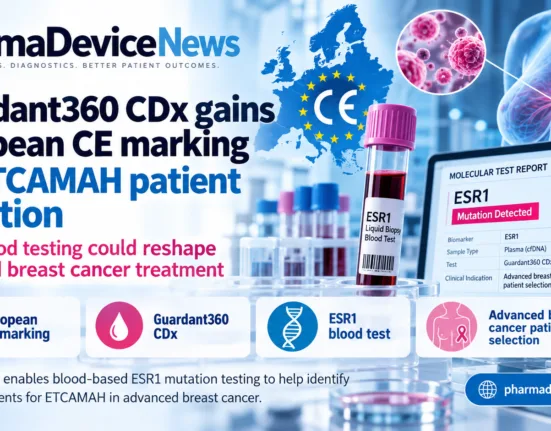
The U.S. Food and Drug Administration has granted accelerated approval to AstraZeneca’s Etcamah, or camizestrant, in combination with abemaciclib, palbociclib or ribociclib for adults with HR-positive, HER2-negative locally advanced or metastatic breast cancer whose tumors develop an ESR1 mutation during treatment with an aromatase inhibitor and a CDK4/6 inhibitor. What makes the September 4 decision especially important is the timing of treatment: the mutation is identified through an FDA-authorized circulating tumor DNA test before conventional imaging shows that the cancer has progressed. The FDA described this as the first approval of a cancer therapy guided by detection of a resistance mutation in ctDNA before radiographic progression.
The agency simultaneously authorized Guardant360 CDx as the companion diagnostic for identifying patients with qualifying ESR1 mutations. In the supporting SERENA-6 study, estimated median progression-free survival was 16 months for patients switched to Etcamah plus their CDK4/6 inhibitor compared with 9.2 months for patients who continued an aromatase inhibitor plus CDK4/6 inhibition. FDA nevertheless used the accelerated approval pathway because it remains uncertain whether intervening at molecular progression rather than waiting for radiographic progression ultimately produces a clinically meaningful long-term benefit, meaning confirmatory evidence is still required.
Why is the FDA allowing treatment to change before breast cancer progresses on a scan?
Patients with HR-positive, HER2-negative metastatic breast cancer commonly begin treatment with endocrine therapy combined with a CDK4/6 inhibitor. Over time, cancer cells can develop ESR1 mutations that make them less dependent on the endocrine mechanism being used, creating resistance even while CT or other imaging still appears stable. SERENA-6 tested whether physicians could detect that molecular resistance in the blood and switch endocrine therapy before visible disease progression occurred.
That concept changes the traditional treatment sequence. Oncology usually escalates or changes treatment after clinical or radiographic evidence shows the current regimen has stopped controlling the disease, whereas the Etcamah strategy treats molecular progression as an actionable event in its own right. If confirmatory evidence shows that earlier intervention improves later outcomes rather than merely delaying the date of the first scan-defined progression, ctDNA monitoring could become a much more important part of routine breast cancer management.
How large was the progression-free survival benefit in SERENA-6?
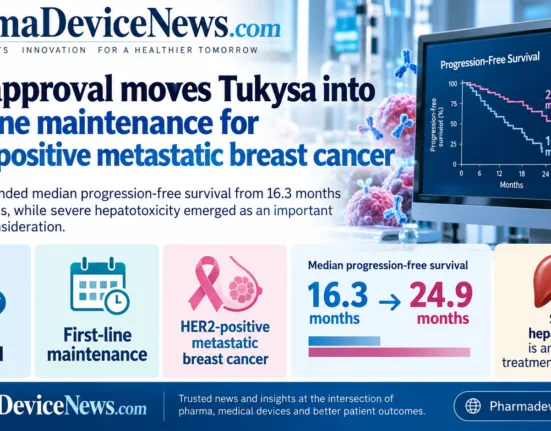
SERENA-6 enrolled 315 patients whose cancers developed an ESR1 mutation while they were receiving an aromatase inhibitor plus a CDK4/6 inhibitor as first-line treatment for advanced disease. Updated results showed that switching the aromatase inhibitor to camizestrant while continuing CDK4/6 inhibition reduced the risk of progression or death by 55%, with median progression-free survival of 16.8 months compared with 9.2 months for patients who remained on their existing endocrine regimen.
AstraZeneca also reported a 99% median reduction in total circulating tumor DNA in the camizestrant group compared with a 64% increase in patients continuing standard therapy. Total ctDNA clearance occurred in 51% of patients receiving camizestrant compared with 1.9% under standard care, providing a striking molecular signal alongside the clinical progression result. These exploratory molecular findings strengthen the biological case for switching therapy but do not replace the need to establish durable patient benefit.
Why was the Etcamah approval not a straightforward regulatory decision?
The FDA’s Oncologic Drugs Advisory Committee voted 3 to 6 in April against concluding that the benefit-risk profile of switching treatment before radiographic progression had been established sufficiently from SERENA-6. The FDA subsequently extended its review deadline to consider additional information, before ultimately granting accelerated approval in September. Advisory committee recommendations are not binding on the agency, and the final decision reflects the FDA’s review of the complete application rather than the committee vote alone.
The approval structure reflects that uncertainty. Etcamah can now be used in the specified molecularly selected population, but AstraZeneca must generate additional evidence verifying clinical benefit. This makes the post-approval program unusually consequential because it will help determine whether acting on molecular resistance before imaging progression represents a durable improvement in cancer care or primarily changes when progression is recorded.
What safety issues accompany Etcamah treatment?
The FDA prescribing information includes a boxed warning related to irregular heart rhythm when Etcamah is administered with certain other medications. The agency also highlights the possibility of abnormally slow heart rate and potential harm to an unborn baby. These issues mean treatment selection requires consideration not only of the ESR1 mutation but also of the patient’s overall medication regimen and cardiovascular risk.
The safety profile in SERENA-6 was otherwise described by AstraZeneca as consistent with the known profiles of camizestrant and the individual CDK4/6 inhibitors, with very low and similar discontinuation rates between study arms. The more important unanswered question is therefore not whether the drug produces anticancer activity, which the progression data clearly demonstrate, but whether intervening months earlier ultimately improves outcomes that matter beyond first progression.