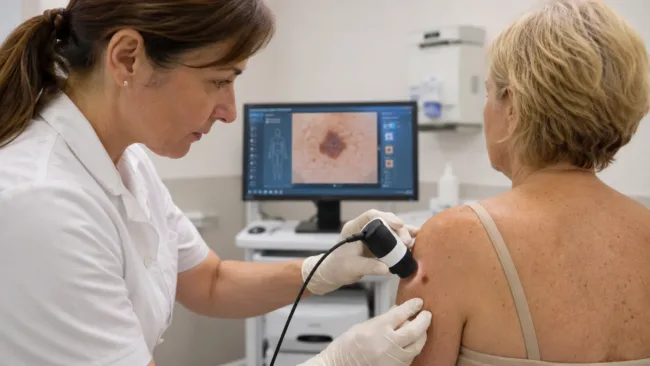
Labcorp Holdings Inc. (NYSE: LH) announced on August 10, 2026 that the U.S. Food and Drug Administration has approved PGDx elio tissue complete CDx as a companion diagnostic for identifying melanoma patients whose tumors carry BRAF V600E or BRAF V600K mutations and who may benefit from FDA-approved BRAF inhibitors or approved BRAF and MEK inhibitor combinations, subject to the corresponding therapeutic product labeling. The decision gives Labcorp a prescriptive companion diagnostic claim within a genomic testing platform that had previously been cleared primarily for broader solid-tumor profiling.
The distinction is commercially and clinically important. PGDx elio tissue complete was originally cleared by the FDA in April 2020 as a next-generation sequencing tumor-profiling test, allowing laboratories to characterize genomic alterations in solid tumors without making the assay itself a companion diagnostic for a particular therapy. The new approval means that detection of BRAF V600E and BRAF V600K in melanoma now carries an FDA-reviewed treatment-selection role within the precise limits of the approved indication.
For Labcorp, the more interesting question is what happens after the regulatory milestone. PGDx elio tissue complete CDx is designed as a distributed, kit-based solution that qualified laboratories can operate within their own institutions rather than sending every specimen to a centralized testing provider. That potentially gives hospitals greater control over samples, genomic data and testing workflows, but it also moves implementation responsibility closer to the customer and makes laboratory infrastructure, sequencing expertise, test volume and economics central to commercial adoption.
What exactly changed when PGDx elio moved from tumor profiling to a melanoma companion diagnostic?
PGDx elio tissue complete already had a substantial regulatory history before the latest announcement. The FDA granted 510(k) clearance to Personal Genome Diagnostics for the original assay on April 24, 2020 under K192063, classifying it as a next-generation sequencing-based tumor profiling test. The platform was designed to interrogate a broad set of cancer-associated genomic alterations from formalin-fixed, paraffin-embedded tumor tissue, giving laboratories a standardized route to comprehensive genomic profiling.
That original clearance and the new companion diagnostic approval serve different purposes. Broad tumor profiling can identify mutations and genomic signatures that may contribute to clinical interpretation, but a companion diagnostic claim establishes a specific regulatory connection between a test result and eligibility for a defined therapy or therapeutic class. In the new indication, the relevant biomarkers are BRAF V600E and BRAF V600K in melanoma, and use of the result for treatment selection remains tied to the approved labeling of FDA-authorized BRAF inhibitors or BRAF and MEK inhibitor combinations.
This is therefore more than a marketing update to an established assay, but it is also narrower than describing the entire 505-gene panel as an FDA-approved treatment-selection tool. PGDx elio tissue complete CDx can generate considerably more molecular information than the two BRAF variants named in the melanoma companion diagnostic indication. The regulatory significance of those additional findings can differ depending on the alteration, cancer type and available therapeutic labeling, so comprehensive profiling and prescriptive companion diagnostic use should not be treated as interchangeable concepts.
That boundary matters in precision oncology because large sequencing panels naturally produce more genomic information than any single approved therapeutic claim can cover. The commercial attraction of multiplex testing is that one tissue sample may support a wider genomic assessment, while the regulatory discipline lies in being clear about which findings have an FDA-reviewed companion diagnostic role and which require interpretation through other clinical evidence, professional guidance or research pathways.
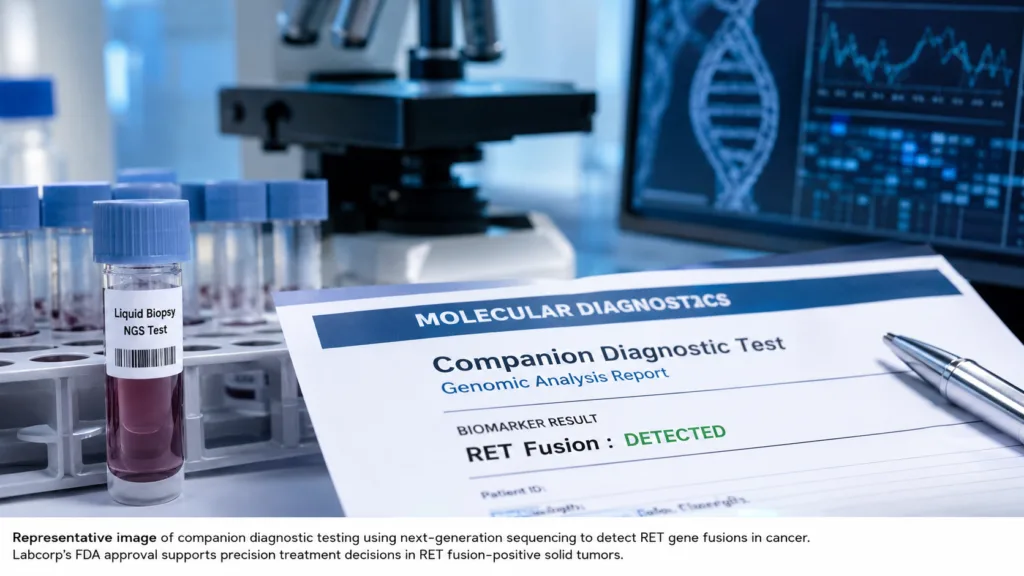
How strong is the BRAF detection performance behind the new melanoma claim?
Labcorp’s current technical information reports positive percent agreement of 98.3 percent and negative percent agreement of 99.2 percent for BRAF V600E detection in melanoma samples. For BRAF V600K, the company reports positive percent agreement of 94.7 percent and negative percent agreement of 100 percent. The listed limit of detection is a variant allele frequency of 3.1 percent for BRAF V600E and 4.7 percent for BRAF V600K, while the reported sample pass rate for melanoma FFPE specimens is 94.4 percent.
Those figures need to be interpreted as diagnostic performance measures rather than clinical efficacy results. Positive percent agreement and negative percent agreement describe how consistently an assay identifies biomarker status relative to the relevant validation framework. They do not indicate the percentage of patients who will respond to a BRAF inhibitor, how long a response will last or whether one targeted regimen is preferable to another.
The approval similarly does not create new evidence that BRAF-targeted therapies work in melanoma. BRAF V600 alterations have long been established treatment-selection biomarkers in advanced melanoma, and multiple targeted therapies already have FDA-approved roles in appropriate patients. The new development concerns the testing infrastructure available to establish that molecular status, particularly Labcorp’s ability to offer a regulated distributed NGS solution with a melanoma companion diagnostic claim.
This distinction may sound technical, but it affects how hospitals evaluate the product. An oncology laboratory is not purchasing a new therapeutic hypothesis. It is assessing whether a regulated NGS workflow can reliably incorporate an established actionable biomarker into a broader genomic profiling process while meeting local requirements for accuracy, quality control, reporting and turnaround time.
Why could the distributed testing model matter more commercially than the BRAF indication itself?
Labcorp describes PGDx elio tissue complete CDx as a 505-gene next-generation sequencing panel that also evaluates genomic signatures including tumor mutational burden and microsatellite instability. The company says its kitted workflow can move from nucleic acid isolation to variant reporting in approximately four to five days, although that stated timeframe does not include DNA extraction and downstream processing.
The distributed format differentiates the product from a model in which hospitals ship specimens to an outside central laboratory and wait for an external report. Qualified institutions can instead perform testing locally, potentially retaining greater control over tissue, genomic data and workflow sequencing. Labcorp has specifically positioned the product for hospitals and clinical laboratories that want to implement molecular profiling within their own systems.
That model can be attractive for high-volume cancer centres, but its economics are not automatically superior for every institution. Bringing NGS in-house requires sufficient case volume, trained molecular laboratory personnel, sequencing equipment, quality systems, specimen handling capabilities and a workflow capable of supporting regular runs without creating inefficient batching delays. Low-volume centres may still find centralized testing operationally simpler.
The technical requirements reinforce that distinction. PGDx elio is built around a regulated sequencing workflow, and the Illumina NextSeq 550Dx platform used in diagnostic applications is itself a substantial laboratory instrument designed to run approved or certified in-vitro diagnostic assays. Implementation therefore involves considerably more than purchasing consumable test kits. Laboratories need the infrastructure and operational discipline to maintain the sequencing process and consistently produce reportable results.
This is where the commercial opportunity becomes more interesting than a simple BRAF testing story. If Labcorp can persuade established molecular laboratories to use PGDx elio as a broader in-house genomic platform, the melanoma CDx claim becomes an additional regulated reason to run a system that can support much wider tumor profiling. The value of the approval may consequently depend less on the absolute number of BRAF-positive melanoma cases than on whether companion diagnostic claims make the entire distributed platform more attractive to hospital laboratories.
Why does FDA approval not guarantee rapid hospital adoption or reimbursement?
Regulatory approval removes one major barrier, but it does not answer the procurement question. Hospitals will still have to compare the full cost of local sequencing with established send-out testing, taking into account instrumentation, reagents, staffing, laboratory space, quality management, maintenance, utilization and the number of samples that can be efficiently batched into sequencing runs.
Turnaround time is another potential advantage that depends heavily on execution. Labcorp states that the kitted workflow can produce variant reporting in four to five days from nucleic acid isolation, but a laboratory’s real-world interval from biopsy to clinically usable report can also be influenced by pathology review, tissue preparation, DNA extraction, sequencing schedules, failed samples, repeat testing and downstream interpretation.
Reimbursement must also be considered separately from FDA approval. Regulatory authorization establishes that a device can be marketed for its specified intended use, while payer coverage and payment policies determine whether a test is reimbursed in particular patient populations and settings. Hospitals with existing comprehensive genomic profiling workflows will therefore evaluate not only whether the assay is clinically suitable but whether its economics work within their payer mix and molecular testing volume.
The 94.4 percent melanoma sample pass rate reported by Labcorp also highlights a practical reality of tissue-based genomic testing. Not every submitted specimen will necessarily produce a reportable result. Tissue quantity, tumor content, nucleic acid quality and other pre-analytical factors remain important in molecular pathology, particularly when testing archived or limited FFPE specimens.
None of these considerations weakens the regulatory significance of the approval. They instead define the next stage of competition. Once multiple technologies can detect clinically relevant biomarkers with acceptable analytical performance, differentiation increasingly moves toward laboratory workflow, specimen requirements, speed, breadth of profiling, informatics, customer support and total testing economics.
How does PGDx elio fit into Labcorp’s wider precision oncology strategy?
The approval also provides a clearer strategic payoff from Labcorp’s acquisition of Personal Genome Diagnostics Inc. Labcorp completed that transaction in February 2022, adding PGDx’s tissue and liquid biopsy technologies to its oncology portfolio and explicitly identifying next-generation sequencing-based genomic profiling as an area it wanted to expand.
Four years later, PGDx elio is evolving beyond its original tumor-profiling clearance into a platform with an FDA-approved companion diagnostic use. That progression matters because companion diagnostics can strengthen relationships between diagnostic companies, hospitals and biopharmaceutical developers. Drug developers increasingly require validated biomarker strategies for targeted oncology programmes, while laboratories want platforms capable of supporting both routine genomic profiling and therapy-linked testing without multiplying the number of separate assays they must operate.
Labcorp already has the financial and commercial scale to support that strategy. The company reported second-quarter 2026 revenue of $3.73 billion, up 5.8 percent from the prior-year period, and raised its full-year revenue growth and adjusted earnings guidance on July 30. Management also identified oncology and other specialty testing areas as continuing strategic priorities.
The melanoma approval should nevertheless be treated as a portfolio-level regulatory advance rather than evidence of a material near-term revenue step-up on its own. Labcorp has not disclosed expected revenue specifically from the BRAF melanoma indication, and the company’s diagnostics business is large enough that the financial contribution from one new companion diagnostic claim may initially be difficult to isolate.
The more useful strategic measure will be whether Labcorp continues adding clinically important companion diagnostic claims to its distributed platforms. A sequencing system with multiple regulated treatment-selection uses across different tumor types becomes more valuable to laboratories because the same infrastructure can potentially support a larger portion of the institution’s molecular oncology workload.
What will determine whether PGDx elio becomes a meaningful hospital oncology platform?
The August 10 announcement closes an important gap between PGDx elio’s original role as an FDA-cleared tumor-profiling system and its newer role as an FDA-approved companion diagnostic for BRAF V600E and BRAF V600K melanoma. The clinical premise is established, the relevant biomarker is already embedded in targeted melanoma treatment, and Labcorp now has a regulated mechanism for connecting the assay result to FDA-approved therapeutic labeling.
The next test is operational rather than scientific. Labcorp has to demonstrate that enough qualified laboratories see an advantage in implementing the platform locally, that its four-to-five-day kitted workflow can translate into dependable real-world turnaround times, and that recurring test volumes can justify the infrastructure required for distributed next-generation sequencing. Payer economics and the ability to integrate results cleanly into oncology workflows will matter alongside analytical performance.
The approval consequently represents regulatory de-risking, but commercial validation remains ahead. PGDx elio tissue complete CDx becomes more strategically important if Labcorp can use the melanoma claim as part of a growing portfolio of therapy-linked indications that make an in-house 505-gene platform increasingly useful to hospitals. If that happens, the value of the July 2026 FDA decision will extend beyond identifying BRAF-mutated melanoma. It will help determine whether distributed, regulated comprehensive genomic profiling can take a larger share of molecular oncology testing that has traditionally flowed through centralized reference laboratories.