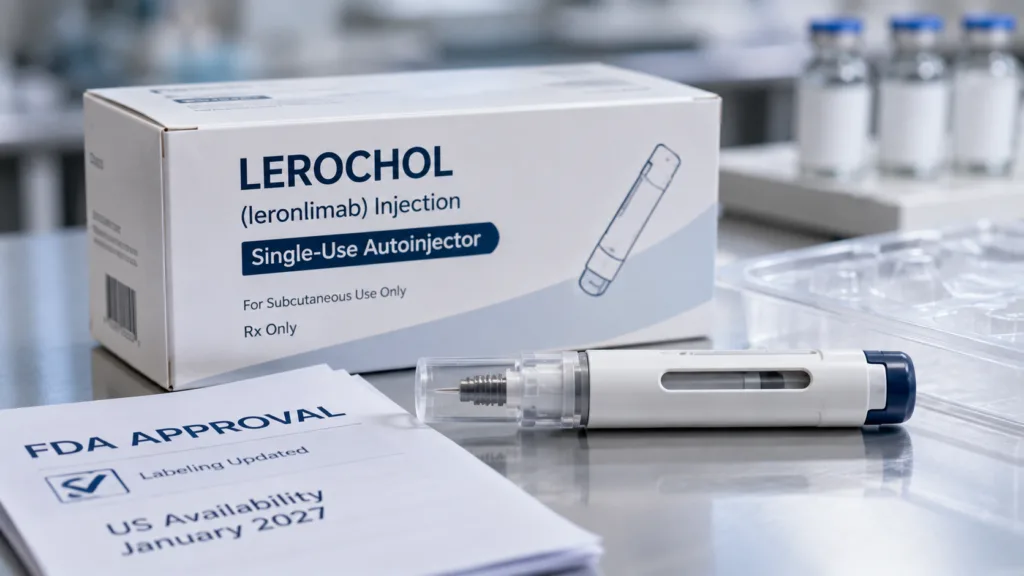
LIB Therapeutics has received US Food and Drug Administration approval for an autoinjector presentation of LEROCHOL, or lerodalcibep-liga, expanding its recently launched monthly PCSK9 inhibitor beyond the prefilled syringe that entered the US market earlier in 2026. The pressure-activated device delivers the complete 300 mg/1.2 mL dose in a single monthly injection and can remain at room temperature for as long as 90 days, while the company expects to make the autoinjector commercially available by January 2027 at the same $199 monthly direct-to-patient cash price offered for the existing syringe.
FDA simultaneously updated LEROCHOL’s prescribing information to include a statement explaining that cardiovascular-outcome trials have shown major cardiovascular-event risk reduction when LDL cholesterol is lowered using statins or monoclonal-antibody PCSK9 inhibitors added to statins. That wording requires precision because it does not mean LEROCHOL itself has completed and won a dedicated cardiovascular-outcomes trial proving a reduction in myocardial infarction or stroke. The drug remains specifically indicated as an adjunct to diet and exercise to reduce LDL cholesterol in adults with hypercholesterolemia, including heterozygous familial hypercholesterolemia.
Why could an autoinjector matter when the drug itself has not changed?
Biologic medicines can have strong efficacy yet underperform in routine practice if patients find administration inconvenient enough to delay or miss doses. LEROCHOL was already designed around a relatively simple schedule: one subcutaneous injection every month rather than the more frequent dosing used by some competing injectable lipid-lowering options.
The autoinjector reduces another layer of friction by placing the same dose into a single-use pressure-activated device rather than requiring the patient to manipulate a syringe. LIB says the dose is delivered within seconds, while the 90-day room-temperature stability can make travel and storage easier for people who would otherwise have to plan around refrigeration.
These are usability advantages, not evidence that the autoinjector lowers LDL cholesterol more effectively than the syringe. The active biologic and approved dose are unchanged, so the commercial hypothesis is that simpler administration can support adherence to a treatment that patients may need for many years.
What did LEROCHOL’s original clinical programme establish about LDL cholesterol reduction?
FDA originally approved LEROCHOL in December 2025 based on three major clinical studies involving 1,844 adults with atherosclerotic cardiovascular disease or elevated cardiovascular risk and 478 patients with heterozygous familial hypercholesterolemia. The broader LIBerate programme ultimately enrolled more than 2,900 participants, while more than 2,400 continued into a longer open-label extension.
LIB Therapeutics reported sustained LDL cholesterol reductions of around 60% in high-risk populations and approximately 59% in heterozygous familial hypercholesterolemia. Those magnitudes put LEROCHOL within the high-potency PCSK9 class, where the practical clinical question is increasingly not whether LDL can be lowered substantially but which patients gain access, stay on therapy and reach guideline-directed targets.
The most common adverse reactions listed in the revised prescribing information include injection-site reactions, nasopharyngitis, diarrhea, nausea and peripheral edema. The approved monthly dose remains 300 mg administered subcutaneously in the abdomen or thigh, with the upper arm available when a caregiver or healthcare professional administers the injection.
What exactly changed in FDA’s cardiovascular language?
The revised indication section says cardiovascular-outcomes trials have demonstrated that lowering LDL cholesterol reduces major adverse cardiovascular events in adults at increased risk when treated with statins or monoclonal-antibody PCSK9 inhibitors added to statin therapy. This recognizes the extensive evidence connecting LDL reduction with cardiovascular risk reduction across drug classes and particularly the established outcomes evidence for older PCSK9 antibodies.
It does not transform LEROCHOL’s indication into a product-specific claim that lerodalcibep has independently reduced cardiovascular events in its own prospective outcomes trial. This nuance matters because clinicians and patients may interpret an updated label mentioning cardiovascular events as equivalent to a dedicated indication for reducing heart attacks or strokes.
LEROCHOL’s current approval remains based on LDL lowering, while the new language places that surrogate effect inside the wider cardiovascular evidence base.
Could the $199 monthly cash strategy matter more than another delivery device?
Cost and insurance access have historically constrained uptake of PCSK9 inhibitors despite substantial LDL-lowering efficacy. LIB launched LEROCHOL in May 2026 with a direct-to-patient cash programme priced at $199 per month, substantially below the historical list prices associated with the class. The company expects insurance coverage to expand progressively during 2027 while maintaining that cash pathway for the autoinjector.
The strategy attempts to solve two different adherence problems at once. The autoinjector addresses physical convenience and the once-monthly schedule reduces dosing frequency, while transparent cash pricing addresses affordability for patients unable or unwilling to navigate insurance authorization.
Whether $199 represents meaningful affordability will vary widely across households and insurance situations, and competitors also offer support programmes. The important strategic difference is that LIB has made the cash price a central commercial feature rather than treating direct payment as a niche alternative.
Where does LEROCHOL fit in an increasingly crowded LDL-lowering market?
Statins remain foundational because of their low cost, oral administration and extensive outcomes evidence, while ezetimibe, injectable PCSK9 antibodies and other therapies provide additional LDL reduction when targets are not reached. LEROCHOL enters this environment as a smaller-binding protein that inhibits PCSK9 but is not itself a conventional monoclonal antibody.
Its differentiation consequently rests on the combination of potent LDL lowering, one monthly injection, relatively small injection volume, prolonged room-temperature stability and now a simplified autoinjector. None individually guarantees commercial success, particularly as lipid guidelines increasingly emphasize aggressive LDL targets and physicians can choose among several powerful options.
The autoinjector approval nevertheless completes an important part of LIB’s intended product proposition. LEROCHOL launched as an effective once-monthly injectable; by January 2027, the company expects that monthly dose to arrive in a device requiring less manual administration.
For chronic cardiovascular prevention, that seemingly modest improvement can matter. Patients do not receive the benefit of LDL reduction from injections they fail to take, making ease of administration part of the clinical effectiveness equation even when the molecular pharmacology remains exactly the same.