
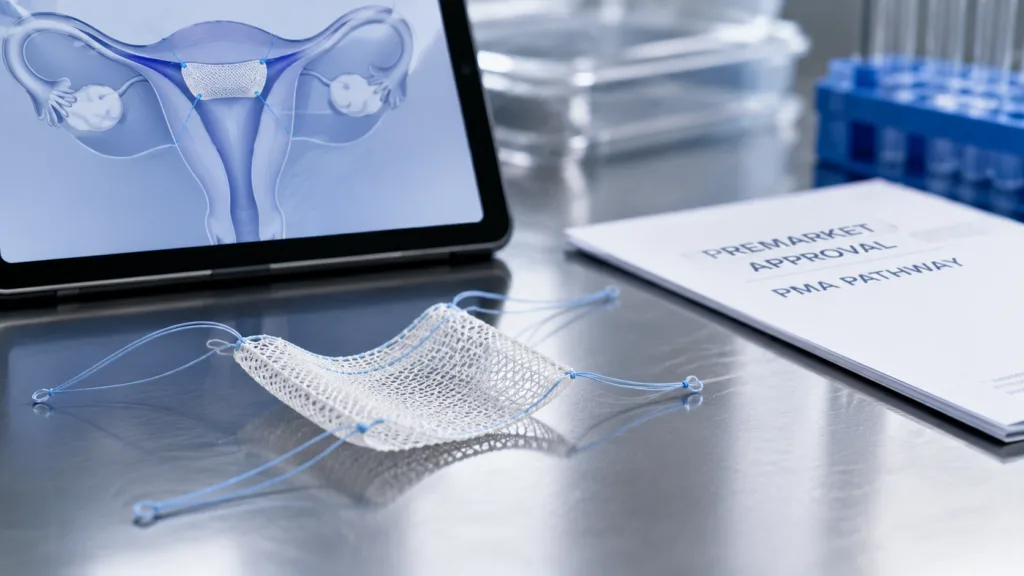
Femasys Inc. (NASDAQ: FEMY) has received FDA agreement to use a modular Premarket Approval submission for FemBloc, allowing the company to submit and obtain review of portions of its US application for the investigational permanent birth-control device while its pivotal clinical programme continues. The August 19 development does not mean FDA has approved FemBloc for US marketing, a distinction made particularly important by Femasys’ announcement wording referring to FDA “approval” of the modular submission approach. FemBloc itself remains investigational in the United States and is being evaluated in the 573-participant FINALE study.
Femasys is attempting to create a permanent contraception procedure that can be performed through the cervix in an OB-GYN office without abdominal incisions, general anesthesia or surgical removal or ligation of the fallopian tubes. Its system delivers a proprietary polymer into both tubes, where the material degrades while stimulating formation of scar tissue intended to create permanent tubal occlusion. The concept is already authorized in Europe and several other international markets, but FDA will require a successful PMA before routine US commercialization.
What is a modular PMA and why does it help Femasys?
A traditional PMA is a comprehensive application containing nonclinical testing, manufacturing information, clinical evidence, labeling and other documentation needed for FDA to determine whether a Class III device provides reasonable assurance of safety and effectiveness. For complex devices, assembling every section before formal review can leave the regulator unable to evaluate mature manufacturing and bench data while a lengthy pivotal trial is still being completed.
A modular PMA divides the application into sections that can be submitted and reviewed sequentially. Femasys can therefore advance elements such as manufacturing, technical and nonclinical evidence before the final pivotal clinical module is ready, potentially reducing the amount of review work remaining after FINALE reaches the necessary clinical milestones.
This can shorten administrative lag but cannot lower the ultimate evidentiary threshold. FDA still has to be satisfied with the completed clinical evidence, manufacturing controls and overall benefit-risk profile before FemBloc can be marketed.
How does FemBloc attempt permanent contraception without surgery?
FemBloc is delivered transcervically, meaning the physician accesses the fallopian tubes through the vagina, cervix and uterus rather than making abdominal incisions. A catheter-based delivery system places the proprietary polymer into each tube, after which the material is intended to degrade and trigger localized tissue response leading to scar formation and permanent occlusion.
The attraction is straightforward. Conventional female sterilization generally involves laparoscopy or another surgical procedure to cut, block or remove the fallopian tubes, which introduces anesthesia, operating-room and recovery requirements. An office-based procedure could reduce those logistical burdens and potentially make permanent contraception more accessible.
Permanent contraception has an unusually high evidentiary bar because failure can result in unintended pregnancy, including potentially dangerous ectopic pregnancy. A procedure intended to be irreversible also demands especially clear patient counseling because the consequences of successful treatment extend for the remainder of reproductive life.
What is the 573-patient FINALE trial designed to establish?
FINALE, registered as NCT05977751, is a prospective, multicenter, international, open-label, single-arm study expected to enroll approximately 573 women aged 21 to 50 seeking permanent contraception. Participants undergo the FemBloc procedure followed by an ultrasound-based confirmation test intended to establish whether tubal occlusion has occurred sufficiently for the woman to rely on FemBloc as contraception.
The central effectiveness outcome is pregnancy after participants have been instructed that they can rely on the procedure for birth control. That is the clinically relevant endpoint because successful delivery of the polymer or apparent tubal blockage is not enough if pregnancies subsequently occur at an unacceptable rate.
ClinicalTrials.gov lists a lengthy follow-up period, reflecting the fact that permanent contraception must be evaluated beyond the immediate procedure. FINALE’s estimated primary completion extends toward 2029, with longer follow-up beyond that, although the precise regulatory dataset required for the initial PMA could involve a defined portion of that planned observation period.
Why will confirmation testing be crucial if FemBloc reaches clinical practice?
A physician cannot assume that delivering material into both fallopian tubes has created immediate and complete contraception. The scar tissue responsible for long-term occlusion takes time to develop, meaning patients need alternative contraception until the result is confirmed.
Femasys’ strategy uses ultrasound confirmation rather than relying on X-ray-based hysterosalpingography, potentially keeping more of the pathway within the OB-GYN office. That could be commercially important because a permanent contraception method requiring several separate specialties or complicated follow-up loses part of the convenience advantage created by avoiding surgery.
The clinical challenge is ensuring that the confirmation method reliably identifies incomplete occlusion. False reassurance could expose patients to pregnancy, while excessive uncertainty could generate unnecessary additional procedures.
Why does FemBloc enter US development with unusual historical baggage around transcervical sterilization?
The concept of non-surgical tubal occlusion is not entirely new. Previous hysteroscopic sterilization products demonstrated that avoiding surgery can be appealing but also that long-term device-related complications can become highly consequential when permanent material remains implanted in the fallopian tubes.
Femasys differentiates FemBloc partly by using material intended to biodegrade rather than leaving a permanent metallic implant. The long-term contraceptive effect is supposed to come from the patient’s own scar tissue after the polymer disappears, potentially avoiding some risks associated with a lasting foreign implant.
That theoretical advantage still requires clinical evidence. FDA will need to evaluate pain, infection, procedure failure, pregnancy, ectopic pregnancy and other potential complications over sufficient follow-up before concluding that the benefit-risk profile supports approval.
The modular PMA agreement therefore matters because it gives Femasys a more efficient regulatory architecture, not because it resolves those clinical questions. FemBloc has now gained a clearer pathway for submitting its eventual evidence while FINALE continues enrolling.
If that pivotal study establishes sufficiently reliable permanent contraception with acceptable complications, FemBloc could create a rare new procedural choice in a field where the alternatives are usually either long-acting reversible contraception or surgery. Until then, the product remains an investigational technology with a better-defined FDA route, not an FDA-approved contraceptive.