Maverix Medical has announced U.S. Food and Drug Administration 510(k) clearance for the Narwhal Cryo System, a single-use flexible cryoprobe designed to perform cryoadhesion and tissue acquisition without a dedicated cryosurgical console. The FDA issued its substantial equivalence decision on June 30, 2026 under 510(k) K261068, although Maverix disclosed the clearance on August 20 and said the product is not yet distributed, with broad U.S. availability expected in 2027.
The regulatory record identifies the cleared products as the Maverix Cryo Biopsy Probe, model MCB-1000, and Maverix Cryo Cartridge, model CC-1000, with Serpex Medical listed as the applicant. Serpex became part of Maverix Medical when the lung cancer-focused platform was established by KKR, Hologic and Ajax Health, making the clearance more than an isolated product event within the company’s evolving device portfolio.
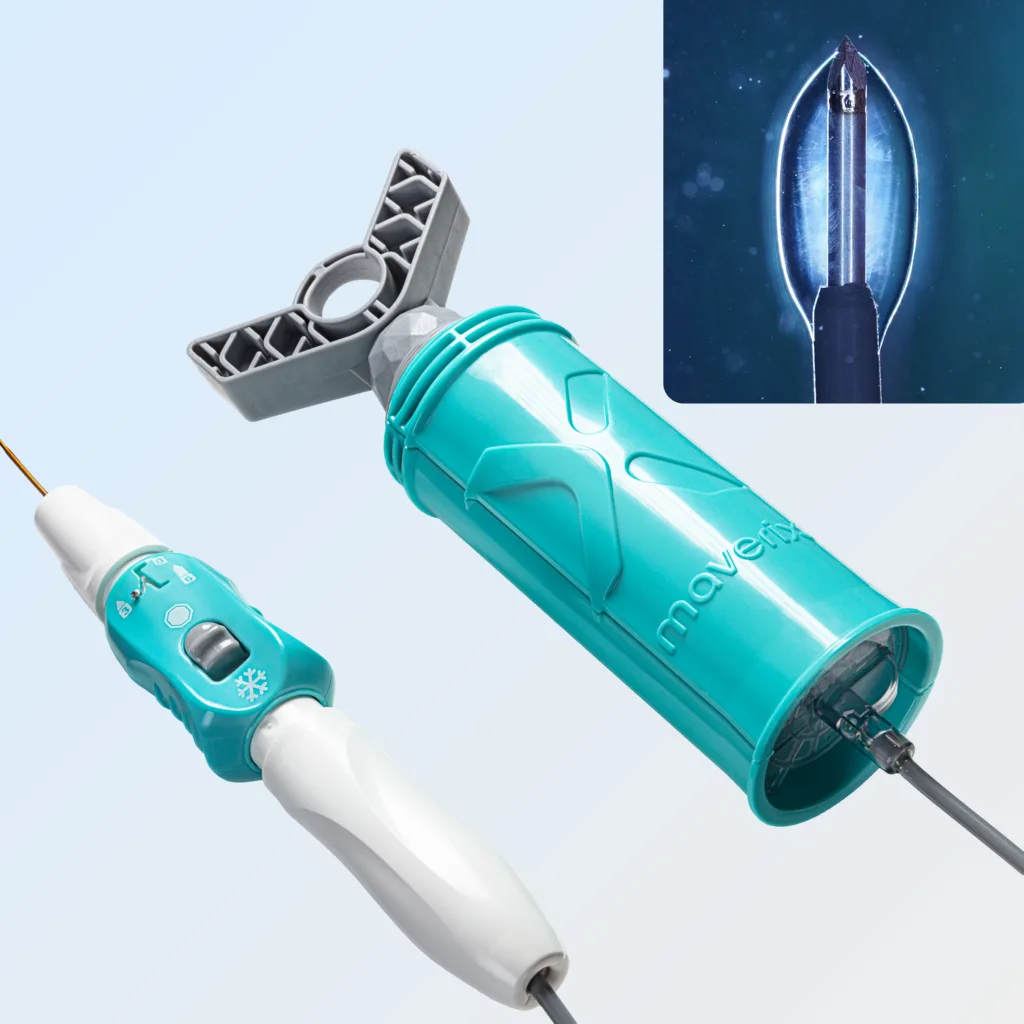
What differentiates Narwhal commercially is not a new clinical mechanism. Cryoadhesion is already established within bronchoscopic tissue acquisition, and the FDA found the Maverix device substantially equivalent to Erbe Elektromedizin’s ERBECRYO 2 flexible cryoprobes. Maverix is instead attempting to alter the hardware and economic model by replacing a reusable console, external compressed-gas cylinder and footswitch with a disposable nitrous oxide cartridge and an activation control incorporated into the probe assembly.
That distinction matters because it potentially converts cryobiopsy from a procedure requiring dedicated cryosurgical capital equipment into one that can be added to appropriately equipped endoscopy or bronchoscopy practices through consumables. The regulatory clearance removes an important barrier to commercialization, but the more consequential test will begin in 2027, when hospitals and ambulatory procedure environments can compare Narwhal’s per-case economics, workflow simplicity, tissue performance and training requirements with established cryoprobe systems and conventional biopsy forceps.
What exactly did the FDA clear for the Maverix Medical Narwhal Cryo System?
The cleared Maverix Cryo Biopsy Probe is a sterile, single-use flexible cryoprobe intended for palliative tissue devitalization during interventional procedures through extreme cold and cryoadhesion. Its stated applications include removal of foreign bodies, mucus plugs, blood clots and necrotic tissue, palliative recanalization of tissue tumors, and tissue biopsy. That wording is important because the clearance should not be interpreted as an FDA determination that Narwhal improves lung cancer diagnosis, increases diagnostic yield or produces better patient outcomes compared with other biopsy technologies.
The Narwhal branding used commercially is also somewhat broader than the naming visible in the FDA database, where the cleared components are identified as the Maverix Cryo Biopsy Probe and Maverix Cryo Cartridge. The system is a Class II cryosurgical device under 21 CFR 878.4350 and product code GEH, and the FDA reached a substantial equivalence determination through the traditional 510(k) pathway rather than approving the device through a Premarket Approval application.
The probe has a 1.3 mm outer diameter and a working length of 1,150 mm, while Maverix says it is compatible with bronchoscopes and endoscopes containing working channels of at least 2.0 mm. An adjustable sheath exposes approximately 3 mm or 6 mm of the cryotip, allowing the operator to modify the active freezing length, while the pointed tip is radiopaque to assist visualization during placement.
The device uses pressurized nitrous oxide and the Joule-Thomson effect to generate rapid cooling at the probe tip. Once tissue freezes to the tip through cryoadhesion, a biopsy sample can be retrieved while freezing remains active. The FDA documentation says the non-sterile cartridge is positioned outside the sterile field, with another cartridge available for use with the same probe if additional refrigerant capacity is required during the procedure.
Why could removing the cryosurgical console change cryobiopsy adoption economics?
Conventional flexible cryoprobes typically depend on a cryosurgical console together with an external compressed-gas source and related operating hardware. Narwhal instead places refrigerant delivery into a disposable cartridge system controlled from the probe assembly, with Maverix reporting about 80 seconds of freezing capacity from each cartridge and approximately 160 seconds of total freeze endurance per probe when a second cartridge is used.
For hospitals, the potential advantage is straightforward but should not be overstated. Removing dedicated capital equipment could reduce the upfront financial hurdle, service requirements and equipment-management burden associated with adding cryobiopsy capability, particularly at facilities where procedure volume might not justify purchasing another console. It could also make cryobiopsy capacity easier to deploy across multiple procedure rooms because the technology is no longer physically tied to a dedicated cryosurgical generator.
The economic equation does not disappear, however, because expenditure moves toward the disposable side of the procedure. Hospitals will need to assess the price of the probe and cartridges, number of cartridges typically consumed per case, purchasing contracts, storage requirements and any savings associated with avoiding console acquisition and servicing. FROSTBITE-2 investigators themselves noted that disposable cryobiopsy equipment was more expensive than forceps and that their randomized trial did not examine cost-effectiveness, highlighting why superior procedural convenience cannot automatically be translated into superior health economics.
Nor does console elimination make cryobiopsy a simple plug-and-play biopsy technique. Bronchoscopy infrastructure, anesthesia or sedation resources, target localization, appropriate airway management and preparedness for complications remain important parts of the procedure. Narwhal removes one equipment layer rather than eliminating the clinical expertise surrounding transbronchial tissue acquisition.
How much clinical evidence supports cryobiopsy, and how much supports Narwhal itself?
This is the most important distinction in interpreting the clearance. The clinical case for bronchoscopic cryobiopsy has strengthened substantially in 2026, but the strongest recent randomized evidence was generated using an Erbe Elektromedizin 1.1 mm cryoprobe, not the Maverix Medical Narwhal system.
The multicenter FROSTBITE-2 randomized clinical trial enrolled 500 adults undergoing transbronchial biopsy for pulmonary nodules or masses, post-lung-transplant assessment or diffuse parenchymal lung disease. Among the 490 patients included in the primary analysis, diagnostic yield reached 88.6% with the 1.1 mm cryoprobe compared with 78.8% using conventional forceps, an absolute difference of 9.8 percentage points that was statistically significant. The study was performed across nine U.S. medical centers, and histopathology assessors were masked to the biopsy technique.
The results were particularly relevant to the lung nodule field because diagnostic yield among patients with pulmonary nodules or masses was 83.2% with cryobiopsy and 70.1% with forceps. Cryobiopsy also produced larger specimens, with median total biopsy area of 16.7 mm² compared with 9.6 mm² for forceps, while median crush artifact occupied a smaller proportion of sampled tissue. Those specimen characteristics are clinically interesting as lung cancer diagnosis increasingly depends on obtaining sufficient tissue for histopathological and molecular assessment, although FROSTBITE-2 did not establish that Narwhal itself improves molecular-testing success or patient outcomes.
The device-specific evidence supporting Narwhal is materially earlier. The FDA summary describes comparative ex vivo testing using bovine liver, porcine kidney and porcine lung, together with Good Laboratory Practice animal testing in an in vivo porcine model, as well as mechanical, cartridge, gas-delivery, usability, biocompatibility, sterilization and packaging assessments. The FDA concluded that technological differences from the predicate device did not create different questions of safety or effectiveness, which is the regulatory foundation of the 510(k) decision.
Maverix additionally reported that its bench and animal programme met predefined performance and safety endpoints, including biopsy weight, avulsion success, histological accessibility, artifact-free samples, bleeding and pneumothorax assessments. Those remain preclinical data, and the company’s own announcement cautioned that the findings may not represent clinical performance.
Why FROSTBITE-2 strengthens the market opportunity without clinically validating Narwhal
The timing is favourable for Maverix because FROSTBITE-2 gives hospitals stronger randomized evidence that modern small-diameter cryobiopsy can improve diagnostic yield compared with forceps in several transbronchial biopsy settings. The trial also reported no significant bleeding events or respiratory failure in either group, while four patients in the forceps group developed pneumothoraces requiring chest-tube placement and none did so in the cryoprobe group. Those results support interest in the technique, but they should not be extrapolated into a claim that the Narwhal Cryo System has demonstrated the same clinical safety profile.
The FROSTBITE-2 study used a 1.1 mm Erbe Elektromedizin cryoprobe, whereas the Maverix probe measures 1.3 mm and uses a materially different refrigerant-delivery architecture. The randomized study was also conducted in experienced centers, with investigators required to have prior cryoprobe experience or complete specific training before enrolling patients. This means the clinical evidence is highly relevant to the therapeutic category while remaining indirect evidence for Narwhal itself.
Recent professional discussion reflects the same evolution. A 2026 CHEST consensus statement noted that transbronchial cryobiopsy has expanded beyond its established role in interstitial lung disease into peripheral pulmonary lesion and other non-interstitial lung disease applications, while also emphasizing that practice variation has moved faster than the evidence base and formal procedural guidance. That environment creates an opening for easier-to-deploy technology, but it also raises the standard Maverix will ultimately face for training, reproducibility and post-launch evidence generation.
Where could the Narwhal Cryo System fit into modern lung nodule biopsy workflows?
The commercial opportunity is closely tied to the rapid development of peripheral bronchoscopy. Robotic bronchoscopy, navigation technologies, radial endobronchial ultrasound, cone-beam computed tomography and other localization tools have improved clinicians’ ability to reach increasingly small and peripheral lung lesions, but reaching a target and acquiring adequate diagnostic tissue remain separate technical challenges.
Narwhal addresses tissue acquisition rather than navigation. Its 1.3 mm profile, radiopaque pointed tip and compatibility with 2.0 mm or larger working channels are designed to allow it to travel through existing bronchoscopes and endoscopes, but the device does not independently locate a pulmonary nodule. Its commercial relevance will therefore depend partly on how effectively it integrates with the navigation and imaging technologies already deployed in advanced interventional pulmonology programs.
This distinction may become increasingly important as tissue requirements evolve. Contemporary lung cancer workups can involve histology together with genomic and protein biomarker testing, making specimen quantity and preservation operationally valuable, but more tissue is not automatically equivalent to a complete or clinically actionable molecular profile. Maverix will benefit if real-world Narwhal use demonstrates reproducible specimen quality across different lesion locations, procedural technologies and hospital environments, rather than merely showing that the probe can acquire tissue under controlled conditions.
What safety and implementation evidence will matter once Narwhal reaches U.S. hospitals?
Cryobiopsy retains procedure-related risks irrespective of how the refrigerant is supplied. Bleeding and pneumothorax are recognized concerns, and Maverix explicitly identifies them as potential risks associated with cryosurgical procedures. In the company’s preclinical testing, minor bleeding occurred in some samples but reportedly satisfied predefined acceptance criteria and was statistically equivalent to the predicate device, while the FDA’s substantial equivalence assessment incorporated animal and bench performance rather than a prospective human Narwhal trial.
Post-launch experience will therefore be more informative than the clearance alone for physicians deciding how broadly to use the system. Hospitals will want to understand device reliability, freeze consistency, cartridge utilization, learning curve, bleeding-control protocols, compatibility with their existing bronchoscopes and localization platforms, and whether the disposable architecture actually shortens preparation or turnover times in routine practice.
Training could be particularly significant. The broader cryobiopsy literature has repeatedly emphasized operator experience and procedural standardization, and the European Respiratory Society has recommended that transbronchial lung cryobiopsy be performed in experienced centers when used for undiagnosed interstitial lung disease. The emerging use of small cryoprobes for pulmonary nodules creates a related need for clear procedural protocols rather than assuming that removal of the console also removes the learning curve.
Why the 2027 Narwhal launch matters for Maverix Medical’s broader lung cancer strategy
Narwhal is entering a company whose strategy has increasingly become a combination of device development, commercial infrastructure and lung cancer diagnostics. Maverix Medical was created in 2023 with investments from KKR and Hologic and is managed by Ajax Health, with Serpex Medical contributed to the platform as its initial device business. Hologic disclosed that its original US$24.5 million investment represented a 45% ownership position in Maverix’s Class A common units, while the platform has subsequently expanded through acquisitions and internal development.
Maverix acquired molecular diagnostics developer Cirrus Bio in 2024 and Thoracent in 2025, giving it businesses spanning steerable endobronchial instruments, biopsy technologies, airway and gastrointestinal stents and an emerging diagnostic programme. Thoracent already sells devices including biopsy forceps and endobronchial ultrasound needles, which provides a more logical commercial route for Narwhal than building a cryobiopsy sales organization from zero.
That commercial connection became even more relevant when Maverix appointed former Medtronic executive Carla Jung as chief executive officer in July 2026, with the company explicitly positioning her appointment around scaling its commercial organization and bringing additional products to market. Maverix now says Thoracent will distribute Narwhal when broad U.S. availability begins in 2027.
The clearance therefore settles the regulatory question before the more difficult market questions begin. Narwhal does not need to prove that cryobiopsy exists as a clinically relevant technique because an increasingly substantial evidence base already supports the category. Maverix instead needs to demonstrate that removing the dedicated console produces enough practical and economic value to change purchasing decisions while preserving reliable tissue acquisition and acceptable procedural performance across routine clinical environments. If that evidence develops after the 2027 launch, the console-free architecture could become the more consequential aspect of Narwhal than the 510(k) clearance itself.