Medicaroid Corporation has secured European CE marking under the Medical Device Regulation for its Hinotori surgical robot, clearing the Japanese system for commercialisation across European Union member states and certain other markets that recognise the certification. The decision opens another major geography for a platform that has already expanded from Japan into Singapore, Malaysia and Vietnam.
The European authorisation covers robotic-assisted procedures in urology, general surgery, gynaecology and thoracic surgery. Medicaroid is now preparing to convert a regulatory milestone into hospital installations, surgeon training and recurring procedure volumes across a region where robotic surgery is growing but procurement remains fragmented between national health systems, private hospital groups and specialist centres.
Hinotori was created through Medicaroid, a joint venture formed by Kawasaki Heavy Industries, Ltd. and Sysmex Corporation. Kawasaki contributed decades of industrial robotics and motion-control expertise, while Sysmex brought healthcare knowledge and a global medical-market network. The combination has produced Japan’s first domestically developed robotic-assisted surgery platform to reach clinical use and now the first such Japanese system to enter the European market.
The CE mark is therefore more than a regional product approval. It tests whether a surgical robot developed outside the established United States and European medtech centres can compete against Intuitive Surgical’s entrenched da Vinci franchise and a growing field of newer systems attempting to reduce costs, improve operating-room flexibility and broaden access to robotic-assisted procedures.
Why does the European CE mark represent a decisive commercial step for Medicaroid?
Medicaroid received Japanese regulatory approval for Hinotori in 2020 and completed the first clinical procedure with the platform later that year. The company subsequently expanded the authorised uses in Japan beyond urology into general surgery, gynaecology and thoracic surgery while building a network of training and service centres.
Its first international approval arrived in Singapore in 2023, followed by Malaysia in 2024 and Vietnam in June 2026. Medicaroid said approximately 20,000 procedures have now been completed globally using the system, giving the company a body of operating experience that is significantly larger than that of a pre-commercial robotics startup.
Europe changes the scale of the opportunity. The region includes large robotic-surgery markets such as Germany, France, Italy, Spain and the United Kingdom, alongside smaller healthcare systems where hospitals may be seeking alternatives to incumbent platforms.
European entry also gives Medicaroid access to respected surgical institutions that can influence adoption elsewhere. A successful rollout at high-volume academic centres could generate clinical publications, surgeon advocates and procedural evidence that support expansion across the Middle East, Africa and eventually the United States.
The regulatory decision does not mean Hinotori will immediately become available in every European country. Medicaroid must still establish commercial teams, negotiate hospital purchases, supply instruments, provide technical service and support country-specific reimbursement and procurement processes.
Those steps are expensive and time-consuming. Surgical robotics companies do not build durable businesses merely by selling a machine. They must create a dependable ecosystem covering training, maintenance, instrument supply, software updates and support during procedures.
What design features could distinguish Hinotori inside crowded European operating rooms?
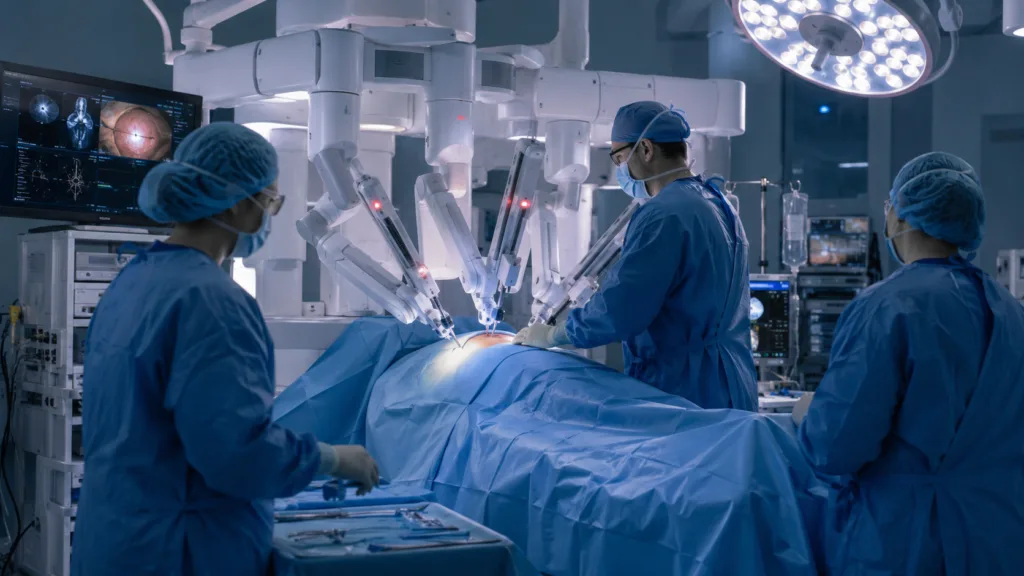
Hinotori uses four robotic arms mounted on a compact operation unit beside the patient. Each arm has eight axes of movement, allowing the system to reproduce complex motions while reducing collisions between arms and preserving working space for nurses and bedside assistants.
The system uses a docking-free design in which the pivot point for each instrument is controlled through software rather than requiring the robotic arms to be physically attached to the trocar. Medicaroid says this creates more space around the patient and may simplify positioning during surgery.
The surgeon operates from an adjustable cockpit while viewing a high-definition three-dimensional image. Ergonomic controls are intended to let physicians work in different postures, potentially reducing neck, shoulder and back strain during long procedures.
These features address practical complaints associated with robotic surgery. Large systems can occupy substantial operating-room space, interfere with bedside access and require time-consuming positioning before an operation begins. A robot that is easier to place and leaves more room around the patient may appeal to hospitals with smaller theatres or mixed surgical workloads.
Technical design alone will not guarantee adoption. Surgeons will evaluate instrument responsiveness, visual quality, procedure time, setup reliability and the range of available tools. Hospitals will compare total ownership costs, including service contracts, disposable instruments and the number of procedures required to justify the investment.
Hinotori’s European value proposition will therefore depend on whether its compact architecture produces measurable workflow benefits rather than simply looking different from established systems.
How does Kawasaki Heavy Industries’ robotics experience shape the Hinotori platform?
Kawasaki Heavy Industries has spent more than five decades developing industrial robots for manufacturing, material handling and other precision applications. Medicaroid has adapted parts of that experience for a medical setting where movement must remain controlled around delicate tissue and patient safety requirements are substantially more demanding.
The Hinotori system uses redundant monitoring to detect unintended arm movement and confirm that the software-controlled pivot position remains stable. Its safety architecture draws on Kawasaki’s industrial robot monitoring technology, while control systems are designed to reduce vibration and restrict motion when robotic arms could interfere with one another.
Medicaroid also participated in the development of an international safety standard covering robotic-assisted surgical equipment. That involvement gave the company early familiarity with requirements that would later influence Japanese and international regulatory submissions.
Transferring industrial robotics into surgery is not straightforward. Factory robots usually perform predictable tasks in controlled spaces, while human anatomy varies and surgical conditions can change within seconds. The physician must remain in control, and the system must respond naturally enough that the robot becomes an extension of the surgeon rather than an obstacle.
Medicaroid’s strategy has consequently centred on assistive robotics rather than autonomous surgery. Hinotori reproduces the surgeon’s movements and is intended to increase precision, visualisation and ergonomic control. It does not independently decide which tissue to cut, seal or remove.
Kawasaki is separately building new artificial-intelligence and semiconductor collaborations in the United States, with healthcare and nursing applications among the initial focus areas. Hinotori could eventually benefit from work involving enhanced data analysis, simulation and connected robotics, although those capabilities remain distinct from the currently approved European system.
Can Medicaroid challenge Intuitive Surgical without matching its installed base?
Intuitive Surgical has spent decades developing the da Vinci ecosystem and has an extensive installed base, a large community of trained surgeons and broad procedure coverage. That position creates a network effect because hospitals often prefer systems already familiar to surgeons, operating-room staff and trainees.
Medicaroid is entering Europe with clinical experience and regulatory approvals, but it remains much smaller. It must persuade hospitals that adopting a second platform or replacing an existing robot will produce enough clinical, operational or financial value to justify retraining staff and changing established workflows.
Price could become one differentiator, although Medicaroid has not disclosed a standard European system price or instrument-cost structure. Hospitals may welcome greater competition if it lowers capital costs, service fees or per-procedure expenses.
Another route is to target hospitals that do not yet own a surgical robot. These institutions may be less constrained by previous investments and more receptive to a compact system designed for several surgical specialties.
Medicaroid can also focus on markets where robot penetration remains lower than in major Western European centres. A smaller installed base may offer more room for new suppliers, particularly if the company can provide financing, training and service through regional partners.
The challenge is that competitors are making similar arguments. Europe is becoming a testing ground for multiple next-generation robotic platforms, each claiming improvements in flexibility, accessibility or economics. Hinotori must demonstrate reliable performance over thousands of procedures outside Japan rather than relying on its engineering heritage alone.
Why will training capacity determine how quickly Hinotori enters European hospitals?
Surgical robots require extensive training because physicians must learn new controls, instrument behaviour, emergency procedures and case-selection principles. Nurses and technicians also need instruction on setup, sterilisation, troubleshooting and instrument management.
Medicaroid began preparing for Europe years before obtaining the CE mark. It established Medicaroid Europe GmbH in Germany in 2020, opened a training centre at ORSI Academy in Belgium in 2023 and added another training location at IRCAD France in 2025.
The IRCAD relationship may be especially valuable because the French institute trains surgeons from multiple countries and serves as a recognised centre for minimally invasive surgery research. Hinotori has already been installed there, giving Medicaroid access to surgeons who may later influence adoption at their home institutions.
Training centres can also help the company collect feedback before wide commercial rollout. European surgeons may use different techniques, instruments or operating-room layouts from Japanese clinicians, and those differences may reveal where software, accessories or training protocols require adjustment.
However, training creates a temporary bottleneck. Medicaroid cannot install systems faster than it can safely prepare surgical teams. Early cases will probably be concentrated in selected centres with experienced robotic surgeons and strong technical support.
A measured launch may generate slower initial revenue but reduce the risk of poorly supported installations. Surgical robotics companies can damage their reputations quickly if new users experience equipment downtime, procedural delays or inadequate service.
Could recurring instruments and service revenue become more important than robot sales?
A robotic surgery system creates several revenue streams. The manufacturer may receive an upfront payment for the platform, followed by recurring income from procedure-specific instruments, accessories, maintenance contracts, training and software.
Medicaroid’s instruments are designed to support functions such as grasping, cutting, coagulation and suturing. Some instruments can be cleaned, sterilised and reused for a limited number of procedures before replacement, creating recurring demand connected directly to surgical volume.
This business model means the number of installed systems does not tell the full commercial story. A robot used frequently across several specialties can generate more attractive recurring revenue than a larger number of machines performing only occasional procedures.
European hospitals will closely examine those economics. The purchase price may attract attention, but procurement teams will calculate instrument costs, maintenance expenses, setup time and operating-room utilisation across the expected life of the system.
Medicaroid will need enough instrument variety to support complex cases and keep surgeons within the Hinotori ecosystem. A limited portfolio could restrict the types of procedures physicians are willing to perform and slow the growth of recurring revenue.
Service responsiveness is equally important. Hospitals cannot leave expensive robotic systems idle while waiting for parts or technicians. Medicaroid’s Düsseldorf base gives it a European operating centre, but the company will need a broader field-service network as installations spread across countries.
What regulatory and commercial risks remain after the European authorisation?
The first risk is rollout execution. Medicaroid has obtained permission to market the system, but it has not announced how many European installations it expects, which countries will launch first or whether distributors will be used in some territories.
A second risk concerns clinical evidence. Hinotori has been used in thousands of procedures, yet European surgeons and hospital committees may request comparative data involving complication rates, operating time, conversion to open surgery and length of hospital stay.
Direct comparisons with da Vinci or other robots may be difficult because outcomes depend heavily on surgeon experience, procedure type and patient selection. Medicaroid must still show that its engineering advantages translate into meaningful clinical or workflow improvements.
Cybersecurity and data governance will become more important as robotic platforms become increasingly connected. Software updates, remote service and surgical-data collection create potential vulnerabilities that hospitals and regulators will scrutinise.
Supply-chain execution is another concern. The system depends on specialised instruments, electronics, cameras, motors and precision components. Medicaroid must maintain European inventory and avoid delays that could interrupt hospital procedure schedules.
The Medical Device Regulation also imposes continuing obligations after certification. Medicaroid must collect post-market evidence, report safety issues and maintain conformity as the system, instruments and software evolve.
Could Europe become a bridge to an eventual United States Hinotori launch?
Medicaroid established a United States subsidiary in San Jose, California, in 2015 and continues to evaluate the American market. The company has not announced a United States Food and Drug Administration submission or commercial launch timetable.
European experience could strengthen a future United States strategy. Hospitals using Hinotori will generate additional real-world evidence, while Medicaroid will gain experience supporting customers outside Asia.
Success in Europe may also help attract distribution, training or development partners in North America. Conversely, a slow rollout would signal that regulatory clearance alone is insufficient to overcome the commercial advantages held by established competitors.
The United States represents a major opportunity but would require substantial investment in clinical evidence, regulatory work, service infrastructure and sales personnel. Medicaroid may therefore prioritise Europe and Asia before committing to a full American launch.
Its parent companies have the financial and technical resources to support a longer development cycle, but Hinotori remains one part of much larger businesses. Kawasaki Heavy Industries is exposed to aerospace, defence, rail, energy and industrial equipment, while Sysmex remains centred on diagnostic instruments and reagents.
That diversified ownership can provide stability, but it may also influence how aggressively capital is allocated if European adoption requires years of investment before reaching profitability.
What will reveal whether Hinotori can become a durable European competitor?
The first indicator will be the identity of the initial hospitals. Installations at recognised robotic surgery centres would provide clinical credibility and create reference sites for prospective customers.
Procedure volumes will matter more than ceremonial launches. Medicaroid needs surgeons to use the system regularly across urology, general surgery, gynaecology and thoracic procedures.
The company must also demonstrate that training capacity, instrument supply and technical service can scale beyond a small number of flagship institutions. A robot that performs well in one expert centre may encounter different challenges when adopted across community hospitals.
Additional clinical publications and conference presentations could strengthen the commercial case, particularly if they show improvements in setup, bedside access or surgeon ergonomics without compromising patient outcomes.
The CE mark has given Medicaroid the regulatory access it spent several years building toward. It has not given the company automatic market share.
Hinotori enters Europe with meaningful advantages: experienced industrial robotics engineering, a healthcare-focused joint venture, use across approximately 20,000 procedures and a compact design intended to preserve operating-room space.
It also enters a market defined by high switching costs, established surgeon loyalty and demanding hospital economics. The next phase will determine whether Hinotori remains an important Japanese engineering achievement or becomes a genuinely international surgical robotics franchise capable of challenging the industry’s dominant platforms.