Nanochon has received regulatory authorization from Panama’s Ministry of Health to begin a first-in-human early feasibility study of Chondrograft, its investigational 3D-printed implant for focal cartilage defects of the knee, according to the medical device developer. The Panama study is planned as a five-patient, single-group investigation focused primarily on device safety through 12 months, meaning the regulatory milestone opens another route for generating human evidence but does not amount to marketing approval or clinical validation of the implant.
The distinction matters because Chondrograft has already entered the clinical-development phase in Canada. Nanochon reported during its second-quarter 2026 update that it was actively screening Canadian participants, while ClinicalTrials.gov lists the Canadian early feasibility study as a separate 10-patient protocol. Panama therefore represents an expansion of Nanochon’s first-in-human programme rather than the first time Chondrograft has crossed from preclinical work into human investigation.
If both registered studies eventually achieve their planned enrolment, Nanochon could accumulate experience across as many as 15 participants, with the five-patient Panama cohort increasing planned first-in-human enrolment capacity by 50% relative to the 10-patient Canadian study. That remains a very small clinical dataset, but for an early-stage implant developer it could provide the initial safety, surgical-handling and imaging evidence needed to refine a larger pivotal programme. The real value of Panama authorization will therefore depend less on the regulatory announcement itself than on whether Nanochon can recruit patients, complete implantation and produce sufficiently consistent follow-up data to support the next stage of development.
Why is the five-patient Panama Chondrograft study important despite its small size?
ClinicalTrials.gov-linked records identify the Panama protocol as NCT07542184, an interventional, open-label, single-group early feasibility study sponsored by Nanochon. Estimated enrolment is five patients aged 22 to 60, with Chondrograft implanted through mini-arthrotomy or arthroscopic surgery at The Panama Clinic in Panama City. The registered primary outcome focuses on the absence of serious adverse device effects through 12 months.
That design sharply limits what can legitimately be concluded from the study. Five patients without a control group cannot establish that Chondrograft produces superior cartilage repair, reduces pain more effectively than established procedures or delays knee replacement. The study is better understood as an early test of whether the implant can be placed as intended and followed without unacceptable device-related safety problems while investigators begin collecting signals on how the implant behaves inside the human knee.
Nanochon said the Panama programme will involve patients with focal chondral defects who have failed conservative treatment. Its announcement specified patients with one or two lesions affecting the femoral condyle and/or trochlea, while the registry requires a recent knee MRI and excludes several conditions that could complicate interpretation of outcomes or follow-up. Juan Osorio is listed as principal investigator at The Panama Clinic, with Nanochon also naming Emilio Tufiño as one of the sports medicine surgeons involved in the study.
The clinical question at this stage is therefore much narrower than whether Chondrograft can become a new standard of care. Investigators first need to understand procedural safety, device fixation, patient recovery and what imaging shows over the first year. Human evidence on these issues is substantially more informative for future development decisions than successful animal studies, but it remains an exploratory foundation rather than confirmatory proof.
How does Panama change Nanochon’s existing first-in-human strategy in Canada?
Nanochon’s Canadian protocol, NCT07249489, is targeting 10 participants aged 22 to 60 with knee cartilage lesions and uses the same basic single-group, open-label early feasibility approach. The study is listed as recruiting, with one Toronto site recruiting and another Canadian site identified in registry-derived records. Nanochon said in July that it was actively screening patients and had added Toronto investigator Jihad Abouali to the programme.
Panama effectively gives the company another clinical geography in which to generate early human experience. The two studies are separately registered, so their results should not automatically be treated as one pooled 15-patient trial. Differences in investigators, sites, recruitment patterns and execution can matter substantially when the total number of participants is this small.
That separation can nevertheless be useful. Comparable findings across different sites would give Nanochon a stronger basis for assessing whether surgical handling and early outcomes are reproducible rather than dependent on one centre. Conversely, inconsistent results could identify procedural, patient-selection or device-related variables that need to be addressed before a pivotal programme becomes larger and considerably more expensive.
There is also an operational benefit. Early-stage device studies can be slowed by highly specific eligibility criteria and limited pools of suitable patients. Adding an authorized Panama site potentially creates another recruitment channel, although the registry was still describing NCT07542184 as not yet recruiting in its latest available update. Regulatory authorization therefore removes one barrier, but actual enrolment and successful implantation remain the milestones that will determine whether Panama accelerates the programme.
What exactly is Chondrograft designed to do inside a damaged knee?
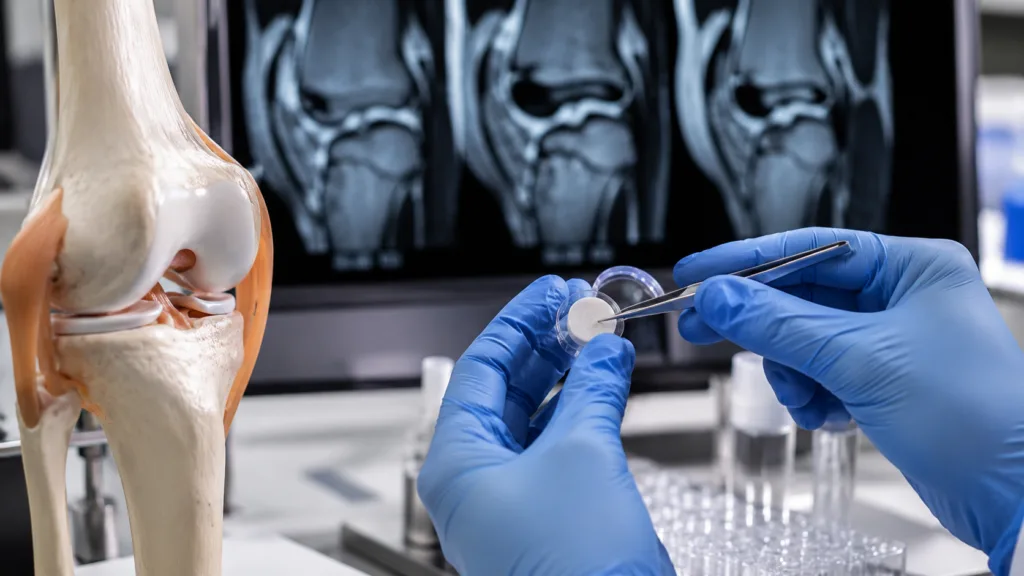
Nanochon describes Chondrograft as an off-the-shelf, 3D-printed implant intended for focal cartilage lesions in patients who require more than conservative management but are not yet candidates for joint replacement. The company says the implant uses a fully synthetic, nylon-based composite engineered to resemble aspects of native cartilage structure and mechanical behaviour. Its design combines immediate mechanical support with a scaffold intended to facilitate longer-term tissue repair.
The device is designed for press-fit placement into the cartilage defect, with Nanochon proposing that the structure can interact with blood and cells originating from the underlying bone. The company has reported tissue integration and regenerative effects in animal models, but its own website explicitly distinguishes those preclinical findings from established human performance. Chondrograft is not approved for marketing.
That evidence boundary is particularly important for regenerative devices. A scaffold can show favourable integration, cartilage formation or mechanical characteristics in animal studies without producing the same magnitude or durability of effect in people. Human knees introduce variation in lesion size, alignment, activity levels, previous injury, rehabilitation and biological response that cannot be fully reproduced by preclinical models.
Nanochon also says Chondrograft has received United States Food and Drug Administration Breakthrough Device designation. Such a designation can facilitate interaction with the regulator during development, but it is not marketing authorization and does not establish that the device is safe or effective. Nanochon’s eventual United States commercial pathway will still require a substantially more developed clinical and regulatory evidence package.
Can early Chondrograft data support Nanochon’s planned pivotal trial and FDA strategy?
The Panama authorization arrives at an important financing and development point for the privately held company. Nanochon said in its second-quarter update that it had raised more than $14 million since inception and was planning to open a $30 million Series A financing in the fourth quarter of 2026. The company linked that financing plan to obtaining at least three months of interim human safety and performance data measured through assessments including pain and MRI findings.
Nanochon intends to direct the proposed financing toward a two-year, multi-site pivotal trial and preparation for a future United States Food and Drug Administration submission. That makes the first-in-human programme more than a clinical experiment. It is also a financing and development inflection point, because evidence from a relatively small number of patients could influence investor willingness to fund the much larger programme needed before commercialization.
The company raised $4.1 million in its Seed Prime II round announced in January 2026, taking disclosed capital raised at that point to $11.3 million, before subsequent funding increased the total above $14 million. Nanochon said the earlier financing was intended to support the Canadian human study, research and development, manufacturing capability and preparation for a future pivotal trial.
Manufacturing will become increasingly important as development progresses. Nanochon said it is investing in its proprietary surgical toolset, packaging, shelf-life testing and sterilization validation. A cartilage implant intended for broader clinical use has to be reproducibly manufactured, packaged and sterilized while maintaining the characteristics evaluated in clinical studies. Establishing that infrastructure before a pivotal trial reduces the risk of generating clinical evidence on a product configuration that later changes materially during scale-up.
What evidence will determine whether Chondrograft moves beyond early feasibility testing?
The first major readout will be safety. The Panama study’s registered primary outcome is absence of serious adverse device effects through month 12, placing device-related complications rather than comparative efficacy at the centre of the protocol. Early feasibility studies are designed to identify whether further investigation is justified, not to settle questions about long-term clinical benefit.
Beyond safety, MRI findings could become particularly relevant because Nanochon’s core biological proposition involves tissue integration and cartilage repair. Imaging evidence may help investigators understand structural changes around the implant, but MRI findings alone will not demonstrate durable clinical benefit. Ultimately, an effective cartilage-restoration therapy would need convincing evidence that structural performance corresponds with outcomes meaningful to patients, including pain, function and potentially durability over longer follow-up.
The pivotal programme will also require a more rigorous framework for understanding how Chondrograft performs relative to existing cartilage-restoration strategies. A five-patient Panama cohort and 10-patient Canadian cohort are appropriate for detecting early problems and generating hypotheses, but they cannot answer comparative questions reliably. Those questions become increasingly important as Nanochon moves from proving that implantation is feasible toward showing why surgeons, hospitals and payers should adopt the device.
Panama therefore gives Nanochon something valuable, but narrower than the headline might suggest: another authorized environment in which Chondrograft can begin accumulating human evidence. The next milestone is not regulatory celebration but execution. Patient enrolment, successful implantation, 12-month safety follow-up and credible imaging and functional signals will determine whether the company can convert a 15-patient potential early-development footprint into the larger pivotal programme on which eventual commercialization depends.