
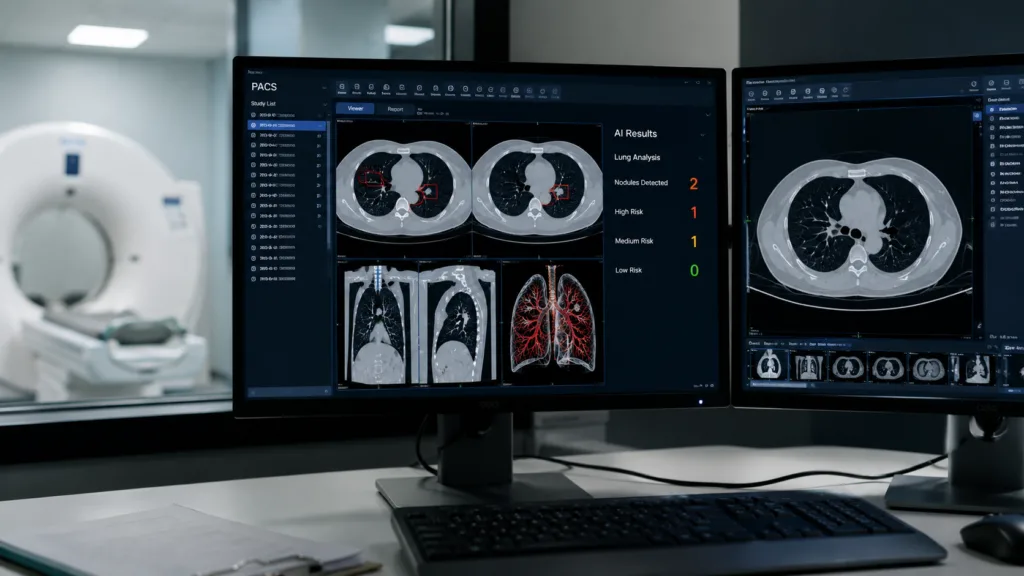
Coreline Soft and INFINITT North America have deployed an artificial intelligence-based chest computed tomography reading workflow at St. Joseph’s Health in Paterson, New Jersey, integrating Coreline Soft’s AVIEW platform directly into the health system’s existing INFINITT picture archiving and communication system rather than requiring radiologists to leave their normal reading environment for a separate AI application. The initial implementation will focus on chest CT examinations used for lung cancer screening, with automated pre-analysis intended to help radiologists identify and quantitatively assess clinically significant findings including pulmonary nodules while supporting comparison with prior images over time. The August 21 deployment is Coreline Soft and INFINITT’s second major North American collaboration after an earlier implementation at ImageCare Radiology, giving the South Korean medical AI company another real-world US site as it expands beyond regulatory clearances into routine clinical workflow.
The distinction between deployment and regulatory clearance is important because Coreline Soft did not receive a new FDA authorization on August 21. The AVIEW product family already includes FDA-cleared medical-device software, including AVIEW Lung Nodule CAD, which FDA cleared under 510(k) K251203 in December 2025 as a Class II computer-aided detection system intended to assist radiologists in finding pulmonary nodules between 3 mm and 20 mm on non-contrast chest CT examinations in asymptomatic populations. FDA’s authorized indication specifies that the software provides adjunctive information and may function as a second reader after the radiologist completes an initial read, reinforcing that the algorithm supports rather than replaces professional interpretation.
What makes the St. Joseph’s implementation more consequential than another AI software installation is the architecture. Coreline Soft says results are inserted into the radiologist’s existing workflow through the INFINITT PACS, eliminating the need to open an external application or manually transfer information between systems, while longitudinal comparison can help clinicians track subtle changes on repeated screening examinations. That approach reflects a larger transition in radiology AI, where health systems are increasingly evaluating not only whether an algorithm can identify an abnormality but whether it can operate quickly and consistently enough inside routine care to justify its presence.
Why is workflow integration becoming as important as the AI algorithm itself?
Early medical imaging AI frequently arrived as stand-alone software that required clinicians to log into separate systems, transfer images, review independent dashboards or reconcile AI output manually with the main radiology report. An algorithm could perform well under validation conditions and still struggle commercially if using it added enough clicks, interruptions or cognitive burden to slow the radiologist rather than accelerate interpretation. As imaging volumes increase and health systems face continuing pressure on radiology staffing, that workflow penalty becomes especially damaging because the value proposition of automation depends partly on reducing rather than creating additional work.
The St. Joseph’s configuration attempts to remove that barrier by embedding AVIEW output inside the existing INFINITT PACS environment. Chest CT examinations can undergo AI pre-analysis before or during the radiologist’s routine reading process, with structured results presented within the system already used to access images rather than through another workstation. Coreline Soft says the arrangement is intended to improve consistency and efficiency without requiring additional manual workflow steps, although the companies have not released a controlled study showing exactly how much interpretation time the St. Joseph’s implementation saves.
This difference between technical performance and operational performance is increasingly important in medical AI purchasing decisions. A hospital may have access to several algorithms capable of detecting similar abnormalities, but integration, response time, cybersecurity, interoperability and the ability to manage results across multiple facilities can determine which system actually reaches everyday use. Coreline Soft’s strategy increasingly appears to be built around becoming clinical infrastructure rather than simply supplying isolated detection models, an approach the company has also emphasized in its US validation programme and planned World Conference on Lung Cancer demonstrations.
What has FDA actually cleared AVIEW Lung Nodule CAD to detect?
FDA’s December 2025 clearance describes AVIEW Lung Nodule CAD as computer-aided detection software designed to assist radiologists in identifying pulmonary nodules measuring 3 mm to 20 mm during review of non-contrast chest CT examinations in asymptomatic populations. The system highlights suspected regions of interest that might otherwise be overlooked, but FDA states that it may be used as a second reader after the radiologist has completed the initial interpretation. The agency also notes that the validation dataset was predominantly acquired using Siemens SOMATOM CT scanners and recommends limiting use to that scanner family, an important technical qualification when discussing broader hospital deployment.
The December clearance involved software version 2.0 and was based on substantial equivalence to an earlier AVIEW Lung Nodule CAD version rather than a new De Novo classification. FDA said a new clinical study was not considered necessary for that particular modification because the intended use, indication and algorithms remained equivalent to the predicate while changes involved areas such as software environment and user-interface modifications. The company therefore cannot accurately characterize the 2025 decision as FDA independently proving that every new workflow implementation improves lung cancer detection; it establishes that the specified software can legally be marketed for its authorized adjunctive detection function.
Coreline Soft also holds other US clearances covering its wider imaging platform, including AVIEW and AVIEW CAC, which supports quantitative analysis of coronary artery calcification. FDA records identify a 2025 clearance for AVIEW CAC and another for the general AVIEW automated radiological image-processing environment, illustrating how the company is building several regulated functions around the same broader chest-imaging ecosystem. Coreline Soft says it now holds 12 FDA 510(k) clearances overall, providing it with a much more developed regulatory base than many medical AI companies entering the US market with only one narrow algorithm.
Why can a lung cancer screening CT reveal more than a pulmonary nodule?
Low-dose CT screening is performed primarily to identify lung cancers early enough for potentially curative treatment, but every chest scan contains anatomical information extending far beyond one suspicious nodule. Emphysematous lung changes can be visible, coronary artery calcification may provide information about cardiovascular risk, and repeated examinations can reveal whether pulmonary nodules are growing, stable or changing in morphology. Coreline Soft’s broader product strategy is to extract several of these signals from a single CT examination rather than restricting artificial intelligence to one binary question about whether a nodule exists.
This concept of multi-disease or opportunistic analysis is commercially attractive because the marginal imaging cost has already been incurred once the patient undergoes the CT. If validated software can extract additional clinically useful information from that existing dataset without requiring another scan, healthcare systems potentially gain more diagnostic value from the same examination while avoiding additional radiation exposure. Coreline Soft is extending the same logic into cardiac CT through AVIEW IPN, an investigational programme designed to identify incidental pulmonary nodules on scans obtained primarily for cardiovascular evaluation, although that particular next-generation application remains in US clinical validation rather than being equivalent to the currently cleared lung-screening indication.
The challenge is preventing additional findings from becoming additional noise. Incidental abnormalities can lead to follow-up imaging, specialist referrals and patient anxiety, so algorithms need appropriately validated thresholds and clearly defined clinical pathways rather than simply flagging every detectable variation. The value of AVIEW’s multiparametric strategy will therefore depend partly on how well quantitative findings are connected to accepted follow-up protocols and structured reporting rather than on the sheer number of abnormalities the software can identify.
Why is longitudinal comparison particularly important in lung cancer screening?
Lung cancer screening is inherently repetitive because many detected nodules cannot be categorized confidently from one image alone. Size, volume and growth rate across sequential scans can help clinicians distinguish stable benign findings from lesions that require closer surveillance or additional diagnostic investigation, which makes access to prior examinations central to the screening process. Coreline Soft says its St. Joseph’s implementation includes prior-image comparison intended to make subtle changes easier to evaluate across time, allowing the AI-supported workflow to address longitudinal surveillance rather than simply performing one-off detection.
Coreline Soft’s AVIEW LCS Plus platform also includes volumetric analysis and calculation of volume doubling time, measures that can provide more sensitive evidence of growth than simple manual diameter measurements in some nodules. The company is positioning these capabilities as part of a broader operational lung-screening pathway encompassing detection, quantitative analysis, prior-study comparison, structured reporting and follow-up management. This direction aligns with the practical reality that a lung screening programme does not succeed merely because an algorithm identifies more nodules; it succeeds when clinically important nodules are followed consistently and patients move through the appropriate diagnostic pathway without unnecessary delays or repeated work.
Longitudinal integration also strengthens the case for embedding AI directly into PACS. If prior examinations, automated measurements and current images are available together in the same reading environment, radiologists may be better positioned to evaluate change without manually reconstructing a history from several systems. Whether that produces measurable improvements in recall rates, reading time or cancer-stage distribution at St. Joseph’s has not yet been reported, making the deployment an implementation milestone rather than completed evidence of patient-outcome benefit.
How does St. Joseph’s fit Coreline Soft’s broader US expansion?
Coreline Soft has been increasing US activity through both commercial deployments and prospective validation programmes. The company says it has accumulated regulatory and clinical experience across 21 countries and contributed to more than 500 peer-reviewed publications and scientific presentations involving the AVIEW platform, while US collaborations include 3DR Labs, Temple Lung Center and Baylor College of Medicine. The St. Joseph’s project adds another live clinical environment and follows the existing partnership with INFINITT at ImageCare Radiology, potentially giving Coreline Soft evidence on how its technology performs across different radiology organizations rather than within one academic pilot.
The company is simultaneously working on two next-generation US clinical-validation programmes, AVIEW IPN and AVIEW Lung Metrics. AVIEW IPN is intended to identify incidental pulmonary nodules visible on cardiac CT examinations, while AVIEW Lung Metrics is being developed around quantitative imaging biomarkers for lung abnormalities and attempts to reduce measurement variability across different scanners and acquisition protocols. Neither programme should be confused with an already FDA-cleared new indication, but both show that Coreline Soft sees quantitative chest imaging as a platform extending beyond the lung cancer screening workflow currently being deployed at St. Joseph’s.
This broader strategy could prove relevant to pharmaceutical development as well as clinical radiology. Standardized quantitative imaging biomarkers can potentially help characterize disease or monitor treatment response across multicenter trials, provided measurements remain reproducible despite variation in scanners and imaging protocols. Coreline Soft has explicitly identified drug-development support as a possible future application for Lung Metrics, giving the company potential exposure to life-sciences research alongside hospital diagnostic workflows.
Does embedding AI into PACS automatically improve lung cancer outcomes?
No, and distinguishing implementation from outcomes is essential when evaluating medical AI announcements. FDA clearance establishes that individual software functions can be marketed for their authorized use, while a hospital deployment establishes that those tools have entered a real clinical workflow, but neither alone proves that patients experience earlier cancer diagnosis, fewer missed malignancies or improved survival. Those stronger claims require appropriate prospective evidence comparing patient pathways and clinical outcomes.
The near-term questions at St. Joseph’s are therefore operational and diagnostic. Radiologists will need to determine whether AVIEW reduces repetitive measurement work, improves consistency between readers, makes prior-image comparison easier and surfaces clinically important findings without creating excessive false-positive alerts or report clutter. Administrators will simultaneously care about whether the integration remains stable, whether output reaches clinicians quickly and whether AI use can scale as screening volume grows.
Coreline Soft’s advantage is that the implementation occurs on top of an FDA-cleared product family rather than an experimental algorithm, while INFINITT provides a pathway into an established PACS environment. The remaining test is the one increasingly confronting the entire radiology-AI sector: whether technically capable algorithms become sufficiently invisible and useful inside the everyday reading process that clinicians continue using them after the novelty of deployment disappears.
The St. Joseph’s project is consequently more important than a conventional software installation but less dramatic than a new FDA approval. It represents the stage after regulatory authorization when medical AI has to prove that it can live inside healthcare infrastructure, work with prior examinations and produce information quickly enough to influence routine interpretation. As lung cancer screening expands and a single chest CT increasingly becomes a source of multiple quantitative findings, that integration layer may determine which AI companies build durable clinical platforms and which remain collections of impressive but underused algorithms.