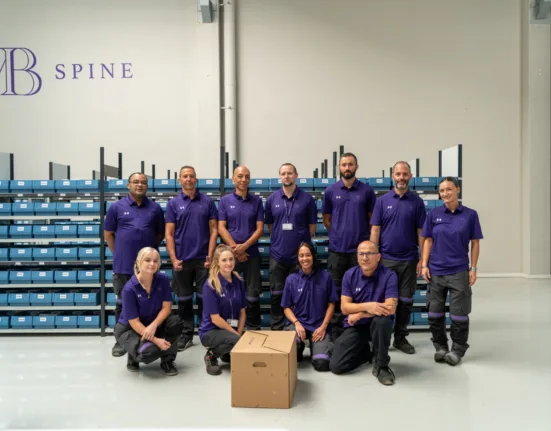
VB Spine LLC has completed its acquisition of exclusive rights to Augmedics’ CT-to-fluoroscopy technology for spine applications and plans to begin integrating CT-Fluoro into the xvision Spine System platform immediately. The transaction gives VB Spine control of a registration approach that combines a patient’s preoperative computed tomography scan with intraoperative images from a standard 2D C-arm, expanding the imaging workflows available for the FDA-cleared augmented reality navigation system.
The deal is commercially important because it reunites CT-Fluoro with the xvision spine platform under VB Spine after the company separately acquired exclusive rights to xvision from Augmedics in April 2026. Financial terms of the CT-Fluoro transaction have not been disclosed, while VB Spine and Augmedics said they are working together on the technology transition.
What changes now is not CT-Fluoro’s regulatory status. The United States Food and Drug Administration cleared the registration method through the 510(k) pathway in October 2024, and Augmedics subsequently began a commercial rollout. The August 2026 transaction instead determines who controls the technology for spine applications and places its future integration and commercialization within VB Spine’s expanding xvision business.
That distinction matters because CT-Fluoro addresses one of the more practical questions surrounding surgical navigation: how much additional imaging infrastructure a hospital or ambulatory surgery center must have before it can use the technology. The approach does not remove imaging from the procedure, but it can avoid dependence on an intraoperative 3D scan by registering a preoperative CT dataset to intraoperative 2D X-ray images. That could make the xvision workflow relevant to facilities already equipped with conventional C-arm fluoroscopy but without dedicated intraoperative 3D imaging equipment.
How does CT-Fluoro change the imaging workflow used by the xvision Spine System?
The underlying technology is best understood as an additional registration pathway rather than a new navigation platform. xvision remains an image-guided system that uses a headset, software, optical tracking and registered patient imaging to show the position of tracked surgical instruments relative to patient anatomy. The augmented reality display allows navigation information to remain in the surgeon’s field of view while the surgeon looks toward the operative field.
Under the CT-Fluoro method described in the FDA documentation, a three-dimensional CT dataset obtained before surgery is registered with the patient during surgery using at least two 2D X-ray images acquired with a C-arm. Augmedics’ 510(k) summary states that the modified system incorporates a new registration algorithm and a deep learning-based spine segmentation algorithm that segments individual vertebrae, including the sacrum and ilium, before feeding that information into the registration process.
The practical significance is flexibility. An xvision user can have a pathway based on intraoperative 3D imaging or one based on preoperative CT combined with fluoroscopy, rather than requiring the same imaging architecture for every eligible case. VB Spine is therefore acquiring more than an isolated algorithm. It is gaining a workflow option that could influence where the broader xvision platform can economically and operationally be deployed.
Frank Phillips of Midwest Orthopedics at Rush, who has used the CT-Fluoro workflow, indicated through VB Spine that registration can be performed after two standard intraoperative fluoroscopic images and can take roughly one or two minutes in his practice. That is an individual clinician’s reported experience rather than evidence that every procedure or hospital will achieve the same workflow performance, but it illustrates the operational proposition VB Spine is trying to commercialize.

Why could avoiding intraoperative 3D imaging matter for hospitals and ambulatory surgery centers?
Advanced navigation adoption is not determined by navigation accuracy alone. Hospitals have to account for capital equipment, operating-room space, imaging availability, staff training, procedure scheduling and the degree to which a new system fits existing surgical workflows. Those factors can become particularly important outside large tertiary centers, where purchasing a dedicated intraoperative 3D imaging system solely to enable navigation may be harder to justify.
VB Spine is explicitly positioning CT-Fluoro around that gap. The company said the workflow could broaden access to augmented reality navigation in regional hospitals and ambulatory surgery centers where conventional intraoperative 3D imaging and navigation infrastructure may be economically difficult to support. Because standard 2D C-arms are already familiar equipment across many surgical environments, compatibility with that imaging base potentially lowers one element of the infrastructure hurdle.
There is an important qualification. CT-Fluoro should not be described as imaging-free or radiation-free navigation. The workflow depends on a preoperative CT examination and intraoperative fluoroscopic X-rays. What it can remove from the xvision registration process is the requirement for an intraoperative 3D scan when the CT-Fluoro method is used. Whether that translates into lower total radiation exposure, shorter room time or lower procedural cost in a specific setting depends on the complete patient pathway and cannot be established from the transaction announcement alone.
That nuance could become particularly important as VB Spine markets the technology to ambulatory facilities. An ASC purchasing decision will depend not only on whether a system can technically operate with existing imaging, but also on acquisition economics, utilization rates, service arrangements, training requirements and how consistently the registration process works across the procedures performed at that facility.
What does the FDA clearance actually establish about CT-Fluoro performance?
The FDA record provides considerably more detail than the acquisition announcement. The CT-Fluoro-enabled xvision Spine System was cleared under 510(k) K241481 as a Class II medical device. Its intended use remains to aid surgeons in precisely locating anatomical structures in open or percutaneous spine procedures, with the cleared indications encompassing specified procedures involving the cervical, thoracic, sacro-lumbar and pelvic anatomy.
The FDA submission explains that the additional 2D-to-3D registration method was evaluated against the previously cleared xvision configuration. Phantom and cadaver testing was used to demonstrate that the modified system met the applicable performance criteria, while the FDA documentation states that overall system accuracy using the 2D-to-3D registration method was verified as comparable with the intraoperative registration method for purposes of the substantial-equivalence assessment.
That is meaningful technical validation, but it should not be stretched into a broader clinical claim. A 510(k) substantial-equivalence determination is not evidence that CT-Fluoro produces superior patient outcomes, lowers complication rates or delivers better economics than every competing navigation workflow. Those questions require clinical and real-world evidence beyond the clearance itself.
The wider xvision platform does have published clinical experience. An early clinical series involving 218 augmented reality-guided screws reported 97.1% overall Gertzbein-Robbins accuracy, while another published series involving 205 screws reported 98% accuracy for augmented reality-assisted pedicle screw placement. These studies support the broader clinical feasibility of headset-based AR navigation, although they do not independently establish that CT-Fluoro registration specifically will reproduce every result across different institutions, procedures and surgeon populations.
Does VB Spine now have a stronger commercial platform around xvision?
The CT-Fluoro closing completes a notable two-step transfer of Augmedics’ spine technology into VB Spine. In April, VB Spine completed the acquisition of exclusive rights to the xvision Spine System from Augmedics. It has now followed with the exclusive rights to CT-Fluoro for spine applications, effectively bringing a key registration technology back together with the navigation platform on which it was developed.
The installed-use history gives VB Spine something many emerging surgical-navigation technologies lack: a platform that has already moved beyond first-in-human demonstrations. Augmedics reported that xvision had been used in more than 13,000 patients and for more than 71,500 navigated pedicle screws as of early 2026. Those are company-reported cumulative figures for xvision overall and should not be interpreted as CT-Fluoro-specific adoption numbers.
That distinction creates one of the most important unanswered commercial questions. Augmedics launched CT-Fluoro commercially in the United States in 2025, but neither the closing announcement nor the available company disclosures provide a separate installed base, case count or utilization figure specifically for CT-Fluoro. As a result, the industry can see the scale of the overall xvision platform, but not yet how rapidly users have migrated toward the preoperative CT plus fluoroscopy registration pathway.
VB Spine’s opportunity is therefore to use its wider spine portfolio and distribution infrastructure to convert a technically cleared workflow into broader routine utilization. Integration also creates the potential for xvision to sit more naturally alongside the company’s implants and other spine technologies, although actual adoption will depend on how VB Spine structures sales, service, training and hospital purchasing around the platform.
Could CT-Fluoro become particularly important as more spine procedures move to ASCs?
The ASC opportunity is compelling precisely because CT-Fluoro tackles infrastructure rather than attempting to reinvent the entire surgical procedure. Ambulatory centers can be highly sensitive to operating-room footprint, equipment utilization, turnover time and capital efficiency. A navigation system that can work with preoperative CT information and standard intraoperative C-arm imaging may therefore present a different purchasing proposition from one dependent on a larger intraoperative imaging installation.
Yet portability and lower imaging requirements do not automatically produce broad adoption. Surgeons still have to become comfortable with registration, tracking and headset-based visualization. Facilities must establish processes for importing and managing preoperative imaging, maintaining compatible equipment, training operating-room teams and supporting the system across repeated cases.
The regulatory documentation also reinforces that xvision remains an aid to anatomical localization rather than an autonomous surgical system. The surgeon remains responsible for the procedure, and the navigation information must be interpreted within the wider operative context. The technology’s value proposition therefore depends on whether it improves the surgeon’s workflow without introducing enough complexity elsewhere to offset those benefits.
For VB Spine, this may ultimately be more important than demonstrating another incremental technical feature. If CT-Fluoro makes navigation deployable in facilities that previously regarded advanced 3D imaging infrastructure as a barrier, the addressable setting for xvision could expand materially. If hospitals still encounter significant training, purchasing or workflow friction, the theoretical infrastructure advantage may translate more slowly into installed systems and case volumes.
What should the spine technology market watch after the CT-Fluoro transaction closes?
The next meaningful evidence will come from execution rather than another transaction announcement. VB Spine has said integration into xvision will begin immediately, but the company has not disclosed financial terms for the acquisition or provided a quantified forecast for CT-Fluoro installations, procedure volumes or revenue contribution.
Several indicators would make the commercial trajectory easier to evaluate: growth in xvision installations, the proportion of centers using preoperative CT registration, utilization within ambulatory surgery centers, training requirements, procedure throughput and additional real-world performance data specifically involving CT-Fluoro. Evidence showing whether facilities can consistently avoid intraoperative 3D imaging without sacrificing navigation performance would be particularly useful.
The strategic logic of VB Spine’s 2026 transactions is nevertheless increasingly visible. Buying the xvision spine rights gave the company an established augmented reality navigation platform, while adding CT-Fluoro gives that platform an alternative imaging and registration pathway designed to reduce dependence on intraoperative 3D equipment. Together, the transactions move VB Spine further into enabling technology rather than leaving it solely within the traditional implant-centered spine market.
The commercial test is now whether that technical flexibility translates into a measurable expansion of navigation use. CT-Fluoro already has FDA clearance, xvision already has thousands of reported procedures behind it, and VB Spine now controls the spine-specific rights to both technologies. The unresolved question is whether integrating them under a larger spine company can turn an attractive workflow proposition into routine adoption across the regional hospitals and ambulatory centers where the imaging barrier may matter most.