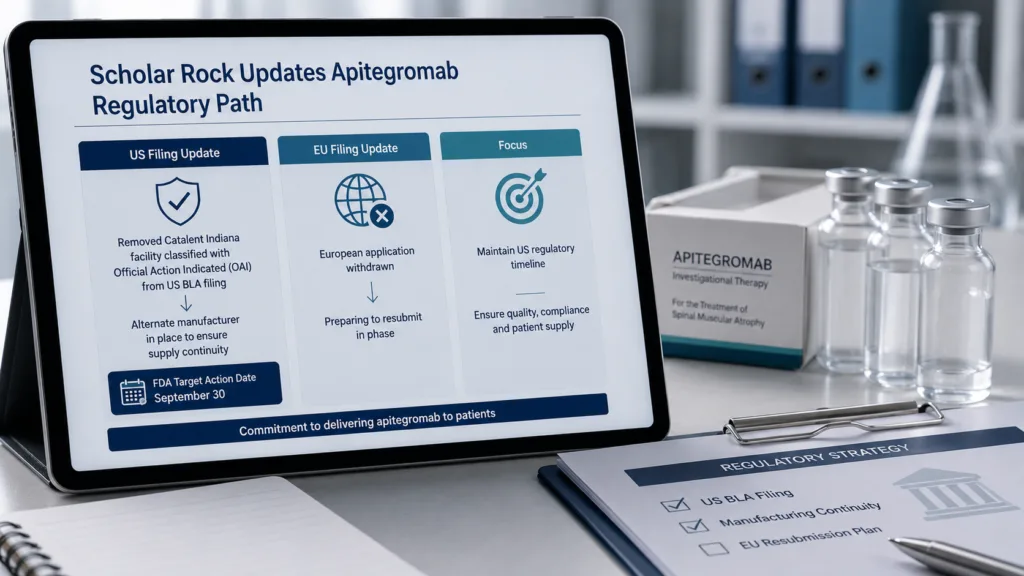
Scholar Rock has removed Catalent Indiana LLC, now part of Novo Nordisk A/S, from the US Biologics License Application for apitegromab after the Food and Drug Administration classified the facility’s April inspection as Official Action Indicated, allowing review of the spinal muscular atrophy therapy to proceed solely through an alternate US fill-finish site. The change preserves Scholar Rock’s expectation of an FDA decision by the September 30, 2026 Prescription Drug User Fee Act target date, but the same manufacturing problem has forced the company to withdraw its European Marketing Authorisation Application and prepare a new submission using the alternate facility.
The August 21 update turns what could have become another broad regulatory delay into sharply different outcomes across three major markets. In the United States, FDA is continuing to review the BLA using the second manufacturer and Scholar Rock says commercial vials produced there are already available. In Europe, the company and European Medicines Agency concluded that withdrawing and resubmitting the application offered the fastest route after the Catalent Indiana inspection classification. In Japan, meanwhile, the Pharmaceuticals and Medical Devices Agency has agreed that Scholar Rock can file apitegromab without conducting an additional Japanese clinical trial.
The episode highlights how late-stage biologic development can become dependent on manufacturing execution even after the pivotal clinical trial has succeeded. Apitegromab’s underlying Phase 3 efficacy programme is not the issue driving the current regulatory complexity; the bottleneck lies in fill-finish compliance and whether regulators can rely on a commercial manufacturing site to produce the medicine consistently.
Why has a fill-finish facility become so important to apitegromab’s approval?
A biologic cannot receive marketing approval on clinical efficacy and safety data alone. Regulators also need assurance that the commercial product can be manufactured consistently according to required quality standards.
Fill-finish is the stage at which bulk biological drug substance is aseptically filled into final containers such as vials or syringes and prepared for eventual packaging and distribution. Because the medicine is exposed to critical sterile-processing steps, deficiencies at a fill-finish facility can prevent approval even when the therapeutic product itself has demonstrated clinical benefit.
Scholar Rock learned that directly in September 2025 when FDA issued a Complete Response Letter for apitegromab because of observations made during a routine inspection of Catalent Indiana. The company said at the time that the CRL did not identify other approvability concerns related to apitegromab’s efficacy, safety or drug-substance manufacturer.
Rather than remain entirely dependent on remediation at that facility, Scholar Rock introduced a second US-based fill-finish manufacturer into its resubmission strategy.
The March 2026 BLA resubmission therefore included both Catalent Indiana and the alternate site, creating two independent manufacturing routes capable of supporting approval. Scholar Rock said this approach had been aligned with FDA during a Type C meeting.
That redundancy has now become decisive.
After the April 2026 inspection of Catalent Indiana, FDA classified the site as Official Action Indicated, or OAI, a status indicating that objectionable conditions are sufficiently significant for regulatory or administrative action to be recommended. On August 7, Scholar Rock said it would remove the facility from the BLA under FDA guidance.
The August 21 update confirms that removal has been completed and FDA review is continuing through the second site.
Does removing Catalent Indiana mean apitegromab is now on a clear path to approval?
It removes one major obstacle, but approval is still not guaranteed.
Scholar Rock says the alternate site is a US commercial facility with a strong regulatory record and recent successful FDA and EMA inspections. The company previously submitted the data package needed for FDA review of the site and says commercial apitegromab supply produced there is already available for launch following approval.
That provides a materially stronger position than Scholar Rock faced after its 2025 CRL, when the problematic Catalent Indiana site was central to the commercial manufacturing chain.
However, FDA still has to determine whether the alternate facility, manufacturing process, analytical comparability and entire BLA satisfy regulatory requirements.
Scholar Rock’s statement that review is progressing well represents the company’s characterization of its interaction with FDA rather than a commitment from the agency that approval will occur.
The September 30 PDUFA date is similarly a target for FDA action, not a guaranteed approval date. The agency could approve the application, issue another Complete Response Letter or in some circumstances extend or otherwise alter the review timeline.
The distinction matters because the underlying clinical programme has already experienced one regulatory disappointment unrelated to the therapeutic effect.
Why did Europe require withdrawal when the United States did not?
The difference largely reflects how the alternate manufacturing site was incorporated into the respective applications.
Scholar Rock had already included two fill-finish facilities in its US BLA resubmission, giving FDA a regulatory package containing the alternate manufacturer before Catalent Indiana received its OAI classification.
The European Marketing Authorisation Application, by contrast, included Catalent Indiana and was already under EMA review. Scholar Rock had been discussing ways to bring the second site into that process while awaiting FDA’s inspection classification of the Indiana facility.
Once the OAI status became clear, Scholar Rock and EMA concluded that withdrawing the existing application and resubmitting it without Catalent Indiana would provide the most expeditious route toward a Committee for Medicinal Products for Human Use opinion.
The withdrawal was completed through a CHMP written procedure that concluded on August 20. Scholar Rock now plans to resubmit the MAA using the alternate fill-finish facility.
That is a regulatory reset rather than an EMA rejection of apitegromab’s clinical evidence.
The practical consequence is still significant because European approval will move later than previously expected. Scholar Rock had once anticipated a European decision during 2026 and had prepared Germany as an early launch market. Withdrawal and resubmission require additional regulatory processing even if the clinical package itself does not need to be rebuilt.
The episode demonstrates why manufacturing redundancy created before a filing can have enormous strategic value. In the United States, the second facility allows review to continue. In Europe, where the alternate site was not embedded in the same way, the application has to be reconstructed around it.
What does apitegromab add to existing spinal muscular atrophy treatment?
Spinal muscular atrophy is caused by insufficient survival motor neuron protein and results in progressive degeneration of motor neurons and muscle weakness.
Modern SMA treatment has been transformed by therapies targeting the underlying SMN biology, including gene replacement and medicines designed to increase production of functional SMN protein. These treatments can markedly change disease progression, particularly when administered early.
Apitegromab targets a different part of the disease.
The fully human monoclonal antibody selectively binds pro- and latent forms of myostatin, a skeletal-muscle regulator that restricts muscle growth. By inhibiting myostatin activation, Scholar Rock aims to improve muscle function in patients who are already receiving therapies addressing SMN deficiency.
The strategy is therefore complementary rather than substitutive. Apitegromab is intended to address residual muscle weakness that can remain even after the primary genetic pathway has been treated.
Scholar Rock’s Phase 3 SAPPHIRE study provided the pivotal evidence supporting the BLA and established statistically significant and clinically meaningful improvement in motor function, according to the company. The regulatory application covers children and adults with SMA.
That muscle-targeted concept could establish a new therapeutic layer within SMA if apitegromab is approved.
Why is Japan emerging as the unexpected positive part of the regulatory update?
Scholar Rock’s Japanese pathway moved materially forward at the same time Europe stepped backward.
Japan has historically often required clinical information from Japanese participants to support domestic registration, creating an additional development burden for rare-disease companies whose global pivotal trials may contain few or no Japanese patients.
PMDA has now agreed that Scholar Rock can submit a Japanese New Drug Application for apitegromab without conducting an additional Japanese clinical trial. The company plans to file by the end of 2026.
The agreement relies on recent Japanese guidance allowing certain orphan and rare-disease medicines to proceed without domestic clinical data when several conditions are met.
Scholar Rock said those conditions include completion of a successful pivotal trial outside Japan, practical difficulty recruiting sufficient Japanese patients because of the rarity of the disease and scientific and clinical evidence supporting the expectation of a favorable benefit-risk profile in Japanese patients.
For a disease such as SMA, avoiding another country-specific efficacy study can potentially accelerate access while reducing duplication of clinical research in a small patient population.
It does not mean PMDA has pre-approved apitegromab. The Japanese regulator will still assess the submitted efficacy, safety, manufacturing and quality package.
What does the manufacturing episode reveal about biologic development risk?
Apitegromab offers an unusually clear demonstration that late-stage drug risk does not end when Phase 3 succeeds.
Clinical programmes naturally attract most attention because efficacy results determine whether a medicine appears capable of helping patients. Yet commercial biologics require a manufacturing chain in which drug-substance production, fill-finish, testing, packaging and distribution all meet stringent standards.
Scholar Rock’s first Complete Response Letter arose from a third-party facility issue that the company said was not specific to apitegromab. Nearly a year later, that same site has received an OAI classification and has now been removed entirely from the product’s commercial strategy.
The decision to qualify a second manufacturer effectively created regulatory insurance.
Without the alternate facility, the US BLA could have faced another potentially lengthy delay while the Indiana site resolved its inspection status. Instead, FDA can continue evaluating an existing alternate route.
The European experience shows the other side of the equation: redundancy only fully protects a programme when regulators have the necessary facility information within the relevant application.
Scholar Rock is now approaching its September 30 FDA target with commercial vials from the replacement site reportedly ready for packaging and labeling, while Europe requires a new filing and Japan offers a route that avoids additional domestic efficacy trials.
The therapeutic question surrounding apitegromab remains whether its Phase 3 muscle-function benefit justifies approval as an adjunct to the disease-modifying treatments that have already transformed SMA.
The immediate regulatory story, however, is about something less glamorous and just as consequential: whether the company built enough manufacturing redundancy to prevent one problematic plant from derailing a potentially global drug launch twice.