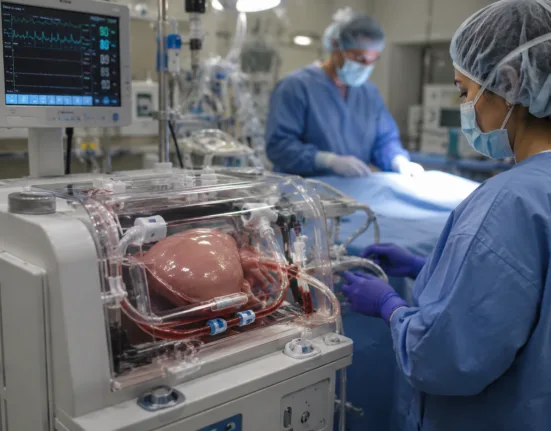
OrganOx, the organ-preservation technology company acquired by Terumo Corporation, has secured an important reimbursement and access milestone in England after the National Institute for Health and Care Excellence supported routine NHS funding for ex-situ machine perfusion technologies used in deceased-donor liver transplantation. The August 21, 2026 guidance is significant because it moves machine perfusion away from dependence on locally variable funding decisions and toward more consistent access across NHS transplant centers, while NICE’s independent assessment concluded that the technologies can provide clinical benefit and represent a cost-effective use of healthcare resources.
OrganOx metra maintains a donor liver in a functioning, oxygenated state at approximately normal body temperature outside the body, allowing clinicians to observe metabolic performance and potentially evaluate organs that might otherwise be declined based largely on static clinical characteristics. OrganOx says the technology has already been used in more than 10,000 liver transplants worldwide, and the device is approved in the United States and Europe as well as other markets. NICE’s support therefore comes after significant clinical adoption rather than at the earliest experimental stage of the technology.
Why does machine perfusion matter when donor livers can already be preserved on ice?
Static cold storage has been fundamental to organ transplantation because cooling reduces metabolic activity and slows tissue injury while an organ is transported between donor and recipient hospitals. The limitation is that a cold-stored liver is largely metabolically inactive, giving transplant teams relatively little opportunity to assess how the organ will function once circulation is restored. This becomes particularly important as programs increasingly consider older donors, donation after circulatory death and other organs whose risk profile may make surgeons reluctant to transplant them.
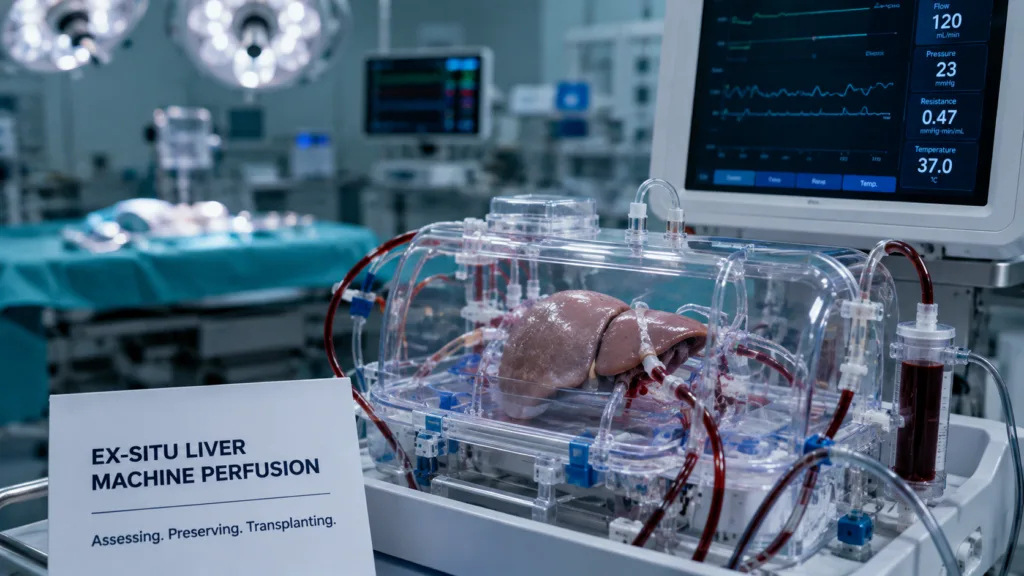
Normothermic machine perfusion takes a different approach by circulating oxygenated blood, nutrients and medications through the liver at physiological temperature. The OrganOx metra is designed to support livers from deceased donors while clinicians monitor parameters such as lactate metabolism, bile production and vascular performance, creating a period during which an organ can be assessed as functioning biological tissue rather than judged largely from pre-donation characteristics and appearance. NICE’s final scope describes the device as transportable and capable of supporting a liver for as long as 24 hours.
That assessment capability is potentially as important as extended preservation itself. A marginal-looking liver that demonstrates favorable metabolic behavior during perfusion could become transplantable, while a liver showing poor function can be declined before implantation rather than exposing a recipient to avoidable graft failure.
What clinical evidence supports the argument that perfusion can increase organ utilization?
A landmark multinational randomized study involving 334 donor livers compared OrganOx normothermic machine perfusion with conventional static cold storage. NICE’s earlier evidence review reported a 24.1% organ discard rate in the static-storage group compared with 11.7% in the machine-perfusion group, providing evidence that functional preservation and assessment can allow a greater proportion of offered organs to reach transplantation.
That difference matters because the principal constraint in liver transplantation is not simply surgical capacity but organ scarcity. Patients can deteriorate or die while waiting, yet donor livers are regularly declined because physicians judge the risk of primary graft dysfunction or other complications too high. Technologies that safely lower the discard rate therefore have the potential to expand the effective organ supply without increasing the number of donors.
NICE nevertheless noted limitations across the evidence base, including the need for more work involving higher-risk organs, longer follow-up and direct comparisons between competing machine-perfusion systems. The new routine-use recommendation therefore should not be interpreted as establishing OrganOx metra as clinically superior to every alternative device; it supports the broader clinical and economic value of ex-situ machine perfusion within the NHS pathway.
Why is NICE funding support commercially important even though OrganOx was already being used in Britain?
A technology can be clinically available without being consistently accessible. OrganOx said metra was already being used in several NHS transplant centers, but local budgets and procurement arrangements could produce variation in whether machine perfusion was available for a particular donor organ or patient. NICE guidance supporting routine funding reduces that variation by giving NHS decision-makers a national evidence-based framework for adoption.
This distinction is particularly important for relatively expensive technologies whose benefit may appear outside the immediate device budget. Machine perfusion can add cost to organ preservation, but the economic value may arise from transplanting organs that would otherwise be discarded, reducing waiting-list mortality or avoiding complications associated with poor graft function. A local hospital budget can struggle to capture those system-wide benefits, whereas NICE assesses clinical outcomes and healthcare economics across the wider NHS.
The external assessment considered multiple perfusion devices and economic studies, including a model submitted by OrganOx. NICE’s reviewers found that available economic analyses differed in their assumptions and conclusions, leading the external assessment group to construct its own model incorporating the transplant waiting list, short-term post-transplant complications, retransplantation and long-term survival.
Could machine perfusion change which donor livers surgeons are willing to accept?
This may be the technology’s most important long-term effect. The number of liver donors cannot be expanded quickly, but utilization can potentially improve if transplant teams gain greater confidence in organs that currently sit near the threshold for acceptance. Donation-after-circulatory-death organs and livers from older or medically complex donors can be particularly difficult to evaluate because the risks of ischemic injury and poor function may be greater than in traditional low-risk grafts.
Ex-situ perfusion effectively creates an observation window. Instead of making an irreversible transplant decision using static information, clinicians can test whether the organ clears lactate, produces bile and maintains stable physiological parameters before proceeding. That does not make every declined liver usable, and aggressive expansion of donor criteria without adequate evidence could expose recipients to additional risk, but the technology creates information that static cold storage cannot provide.
OrganOx says metra has now been involved in more than 10,000 liver transplant procedures, giving the company a substantial real-world base from which to refine selection and preservation protocols. Wider NHS adoption could also generate larger datasets on which donor characteristics respond best to machine perfusion and whether use produces durable improvements in transplantation rates and outcomes.
What does the NICE decision mean for the wider organ-technology market?
Routine NHS support is a meaningful validation of the category rather than simply one manufacturer. Several companies have developed normothermic or hypothermic perfusion systems, and competitive differentiation increasingly involves transportability, ease of use, preservation time, organ assessment capability and evidence that the technology can expand donor utilization without worsening outcomes.
For OrganOx, the decision strengthens a commercial platform that already has regulatory approval in multiple major markets and now sits inside Terumo Corporation following its acquisition. The combination of reimbursement support and a larger medtech owner could accelerate deployment by providing broader hospital relationships and manufacturing infrastructure, particularly as transplantation programs seek ways to address persistent organ shortages.
The key measure of success will not be how many machines NHS hospitals purchase. It will be whether routine machine perfusion enables more donated livers to be transplanted safely, shortens waiting times and reduces deaths among patients who might otherwise never receive an organ.
NICE has effectively concluded that ex-situ perfusion has moved far enough beyond experimental preservation to justify routine access within the health service. That turns the next stage into an implementation challenge: converting a promising technology for keeping a liver alive outside the body into a consistent mechanism for making more donor organs usable.