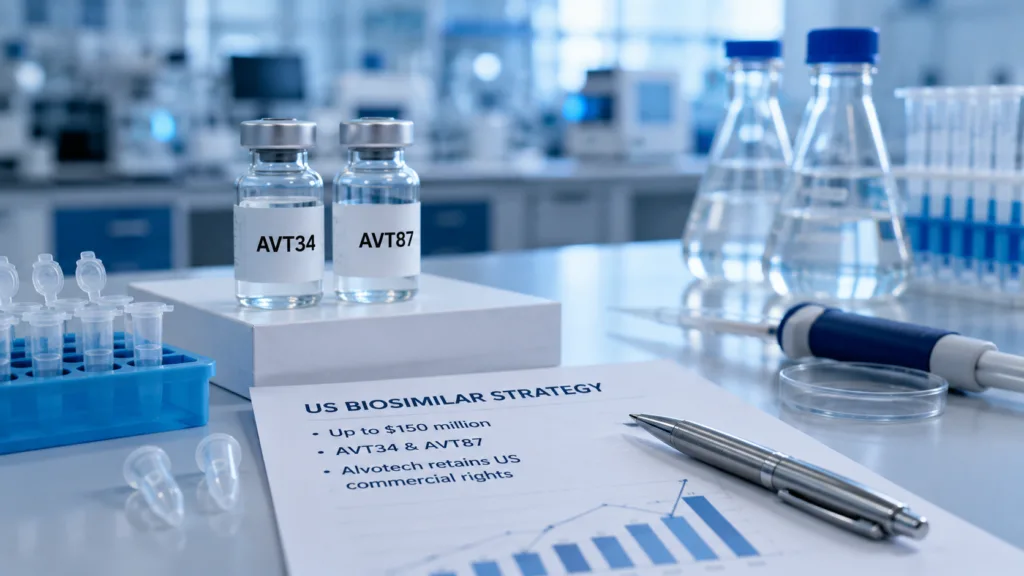
Alvotech (NASDAQ: ALVO) has signed a licensing and commercialization agreement worth up to approximately $150 million with Lotus Pharmaceutical covering proposed biosimilars to AstraZeneca’s Imfinzi and Roche’s Hemlibra in the United States and eight Asian markets, while retaining the right to commercialize both products directly in the US alongside its new partner. The structure marks a strategic change for Alvotech because the Iceland-based biosimilar manufacturer says this is the first time it will have the opportunity to participate directly in future US commercialization of its own products rather than relying entirely on a partner to take them to market.
The two candidates target large but very different biologic franchises. AVT34 is being developed as a biosimilar to durvalumab, marketed by AstraZeneca as Imfinzi across several cancers, while AVT87 is a proposed biosimilar to Roche’s emicizumab, marketed as Hemlibra for prevention or reduction of bleeding episodes in hemophilia A. Alvotech cited 2025 global sales of approximately $6.1 billion for Imfinzi and approximately CHF4.8 billion, or around $5.8 billion, for Hemlibra, putting the combined reference-product revenue base close to $12 billion before accounting for future growth, competition or erosion.
How is the $150 million Alvotech-Lotus deal actually structured?
Alvotech can receive up to approximately $150 million through upfront and milestone payments, while commercial supply revenue sits outside that headline figure. The agreement therefore should not be described as Lotus paying Alvotech $150 million immediately because an undisclosed portion depends on future development or regulatory milestones. Alvotech will retain responsibility for developing both biosimilars, obtaining and maintaining US marketing authorizations and manufacturing commercial supply.
In the United States, the arrangement is semi-exclusive rather than exclusive. Lotus will sell the products through its wholly owned US subsidiary Alvogen, but Alvotech retains the ability to commercialize the same products directly, allowing it to participate in pricing, contracting and customer relationships while still using Alvogen’s existing infrastructure.
The Asian rights are more conventional. Lotus receives exclusive commercialization rights in South Korea, Taiwan, Thailand, Vietnam, the Philippines, Singapore, Hong Kong and Malaysia and will manage local regulatory filings in those markets. Alvotech remains the exclusive supplier, preserving manufacturing economics even where it does not handle commercial execution.
Why does a proposed Imfinzi biosimilar matter as cancer immunotherapy matures?
Durvalumab is a PD-L1-blocking antibody used across several oncology settings, including lung and biliary tract cancers. Checkpoint inhibitors transformed cancer treatment over the past decade, but many of the earliest blockbuster immunotherapies are gradually approaching the period when biosimilar competition becomes commercially relevant.
This creates a different biosimilar opportunity from earlier anti-TNF or supportive-care biologics. Checkpoint inhibitors may be used across several indications, lines of therapy and increasingly complex combinations, meaning a successful biosimilar can potentially participate in a broad oncology market rather than one narrow disease category.
The development burden is substantial because manufacturers must establish analytical and functional similarity to a complex monoclonal antibody and build a regulatory package capable of supporting biosimilarity to a product whose approved indications continue evolving. Alvotech’s existing focus on integrated biosimilar development and manufacturing provides a platform for that work, but AVT34 remains a proposed biosimilar and has not yet received the regulatory approvals required for commercial sale.
Why could Hemlibra present a particularly unusual biosimilar challenge?
Emicizumab is structurally and functionally more unusual than a conventional monoclonal antibody because it is a bispecific antibody designed to bridge activated factor IX and factor X, mimicking part of the function of factor VIII in the coagulation cascade. It has significantly changed hemophilia A prophylaxis because it can be administered subcutaneously and works in patients with or without factor VIII inhibitors.
Developing a biosimilar therefore requires demonstrating close similarity across an especially complex biological mechanism rather than simply recreating a standard single-target antibody. Analytical characterization, functional assays and clinical pharmacology will be important in establishing that AVT87 behaves like the reference medicine without clinically meaningful differences.
The commercial prize is large, but competition could be significant by the time patents and regulatory exclusivities allow broad biosimilar entry. The approximately $5.8 billion in 2025 Hemlibra sales cited by Alvotech provides a useful measure of the reference franchise but should not be treated as the revenue pool a future AVT87 product would automatically capture.
Why does Alvotech retaining US commercial rights change its business model?
Alvotech historically built global reach largely through regional partners capable of handling regulatory submissions, payer access and sales while Alvotech focused heavily on development and manufacturing. That model reduces the commercial infrastructure needed in each country, but it also means partners capture part of the downstream economics once a biosimilar reaches patients.
The Lotus arrangement gives Alvotech another option. It can continue supplying product and benefit from Lotus and Alvogen’s commercial platform while simultaneously building its own direct US participation, potentially retaining a greater share of future economics. Chief Executive Lisa Graver described the structure as an evolution of Alvotech’s strategy because of that opportunity to participate directly in US commercialization.
Direct commercialization also increases risk. The US biosimilar market involves contracting with large health systems, specialty pharmacies, wholesalers and payers, while manufacturers frequently compete through rebates and discounts rather than headline list prices. Alvotech will therefore need commercial capabilities beyond manufacturing if it wants its retained rights to translate into meaningful market share.
Does the nearly $12 billion reference-product sales base make this a low-risk transaction?
No. The reference franchises demonstrate why the targets are commercially attractive, not why the biosimilars will inevitably succeed. Development must still establish biosimilarity, regulators must approve each product, patent and launch timing must be navigated, and competing biosimilar developers may arrive in the same period.
Price erosion can also be substantial once several biosimilars compete, meaning the eventual addressable revenue pool can be dramatically smaller than the historical originator sales number. In oncology, formulary placement and hospital purchasing contracts can shift market share rapidly, while hemophilia specialists may evaluate switching dynamics differently for a highly effective prophylactic therapy used chronically.
The $150 million milestone structure shares part of this uncertainty between the partners. Lotus gains access to two potentially large global opportunities without buying the programmes outright, while Alvotech receives financing and commercial infrastructure but preserves development control, manufacturing revenues and direct US participation.
That final point is what makes this deal strategically more interesting than its headline value. AVT34 and AVT87 broaden Alvotech’s pipeline into two premium biologic franchises, but the company is simultaneously changing how it expects to capture value from the products. If the programmes survive development and reach the US market, Alvotech intends to be more than the factory behind someone else’s biosimilar launch.