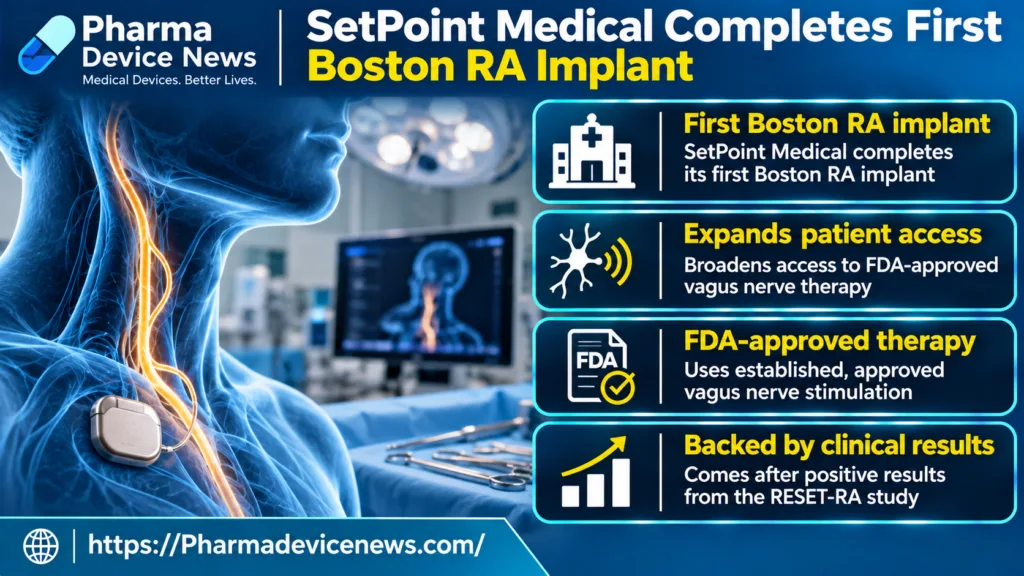
SetPoint Medical has announced the first implantation of its FDA-approved SetPoint System at Beth Israel Deaconess Medical Center in Boston, expanding access to an implantable neurostimulation treatment for adults with moderately to severely active rheumatoid arthritis. Announced on October 28, 2026, the procedure was performed by Joshua P. Aronson, a functional neurosurgeon at the Boston medical centre, marking another step in the commercial rollout of the device across the United States.
The SetPoint System received US Food and Drug Administration approval in July 2025 for adults whose rheumatoid arthritis has responded inadequately to, lost response to, or proved intolerant of at least one biologic or targeted synthetic disease-modifying antirheumatic drug. Unlike medicines designed to suppress or modify inflammatory pathways through pharmacological mechanisms, the implant delivers electrical stimulation to the left vagus nerve to engage the body’s inflammatory regulatory processes.
The Boston procedure represents an expansion of clinical availability rather than a new regulatory approval or demonstration of additional efficacy. SetPoint Medical has not disclosed the treated patient’s outcomes, and the first local implantation does not establish how effectively the device will perform across a broader New England population. Its commercial significance will depend on sustained patient access, appropriate clinical selection, procedural capacity and reimbursement arrangements.
Why is the first SetPoint System procedure in Boston an important milestone for rheumatoid arthritis treatment access?
The introduction of SetPoint Therapy at Beth Israel Deaconess Medical Center adds another specialist treatment location to the device manufacturer’s expanding US network. Boston is an important academic healthcare market with established rheumatology and neurosurgical services, making it a relevant setting for evaluating the practical delivery of implantable neuroimmune modulation. The procedure demonstrates that the institution has begun offering the technology to appropriately selected patients.
The SetPoint System requires collaboration between rheumatologists and clinicians trained in implantation and device management. Rheumatologists assess disease activity, previous treatment responses and suitability for the approved indication, while surgical specialists perform the implantation procedure. Continued follow-up is required to monitor treatment response and device-related considerations.
Aronson performed the first procedure at Beth Israel Deaconess Medical Center, while rheumatologist Brian J. Stout was involved in introducing the therapy within the hospital’s clinical programme. The physicians have characterised neuroimmune modulation as an additional option for patients whose disease remains inadequately controlled despite previous targeted medicines. Their assessment reflects the device’s distinct mechanism rather than evidence that it should replace existing first-line treatments.
Murthy V. Simhambhatla, president and chief executive officer of SetPoint Medical, has positioned the Boston milestone within the company’s broader national access strategy. Management is working with hospitals, rheumatology practices and neurosurgical teams to establish additional treatment locations. However, the company has not disclosed the number of patients expected to receive therapy through Beth Israel Deaconess Medical Center or a timetable for further expansion in New England.
The immediate operational achievement is the establishment of a new implantation site. Wider adoption will depend on whether the hospital can identify suitable patients, coordinate specialist assessment and provide ongoing device management within an economically sustainable care pathway.
How does the SetPoint System use vagus nerve stimulation to influence inflammation in rheumatoid arthritis?
Rheumatoid arthritis is a chronic autoimmune disease in which immune-mediated inflammation affects joints and can cause progressive damage, pain and reduced physical function. Current treatment strategies generally focus on controlling disease activity through conventional, biologic and targeted synthetic disease-modifying antirheumatic drugs. Although these medicines can be effective, some patients experience inadequate responses, treatment-related adverse effects or loss of benefit over time.
SetPoint Medical’s approach is based on the relationship between the nervous system and immune regulation. The vagus nerve forms part of a network involved in communication between the brain and multiple organs, including processes associated with inflammatory signalling. Research into the inflammatory reflex has identified mechanisms through which neural activity can influence immune responses.
The SetPoint System is designed to deliver electrical stimulation to the left vagus nerve in the neck. This stimulation is intended to activate endogenous anti-inflammatory pathways that may reduce rheumatoid arthritis disease activity. The therapeutic mechanism therefore differs from drugs that directly inhibit specific inflammatory molecules or immune-cell functions.
The implant delivers stimulation for one minute each day, using treatment parameters programmed by the clinical team. According to the FDA’s device documentation, the system includes an implanted stimulator, an external charger and programming equipment used by authorised healthcare professionals. The implanted component is approximately 2.5 centimetres long and weighs about three grams.
The mechanism provides a scientifically established rationale for investigating neuromodulation as a rheumatoid arthritis treatment. However, activation of an anti-inflammatory pathway does not automatically establish the magnitude of clinical benefit in an individual patient. That question is addressed through controlled clinical evidence rather than the biological mechanism alone.
What did the pivotal RESET-RA trial demonstrate about the effectiveness of SetPoint Therapy?
The FDA’s approval was supported by the RESET-RA pivotal study, a randomised, double-blind, sham-controlled investigation conducted across 41 US clinical sites. The trial enrolled 242 adults with moderately to severely active rheumatoid arthritis who had experienced inadequate response, loss of response or intolerance to at least one biologic or targeted synthetic disease-modifying antirheumatic drug. All participants received the implanted device before being randomised to active stimulation or a non-active control condition.
The primary effectiveness endpoint evaluated the proportion of patients achieving an ACR20 response after 12 weeks. ACR20 is a standard rheumatoid arthritis outcome measure requiring at least 20% improvement in tender and swollen joint counts, together with improvement in additional disease-related assessments. It is widely used to evaluate treatment effects in inflammatory arthritis studies.
In the active treatment group, 43 of 122 participants achieved an ACR20 response, corresponding to 35.2%. The sham-control group recorded responses in 29 of 120 participants, or 24.2%. The absolute difference was approximately 11 percentage points, and the comparison met statistical significance with a p-value of 0.0209.
These results provide controlled evidence that active vagus nerve stimulation improved the primary response measure compared with sham treatment during the initial blinded period. However, a statistically significant difference does not mean that the intervention was effective for every patient. Most actively treated participants did not meet the ACR20 response threshold at 12 weeks.
The size of the treatment effect is important when evaluating clinical positioning. SetPoint Therapy provides a different therapeutic mechanism, but the trial does not establish superiority over biologic or targeted synthetic medicines. Its clinical value must be assessed within the approved treatment population and in relation to the benefits and risks of device implantation.
Why are the longer-term RESET-RA results important for evaluating implantable rheumatoid arthritis treatment?
After the initial 12-week blinded period, participants assigned to the sham-control group crossed over to active stimulation. The trial then continued with open-label follow-up intended to evaluate longer-term effectiveness and safety. This design allowed researchers to gather additional treatment experience, although the absence of a continuing untreated control group limits later comparative conclusions.
The FDA’s assessment reported that treatment responses increased during follow-up. Across participants receiving active stimulation after crossover, the ACR20 response rate among those completing the relevant assessment reached approximately 52.8% at week 48. The findings suggest that some patients may experience improvement beyond the initial three-month observation period.
However, the week 48 response rate should not be interpreted as a randomised comparison against sham treatment. All participants had access to active stimulation by that stage, and the reported analysis involved patients who completed follow-up. Changes in concurrent treatment, patient selection and other factors can influence longer-term outcomes.
The FDA documentation also reported high treatment persistence during the first year of follow-up. Approximately 97.5% of participants remained on SetPoint Therapy at week 48, while around one-quarter had added a biologic or targeted synthetic disease-modifying medicine. This provides information about treatment continuation but does not establish that the implant permanently eliminates the need for pharmaceutical therapy.
Longer-term observation remains important because rheumatoid arthritis is a chronic disease requiring sustained control of inflammation. Patients and clinicians need to understand whether symptom improvements persist, whether medication requirements change and whether structural joint damage can be adequately controlled. The current evidence supports continued evaluation without establishing that device treatment prevents every long-term complication of rheumatoid arthritis.
What safety risks must patients and clinicians consider before SetPoint System implantation?
The SetPoint System introduces procedural and device-related risks that differ from those associated with oral or injectable medicines. Implantation involves surgery in the neck near the left vagus nerve, creating potential complications involving anaesthesia, surrounding tissues and nerve function. Patients may experience pain, bruising, swelling, coughing, throat irritation or voice changes following the procedure.
The pivotal RESET-RA study provided important safety information. According to the FDA’s summary of safety and effectiveness, serious adverse device effects occurred in 1.6% of the 242 implanted participants. These events were associated with implantation procedures and resolved, with no serious adverse device effects attributed directly to stimulation or the device itself during the evaluated period.
The FDA also reviewed technical issues involving charging, programming and certain procedural deviations. These findings highlight the importance of operator training and adherence to the device’s instructions for use. Even when a device has demonstrated an acceptable benefit-risk profile for approval, its safety depends partly on correct implantation and subsequent management.
Long-term treatment introduces additional considerations. The FDA’s review documented device removal in 14 of the 242 implanted participants during extended follow-up, representing 5.8% of the study population. Reasons and circumstances surrounding removal are relevant to understanding long-term device management and should not be ignored when evaluating treatment persistence.
The system also has specific contraindications. It should not be used in patients who have undergone vagotomy or splenectomy, and clinicians must assess whether the patient can safely undergo surgery and use the device. Compatibility with certain other implanted medical devices and imaging procedures requires appropriate review.
These requirements make patient selection an important part of treatment delivery. An implantable intervention may avoid some medication-related adverse effects, but it introduces its own safety and operational responsibilities. The decision to use the technology must therefore reflect the complete benefit-risk profile rather than the absence of a conventional drug mechanism.
How does SetPoint Therapy differ from biologic and targeted synthetic rheumatoid arthritis treatments?
Biologic disease-modifying antirheumatic drugs have expanded rheumatoid arthritis treatment by targeting specific components of immune signalling. These include therapies directed against tumour necrosis factor, interleukin-6 pathways, B-cell activity and other immune mechanisms. Targeted synthetic medicines, including Janus kinase inhibitors, provide additional treatment options through intracellular signalling pathways.
Despite these advances, some patients experience persistent disease activity or cannot continue particular treatments because of adverse effects. Others may lose their initial response over time, requiring treatment changes. The approved SetPoint indication addresses adults who have already experienced inadequate response, loss of response or intolerance involving at least one biologic or targeted synthetic therapy.
The device offers a mechanistically different option by modulating neural pathways associated with inflammatory regulation. Its proposed advantage is not based on binding a specific inflammatory cytokine or directly suppressing one immune-cell population. Instead, the therapy seeks to influence endogenous immune regulation through electrical stimulation.
However, mechanism alone does not establish a broader safety advantage. Approved medicines have extensive clinical evidence supporting their use in defined populations, while SetPoint Therapy has its own implantation risks and clinical response limitations. The pivotal trial also does not provide a direct comparison showing that the device is more effective than switching to another biologic treatment.
The practical role of the system will therefore depend on treatment sequencing. Rheumatologists must determine which patients are most likely to benefit after previous therapies have failed or become unsuitable. Additional real-world evidence could help clarify the characteristics associated with favourable responses.
SetPoint Therapy should not be described as a universal replacement for disease-modifying medicines. Its FDA-approved indication is specific, and patients may continue receiving other rheumatoid arthritis treatments according to clinical circumstances. The device adds a therapeutic option within a complex treatment pathway rather than eliminating the need for pharmaceutical care.
Why could the requirement for specialist implantation influence hospital adoption and treatment access?
Unlike a conventional prescription medicine, the SetPoint System requires an organised procedural pathway before treatment can begin. Patients must undergo assessment by clinicians familiar with rheumatoid arthritis and the device’s indication, followed by a surgical evaluation. The implantation itself requires appropriately trained personnel and access to suitable facilities.
This creates an adoption challenge for healthcare systems because rheumatology services and neurosurgical departments do not always operate within closely integrated clinical pathways. Hospitals may need to establish referral protocols, define responsibilities for follow-up and coordinate device programming. The first Boston procedure indicates that Beth Israel Deaconess Medical Center has begun implementing such a pathway.
The procedure is performed on an outpatient basis for appropriately selected patients, according to SetPoint Medical. However, outpatient delivery does not eliminate the need for preoperative assessment, anaesthesia planning and postoperative monitoring. Patients must also understand how to use the external charging system and comply with ongoing device management requirements.
The FDA documentation describes a charger that is worn around the neck and typically used once weekly for approximately 10 minutes. Treatment stimulation itself is programmed to occur automatically for one minute each day. These requirements differ from repeated medication administration but still create ongoing responsibilities for patients.
Hospital adoption will depend partly on how efficiently these processes can be delivered. A treatment centre must consider the number of eligible patients, procedure scheduling, specialist training and follow-up capacity. The availability of an approved device does not automatically mean every rheumatology practice can offer it.
For SetPoint Medical, expanding access requires building clinical infrastructure as well as generating demand. The Boston procedure provides evidence of another operational treatment site, but sustained utilisation will depend on whether the hospital can establish a repeatable and clinically appropriate service.
How will insurance coverage and reimbursement determine the commercial prospects of SetPoint Therapy?
FDA approval allows the SetPoint System to be marketed for its authorised indication, but regulatory approval is distinct from reimbursement. Insurers and healthcare organisations must determine how device implantation, the implant itself and subsequent clinical management will be covered and paid for. These decisions can influence whether eligible patients can access treatment without substantial financial barriers.
The commercial model differs from that of a conventional medicine because the principal costs may include the implant, surgical procedure and associated care. Follow-up visits, device programming and technical support can introduce additional resource requirements. Hospitals will need to assess these expenses alongside potential clinical benefits.
Payers may examine the treatment’s effectiveness in patients who have experienced inadequate responses to existing therapies. The pivotal trial provides randomised evidence supporting the approved indication, but insurers may also consider longer-term outcomes and the costs associated with implantation. The availability of established alternative medicines could influence coverage policies.
Real-world evidence may therefore become increasingly important. Health systems will want to understand treatment persistence, changes in disease activity, use of additional medicines and the occurrence of device-related complications. These outcomes could help determine whether the technology provides sufficient value relative to its total cost.
The Boston announcement does not disclose reimbursement rates, the number of insurers providing coverage or the financial arrangements associated with the first procedure. It would therefore be premature to assume that the local implantation establishes broad insurance access throughout New England. Actual patient availability may differ according to individual coverage arrangements and clinical eligibility.
Could neuroimmune modulation eventually extend beyond rheumatoid arthritis into other autoimmune diseases?
SetPoint Medical is investigating the broader potential of its neurostimulation platform for conditions involving immune-mediated inflammation. The company has identified Crohn’s disease and multiple sclerosis among possible future areas of evaluation. These programmes reflect interest in applying neural regulation of inflammatory pathways beyond rheumatoid arthritis.
The biological rationale is plausible because inflammatory signalling contributes to several autoimmune conditions. However, different diseases involve distinct tissues, immune mechanisms and clinical outcomes. Evidence supporting vagus nerve stimulation in rheumatoid arthritis cannot automatically establish effectiveness in gastrointestinal or neurological disorders.
Any additional indication would require an appropriate clinical development programme. Researchers would need to identify relevant patient populations, treatment parameters and meaningful endpoints. Safety considerations could also differ according to the underlying disease and the characteristics of affected patients.
Regulatory authorisation would remain indication-specific. The current FDA approval applies to the defined adult rheumatoid arthritis population and does not permit the company to market the system generally for Crohn’s disease, multiple sclerosis or other autoimmune conditions. Potential future uses should therefore remain clearly distinguished from the approved treatment.
The broader platform strategy may create long-term development opportunities, but near-term commercial execution will depend on rheumatoid arthritis adoption. Establishing reliable treatment pathways and generating additional real-world evidence could help inform subsequent expansion decisions.
What does the first Boston procedure mean for SetPoint Medical’s commercial growth strategy?
SetPoint Medical is a privately held, commercial-stage medical technology company developing implantable neuroimmune modulation systems. Its FDA approval in July 2025 established a regulatory foundation for commercial distribution in rheumatoid arthritis. The October 2026 procedure represents continued expansion of access through additional US clinical institutions.
The company has already announced treatment programmes in other US regions, indicating a gradual rollout involving rheumatologists, surgeons and healthcare systems. This approach reflects the specialist infrastructure required for implantation and ongoing patient management. It differs from distributing a medicine through conventional pharmacy channels.
Beth Israel Deaconess Medical Center adds an academically established hospital to that network. The involvement of specialist rheumatology and neurosurgical clinicians may support appropriate patient assessment and coordination. However, the announcement does not identify a committed number of future implants or provide evidence of a specific commercial revenue contribution.
The pace of expansion will depend on several interacting factors. These include physician familiarity, patient referrals, surgical capacity, reimbursement arrangements and follow-up resources. Wider awareness may increase demand, but actual adoption will be constrained by the number of institutions able to provide the complete treatment pathway.
The clinical evidence also supports a measured commercial outlook. RESET-RA met its primary endpoint, but the absolute ACR20 response difference was approximately 11 percentage points at 12 weeks, and implantation introduces procedural risks. These factors will influence how rheumatologists position the device relative to other available therapies.
For SetPoint Medical, the next indicators of commercial progress will be additional treatment centres, sustained procedure volumes and evidence of longer-term patient benefit. The Boston procedure confirms that an established academic hospital has introduced the technology, but a single implantation does not demonstrate broad adoption or financial success.
The SetPoint System represents a distinctive FDA-approved treatment approach for adults with rheumatoid arthritis who have not responded adequately to certain advanced medicines. Its clinical evidence supports effectiveness in the authorised population, while its commercial expansion depends on specialist delivery and patient access. The longer-term test will be whether routine clinical use reproduces the benefits observed in RESET-RA while maintaining an acceptable safety profile and sustainable treatment infrastructure.