Sight Sciences, Inc. (NASDAQ: SGHT) has secured an updated FDA indication for the TearCare System stating that the thermal-activated gland expression therapy improves meibomian gland function in adults with evaporative dry eye disease caused by meibomian gland dysfunction when used with manual gland expression. Effective August 18, 2026, the revised wording gives Sight Sciences a stronger functional claim than a generic indication for treatment of dry eye symptoms and follows randomized evidence comparing TearCare directly against Allergan’s Restasis cyclosporine ophthalmic emulsion.
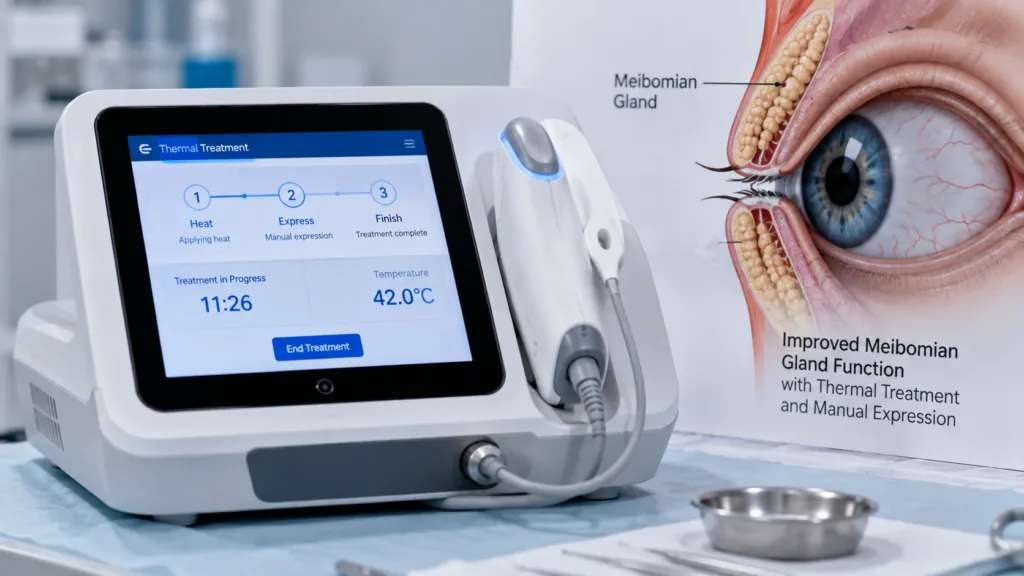
TearCare delivers controlled heat through flexible SmartLids devices placed over the eyelids while allowing the patient to blink, after which a clinician manually expresses the meibomian glands to remove obstructed material. FDA’s updated indication also incorporates optional eyelid debridement into the procedure. Sight Sciences says this makes TearCare the first treatment with an FDA indication specifically stating improvement in meibomian gland function in patients with evaporative dry eye disease due to MGD.
Why does meibomian gland function matter in evaporative dry eye disease?
Meibomian glands produce the lipid layer of the tear film, which slows evaporation of the underlying aqueous tears. When gland openings become obstructed or secretion quality deteriorates, the tear film can become unstable and evaporate more rapidly, producing burning, fluctuating vision, irritation and other symptoms associated with dry eye.
Many therapies primarily attempt to supplement tears or reduce ocular-surface inflammation. TearCare instead targets obstructed glands mechanically by heating their secretions and expressing the contents, attempting to improve the physiological source of the tear-film lipid layer rather than merely adding an external lubricant.
This does not mean all dry eye disease is caused by MGD or that TearCare is appropriate for every patient. Dry eye can involve aqueous deficiency, inflammation, neurological factors and other pathologies, making patient selection important.
What did the 345-patient SAHARA trial show against Restasis?
SAHARA randomized 345 adults across 19 ophthalmology and optometry practices in 11 US states, with 172 receiving TearCare and 173 receiving twice-daily cyclosporine 0.05% for six months. TearCare patients were treated at baseline and again at month five, while the active-comparator group self-administered Restasis throughout the controlled period.
Tear break-up time improved significantly in both groups but improved more with TearCare, producing a statistically significant between-group difference with a P value of 0.0006. Patient-reported Ocular Surface Disease Index scores improved substantially in both groups without a significant between-treatment difference, meaning TearCare produced stronger improvement on the tear-film stability endpoint while symptom improvement was broadly comparable.
Measures of meibomian gland secretion improved significantly more with TearCare, providing the clinical foundation for the new functional indication. Treatment-related adverse events were uncommon, with eight of the 10 events occurring in the cyclosporine group and nine of the 10 classified as mild.
How durable is an office-based thermal procedure compared with daily eye drops?
The third stage of SAHARA followed 166 TearCare participants beyond the original controlled phase. All evaluated signs and symptoms remained significantly improved from original study baseline across follow-up to 24 months, while 32 patients required an additional treatment. Median time to retreatment was eight months, and the probability of remaining retreatment-free at six months was 92%.
These data are relevant because procedure-based therapy competes partly on freedom from daily adherence. A patient can forget or discontinue eye drops, whereas an office procedure delivers the planned treatment independent of daily behavior. The counterargument is that patients must return periodically for another procedure, and the durability of benefit differs between individuals.
The long-term SAHARA extension was not a continued randomized comparison against Restasis, so the durability findings demonstrate persistence relative to baseline rather than superiority over chronic pharmacological therapy throughout two years.
Does the expanded FDA indication mean TearCare cures meibomian gland dysfunction?
No. MGD is typically chronic, and the need for retreatment in the SAHARA extension illustrates that gland obstruction and dysfunction can recur. The new labeling establishes that the procedure improves gland function under the authorized treatment conditions; it does not imply permanent restoration of every affected gland.
Sight Sciences’ language about addressing an underlying cause should also be interpreted within this context. Improving obstructed gland function is more disease-directed than simply lubricating the eye, but MGD can be influenced by anatomy, inflammation, age, medications and other factors that one thermal procedure cannot eliminate permanently.
The clinically useful question is whether periodic gland-directed intervention produces sufficiently durable improvement in signs and symptoms to justify the cost and procedure relative to drops, home heat therapy or competing office-based systems.
Why could the new claim matter commercially?
Medical-device adoption is heavily influenced by labeling because the authorized indication shapes how physicians communicate the procedure and how companies differentiate products. A claim specifically tied to improving gland function gives Sight Sciences a stronger clinical narrative than simply saying TearCare heats eyelids or helps treat dry eye.
It also aligns closely with the randomized evidence. SAHARA did not merely show symptom improvement; it demonstrated superior gains in multiple measures of meibomian gland secretion compared with cyclosporine, while symptom outcomes were comparable. The new indication effectively elevates that physiological result into the product’s regulatory positioning.
Competition in dry eye remains intense because physicians can choose artificial tears, prescription anti-inflammatory drugs, thermal systems, intense pulsed light and other procedures. TearCare’s commercial argument increasingly rests on being an office intervention targeted specifically at meibomian gland dysfunction and backed by randomized comparison with a widely used prescription medicine.
FDA’s label update therefore does not transform the underlying technology. It transforms what Sight Sciences is permitted to say the technology accomplishes, and in a crowded procedural category, a regulator-recognized claim of improved physiological gland function can be almost as important commercially as another hardware generation.