AbelZeta Pharma has regained worldwide rights to C-CAR039, now known as prizloncabtagene autoleucel or prizlon-cel, and received US Food and Drug Administration clearance of an Investigational New Drug application to study the dual CD19/CD20 CAR-T therapy in relapsed or refractory large B-cell lymphoma. The August 16 announcement returns development, manufacturing, regulatory, commercialization and partnering control to AbelZeta at the same time the company prepares US development in two strategically different groups: patients receiving third-line or later therapy after relapse following previous CAR-T and second-line patients who have not yet received CAR-T.
The programme is supported by long-term results from early Chinese studies involving 48 patients with relapsed or refractory B-cell non-Hodgkin lymphoma. AbelZeta reported an overall response rate of 91.5%, complete response rate of 85.1% and median progression-free survival of 60.1 months after median follow-up of 53.9 months. Those figures are unusually durable for an early CAR-T dataset, but they arise from small, non-randomized studies and cannot be assumed to reproduce in the US populations now being discussed with FDA.
Why target both CD19 and CD20 rather than use another conventional CD19 CAR-T?
Most established CAR-T therapies for aggressive B-cell lymphoma target CD19, a surface protein broadly expressed on malignant B cells. The approach can produce deep and durable remissions, but some tumors relapse after losing or reducing CD19 expression, allowing the cancer to escape immune recognition even though the engineered T cells remain capable of killing cells carrying the original target.
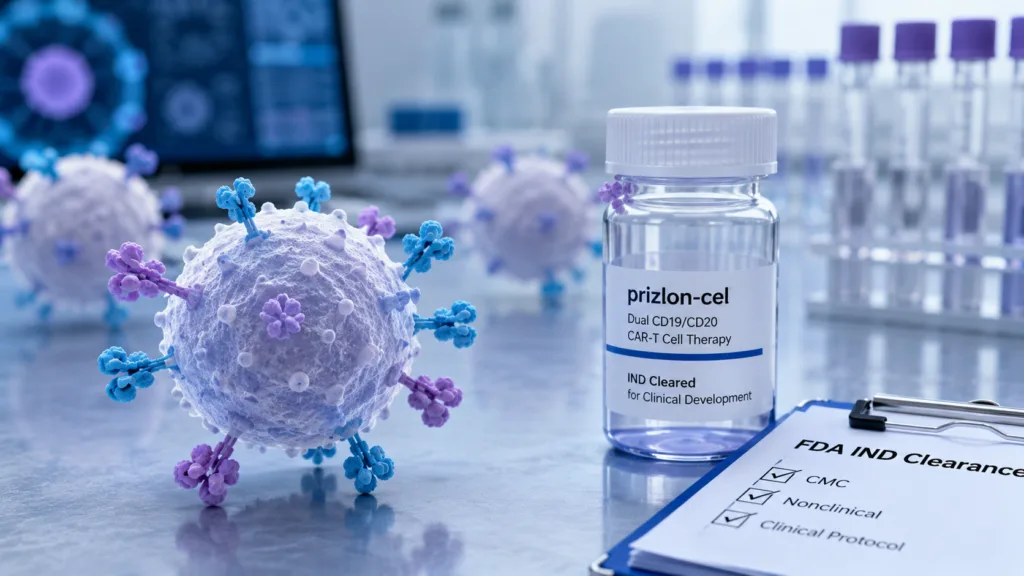
Prizlon-cel is designed to recognize both CD19 and CD20, theoretically making it more difficult for a malignant clone to escape by losing only one antigen. A cancer cell that downregulates CD19 may remain visible through CD20, while a cell with altered CD20 expression may still be recognized through CD19.
Dual targeting does not guarantee prevention of relapse because tumors can escape through multiple biological mechanisms including poor CAR-T persistence, suppressive microenvironment and loss of both targets. The approach nevertheless provides a plausible rationale for studying prizlon-cel specifically after failure of another CAR-T product.
What do the 48-patient Chinese results actually establish?
The 91.5% objective response and 85.1% complete-response rates indicate that most evaluable patients experienced substantial tumor reduction in the early studies, while median progression-free survival of 60.1 months suggests prolonged disease control in a meaningful proportion. Long-term follow-up is particularly valuable in CAR-T because an initial complete response matters most when it is maintained rather than followed rapidly by another relapse.
However, early single-arm trials can produce stronger results than later multicenter development because patient selection, manufacturing consistency and investigator experience may differ. The 48-patient analysis also included relapsed or refractory B-cell non-Hodgkin lymphoma more broadly rather than perfectly matching every population AbelZeta intends to pursue in the United States.
The US IND clearance therefore begins a new evidentiary chapter. FDA is allowing clinical testing to proceed; it has not determined that the historical data demonstrate efficacy for a US indication.
Why could post-CAR-T large B-cell lymphoma become the most differentiated opportunity?
As CAR-T moves earlier into large B-cell lymphoma, the number of patients eventually relapsing after one CAR-T product will also grow. Treatment after CAR-T failure remains challenging because the disease has already demonstrated resistance to multiple therapeutic mechanisms and because the biological reasons for failure vary between patients.
A second CAR-T might appear counterintuitive, particularly if both products rely on similar manufacturing and T-cell biology. The dual CD19/CD20 design gives AbelZeta a mechanistic argument that prizlon-cel is not simply another version of the same therapy, especially in patients whose relapse involves antigen escape.
The company says it is working with FDA to finalize protocols in third-line or later patients previously treated with CAR-T and in second-line CAR-T-naïve patients. These groups address different commercial questions: the first tests whether dual targeting can rescue patients after another cellular therapy fails, while the second tests whether prizlon-cel can compete against already established CAR-T products earlier in treatment.
Why does regaining global rights matter just as the US IND clears?
AbelZeta regained all development and commercial rights in July 2026, giving the company complete control over trial design, manufacturing strategy, partnering and eventual commercialization. Reacquiring an asset can be particularly consequential in cell therapy because manufacturing is inseparable from the product: differences in cell collection, processing, expansion, quality release and treatment logistics can directly affect clinical execution.
AbelZeta operates its own GMP cell-therapy facilities in Rockville, Maryland and Shanghai, which could give it greater control over the development chain as prizlon-cel moves between Chinese and US programmes.
Full rights also create financing risk because AbelZeta must shoulder more of the development expense unless it subsequently forms another partnership. A globally controlled late-stage CAR-T programme can be strategically valuable, but multicenter trials and commercial manufacturing require substantial capital.
What evidence would make prizlon-cel genuinely competitive with existing CAR-T therapies?
The next US dataset needs to show more than a high response rate. Investigators will need to establish manufacturing success, time from leukapheresis to infusion, severe cytokine release syndrome, neurological toxicity, infection, cytopenias and treatment-related mortality alongside response durability.
For patients previously exposed to CAR-T, researchers will also need to understand why the earlier therapy failed and whether response correlates with retention or loss of CD19 and CD20. Demonstrating substantial activity specifically in patients with documented antigen escape would provide stronger mechanistic validation for dual targeting than responses in an unselected relapse population.
For second-line CAR-T-naïve disease, the bar is even higher because approved products already have randomized evidence supporting use. A new entrant would need differentiation in efficacy, safety, manufacturing reliability or patient access rather than simply showing that another CAR-T can produce remissions.
Prizlon-cel begins US development with a better foundation than many first-in-human cell therapies: dozens of treated patients and follow-up extending beyond four years. The challenge is now to convert an impressive early Chinese dataset into evidence that survives broader prospective testing and demonstrates exactly where a dual CD19/CD20 CAR-T provides an advantage in an increasingly mature cellular-therapy market.