For most of modern pharmaceutical development, small-molecule drugs have worked by finding a useful pocket on a disease-associated protein, binding to it and preventing that protein from performing some harmful function. Targeted protein degradation changes the objective. Instead of continuously occupying a protein strongly enough to inhibit it, a degrader can bring that protein into proximity with the cell’s own disposal machinery, mark it for destruction and allow the drug molecule to move on to another target. The conceptual shift from occupancy-driven pharmacology to event-driven degradation has created one of biotechnology’s most heavily financed drug-development fields and, after more than two decades of research, has now crossed a major regulatory threshold.
On May 1, 2026, the US Food and Drug Administration approved vepdegestrant, marketed as Veppanu, for certain adults with ESR1-mutated, estrogen receptor-positive, HER2-negative advanced or metastatic breast cancer. FDA describes vepdegestrant as a heterobifunctional protein degrader, and Nature Reviews Drug Discovery characterized the decision as the first FDA approval of a PROTAC. In the ESR1-mutated population of the randomized VERITAC-2 trial, median progression-free survival was five months with vepdegestrant versus 2.1 months with fulvestrant, corresponding to a hazard ratio of 0.57. The approval does not prove that every degrader architecture will work, but it converts PROTACs from a promising experimental modality into a drug class with human regulatory validation.
How does a PROTAC destroy a protein instead of merely blocking it?
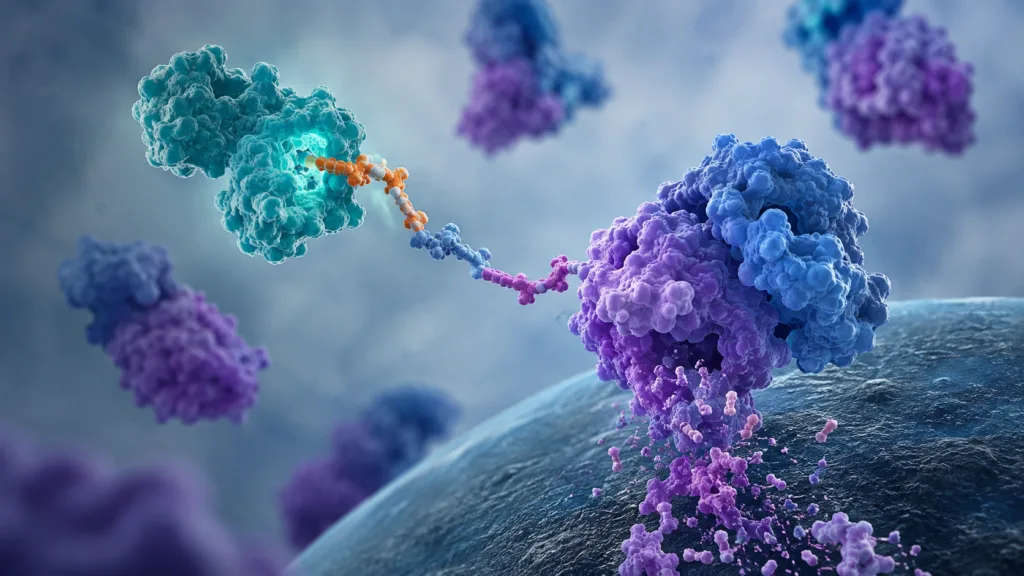
A conventional inhibitor usually requires a binding site that directly controls an important function of the target protein. If a protein has no suitable enzymatic pocket, or if blocking that pocket does not disable the full biological activity of the molecule, medicinal chemists can struggle to develop an effective inhibitor. PROTACs approach the problem differently by using a bifunctional structure containing one component that binds the target protein and another that binds an E3 ubiquitin ligase, connected by a chemical linker. Bringing the two proteins together allows the ligase machinery to attach ubiquitin signals to the target, directing it toward degradation by the proteasome.
The drug does not necessarily need to remain attached while the target stays suppressed. Once degradation has been triggered, the degrader can theoretically disengage and participate in another degradation event, creating catalytic-like pharmacology in which transient binding produces a longer-lasting biological consequence. This is one of the reasons the field uses the term event-driven pharmacology: the therapeutically important event is destruction of the target rather than continuous drug occupancy of a functional site.
This can potentially broaden what is considered druggable. A degrader does still need to bind the disease protein somewhere, but that binding site does not necessarily have to be the protein’s active site. It may therefore be possible to eliminate proteins that have historically resisted conventional inhibition because their surfaces lack deep drug-binding pockets or because disease activity depends on scaffolding and protein-protein interactions rather than one easily inhibited enzymatic function.
What is the difference between a PROTAC and a molecular glue?
PROTACs are typically larger bifunctional molecules explicitly built with one end recognizing the target and the other recruiting an E3 ligase. Molecular glues are generally smaller molecules that alter or stabilize an interaction between two proteins, effectively causing proteins that would not normally bind strongly to come together. When one of those partners is part of the ubiquitin machinery, the newly created interaction can cause degradation of another protein.
The distinction matters for drug design. PROTACs give chemists a modular framework because the target-binding component, ligase recruiter and linker can all be changed, but their relatively large molecular size can make oral absorption, cellular penetration and pharmacokinetics challenging. Molecular glues may possess more conventional drug-like properties, yet they can be harder to discover rationally because a small structural change may completely alter which protein interaction the molecule induces.
Increasing structural and computational understanding is beginning to narrow that discovery gap. Researchers are mapping the surfaces that allow molecular glues to stabilize novel protein interactions and developing methods intended to move glue discovery away from serendipity toward more predictable design. If that succeeds, molecular glues could eventually expand induced-proximity pharmacology beyond the relatively small group of protein interactions discovered historically by chance.
Why was estrogen receptor degradation a logical first clinical proving ground?
The estrogen receptor is already a clinically validated target in hormone-sensitive breast cancer, and medicine has decades of evidence showing that reducing estrogen-receptor signaling can slow tumor growth. Drugs such as fulvestrant also established that degrading the receptor itself can be therapeutically useful, giving PROTAC developers a biological target where the central uncertainty concerned the degradation technology rather than whether estrogen receptor mattered in breast cancer.
Vepdegestrant was designed to recruit an E3 ligase to estrogen receptor and induce its degradation. FDA restricted the initial indication to tumors carrying ESR1 mutations detected through an FDA-authorized test because VERITAC-2 showed clear benefit in that biomarker-selected group, whereas FDA’s multidisciplinary review noted that the trial did not meet its prespecified efficacy threshold across the complete intent-to-treat population and exploratory analyses suggested no benefit in patients without detected ESR1 mutations.
That result offers an important lesson for the entire degrader field. A novel modality does not erase tumor biology. Even when protein degradation works pharmacologically, patient selection can determine whether removing the target translates into meaningful clinical benefit.
Can degraders overcome resistance to conventional inhibitors?
Potentially, but only in certain situations. Resistance to conventional targeted therapy can develop when mutations change a drug-binding pocket, when the target protein remains active through nonenzymatic functions or when higher target concentrations overwhelm the inhibitor. Degrading the complete protein could theoretically bypass some of those mechanisms by removing both enzymatic and structural functions instead of trying to block one activity.
Resistance can also develop against degraders themselves. The tumor may alter the target-binding site, reduce expression or function of the recruited E3 ligase, modify ubiquitination pathways or change downstream signaling so that loss of the target is no longer sufficient. A degrader therefore does not make resistance disappear; it creates a different evolutionary pressure and consequently a different collection of potential resistance mechanisms.
The choice of E3 ligase creates another constraint. Human cells contain hundreds of E3 ligases, but much of current degrader development relies on only a relatively small subset, particularly cereblon and von Hippel-Lindau protein. Expanding the usable ligase repertoire could allow researchers to exploit tissue-specific expression and design degraders that operate preferentially in particular organs or disease contexts.
Why does targeted protein degradation create new safety questions?
Removing a protein can produce deeper and longer biological effects than partially inhibiting it, which can be advantageous therapeutically but increases the importance of understanding what that protein does in healthy cells. A degrader that eliminates too much target from normal tissue could produce toxicity even when the same target is highly desirable in diseased cells.
Cereblon-recruiting degraders create additional considerations because cereblon itself has a well-established biology involving degradation of multiple endogenous proteins. A 2026 Nature Reviews Drug Discovery perspective highlighted the need to evaluate intended and unintended neosubstrates, developmental toxicity and other risks when designing cereblon-recruiting molecular glues and PROTACs. The lesson is that the safety problem involves not only where the degrader binds, but also which proteins the recruited degradation machinery may unexpectedly eliminate.
This makes proteomic profiling unusually important. Traditional pharmacology asks which receptors or enzymes a molecule binds. Degrader development must additionally ask which proteins disappear after exposure, including proteins that may never have been identified as conventional binding partners.
Can targeted degradation extend outside intracellular proteins?
The field is already attempting to do so. Classical PROTACs exploit the ubiquitin-proteasome system and are therefore naturally suited to proteins accessible within cells. Newer approaches are being designed around lysosomal and autophagy pathways to remove membrane proteins, extracellular proteins, damaged organelles and other biological material beyond the reach of conventional PROTAC architecture.
Antibody-based degraders have also entered clinical development. These biologic constructs aim to bind extracellular or cell-surface disease proteins and redirect them toward cellular pathways that internalize and destroy them. Nature Reviews Drug Discovery reported in 2026 that several biologic degradation programmes had moved into clinical testing, illustrating how the original concept of induced proximity is becoming broader than one small-molecule technology.
The long-term opportunity may therefore be larger than the PROTAC acronym implies. Drug developers are increasingly treating induced proximity as a general pharmacological principle: bring two biological components together that ordinarily do not interact strongly, then use the resulting interaction to trigger degradation, inhibition, stabilization or another therapeutically useful cellular event.
What does the first FDA-approved PROTAC really prove?
Vepdegestrant proves that a heterobifunctional degrader can be formulated as an oral medicine, achieve sufficient systemic exposure, degrade a clinically meaningful target and produce randomized efficacy convincing enough for FDA approval in an appropriately selected population. That resolves several questions that remained theoretical when the first PROTAC concept was published in 2001.
It does not prove that degradation is inherently superior to inhibition or that historically undruggable targets will suddenly become easy pharmaceutical programmes. Vepdegestrant attacks one of oncology’s most thoroughly validated targets, and its approval emerged in a biomarker-defined subgroup rather than the complete randomized population.
The more consequential phase of targeted protein degradation therefore begins after its first approval. The field now has to demonstrate that induced degradation can do what conventional pharmacology genuinely cannot: drug proteins without useful inhibitory pockets, overcome clinically important resistance mechanisms, create tissue-selective pharmacology and extend controlled degradation into membrane and extracellular disease biology. Success on those harder targets will determine whether protein degradation becomes another important drug class or a fundamental expansion of what medicine considers druggable.