Continuous glucose monitors were developed to solve a serious medical problem: giving people with diabetes a far more complete view of glucose than intermittent finger-stick measurements could provide. Sensors now record interstitial glucose around the clock, show direction and rate of change and can warn insulin-treated patients about dangerous excursions. The technology has since moved rapidly outside intensive diabetes management, culminating in FDA clearance of over-the-counter systems that can be purchased without a prescription and, in some cases, are explicitly intended for adults without diabetes who want to understand how food and exercise affect glucose.
That regulatory expansion has created a new consumer-health question: if continuous glucose data are valuable for diabetes, should people without diabetes also monitor themselves? The answer is more complicated than the commercial momentum suggests. A 2026 systematic review covering 23 studies and 1,074 non-diabetic participants found evidence of improvement in mean glucose in pooled analyses, but no significant improvement in body mass index, while the underlying studies varied widely in populations, interventions and objectives. The evidence suggests CGMs can provide useful behavioral feedback, but it does not establish that every healthy person benefits clinically from wearing one.
What does a continuous glucose monitor actually measure?
Most current CGMs use a small sensor filament inserted into the subcutaneous tissue. The device measures glucose in interstitial fluid rather than directly sampling blood, with software translating the electrochemical signal into estimated glucose concentrations and trends.
Because glucose must move between blood and interstitial fluid, sensor readings can lag behind rapid blood-glucose changes. Algorithms compensate for much of this difference, but users should not assume that every momentary number is identical to a laboratory plasma-glucose measurement.
For people receiving insulin, that continuous stream can be clinically transformative because dosing decisions and hypoglycemia prevention depend on understanding direction as well as absolute concentration. For a person without diabetes, the interpretation is less straightforward because brief post-meal rises are normal physiology rather than evidence of disease.
Why did FDA allow an OTC CGM for people without diabetes?
FDA cleared Dexcom’s Stelo system in 2024 as the first over-the-counter CGM, initially for adults aged 18 and older who do not use insulin. The authorized population included people with diabetes managed without insulin and people without diabetes interested in understanding how diet and exercise affect glucose. The system was specifically not intended for people with problematic hypoglycemia because it was not designed to provide the type of low-glucose alerts required for that higher-risk use.
FDA subsequently expanded OTC CGM access further, including pediatric use of Stelo in 2026 for qualifying non-insulin users aged two years and older. Abbott has also obtained clearance for OTC glucose-monitoring systems, illustrating how a category once centered on prescription diabetes management has evolved toward broader consumer access.
Clearance means the devices have met regulatory requirements for their authorized uses. It does not mean FDA has concluded that wearing a CGM causes weight loss, prevents diabetes in healthy people or improves longevity.
Can glucose feedback change the way people eat?
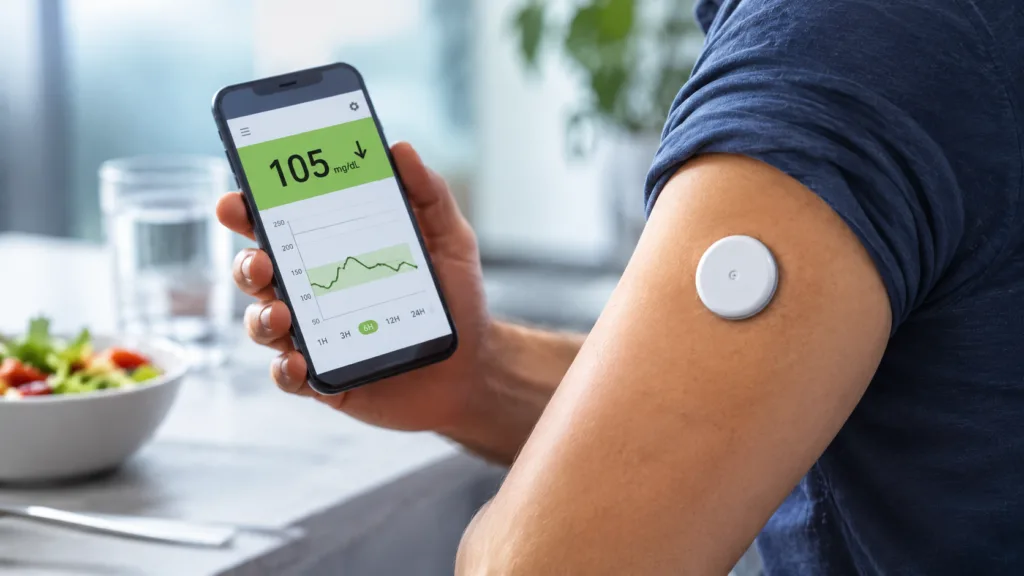
This is probably the most plausible benefit outside established diabetes treatment. A person can eat two meals containing similar calorie counts and observe very different glucose responses, making the metabolic consequences of food composition, portion size, timing and exercise more visible than an abstract nutrition label.
Real-time feedback may encourage behavioral experimentation. Someone might notice that walking after a meal reduces a postprandial excursion or that adding protein and fiber changes the glucose curve associated with a carbohydrate-heavy meal.
The difficulty is proving that these observations produce durable improvements once the novelty of wearing a sensor disappears. The 2026 systematic review found that many non-diabetic studies focused on dietary behavior, weight management or metabolic optimization, but the evidence was heterogeneous and BMI did not improve significantly in the pooled analysis.
A CGM can therefore function as a behavioral feedback tool without having proven itself as a weight-loss device.
Are post-meal glucose spikes dangerous in people without diabetes?
Not necessarily. Blood glucose is supposed to rise after eating carbohydrates because glucose has entered the circulation and the pancreas responds by secreting insulin. A transient increase that returns appropriately toward baseline can represent normal physiology.
Consumer interpretation can become problematic when every upward movement is labeled a harmful “spike.” People may begin avoiding nutritionally valuable foods because a sensor displays a temporary rise, even when their overall metabolic health and glucose regulation are normal.
This is particularly important because glucose is only one component of nutrition. A dietary pattern optimized solely to flatten a CGM trace could ignore fiber, micronutrients, cardiovascular effects, overall energy intake and long-term dietary sustainability.
Recent medical reviews have therefore emphasized both the expanding applications of CGM and the uncertainty surrounding widespread use in people without diabetes.
Could too much glucose data create its own health problems?
Continuous measurement can transform ordinary biological variability into hundreds of data points demanding interpretation. For some users, that information can be motivating; for others, it can create anxiety, compulsive food decisions or excessive concern about harmless short-term fluctuations.
Sensors also have measurement error. Pressure on a sensor during sleep can occasionally produce misleading low readings, rapid changes can create discrepancies with blood glucose and normal sensor-to-sensor variation means users should avoid overreacting to isolated numbers.
These issues become particularly relevant when no clinician is involved. OTC access removes an important barrier and gives consumers more autonomy, but it also means people may interpret medical-device data using social-media advice or commercial app scoring systems rather than established clinical thresholds.
Where could CGM use beyond insulin-treated diabetes have the strongest medical case?
People with type 2 diabetes who do not use insulin represent a stronger evidence-based expansion area because glucose remains directly related to a diagnosed disease even when immediate dosing decisions are not required. Continuous data can reveal fasting patterns, postprandial hyperglycemia and the impact of medication or lifestyle changes that occasional finger-stick testing may miss.
Prediabetes and high-risk metabolic populations are another logical research area. A CGM could potentially identify patterns associated with worsening glucose tolerance and provide immediate lifestyle feedback, although demonstrating that sensor use itself prevents progression to diabetes requires prospective outcomes evidence.
The technology may also have research uses in pregnancy, endocrinology, sports physiology and nutritional science, but each application requires its own validation rather than assuming that benefits established in diabetes automatically transfer to a new population.
Will over-the-counter CGMs become ordinary consumer wearables?
The barriers are falling quickly. Sensors are becoming smaller, easier to apply and available without prescriptions, while smartphones already provide the display and computing infrastructure required to interpret thousands of readings.
What remains uncertain is whether glucose becomes another mainstream personal metric like heart rate and step count or remains valuable mainly for people with identifiable metabolic risk. The answer will depend partly on whether future randomized studies demonstrate meaningful improvements in weight, progression to diabetes, cardiovascular risk markers or other clinically important outcomes.
The distinction between information and intervention will remain central. A CGM can show what glucose is doing with extraordinary detail, but data alone do not create better health. For people without diabetes, the most useful question may therefore be less “What did my glucose do after this banana?” and more “Will seeing this information repeatedly change a behavior that matters enough to improve a meaningful health outcome?”
Over-the-counter clearance has effectively settled the access question. The evidence now has to settle the value question.