
Tissium has secured a financing package worth approximately €60 million, or $68 million, as it moves from device development into the more difficult phase of commercialising Coaptium Connect, its FDA-authorised system for repairing severed peripheral nerves without placing sutures through the nerve ends.
The package combines a completed €30 million Series D2 financing with access to as much as €30 million from the European Investment Bank. Tissium plans to use the capital to expand the U.S. commercial rollout of Coaptium Connect, support clinical programmes and extend its programmable polymer platform into hernia repair, cardiovascular reconstruction and other surgical applications.
The financing gives the privately held medical technology company resources to build sales, training, manufacturing and clinical capabilities. It does not remove the central adoption challenge facing Coaptium Connect.
Peripheral nerve microsurgery is technically demanding, but it is also well established. Surgeons will need convincing evidence that a light-activated polymer and bioabsorbable chamber can deliver more consistent nerve alignment, reduce tissue trauma and improve functional recovery without introducing new failure modes.
Tissium has encouraging first-in-human results from a 12-patient digital nerve study. However, the study was small, single arm and limited to relatively short nerve gaps. The company must now prove that early outcomes translate into reliable performance across larger patient populations, varied injuries and routine U.S. surgical practice.
How does Coaptium Connect repair a severed peripheral nerve without conventional sutures?
Peripheral nerves connect the brain and spinal cord with the muscles, skin and internal organs. When a nerve is cut, the two separated ends must be aligned closely enough for regenerating axons to cross the injury and reconnect with their intended targets.
Conventional repair frequently involves microsutures placed through the outer layers of the nerve. The procedure requires magnification, specialist training and precise handling because excessive tension, poor alignment or additional tissue damage can compromise regeneration.
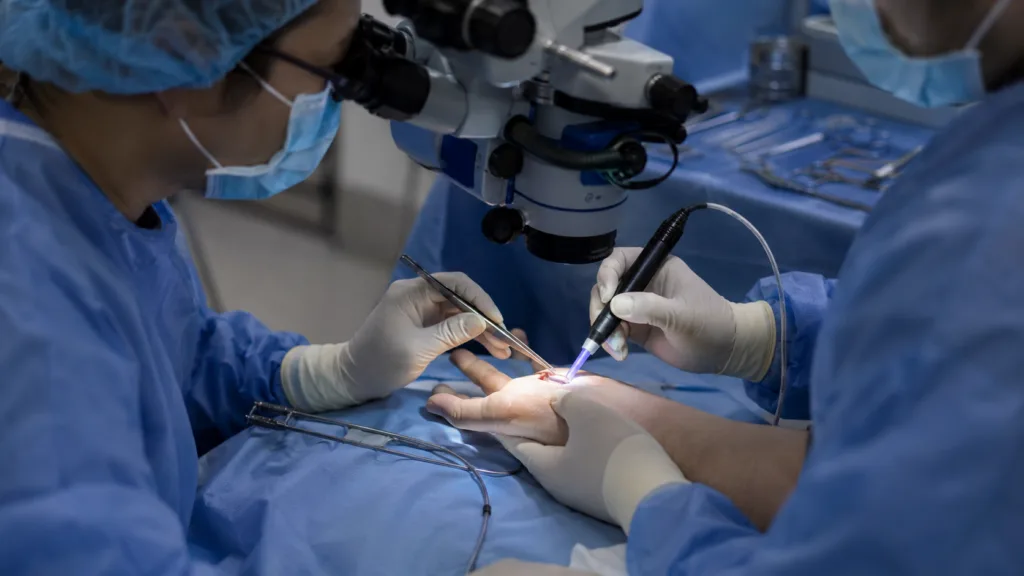
Coaptium Connect uses a different approach. The system includes a flexible, bioabsorbable coaptation chamber positioned around the two nerve ends. A prefilled syringe delivers a photoactive polymer that secures the chamber to the nerve segments.
A reusable light device activates the polymer, causing it to set in place during the procedure. The chamber maintains alignment, separates the repair site from surrounding tissue and creates a protected route through which axons can regenerate.
Both the polymer and chamber are designed to degrade through hydrolysis as healing progresses. The intention is to provide temporary mechanical support without leaving permanent foreign material around the nerve.
The technology does not chemically regenerate the nerve or accelerate axonal growth directly. It creates an environment intended to support the body’s natural repair process while avoiding sutures passing through fragile nerve tissue.
That distinction is important. Coaptium Connect is a surgical repair device rather than a regenerative medicine therapy. Its clinical value will depend on whether the improved handling and reduced tissue penetration lead to better functional outcomes.
Why can microsutures complicate nerve repair even when surgeons perform them correctly?
Microsuture repair remains an effective and widely used technique, but it places considerable technical demands on the surgeon. The nerve ends must be aligned accurately without excessive tension, twisting or compression.
Passing a needle through the nerve’s outer tissue can create additional trauma at a site that is already damaged. Sutures can also produce local inflammation, scar formation and foreign-body responses.
Too few sutures may create an unstable repair. Too many can increase tissue injury and operating time. Even small alignment errors may direct regenerating axons toward the wrong internal pathways, potentially limiting sensory or motor recovery.
The difficulty increases when nerves are small, the surgical field is restricted or the injury involves irregular tissue. Hand and trauma surgeons may also perform nerve repairs under time pressure while managing damage to tendons, blood vessels and surrounding structures.
A sutureless system could simplify alignment and reduce variability between surgeons. It may be particularly valuable in digital nerves, where the structures are small and functional recovery affects sensation, dexterity and the ability to return to work.
However, removing sutures does not remove every surgical challenge. The nerve ends must still be prepared and positioned correctly. The chamber must fit the nerve diameter, and the polymer must be applied consistently without interfering with surrounding tissue.
Coaptium Connect may shift the source of procedural risk rather than eliminate it. Success will depend on device selection, surgeon training, light activation, polymer handling and appropriate patient selection.
What exactly did the FDA authorise Coaptium Connect to treat in the United States?
The FDA granted De Novo authorisation to Coaptium Connect with Tissium Light in June 2025, creating a new Class II category for an in situ polymerising peripheral nerve repair device.
The authorised indication is narrower than the general phrase sutureless nerve repair may suggest. The system is intended for peripheral nerve injuries in which the nerve is no longer continuous and the gap is no greater than one centimetre, or can be reduced to that distance through flexion of the affected extremity.
The device accommodates nerves with diameters of up to six millimetres and is offered in different chamber sizes. It is available only for prescription use by trained healthcare professionals.
This means Coaptium Connect is not currently authorised for every peripheral nerve injury. Larger gaps may require nerve grafts, conduits or other reconstruction techniques. Injuries involving extensive tissue loss, infection or complex branching patterns may also require a different strategy.
The limited indication is commercially relevant because a broad description of peripheral nerve repair could create expectations beyond the actual label. Tissium must focus its initial sales effort on injuries that fit the authorised dimensions and clinical circumstances.
The De Novo pathway is significant because it established a regulatory classification that did not previously exist. Future competing devices may use Coaptium Connect as a reference point, increasing the importance of Tissium building surgeon relationships and clinical experience before the market becomes more crowded.
Did the FDA authorisation rely on the 12-patient human nerve repair study?
The FDA’s De Novo assessment did not rely on a clinical study evaluating the device’s safety and effectiveness in patients. The agency’s public summary states that no clinical studies were reviewed in support of the request.
The authorisation was based substantially on nonclinical evidence, including laboratory, animal and human cadaver testing. These studies assessed mechanical integrity, polymer degradation, biocompatibility, device migration, tissue response and the ability of repaired nerves to demonstrate regeneration and functional recovery.
The FDA concluded that the probable benefits outweighed the probable risks for the defined indication when combined with general and device-specific controls.
This regulatory route should not be misunderstood. De Novo authorisation establishes that the device can be marketed for its intended use under the required controls. It does not mean large comparative trials have shown that Coaptium Connect produces better patient outcomes than microsutures.
The 12-patient first-in-human study was published separately after the regulatory decision. That study provides useful clinical support for the commercial launch, but it should be evaluated according to its own design and limitations rather than treated as the evidentiary basis for the FDA decision.
The distinction matters for hospitals and surgeons assessing the technology. Regulatory authorisation answers whether the device may be marketed. Comparative clinical evidence must answer whether it should become a preferred method of nerve repair.
How convincing are the first-in-human results from digital nerve injuries?
Tissium’s prospective, single-arm study enrolled 12 patients with digital nerve injuries. Ten completed the full one-year follow-up.
Every patient completing follow-up achieved good or excellent static two-point discrimination at six and 12 months. This test evaluates whether a patient can distinguish two nearby points touching the skin and is commonly used to assess sensory recovery after digital nerve repair.
The study also reported full finger flexion and extension, no device-related complications, no neuroma formation detected by ultrasound and no pain among completing patients at 12 months. The median time to return to work was less than six weeks.
These findings are encouraging because they suggest that the device can maintain nerve alignment long enough to support sensory regeneration. The lack of identified neuromas is also relevant because disorganised nerve growth can cause persistent pain and impaired function.
However, the dataset is too small to establish complication rates or comparative superiority. Two participants did not complete the full follow-up, and the study lacked a randomised microsuture control group.
Digital nerve injuries also represent only one part of the peripheral nerve repair market. Results in small sensory nerves within the fingers may not predict outcomes in larger mixed motor and sensory nerves.
The study supports feasibility and justifies broader clinical use. It does not prove that Coaptium Connect consistently produces faster recovery, better sensation or fewer complications than skilled microsurgical repair.
What risks could emerge as more surgeons begin using a light-activated polymer in practice?
The FDA identified several potential risks associated with this new device category, including failed repair, adverse tissue reactions, infection, tissue injury, device failure and user error.
A failed repair could delay nerve regeneration and complicate a second procedure. If the chamber or polymer loses integrity before sufficient healing occurs, nerve alignment could be disrupted.
Incorrect device sizing or application could place unwanted pressure on the nerve. Improper positioning might also create a gap, rotation or tension that compromises axonal growth.
Although the polymer is designed to be biocompatible and bioabsorbable, broader commercial use will provide more information about inflammatory responses, degradation and performance in patients with different medical conditions.
The system also introduces a reusable light source and several procedural components. Hospitals must ensure correct preparation, sterility and activation while training surgeons and operating-room personnel on a workflow that differs from conventional suturing.
Tissium must monitor complaints, device failures, repeat surgeries and functional outcomes closely during the launch. Early post-market transparency will influence whether hospitals treat isolated complications as manageable learning events or evidence that the platform is unreliable.
The most important commercial promise is procedural consistency. If outcomes depend heavily on individual technique or extensive training, the system may struggle to deliver the standardisation that differentiates it from microsutures.
Can Tissium persuade surgeons to change a technique they already understand?
Medical-device adoption frequently depends less on novelty than on workflow. Surgeons tend to change established techniques when a new product produces clear clinical benefits, reduces operating difficulty or improves efficiency without adding substantial cost or risk.
Coaptium Connect may offer several practical advantages. It could reduce the need to pass needles through small nerves, provide more uniform circumferential support and shorten the technically demanding part of the repair.
The system could also make nerve repair more accessible to surgeons with less experience in advanced microsuturing, although it should not be presented as a replacement for specialist judgement.
Adoption will require structured training. Surgeons need experience selecting the correct chamber, preparing nerve ends, applying the polymer and using the activation light.
Hospitals will examine the cost of the disposable device, reusable equipment and training against potential savings from reduced operating time, fewer complications and faster patient recovery.
Tissium has not publicly disclosed pricing or reimbursement economics. These factors will affect whether the system is used routinely or reserved for cases in which conventional suturing is especially difficult.
The company’s U.S. rollout will therefore need more than positive clinical presentations. It must generate hospital-level evidence showing procedural reliability, operating-room efficiency and outcomes that justify acquisition and stocking.
Why does the $68 million financing include both equity capital and milestone-linked European debt?
The financing package gives Tissium access to capital while distributing risk between private investors and the European Investment Bank.
The completed €30 million Series D2 round provides equity capital to support commercial and clinical expansion. The additional European Investment Bank facility is divided into three €10 million tranches linked to commercial, clinical and financing milestones.
Tissium expected to draw the first €10 million tranche by the end of June 2026. Access to later tranches depends on its progress, meaning the entire €60 million should not be treated as immediately available cash.
The structure can reduce the need for repeated equity fundraising if commercial milestones are achieved. It also imposes execution discipline because additional capital is connected to measurable progress.
For the European Investment Bank, the transaction supports medical technology development, manufacturing capacity and skilled employment in Europe while helping a French company expand in the United States.
For Tissium, the funding arrives at a capital-intensive stage. Commercial medtech companies must build inventories, train surgeons, support hospitals, collect post-market evidence and expand manufacturing before sales necessarily cover those investments.
The company must also fund a broader pipeline. Spreading capital across nerve, hernia and cardiovascular programmes could create a valuable platform, but it could also distract management from making Coaptium Connect commercially successful.
Could the same programmable polymer platform work beyond peripheral nerves?
Tissium describes its materials as biomorphic programmable polymers because they are designed to adapt to moving and delicate biological tissues.
The underlying concept has potential beyond nerve coaptation. Surgeons across several specialties need materials that can seal, attach or reconstruct tissue without rigid implants or extensive suturing.
Tissium is developing applications in hernia repair and cardiovascular reconstruction. These markets could be considerably larger than the initial nerve indication, but they also involve different mechanical forces, healing processes and safety requirements.
A polymer that performs well around a small peripheral nerve cannot automatically be assumed to work in the abdominal wall or cardiovascular system. Each application will require its own device design, clinical evidence and regulatory pathway.
The platform strategy nevertheless gives Tissium an important commercial opportunity. A shared polymer chemistry, light-activation system and manufacturing capability could support multiple products while lowering the cost of creating each new programme.
Coaptium Connect is therefore more than a first revenue product. It is the company’s test of whether programmable polymers can move from laboratory innovation into scalable surgical tools.
Commercial reliability in nerve repair would strengthen confidence in the broader pipeline. Manufacturing problems or post-market complications could affect the perception of the entire platform.
What must Tissium prove before sutureless nerve repair can become a new surgical standard?
The company needs larger prospective studies that include diverse nerve injuries, surgeons and clinical centres. Randomised or carefully matched comparisons with microsuture repair would provide more useful evidence than additional uncontrolled case series.
Future studies should examine sensory and motor recovery, chronic pain, neuroma formation, reoperation rates, procedure duration and return to work. Longer follow-up will help determine whether early alignment produces durable functional benefits.
Tissium should also publish learning-curve data. Hospitals need to know how many procedures surgeons require before achieving consistent results and whether outcomes vary between experienced microsurgeons and less specialised users.
Economic evidence will become equally important. A device can improve workflow yet struggle commercially when hospitals cannot justify its cost or obtain adequate reimbursement.
Post-market surveillance should identify device failures and user errors quickly. Transparent reporting could strengthen surgeon confidence even when complications occur, provided the company shows that risks are understood and manageable.
The authorised indication may eventually expand, but Tissium should avoid allowing platform ambition to outrun evidence. Establishing Coaptium Connect as a reliable option for defined short-gap injuries would create a stronger foundation than pursuing broad claims prematurely.
Can Tissium convert polymer innovation into a defensible commercial medtech business?
Tissium has reached a stage that many medical-device startups never achieve. It has an FDA-authorised product, first-in-human evidence, initial U.S. commercial use and a substantial financing package.
The company’s challenge has shifted from proving that its polymer can hold tissue together to proving that hospitals and surgeons will adopt it repeatedly.
My assessment is that Coaptium Connect addresses a genuine surgical problem. Avoiding sutures through delicate nerve tissue is clinically intuitive, while a bioabsorbable chamber may support more consistent alignment and protect the repair site.
The existing human evidence is promising but too limited to establish a new standard of care. The lack of a comparative control and the small number of patients leave unanswered questions about relative outcomes, complication rates and cost-effectiveness.
The $68 million financing gives Tissium the opportunity to answer those questions while expanding its commercial infrastructure. It also raises expectations that the company will produce measurable adoption rather than remain an interesting technology with occasional use.
Coaptium Connect does not need to replace every microsuture repair to become commercially meaningful. It needs to demonstrate that, in suitable short-gap injuries, it makes the procedure more predictable and produces outcomes at least as strong as conventional techniques.
If Tissium can prove that case in larger studies and routine practice, its light-activated polymer could change how surgeons approach peripheral nerve repair and validate a much broader tissue-reconstruction platform.
Key takeaways from Tissium’s $68 million Coaptium Connect expansion strategy
- Tissium has secured a €60 million financing package consisting of a completed €30 million Series D2 round and an European Investment Bank facility of up to €30 million.
- The capital will support the U.S. rollout of Coaptium Connect, clinical development, manufacturing and additional programmable polymer applications.
- Coaptium Connect is FDA authorised for sutureless repair of severed peripheral nerves involving a gap of no more than one centimetre, or a gap that can be reduced to that distance through extremity flexion.
- The device uses a bioabsorbable chamber and light-activated polymer to align nerve ends without conventional microsutures.
- A 12-patient first-in-human study produced encouraging sensory-recovery and safety findings, but only ten patients completed one-year follow-up and there was no randomised comparator.
- The FDA’s De Novo decision relied primarily on laboratory, animal and cadaver evidence rather than a clinical study.
- Commercial success will depend on surgeon training, hospital economics, comparative outcomes and transparent post-market surveillance.