Dunbar Pharmaceuticals has entered the United Kingdom market with its plant-derived dronabinol active pharmaceutical ingredient through IPS Pharma, extending the Irish manufacturer’s European commercial push into one of the region’s more tightly controlled cannabinoid medicine markets. The development is significant primarily as an API supply and pharmaceutical manufacturing story, rather than as the launch or approval of a new finished medicine.
That distinction matters. Dronabinol is delta-9-tetrahydrocannabinol used as a pharmaceutical active substance, but it does not currently have a marketing authorisation from the Medicines and Healthcare products Regulatory Agency in the United Kingdom. The National Institute for Health and Care Excellence continues to identify dronabinol as a Schedule 2 controlled drug without a UK marketing authorisation.
Dunbar Pharma’s proposition is narrower and potentially more commercially interesting than a conventional cannabinoid product launch. The company manufactures dronabinol from cannabis plant material at its facility in Athlone, Ireland, and describes the API as an EU GMP-manufactured, plant-derived alternative to historically synthetic sources of pharmaceutical dronabinol. Its own manufacturing information says the process produces dronabinol exclusively from cannabis plant material and incorporates in-house analytical testing and stability programmes.
The central question is therefore not whether dronabinol has suddenly become available in Britain. It has not. The more relevant issue is whether Dunbar Pharma can establish plant-derived, pharmaceutical-grade dronabinol as a differentiated input for UK compounding, specials manufacturing and other permitted pharmaceutical pathways while navigating controlled-drug requirements, pharmacy adoption and a market where clinical use remains far more constrained than the commercial language surrounding medical cannabis sometimes suggests.
Is Dunbar Pharma really bringing the first dronabinol API into the UK?
The wording around the launch requires precision. Dunbar Pharma’s claim concerns plant-derived dronabinol, not the first dronabinol API of any kind to reach the UK.
Current Medicines and Healthcare products Regulatory Agency records already show dronabinol within the UK active-substance supply chain. For example, Celadon Pharma Limited is registered to import dronabinol manufactured by Purisys LLC in the United States and to distribute dronabinol. Another current registration for Professional Compounding Centers of America Limited also identifies Purisys as a third-country dronabinol manufacturer.
That makes the plant-derived qualifier essential. Dunbar Pharma says its dronabinol is produced entirely from cannabis biomass, while Purisys has historically been identified publicly as a supplier of synthetically derived cannabinoid APIs. The available regulatory records demonstrate that dronabinol itself was already present in the UK API ecosystem, but they do not invalidate the narrower claim that Dunbar’s product represents a new plant-derived source.
For pharmaceutical customers, the distinction could have commercial relevance if pharmacies, formulators or prescribing channels develop a preference for a plant-derived source. It should not, however, be interpreted as evidence that plant-derived dronabinol is inherently more effective, safer or better tolerated than chemically equivalent pharmaceutical dronabinol produced through another manufacturing route. Establishing such advantages would require appropriate comparative evidence rather than manufacturing provenance alone.
Dunbar Pharma itself has made broader statements about the potential advantages of its plant-derived product, but the material reviewed for this story does not establish comparative clinical superiority over synthetic dronabinol. The more defensible differentiation today lies in sourcing, manufacturing process, regulatory documentation, traceability and the company’s positioning within plant-based pharmaceutical manufacturing.
Why does IPS Pharma matter to Dunbar Pharma’s UK commercial strategy?
The choice of IPS Pharma gives Dunbar a partner that already operates inside the UK’s specialist and unlicensed-medicines infrastructure.
IPS Pharma is the trading operation of Vertical Pharma Resources Limited, a Surrey-based pharmaceutical company involved in specials, imported unlicensed medicines and clinical-trial supply. The company says it can provide more than 20,000 formulations across its unlicensed-medicine and clinical-trial activities, while UK public records identify Vertical Pharma Resources Limited as the entity behind the IPS Pharma operation.
The regulatory footprint is material because dronabinol is not an ordinary commodity pharmaceutical ingredient. The Medicines and Healthcare products Regulatory Agency lists Vertical Pharma Resources Limited as a registered active-substance operator, while a current good distribution practice record identifies its West Molesey operation. The company also holds a manufacturer’s authorisation covering investigational medicinal products.
IPS Pharma has additionally been expanding its exposure to the UK medical-cannabis sector. In 2025 it entered a supply agreement with New Zealand producer Puro, and the company subsequently reported receiving its first shipment under that arrangement in 2026. That creates an existing cannabinoid distribution and specialist-pharmacy context into which Dunbar’s dronabinol can potentially fit.
For Dunbar Pharma, this reduces one of the biggest hurdles confronting a specialist API manufacturer entering another regulated jurisdiction. Producing a compliant active ingredient is only one part of the commercial chain. The manufacturer also needs controlled distribution, regulatory documentation, customers capable of handling the ingredient and a route into pharmacies or manufacturers operating within the applicable prescribing and medicines framework.
Could plant-derived dronabinol expand pharmaceutical compounding in the UK?
This may ultimately be the most interesting part of the story.
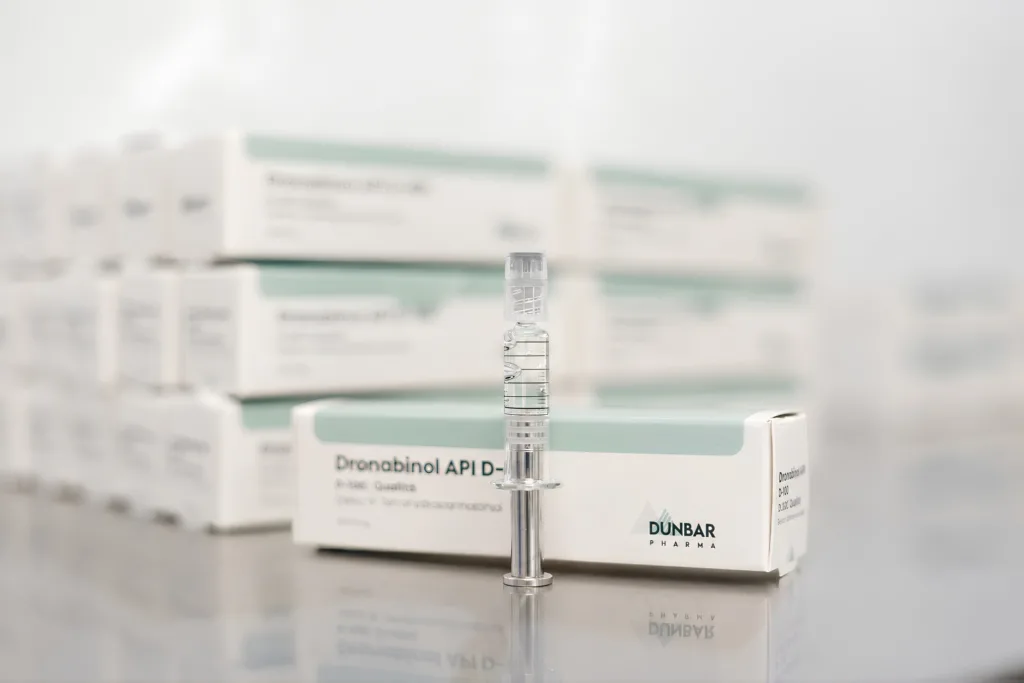
Dunbar Pharma positions its dronabinol primarily as a pharmaceutical API rather than a conventional cannabis flower product. Its pharmacist materials describe the ingredient as neat dronabinol, with batch documentation and formulations intended to support pharmacy compounding in jurisdictions where that pathway is permitted. The manufacturer also markets several API unit sizes and says its batches undergo quality-control and quality-assurance release at its Irish operation.
That creates the possibility of a more standardised formulation model in which a pharmacist or authorised manufacturer works with a defined concentration of a single active ingredient instead of relying on the broader chemical composition of cannabis flower or less purified extracts.
Commercially, that proposition has some logic. Pharmaceutical manufacturing generally values reproducible potency, validated analytical specifications, batch consistency, stability data and traceable starting materials. A purified API can also give formulation specialists greater control over the concentration and dosage form being produced.
But availability should not be confused with broad clinical uptake. A new source of dronabinol does not change UK prescribing guidelines, create a new authorised indication or itself establish a reimbursement pathway.
The National Institute for Health and Care Excellence, whose cannabis-based medicinal-products guidance was last reviewed in 2025 without a change in practice, specifically recommends that dronabinol should not be offered for management of chronic pain in adults. Its guidance also stresses consideration of licensing status, benefits, harms, dependence risk and other clinical factors when cannabis-based medicinal products are considered.
That is an important counterweight to the broader list of therapeutic areas sometimes associated with dronabinol internationally. UK commercial potential will depend on the lawful prescribing and manufacturing context actually available in Britain, not simply on indications or uses established in other countries.
How do UK controlled-drug rules affect Dunbar Pharma’s dronabinol opportunity?
Dronabinol’s regulatory status makes this a substantially different supply-chain challenge from launching an ordinary pharmaceutical excipient or uncontrolled API.
The Home Office lists dronabinol as a Class B, Schedule 2 controlled drug. Schedule 2 status allows recognised medicinal use but brings tighter controls around possession, supply, prescribing, storage and movement than ordinary pharmaceutical ingredients. UK government guidance also requires companies involved in relevant controlled-drug activities to hold the necessary licences and meet the applicable medicines requirements.
Separately, UK companies manufacturing, importing or distributing active substances must register with the Medicines and Healthcare products Regulatory Agency and comply with good manufacturing and distribution practice requirements. These controls mean expansion depends on more than signing distributors and finding customers. Regulatory permissions, quality systems, controlled-drug handling, documentation and supply-chain governance remain fundamental to scale.
This may actually favour specialist operators over less established cannabinoid businesses. Dunbar Pharma is positioning itself as a conventional pharmaceutical manufacturer that happens to work with cannabinoids, rather than as a cannabis producer attempting to move upstream into pharmaceuticals. Its Athlone operation focuses on GMP cannabinoid APIs, in-house quality control and stability programmes, while IPS Pharma already operates within regulated pharmaceutical manufacturing and specialist medicine distribution.
The commercial proposition is consequently about pharmaceuticalisation as much as cannabis. The companies are trying to move the cannabinoid conversation toward defined active ingredients, controlled manufacturing specifications and repeatable formulation rather than simply increasing the availability of cannabis-derived products.
Can the UK become a meaningful second European market for Dunbar Pharma?
The UK entry follows Dunbar Pharma’s earlier push into Germany, where the company has already promoted its plant-derived dronabinol to pharmacies and distributors. Germany is particularly relevant because pharmacy compounding using dronabinol has a longer-established infrastructure, giving Dunbar an opportunity to test commercial demand for its plant-derived positioning before expanding more aggressively across Europe.
The UK presents a different challenge. Regulatory permission for controlled substances and the existence of specialist pharmacy infrastructure do not automatically translate into high prescription volumes. Clinical guidance remains restrictive in several of the conditions frequently associated with cannabinoids, and dronabinol itself lacks a UK marketing authorisation.
Dunbar therefore needs adoption at several levels. IPS Pharma must establish a reliable supply and distribution route. Pharmacies and pharmaceutical customers need reasons to choose the plant-derived API over alternative sources. Prescribers need appropriate clinical circumstances in which dronabinol can be used within existing rules. And pricing must remain commercially viable despite the compliance costs associated with a tightly controlled API.
The manufacturer appears to have prepared some of the infrastructure needed for that strategy. Dunbar says its Irish site carries out commercial API manufacturing, in-house testing and stability work and that its dronabinol is produced through a proprietary process using cannabis material. The company has also built dedicated materials for prescribers, pharmacists and distributors, indicating that commercialisation is being structured around professional pharmaceutical channels rather than direct consumer demand.
The UK launch should consequently be viewed as an expansion of Dunbar Pharma’s addressable pharmaceutical supply network rather than evidence of an immediate change in treatment practice. What the agreement potentially creates is another regulated route through which a highly purified plant-derived THC active ingredient can reach authorised pharmaceutical users.
The next meaningful evidence will come from execution. Shipment volumes, pharmacy uptake, formulation activity, repeat orders and expansion into additional regulated markets will say considerably more about the value of Dunbar Pharma’s platform than the “first” label attached to the UK launch.
For now, the most defensible conclusion is also the most commercially interesting one: Britain already has dronabinol in its pharmaceutical supply chain, but Dunbar Pharma is trying to introduce a different manufacturing proposition. If plant-derived sourcing, EU GMP production and IPS Pharma’s specialist distribution network translate into repeat demand from pharmacies and pharmaceutical manufacturers, the UK could become an important test of whether cannabinoid APIs can develop into a more conventional specialty-pharmaceutical business rather than remaining a niche extension of the medical-cannabis market.