Vista AI, a U.S.-based medical imaging software company specializing in AI-powered MRI automation, has raised $29.5 million in Series B financing to accelerate its product roadmap and scale adoption across U.S. hospitals and imaging centers. The funding round, announced on January 14, 2026, includes strategic investments from leading health systems such as Cedars-Sinai Health System, Intermountain Health, University of Utah Hospital System, Temple University and Fox Chase Cancer Center, and Tampa General Hospital. Venture capital firms including Khosla Ventures and Bold Brain Capital also participated. With its FDA-cleared cardiac MRI platform already in use, Vista AI now aims to expand into additional anatomies including the brain, spine, and prostate, while rolling out remote scanning services for sites with limited in-house MRI expertise.
Why health systems are directly investing in MRI automation infrastructure
The direct involvement of health systems as equity participants rather than just customers marks a shift in how radiology infrastructure is being modernized. At a time when labor shortages, backlogs, and uneven scan quality are straining imaging operations, hospital administrators are placing bets on automation to increase consistency and throughput without increasing staff. Vista AI’s pitch is not that it replaces technologists, but that it enables them to deliver high-quality imaging with less variability, faster scheduling, and broader access, even in remote or resource-constrained environments.
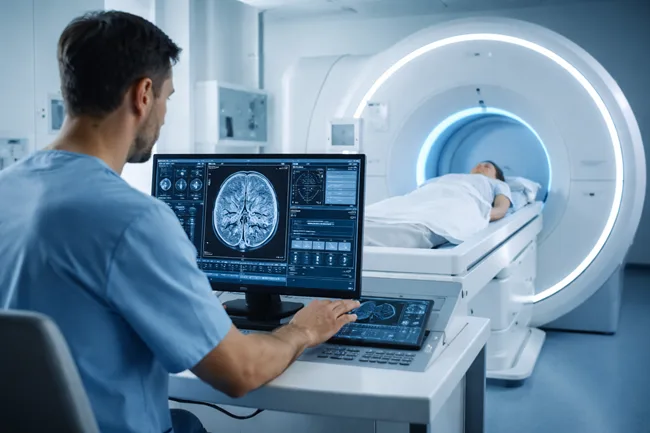
Industry observers note that the bottleneck in radiology is no longer just interpretation. While AI companies focusing on post-scan diagnostics have attracted attention, Vista AI is addressing the acquisition layer itself. This foundational layer has traditionally relied heavily on the availability and experience of trained MRI technologists, whose scarcity is contributing to growing scan delays nationwide. By standardizing and automating the scanning workflow, Vista AI is positioning itself not as a feature, but as infrastructure. The Series B investment reflects a growing recognition among institutional buyers that automation must be embedded into the operational fabric of modern radiology departments.
The company’s results at sites like Brigham and Women’s Hospital, where its platform reportedly eliminated a 28-day cardiac MRI backlog and enabled next-day access without additional scanners or staff, serve as a compelling proof of concept. For Tampa General Hospital, Intermountain Health, and others looking to replicate similar efficiency gains across their networks, equity participation may serve as both a strategic and financial hedge on the platform’s potential ubiquity.
Expansion into brain, spine, and prostate imaging introduces clinical and regulatory complexity
Vista AI’s current commercial traction centers around its cardiac MRI automation, which has gained traction in part because of the limited number of technologists trained in this high-complexity modality. The next phase of growth will test whether the company’s automation engine can generalize effectively to other anatomies with distinct imaging requirements. Brain scans, for example, are used across a wide range of indications from stroke to neuro-oncology and demand precision in slice orientation and contrast sequencing. Prostate and spine imaging add another layer of complexity due to patient positioning, motion artifacts, and multi-planar visualization needs.
Clinicians following AI adoption in radiology suggest that while cardiac MRI provided a relatively niche but high-impact use case, modalities like brain or spine imaging will require significantly more data diversity, user feedback loops, and protocol flexibility. FDA clearance for each of these extensions will likely require separate validation studies, possibly involving pivotal trials that assess diagnostic equivalence in comparison to human-performed scans.
Regulatory watchers believe this phase of anatomical expansion could prove more difficult than the initial FDA clearance. Differences in institutional protocols, variations in disease presentation, and evolving reimbursement frameworks for advanced imaging all create barriers that go beyond software development. Vista AI’s ability to secure de novo or 510(k) clearances for its upcoming anatomy modules will be closely watched by health system IT leaders and venture investors alike.
Remote scanning could unlock access, but brings policy and workforce tension
Vista AI’s move into remote scanning services is an attempt to extend its platform beyond hospitals with in-house MRI technologists. By offering a solution that pairs automated scanning protocols with remote guidance or oversight, the company is targeting imaging centers and rural providers who currently lack the infrastructure or trained personnel to perform high-complexity MRI exams. This offering aligns with broader health equity goals, especially for underserved regions where access to cardiac or neurological MRI remains limited.
However, remote scanning is not without friction. Credentialing requirements, licensure portability, and reimbursement clarity are all potential stumbling blocks. Questions remain around who is ultimately liable when a remote scan is performed based on AI-driven workflows, especially if interpretation errors trace back to acquisition errors. Medical device companies operating in this hybrid AI-remote services model will need to establish clear clinical governance frameworks to reassure both regulators and risk managers.
Professional associations may also view this shift with caution. While automation aims to supplement, not replace, technologists, there is concern within the radiologic technologist community that remote solutions could erode professional standards or lead to tiered staffing models with diluted credential requirements. Whether Vista AI can gain the trust of this stakeholder group could influence the pace and scope of remote adoption.
What makes Vista AI’s model distinct in the radiology AI landscape
In a sector crowded with startups offering computer vision for lesion detection, workflow triage, or scan enhancement, Vista AI’s emphasis on the front end of the scan process sets it apart. The majority of AI imaging companies operate post-acquisition, interpreting scans or helping radiologists prioritize cases. Vista AI’s decision to focus on the scanning layer itself is less glamorous but arguably more foundational. Without consistent, high-quality acquisition, even the best interpretation models struggle to deliver clinical value.
This positions the company in a unique strategic space. Rather than offering algorithm-as-a-service, Vista AI is building a full-stack platform that integrates with MRI scanners and embeds into hospital imaging workflows. If successfully scaled, this infrastructure-level integration could allow Vista AI to benefit from long-term contracts, recurring SaaS revenues, and enterprise-wide deployments across multi-hospital networks.
Industry observers compare this approach to companies that became embedded within the electronic health record or PACS ecosystems. Once critical workflows depend on a platform, displacement becomes difficult. That stickiness could translate into strong customer retention and pricing power, particularly if the system continues to demonstrate measurable ROI.
That said, the full-stack model also increases exposure to integration risk. MRI vendors, EHR providers, and health IT consultants may push back against platforms that introduce new operational dependencies. Vista AI will need to balance its infrastructure ambitions with interoperability and clinical autonomy safeguards to avoid backlash from radiologists or imaging directors wary of closed-loop systems.
What could go wrong: execution risks, competition, and validation gaps
The funding milestone validates Vista AI’s commercial promise, but several key risks remain. First, expansion into new anatomies depends on not only regulatory clearance but clinical validation. Without high-quality, multi-site data showing scan quality and diagnostic equivalence, Vista AI’s claims of automation readiness will face skepticism from payers and radiologists.
Second, the remote scanning model will need robust security, oversight, and audit systems. Any perception of degraded scan quality or missed pathology due to remote acquisition could slow adoption dramatically. Hospitals may be enthusiastic investors, but they are also risk-averse purchasers, especially in areas touching patient safety.
Third, while Vista AI may currently enjoy a unique position, competitors are circling. Some imaging companies may choose to extend into scan acquisition automation themselves, while scanner manufacturers could build similar capabilities into their hardware ecosystems. If Siemens Healthineers, GE HealthCare, or Philips begin embedding protocol automation natively, Vista AI could be forced to pivot toward integrations or acquisitions to defend its market.
The final risk is one of overreach. Moving from a single modality to a universal MRI automation layer, while also launching remote services, creates product sprawl. If execution falters on any front, it could undermine the trust of early investors and slow enterprise deployment.
Still, with this Series B round and health system participation, Vista AI appears to be one of the few AI-native radiology companies transitioning from point solution to platform. If it succeeds, it may help redefine how imaging departments think about MRI—not just as a device, but as an orchestrated, software-enabled workflow.