Vitestro has secured US Food and Drug Administration marketing authorization for Aletta, its autonomous robotic phlebotomy system, creating a new regulatory category for a device designed to perform diagnostic blood draws without hands-on needle placement by an operator. The August 19, 2026 authorization is significant not simply because another medical robot has entered the US market, but because the FDA has accepted a model in which one trained phlebotomy supervisor can oversee as many as three autonomous blood collection devices at the same time.
The Netherlands-based medical robotics company received authorization through the FDA’s De Novo pathway, which is used for novel low- to moderate-risk devices for which no legally marketed predicate device provides an appropriate basis for a traditional 510(k) submission. The decision therefore establishes a new device type together with special controls governing areas including labeling, performance testing and clinical testing, potentially creating a regulatory foundation that later competing systems could seek to use through the 510(k) pathway if they can demonstrate substantial equivalence.
Aletta is authorized for adults in outpatient settings and does not eliminate professional oversight. A trained phlebotomist starts each session, remains available to respond to problems and checks that blood collection tubes have been filled in the correct sequence and to an adequate level after the procedure. That distinction matters commercially because Vitestro is initially positioning automation as a way to extend scarce phlebotomy capacity rather than remove trained personnel completely from the diagnostic workflow.
How does Aletta perform a blood draw without hands-on needle insertion?
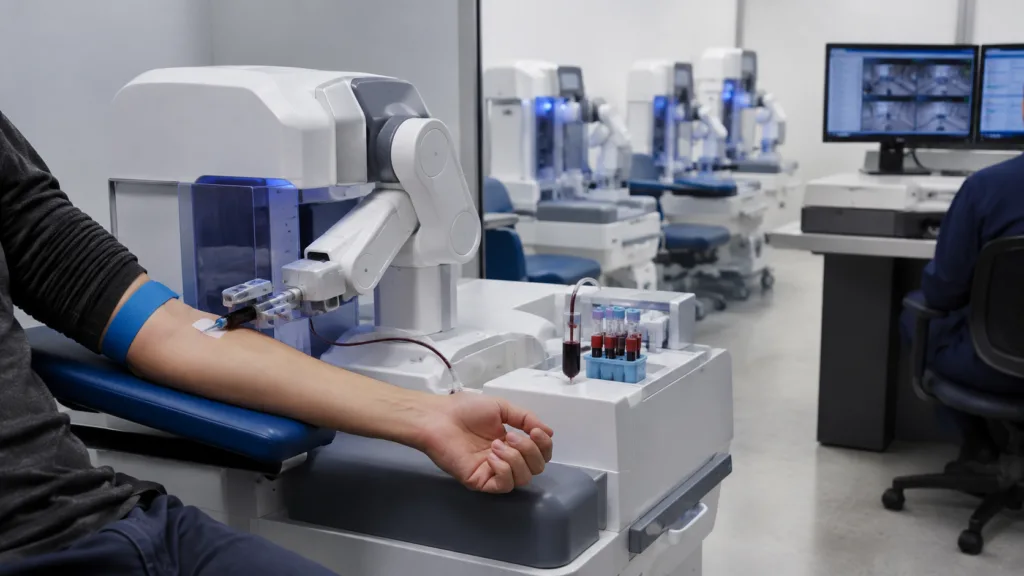
Aletta combines near-infrared imaging with Doppler ultrasound to identify a suitable vein and distinguish veins from arteries before attempting venipuncture. If the system cannot identify an appropriate vessel, it does not proceed with the needle insertion, providing an important technical limitation on autonomous operation rather than attempting a draw under unsuitable conditions.
Once a suitable vein has been selected, Aletta performs a sequence that ordinarily requires direct human execution. The system applies the tourniquet, prepares the puncture site, inserts the needle, handles collection-tube changes, disposes of the needle and applies a bandage. The FDA also described several safety mechanisms, including continuous application of disinfectant while ultrasound scanning is performed, automated detachment of the needle when excessive patient movement is detected and onboard sensors capable of stopping the procedure and alerting the supervisor when potentially unsafe conditions occur.
The authorization therefore covers substantially more than robotic assistance with vein visualization or needle guidance. The important technological distinction is that the device integrates vessel identification, robotic venipuncture and the broader specimen-collection workflow into an autonomous system, while retaining defined checkpoints where trained staff continue to exercise oversight.
That architecture could prove particularly relevant for high-volume outpatient laboratories, where the commercial value of automation will depend not only on whether a robot can successfully puncture a vein but also on how reliably the entire preanalytical workflow can be incorporated into existing staffing, specimen handling and laboratory information processes.
What clinical evidence supported the FDA De Novo authorization?
The FDA said clinical data demonstrated blood draw success rates comparable to or better than trained human phlebotomists when Aletta proceeded with a needle stick. The regulator said performance was demonstrated across patients with different health conditions and skin tones, including people reporting difficult venous access, while device-related adverse events were uncommon and mild.
More detailed evidence comes from the Autonomous Blood Drawing Optimization and Performance Testing, or ADOPT, programme, registered as NCT05878483. A peer-reviewed multicentre study published in Clinical Chemistry evaluated an investigational autonomous robotic phlebotomy device across outpatient phlebotomy sites in the Netherlands and included two distinct cohorts.
In the first cohort, 153 patients underwent assessment of analytical equivalence between robotically and manually collected blood specimens. Researchers reported no statistically significant differences for activated partial thromboplastin time, prothrombin time, lactate dehydrogenase, aspartate transaminase or platelet count. This element is important because reliable venipuncture alone would have limited diagnostic value if the automated collection process altered specimen quality sufficiently to affect laboratory results.
The second cohort enrolled 1,633 patients and examined the device in routine use. Among patients for whom the robotic system identified a suitable vein, first-stick success reached 94.5%, with a 95% confidence interval of 93.3% to 95.5%. First-stick success was 92.7% among patients reporting difficult venous access, 97.4% among patients with body mass index above 30 kg/m² and 93.4% among people aged at least 65 years.
The qualification that the 94.5% figure applies when the device identified a suitable vein is clinically important. It should not be interpreted as meaning Aletta successfully completed a first-stick blood draw in 94.5% of every person presenting for phlebotomy regardless of anatomical suitability. The technology incorporates a decision not to puncture when it cannot identify an appropriate target, making vein-selection capability and the proportion of patients eligible for an autonomous attempt relevant considerations when laboratories evaluate real-world throughput.
Adverse events occurred at a rate of 0.6% in the published study and were all classified as mild. Patient-experience findings were also encouraging: 90% reported experiencing far less, less or similar pain compared with manual blood collection, while 82% either preferred robotic phlebotomy, strongly preferred it or expressed no preference.
Could one phlebotomist supervising three Aletta systems materially change laboratory staffing?
The FDA authorization allows one trained phlebotomist to oversee as many as three Aletta devices simultaneously, giving Vitestro a potentially important operational argument as US laboratories contend with continuing demand for blood collection personnel. The US Bureau of Labor Statistics projects phlebotomist employment to increase about 6% between 2024 and 2034, with approximately 18,400 openings expected annually on average, much of that demand reflecting workers leaving the occupation or labor force.
The three-device supervision model should not, however, be interpreted automatically as a threefold increase in productivity. Actual throughput will depend on procedure duration, patient preparation, unsuccessful vein identification, supervisor interventions, cleaning, specimen verification, tube requirements, room layout and integration with laboratory workflows. Neither the FDA authorization nor the available clinical publication establishes that one person operating three systems can process exactly three times as many patients as conventional phlebotomy.
What the authorization does establish is a regulatory framework for testing a different labor model. Instead of assigning one phlebotomist directly to one patient throughout the blood draw, the professional can potentially oversee several automated procedures while concentrating attention on exceptions, verification and cases requiring human intervention.
That could make Aletta most commercially attractive initially in centralized outpatient facilities with sufficiently high and predictable blood draw volumes to keep several systems in use. Smaller physician offices or low-volume collection points may face a different economic calculation because the benefits of parallel device supervision depend on utilization as much as technical performance.
Why does the De Novo decision matter for Vitestro’s US commercialization strategy?
Vitestro had been preparing specifically for a US De Novo submission before the authorization. In March 2026, the company closed a $70 million oversubscribed Series B financing backed by investors including Labcorp Venture Fund, Mayo Clinic and Sutter Health, alongside financial investors and existing shareholders. Vitestro said the proceeds would support its De Novo programme, manufacturing scale-up, additional clinical activity and commercial infrastructure for expansion from Europe toward the United States.
The strategic composition of that investor group is notable because laboratory and healthcare-system relationships may be almost as important as regulatory authorization for a device that changes a familiar clinical workflow. Vitestro has also worked with US institutions including Northwestern Medicine on clinical research intended to evaluate autonomous blood collection and support adoption in hospital and outpatient environments.
Aletta was already CE marked for clinical use in Europe before the US decision, giving Vitestro experience with deployment outside an investigational environment. The FDA authorization now removes a major regulatory barrier to the company’s US strategy, but broad commercialization will still require healthcare providers to decide whether the system can generate sufficient staffing, throughput, consistency or patient-experience benefits to justify acquisition and integration costs.
The next phase is therefore likely to be less about proving that autonomous venipuncture is technically possible and more about proving that it works economically and operationally at scale. Laboratories will need evidence around uptime, procedure times, intervention rates, utilization across different patient populations, maintenance requirements and integration into existing specimen-management systems.
Does Aletta signal a broader move toward automation of the diagnostic preanalytical workflow?
Clinical laboratories have automated substantial portions of specimen processing and analysis, but collecting the specimen from the patient has remained unusually dependent on manual skills. Aletta shifts automation farther upstream into the preanalytical phase, where variability in patient anatomy, movement, vessel identification and needle handling makes robotics considerably more complicated than automating repetitive tasks inside a laboratory.
The FDA’s decision does not establish autonomous robotic phlebotomy as superior to conventional blood collection across every clinical environment. The authorized use remains limited to adults in outpatient settings, professional supervision remains mandatory and the device retains the option not to attempt venipuncture when a suitable vein cannot be identified. Those boundaries will matter as providers consider which patient groups and collection settings are appropriate for the technology.
Nevertheless, De Novo authorization gives the emerging category something it previously lacked in the United States: a defined regulatory route and an FDA-reviewed example of an autonomous system capable of carrying out essentially the complete blood draw procedure.
For Vitestro, the immediate opportunity is to convert that regulatory first into clinical adoption. For the broader diagnostics and medical robotics industry, the more consequential development may be that autonomous venous blood collection has moved from experimental validation into an FDA-authorized device category, creating a benchmark against which future robotic phlebotomy platforms will increasingly be measured.