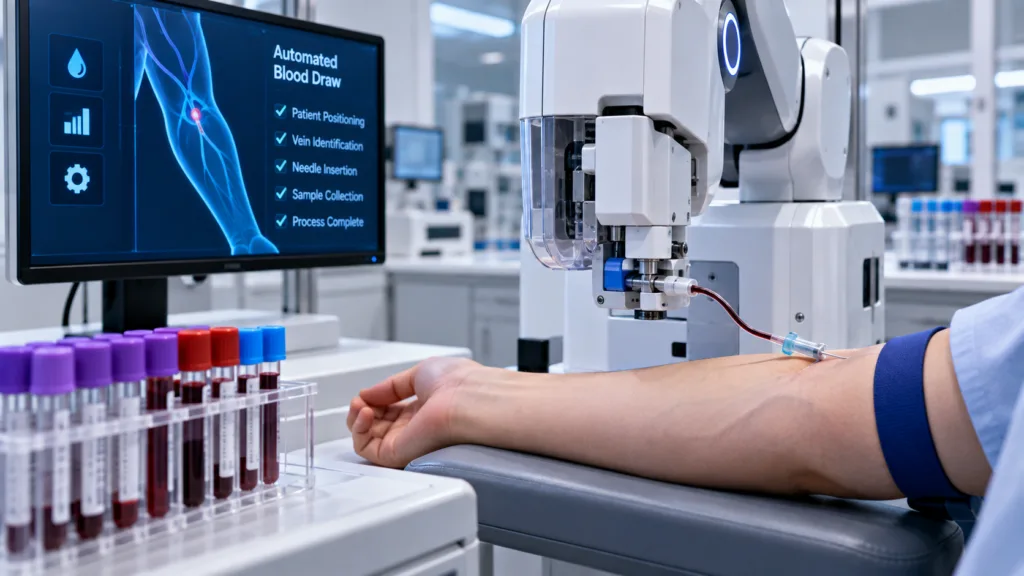
Vitestro has secured United States FDA De Novo authorization for Aletta, establishing the first regulatory pathway in the country for a standalone robotic system capable of drawing blood from an adult patient’s arm without hands-on operator intervention. The device is authorized for outpatient settings and must operate under a supervisor trained in phlebotomy, but one supervisor may oversee as many as three Aletta systems simultaneously. The FDA explicitly identified potential workforce benefits as part of the significance of the authorization.
Aletta uses near-infrared imaging, ultrasound and Doppler ultrasound to locate vessels, distinguish veins from arteries, guide a robotic needle and complete diagnostic blood collection. Vitestro says the system can autonomously identify a vein, insert the needle, change and invert sample tubes and apply a bandage, moving automation beyond needle placement into most of the collection workflow.
Why automate one of healthcare’s most routine procedures?
Blood collection is among the highest-volume procedures in healthcare. Hospitals, laboratories and outpatient centres perform millions of venipunctures, yet the task remains labour intensive and depends heavily on trained staff.
That becomes economically significant when labour supply tightens. The FDA specifically referenced the phlebotomist shortage when announcing Aletta’s authorization and noted that one trained supervisor can oversee three systems.
Automation could therefore change staffing ratios rather than simply replace a needle with a robot. A laboratory that currently requires several phlebotomists working simultaneously could potentially use staff to supervise automated collection while focusing human expertise on difficult patients, troubleshooting and tasks that machines cannot perform.
How does Aletta find a vein without a human palpating the arm?
Experienced phlebotomists often use visual inspection and palpation to identify a suitable vessel. Aletta converts that judgement into an imaging and robotics problem.
Near-infrared technology identifies superficial vascular patterns, while ultrasound provides deeper anatomical information. Doppler ultrasound then helps verify that the selected vessel is a vein rather than an artery. The robotic system positions the needle and performs insertion after identifying an acceptable target.
The device is also designed to abort the procedure if it cannot identify a suitable vein. That is an important safety characteristic because autonomous systems need to recognize when not to act rather than simply optimize success when conditions are ideal.
What does the 94.5% first-stick success rate actually tell hospitals?
Vitestro’s multicentre ADOPT study reported a 94.5% first-stick success rate for the investigational version of Aletta. The study was published in Clinical Chemistry and evaluated performance, safety and patient experience across routine diagnostic blood collection.
First-stick success matters because failed venipuncture creates discomfort, delays and additional staff effort. Multiple attempts are particularly challenging for patients with small, deep, scarred or otherwise difficult veins.
A single percentage cannot fully establish superiority over skilled phlebotomists, however. Manual success varies with patient population and operator experience, while robotic performance must remain consistent across age, body type, skin tone, hydration status and vascular anatomy. The commercial question is whether Aletta performs predictably enough across routine outpatient populations to offset the flexibility and judgement of experienced humans.
Will patients accept a robot inserting the needle?
Patient psychology may be as important as engineering. Blood draws already create anxiety for many people, and introducing an autonomous robot could initially increase concern even if the procedure ultimately feels similar or less painful.
Vitestro reports that 85% of patients in its experience considered the pain less than or similar to a manual draw. The company also emphasizes patient education as part of deployment, reflecting the need to explain what the system does, when a human is supervising and what happens if the robot cannot identify a suitable vessel.
Trust may improve rapidly if early deployments demonstrate reliability. Automated blood-pressure cuffs, infusion pumps and robotic surgery once felt unfamiliar, but patients often normalize technology when it becomes routine and clinicians endorse it.
Does automation improve the specimen as well as the collection experience?
Laboratory quality depends not just on getting blood into a tube but on obtaining a specimen that has not been damaged by poor technique. Hemolysis, insufficient fill volume, incorrect tube handling and identification errors can invalidate tests and require recollection.
Aletta’s ability to automate tube handling and inversion creates the possibility of greater procedural standardization. Robots repeat programmed actions consistently, potentially reducing operator-to-operator variation.
The manufacturer will need real-world evidence demonstrating whether that theoretical consistency actually lowers specimen rejection or recollection rates. Hospitals may find savings from improved sample quality as valuable as labour savings if automation prevents repeat testing and downstream delays.
What does De Novo authorization mean for competing robotic systems?
The FDA used the De Novo pathway because Aletta represented a new device type without an appropriate legally marketed predicate. The agency created the classification “robotic peripheral venous blood collection system,” establishing the regulatory framework future entrants may use.
That is strategically important. Vitestro gains first-mover recognition, but it also helps define the regulatory category competitors can eventually enter through subsequent pathways if they demonstrate substantial equivalence where applicable.
Early commercial success could therefore attract more medical robotics companies into venous access. Blood collection is only one potential application. Similar imaging and robotic capabilities could eventually support catheter placement, vascular access for infusions or other needle-based procedures.
Can the economics justify a robotic blood-draw station?
Hospitals will compare device acquisition, service, consumables, floor space and integration costs against labour savings and throughput. A robot that successfully performs blood draws but processes patients too slowly could struggle economically during high-volume morning collection periods.
The supervision ratio is the key starting point. If one phlebotomist can safely manage three devices while each runs with minimal intervention, labour productivity could increase materially. If staff frequently need to assist with positioning, difficult veins, patient anxiety or equipment issues, the theoretical advantage narrows.
Vitestro raised approximately $22 million to accelerate autonomous phlebotomy development and commercialization, indicating that scaling manufacturing and deployment requires meaningful capital even after the underlying technology has been developed.
Could robotics change the phlebotomist’s job rather than eliminate it?
The FDA authorization itself suggests a supervisory model, not a completely staff-free laboratory. A qualified person remains responsible for oversight, and human intervention is needed when the robot cannot find an appropriate vein or when patients fall outside the intended-use criteria.
That could shift the profession toward exception management. Instead of spending nearly all of their time performing standard venipunctures, skilled staff could focus on paediatric patients, difficult access, inpatient collections, complications and supervision of several automated stations.
Healthcare automation often works best in this form. Machines perform repetitive, standardized tasks while humans manage complexity and judgement.
What would prove Aletta is genuinely changing laboratory medicine?
The first evidence will come from commercial throughput rather than regulatory approval. Laboratories need to know how many patients an Aletta unit can process per hour, how often procedures require staff intervention, what percentage of patients cannot be treated by the system and how uptime compares with conventional collection stations.
The second test is economics. If automation increases staffing capacity without reducing patient satisfaction or sample quality, the rationale strengthens rapidly in regions struggling to recruit phlebotomists.
The final test is expansion. Adult outpatient venipuncture is a controlled starting environment. If future generations demonstrate safe performance across broader patient populations and more complex vascular access, autonomous needle procedures could become a much larger medtech category.
Aletta therefore deserves attention not because robotics makes an ordinary blood draw look futuristic. Its importance lies in applying automation to one of healthcare’s most repetitive human workflows. If Vitestro can make the economics work at scale, the most consequential effect may be almost invisible: patients still arrive, blood still enters familiar laboratory tubes, but the person holding the needle increasingly becomes a machine.