Cornerstone Robotics has received European Union CE Mark certification under the Medical Device Regulation for its Sentire Endoscopic Surgical System, giving the Hong Kong-based surgical robotics developer formal access to European markets and marking a significant regulatory milestone in its global expansion strategy.
The company said the approval covers minimally invasive surgical procedures across general surgery, gynaecology, thoracic surgery and urology. Cornerstone Robotics described the Sentire Surgical System as a high-end robotic platform combining clinical workflows with integrated engineering, software and imaging technologies. The company said the CE certification confirmed that the system’s safety, efficacy and quality management framework complied with European regulatory requirements.
PR Newswire reported that the CE Mark formally grants the Sentire Surgical System access to European markets. Cornerstone Robotics also said the system has completed numerous complex procedures in the United Kingdom under a clinical investigation with Portsmouth Hospitals University NHS Trust, spanning urology, gynaecology and upper and lower gastrointestinal surgery.
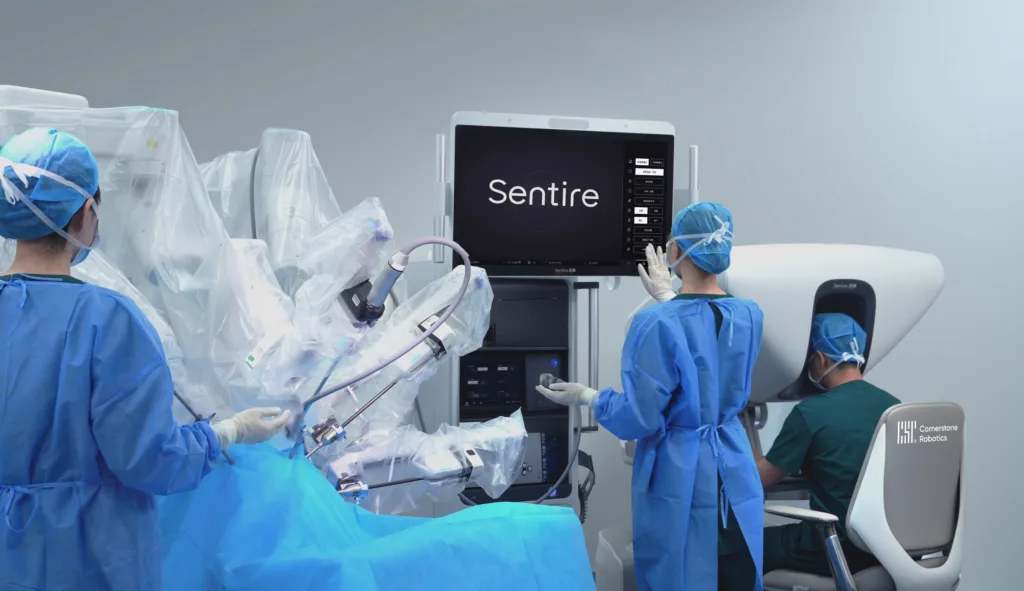
The approval is strategically important because Europe’s Medical Device Regulation has become a much tougher gatekeeper for medical technology companies than the older CE framework. For surgical robotics companies, clearing MDR requirements is not just a regulatory checkbox. It is a credibility signal that can influence hospital procurement, surgeon confidence, training partnerships and investor perception.
Why does the Sentire CE Mark matter for surgical robotics?
The Sentire CE Mark matters because surgical robotics is entering a more competitive and more geographically diversified phase. For years, the global surgical robotics market has been dominated by a small number of major platforms, especially in high-value hospital systems. New challengers are now trying to prove that robotic surgery can become more accessible, more cost-efficient and more widely deployable across healthcare systems.
Cornerstone Robotics is positioning Sentire as part of that next wave. The company’s system is designed for minimally invasive surgery, where robotics can support precision, visualisation, ergonomics and instrument control. The approved indications across general surgery, gynaecology, thoracic surgery and urology give the company a relatively broad procedural canvas, although real adoption will depend on clinical evidence, surgeon training, service support and hospital economics.
The European approval also gives Cornerstone Robotics a pathway into one of the world’s most influential medical device markets. Europe is not a single commercial environment, but approval under MDR provides a foundation for market entry across EU countries. From there, the company will need to navigate country-level procurement, reimbursement considerations, clinical adoption patterns and hospital budget pressures.
This is where the story becomes more interesting than the approval headline. The CE Mark gets Sentire through the regulatory door. It does not automatically guarantee commercial scale. Surgical robotics is one of those medtech categories where approval is only the beginning of the hard part.
How does MDR approval change Cornerstone Robotics’ global positioning?
The EU Medical Device Regulation has raised the bar for clinical evidence, post-market surveillance, quality systems and technical documentation across Europe. For a surgical robotics company, that makes MDR approval a meaningful validation point, particularly for a company seeking global recognition from a Hong Kong and China base.
Cornerstone Robotics said the Sentire Surgical System has now received market approval across China, the European Union and Singapore. That creates a three-region regulatory footprint spanning Asia and Europe, giving the company a broader commercial identity than a single-market device developer.
The company’s global positioning is also supported by its operational footprint. Cornerstone Robotics said it has three global research and development hubs, six business centres worldwide, and a 30,000-square-metre manufacturing facility in China. That combination of in-house development and manufacturing capacity is being presented as a strategic advantage, especially as surgical robotics companies face supply chain, service reliability and cost-structure pressures.
The company also closed an oversubscribed financing round of approximately 200 million dollars in November 2025, which it said reflected investor confidence in its long-term growth and commercialisation prospects. For a capital-intensive category such as surgical robotics, funding depth matters. Hospitals need confidence that a robotics supplier can support installation, training, maintenance, upgrades and long-term service.
Why the United Kingdom clinical investigation is important
Cornerstone Robotics’ early United Kingdom presence is central to the European strategy. The company said it partnered with Portsmouth Hospitals University NHS Trust in 2025 to conduct a compliant clinical investigation of the Sentire Surgical System. The company said the investigation helped generate real-world clinical data, support evidence-based research, develop training protocols and prepare for clinical adoption.
That matters because surgical robotics adoption is heavily shaped by clinical champions. A device can be technically impressive, but surgeons need hands-on experience, hospital administrators need evidence, and operating-room teams need training workflows. Early clinical investigation sites can become important reference points for broader rollout if outcomes, usability and service support are convincing.
The UK investigation also gives Cornerstone Robotics a practical bridge into Europe. Although the United Kingdom is outside the European Union, a UK-based clinical investigation can still support broader credibility because NHS-affiliated clinical experience carries weight in global medtech circles. The company said the Sentire system completed complex procedures across multiple specialties in the UK and that clinicians were satisfied with its performance.
The real question is whether this early experience converts into repeatable adoption. Surgical robotics systems require more than one successful trial site. They need training scale, procedural consistency, operating-room integration and a business case that works for hospitals.
What makes surgical robotics such a difficult commercial category?
Surgical robotics is attractive because it sits at the intersection of precision surgery, digital health, hospital differentiation and procedural efficiency. But it is also one of the most difficult categories in medtech to commercialise.
The first challenge is cost. Robotic systems are expensive to purchase, install and maintain. Hospitals must justify capital expenditure against procedural volumes, surgeon demand, patient outcomes, operating-room efficiency and competitive positioning. A system that is clinically interesting but underutilised can become a costly asset.
The second challenge is training. Robotic surgery adoption depends on surgeon learning curves, theatre-team coordination and institutional protocols. Companies need to invest heavily in training programmes, simulation, proctoring and technical support.
The third challenge is evidence. Hospitals want to know whether a system improves outcomes, reduces complications, shortens hospital stays, supports faster recovery, or improves efficiency. Even when clinical benefits are plausible, procurement committees often demand local evidence and economic justification.
The fourth challenge is service. Surgical robots are not simple devices. Hospitals need uptime, maintenance, instrument supply, software support and fast technical response. A weak service model can damage adoption even if the robot itself performs well.
Cornerstone Robotics appears to recognise this. The company said it has established a UK subsidiary and is building localised services, including training, clinical technical support and after-sales service. That local infrastructure will be critical if the Sentire system is to move from regulatory approval to hospital adoption.
What does this mean for Europe’s surgical robotics market?
Europe’s surgical robotics market is becoming more open to challengers, but it remains demanding. Hospitals are interested in robotic surgery, but capital budgets are under pressure. Health systems want innovation, but they also want evidence, affordability and operational reliability.
New entrants such as Cornerstone Robotics may benefit from hospitals seeking alternatives to incumbent systems. Competition can potentially lower costs, improve service models and encourage platform differentiation. However, challengers must prove that they can match or exceed incumbent expectations around clinical performance, instrument ecosystem, surgeon experience and support infrastructure.
The Sentire approval also reflects the rising role of Asian surgical robotics companies in global medtech. Chinese and Hong Kong-based companies are no longer competing only in domestic markets. They are increasingly seeking international regulatory approvals, clinical partnerships and overseas commercial expansion.
This could intensify competition in Europe. If companies such as Cornerstone Robotics can offer capable systems with compelling economics, European hospitals may have more negotiating leverage. But acceptance will depend on trust, evidence and service quality, not merely price.
What are the risks after CE Mark approval?
The biggest risk is slow commercial uptake. MDR approval opens the market, but hospitals may still move cautiously. Surgical robotics procurement decisions can take time, especially in public health systems where budgets, tendering and clinical committees shape adoption.
The second risk is evidence depth. Cornerstone Robotics has highlighted real-world clinical activity in the United Kingdom, but broader adoption will require more published clinical data, economic evidence and specialty-specific outcomes. Hospitals will want to understand how Sentire performs across procedures and patient groups.
The third risk is competitive pressure. The surgical robotics market includes established incumbents and other challengers with global ambitions. Cornerstone Robotics will need to define why Sentire is differentiated, whether through system design, imaging, software, usability, service, pricing or accessibility.
The fourth risk is scaling support. A surgical robot can fail commercially if service and training capacity lag behind installation growth. Cornerstone Robotics’ UK subsidiary and localised service strategy are therefore not side details. They are essential to the commercial story.
Investor and industry view: why this approval is strategically meaningful
The CE Mark gives Cornerstone Robotics a stronger international profile at a time when investors are looking for medtech companies that can move beyond domestic regulatory wins and demonstrate global commercial potential. The company’s 200 million dollar financing round in 2025 already suggested strong institutional appetite for its robotics platform.
From an industry perspective, the approval reinforces a wider shift in surgical robotics. The market is no longer just about proving that robotic surgery works. It is about proving that robotic surgery can scale across more hospitals, specialties and geographies without becoming financially inaccessible.
Cornerstone Robotics’ challenge is to turn regulatory momentum into hospital adoption. If Sentire can gain reference sites in Europe, build surgeon confidence and demonstrate strong service reliability, the company could become a more serious challenger in the global surgical robotics race.
If adoption is slow, the CE Mark may remain a regulatory milestone rather than a commercial turning point. That is the line every medtech company has to cross after approval.
Can Sentire become a credible challenger in surgical robotics?
Cornerstone Robotics has cleared an important hurdle by securing CE Mark certification for the Sentire Surgical System under Europe’s MDR framework. The approval gives the company access to European markets and supports its positioning as a global surgical robotics developer with approvals in China, Singapore and the European Union.
The next phase will be harder. Cornerstone Robotics must prove that Sentire can win hospital trust, support surgeons across multiple specialties, deliver reliable service and show that its platform can fit into real-world operating-room economics.
The company has the ingredients of a serious challenger: regulatory momentum, UK clinical experience, global research and development hubs, manufacturing capacity, localised service ambitions and significant investor backing. But surgical robotics is not won by technology alone. It is won by adoption, outcomes, training, support and economics.
For now, the Sentire CE Mark is a meaningful signal that the surgical robotics race is widening. Europe may become the next proving ground for whether newer robotic platforms can challenge incumbents and make minimally invasive robotic surgery more accessible across health systems.

Why Cornerstone Robotics’ Sentire CE Mark could shake up Europe’s surgical robotics market added by Pallavi Madhiraju on
View all posts by Pallavi Madhiraju →