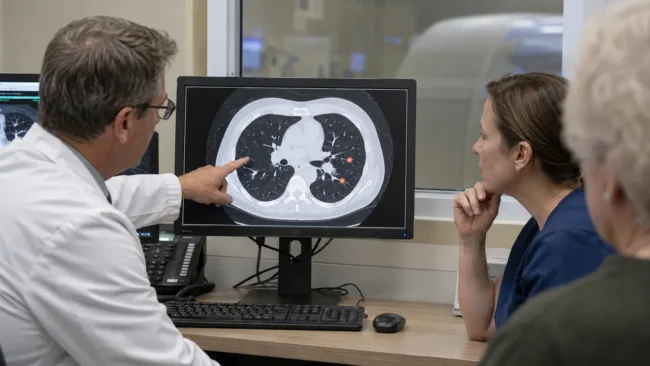
DELFI Diagnostics has received a New York State Department of Health Clinical Laboratory Permit and Test Approval letter for FirstLook Lung, its AI-powered, blood-based laboratory-developed test for lung cancer screening support. The approval allows the diagnostics-focused company to offer FirstLook Lung in New York, completing its authorization to serve health systems across all 50 U.S. states while it continues to pursue U.S. Food and Drug Administration approval for an in vitro diagnostic version of the test.
The development matters because New York is not just another state authorization. For laboratory-developed tests, New York’s clinical laboratory review process is widely treated across the diagnostics industry as one of the toughest state-level regulatory hurdles in the United States. That gives DELFI Diagnostics a stronger access story, a more credible quality signal, and a wider commercial runway at a time when blood-based cancer detection is trying to move from scientific promise into routine clinical workflows.
Why New York approval matters for DELFI Diagnostics beyond simple geographic expansion
The most immediate change is straightforward: FirstLook Lung can now be offered in every U.S. state. For a test designed to serve people who meet United States Preventive Services Task Force eligibility criteria for lung cancer screening, national availability removes a practical barrier for health systems, integrated delivery networks, and population health programs that operate across multiple jurisdictions.
The deeper significance is regulatory. New York’s review process has long carried symbolic weight because it requires formal assessment before a laboratory-developed test can be offered to patients in the state. For DELFI Diagnostics, passing that process gives the U.S.-based diagnostics developer a useful validation point as it advances a broader regulatory strategy. It does not equal U.S. Food and Drug Administration approval, and that distinction remains important. However, it does indicate that the company has cleared a demanding state-level quality and test-review process while building out its laboratory infrastructure.
The unresolved question is whether state-level approval and national availability can translate into durable clinical adoption. Lung cancer screening has not struggled only because of test access. It has also faced problems related to patient awareness, clinician referral patterns, low-dose computed tomography capacity, stigma around smoking history, reimbursement pathways, and follow-up adherence. DELFI Diagnostics has removed one access constraint, but it still has to prove that blood-based screening can fit into real-world workflows without creating confusion, over-testing, or gaps in confirmatory imaging.
How FirstLook Lung fits into the larger challenge of lung cancer screening uptake
FirstLook Lung is positioned as a convenient first step for individuals eligible for lung cancer screening under United States Preventive Services Task Force criteria. That positioning is important because lung cancer remains one of the most difficult cancer screening markets, despite the existence of guideline-recommended low-dose computed tomography for high-risk individuals.
The commercial logic is clear. A blood draw is easier to integrate into routine care than a separate imaging appointment, particularly for patients who are already undergoing regular laboratory work. DELFI Diagnostics is trying to use that convenience advantage to identify individuals at elevated risk and guide them toward low-dose computed tomography follow-up. In theory, that could help bring more eligible people into the screening funnel before symptoms appear, when lung cancer is more treatable.
The risk is that blood-based screening tools must be carefully positioned so they complement, rather than displace, guideline-backed imaging. FirstLook Lung has not been cleared or approved by the U.S. Food and Drug Administration, and it remains a laboratory-developed test. That means clinicians, payers, and health systems will likely evaluate it through a practical lens: does it improve screening participation, does it help prioritize follow-up, and does it reduce missed opportunities without adding unnecessary downstream burden? The test’s future depends not only on analytical performance, but also on how responsibly it is embedded into care pathways.
What fragmentomics and artificial intelligence add to the cancer diagnostics race
DELFI Diagnostics’ platform is built around fragmentomics, an approach that analyzes patterns of circulating cell-free DNA fragments in blood rather than focusing only on specific mutations. The company uses artificial intelligence to interpret these fragment patterns and support cancer detection. That makes FirstLook Lung part of a broader industry shift toward computational diagnostics, where signal detection depends on pattern recognition across complex biological data.
This is genuinely meaningful because cancer screening has historically been constrained by the difficulty of detecting early disease with enough sensitivity and specificity to be clinically useful. A fragmentomics-based approach may offer a different route by examining genome-wide fragmentation patterns associated with cancer biology. The value proposition is not just that the test uses blood, but that it may detect signals that conventional molecular approaches might not capture in the same way.
However, AI-powered diagnostics also introduce scrutiny. Regulators and clinicians will want clarity on model validation, reproducibility, population diversity, data quality, and performance across early-stage disease. A compelling negative predictive value can help build confidence, but adoption will depend on broader evidence around false positives, false negatives, downstream imaging rates, and clinical outcomes. In diagnostics, artificial intelligence is only as valuable as the clinical decisions it improves, and that is where DELFI Diagnostics will continue to face the hardest questions.
Why national availability does not remove the need for FDA clearance
The New York authorization strengthens DELFI Diagnostics’ laboratory-developed test pathway, but it does not eliminate the importance of U.S. Food and Drug Administration review. The diagnostics-focused company has described the permit as a meaningful marker on the path toward FDA approval of its in vitro diagnostic device for FirstLook Lung. That wording matters because the market increasingly distinguishes between laboratory-developed test availability and FDA-cleared or FDA-approved diagnostic platforms.
FDA authorization could change the commercial equation. It may support broader payer confidence, strengthen hospital procurement conversations, and make the test more attractive to health systems that prefer diagnostics with federal regulatory clearance. It may also become more important as the regulatory environment for laboratory-developed tests continues to evolve in the United States.
The remaining uncertainty is timing, evidence depth, and regulatory expectations. Novel blood-based cancer screening technologies are being evaluated not just for technical performance, but for whether they deliver clinically meaningful benefits at population scale. DELFI Diagnostics has built a stronger compliance and access foundation through CLIA certification, CAP accreditation, ISO 13485 certification, ISO 27001 certification, and now New York approval. Still, the transition from national laboratory-developed test access to FDA in vitro diagnostic approval is a separate test of clinical evidence, regulatory execution, and manufacturing-grade quality systems.
What health systems may watch before adopting FirstLook Lung more broadly
For health systems, the appeal of FirstLook Lung sits at the intersection of access, workflow, and population health. A blood-based test that can be integrated with routine laboratory work could help systems identify more eligible patients for lung cancer screening, especially in underserved populations where imaging access and screening adherence remain persistent barriers.
DELFI Diagnostics has emphasized electronic medical record integration as part of its strategy. That is a commercially important point because diagnostics adoption often fails when a test creates extra manual work for clinicians. If FirstLook Lung can be embedded into electronic medical record prompts, ordering systems, laboratory workflows, and follow-up pathways, it may become easier for health systems to deploy at scale.
The challenge is operational discipline. A blood-based risk signal is only useful if the follow-up system works. Health systems will need clear protocols for ordering, results communication, low-dose computed tomography referral, patient navigation, and documentation. If a positive or elevated-risk result does not lead to timely imaging, the value of the test weakens. If too many patients are routed into imaging without clear benefit, the test may face resistance from payers and radiology networks. The next phase of adoption will depend on evidence that FirstLook Lung improves the screening journey rather than simply adding another step.
How DELFI Diagnostics’ approval reflects the broader commercialization test for cancer screening startups
The cancer diagnostics market has become one of the most closely watched segments in life sciences because the upside is enormous and the hurdles are unforgiving. Blood-based cancer tests promise convenience, earlier detection, and broader access. Yet commercial success depends on a difficult mix of evidence generation, regulatory clarity, physician trust, reimbursement, health system integration, and patient follow-through.
DELFI Diagnostics now has a cleaner national access narrative than many early-stage diagnostics players. FirstLook Lung is commercially available as a laboratory-developed test across all 50 states, and the company has accumulated several quality and data security credentials that matter in institutional settings. That could help the company in conversations with hospitals, payers, and population health programs that need confidence in both laboratory operations and data governance.
The risk is that the diagnostics sector has seen many promising technologies struggle after launch because clinical utility takes longer to prove than analytical performance. A test can be technically sophisticated and still face slow adoption if physicians are unsure when to order it, payers are cautious about coverage, or health systems lack the infrastructure to manage follow-up. DELFI Diagnostics has cleared a meaningful access milestone, but the next commercial phase will test whether the company can convert regulatory credibility into routine clinical demand.
Why FirstLook Lung could become a test case for blood-based screening in underserved populations
One of the most important angles in DELFI Diagnostics’ strategy is access for historically underserved populations. Lung cancer screening has a known participation problem, and the burden often falls hardest on patients who face transportation barriers, limited specialist access, fragmented primary care, or lower engagement with preventive health services.

A blood-based test could be valuable if it brings screening conversations into settings where patients already receive care. Community clinics, primary care networks, employer health programs, and integrated health systems may find it easier to incorporate a blood draw than to immediately route every eligible patient into an imaging pathway. That could make FirstLook Lung a useful tool for identifying people who need follow-up with low-dose computed tomography.
However, the equity promise depends on implementation. A test that is technically available nationwide is not automatically accessible to all patients. Reimbursement, out-of-pocket costs, clinician education, language access, follow-up coordination, and imaging availability still matter. If DELFI Diagnostics can demonstrate that FirstLook Lung increases screening participation in populations that are currently missed by conventional pathways, the test could gain a stronger public health argument. Without that evidence, the access story may remain more aspirational than transformative.
What clinicians, regulators, and diagnostics investors are likely to watch next
Clinicians will likely focus on how FirstLook Lung performs in real-world screening-eligible populations and how results should be interpreted alongside existing lung cancer screening recommendations. The test’s reported negative predictive value is likely to attract attention, but clinicians will also want practical clarity around elevated-risk results, false-positive management, false-negative risk, and the appropriate relationship between blood testing and low-dose computed tomography.
Regulators will watch the company’s evidence package as DELFI Diagnostics advances toward FDA in vitro diagnostic approval. The key issue will be whether the company can support claims that are clinically meaningful, reproducible, and applicable across diverse patient groups. In cancer screening, regulators tend to scrutinize not only whether a test detects disease, but also whether the balance of benefits and harms is acceptable for broad use.
Industry observers will also watch whether DELFI Diagnostics can establish partnerships that turn FirstLook Lung into a workflow product rather than a standalone laboratory test. The future of blood-based cancer screening may belong to companies that can combine scientific performance with ordering simplicity, electronic medical record integration, payer alignment, and reliable patient navigation. In that sense, the New York approval is less an endpoint than a gateway into the harder phase of commercialization.
The strategic read on DELFI Diagnostics after its New York laboratory permit
DELFI Diagnostics’ New York approval gives FirstLook Lung national reach and adds a meaningful regulatory credibility marker to the company’s lung cancer screening strategy. It strengthens the case that the diagnostics-focused company has built a serious laboratory and quality infrastructure around a novel AI-powered fragmentomics platform.
The development is not a substitute for FDA approval, and it does not resolve the broader adoption challenges that have long limited lung cancer screening uptake. Still, it gives DELFI Diagnostics a stronger position from which to engage health systems, clinicians, and population health programs. The next phase will be judged less by state-by-state availability and more by clinical utility, workflow performance, reimbursement traction, and evidence that blood-based testing can move more eligible people into timely follow-up care.
For the cancer diagnostics sector, this is the real story. Blood-based screening is no longer only a laboratory science race. It is becoming a systems integration race. DELFI Diagnostics has just expanded its addressable market to every U.S. state. Now it has to prove that access can become adoption, and that adoption can translate into earlier detection where it matters most.
Key takeaways
- DELFI Diagnostics can now offer FirstLook Lung in New York, giving the blood-based lung cancer screening test availability across all 50 U.S. states.
- The New York State Department of Health approval is strategically important because the state’s laboratory-developed test review process is widely seen as one of the most rigorous in the United States.
- FirstLook Lung remains a laboratory-developed test and has not been cleared or approved by the U.S. Food and Drug Administration, making FDA in vitro diagnostic approval the next major regulatory milestone.
- The test’s long-term commercial success will depend on clinical utility, reimbursement, electronic medical record integration, low-dose computed tomography follow-up, and adoption by health systems serving screening-eligible populations.
- The broader implication is that blood-based cancer screening companies are now being judged not only on test performance, but also on their ability to fit into real-world clinical workflows.