When GE HealthCare and NXP Semiconductors N.V. took the stage at CES 2026 to showcase their collaboration, it marked more than a moment of tech theater. The partnership unveiled two forward-looking concept technologies that aim to apply edge artificial intelligence to some of the most demanding environments in medicine: the operating room and the neonatal intensive care unit. Although still in the conceptual stage and not cleared for market use, the demonstration raised important questions about where medical AI is heading and whether on-device intelligence can complement, or even surpass, cloud-based systems in real-time clinical decision support.
What stood out was the architectural shift. These were not cloud-reliant platforms funneling data into remote servers for batch analysis. Instead, the systems were designed to run entirely on local hardware using NXP’s application processors and neural processing units. By embedding inference engines directly into point-of-care devices, the collaboration signaled a strong belief that secure, low-latency edge AI could play a pivotal role in enabling safer, faster, and more context-aware interventions in acute care.
For GE HealthCare, the move builds on its Responsible AI strategy, which places clinician support and patient safety at the center of its digital innovation framework. For NXP Semiconductors N.V., the opportunity lies in extending its edge processing portfolio into the regulated world of healthcare, where security, explainability, and performance determinism are not just features but regulatory prerequisites.
Why edge AI is becoming a priority in time-critical, high-risk medical settings
The timing of this push toward edge artificial intelligence is no coincidence. Across hospitals globally, acute care environments are facing mounting pressures. In operating rooms, anesthesiologists must constantly monitor a stream of data from ventilators, monitors, infusion pumps, and alarms, often while coordinating with multiple staff members under time constraints. In neonatal intensive care units, clinicians are tasked with interpreting subtle behavioral or physiological changes in vulnerable infants, where seconds can make a difference. In both contexts, the introduction of edge AI promises to reduce response time, lower cognitive load, and allow for more proactive interventions.
What differentiates edge AI from conventional AI deployments in these scenarios is not just latency reduction. It is the architectural sovereignty it offers. Data is processed where it is generated, minimizing exposure to external systems and improving resilience during connectivity loss. This architectural decentralization also supports enhanced privacy, a growing concern in sensitive pediatric and surgical environments. With local inferencing, hospitals gain greater control over data flows and mitigate dependency on external cloud services, which may not always meet institutional data governance standards.
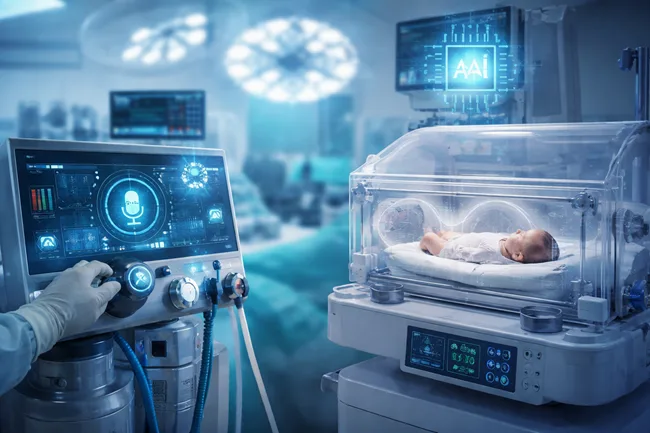
The systems previewed by GE HealthCare and NXP Semiconductors N.V. are not off-the-shelf upgrades. They reflect purpose-built workflows aimed at some of the most problematic friction points in acute care. For anesthesiology, the focus was on enabling hands-free voice interaction with anesthesia machines, reducing the need for tactile input during procedures. In the NICU, the emphasis was on intelligent posture and environment monitoring, where edge AI would detect if a baby was crying, had rolled over, or if an object had entered the crib, all without sending images to external databases.
How the voice-controlled anesthesia concept aligns with clinician workload reduction trends
Among the most talked-about elements of the CES 2026 showcase was the anesthesia system designed to accept real-time voice commands. In theory, this allows anesthesiologists to adjust settings or trigger functions without diverting their attention from the patient. The rationale is rooted in safety. Operating rooms are crowded, dynamic spaces where visual and manual interfaces can become bottlenecks or even hazards. By enabling voice-based control, the system aims to reduce alarm fatigue, improve workflow fluidity, and lower the risk of input errors under pressure.
But the leap from prototype to practice will not be frictionless. Experts familiar with operating room informatics note that voice recognition systems must contend with a variety of accents, background noise levels, and rapid shifts in command context. Regulatory scrutiny will be particularly high if these systems are intended to interface with life-supporting devices, meaning fallback modes, manual overrides, and audit trails will need to be fully hardened. Even then, widespread adoption may hinge on clinical validation studies that demonstrate improvements in response time, safety outcomes, or clinician satisfaction metrics.
Why the neonatal monitoring prototype illustrates the promise and pitfalls of agentic AI
In neonatal care, the edge AI prototype introduced by GE HealthCare and NXP Semiconductors N.V. was designed to identify key environmental and postural indicators, such as whether an infant has shifted into a prone position or whether an external object is in the crib. This aligns with the broader movement toward predictive and agentic monitoring, where AI systems autonomously identify deviations and alert clinicians without needing constant human supervision.
What makes this prototype distinct is its privacy-preserving architecture. All data processing occurs on-device using NXP’s eIQ AI Toolkit, ensuring that images or sound recordings never leave the physical hardware. For NICUs concerned about the ethical handling of sensitive video or audio data, this design may offer a blueprint for regulatory alignment.
Still, clinicians caution that real-world deployment of such systems requires more than proof of technical feasibility. Sensitivity thresholds must be finely calibrated to avoid false alarms, especially in overstretched care units where alert fatigue is already prevalent. Moreover, without integration into existing alarm escalation and triage systems, isolated devices risk becoming siloed tools rather than part of a holistic care environment.
What this collaboration reveals about the changing nature of medical AI partnerships
GE HealthCare’s decision to collaborate with a semiconductor firm on AI concept development is a sign of deeper changes within the healthcare technology ecosystem. Rather than building every software module or inference engine internally, large medtech companies are now forming hardware-software alliances to speed up innovation while offloading the burden of embedded system engineering to domain specialists.
For NXP Semiconductors N.V., this collaboration offers a chance to gain a foothold in a vertical with strong barriers to entry. The regulated medical device sector prizes long-term reliability, validated performance, and risk-managed deployment, which aligns with the company’s focus on secure embedded processing. If successful, the GE HealthCare collaboration could open doors for its eIQ AI Toolkit and application processors in other areas such as diagnostic imaging, remote patient monitoring, or connected therapeutics.
Such partnerships may also allow both companies to align with emerging frameworks for trustworthy AI. GE HealthCare has previously outlined its Responsible AI pillars, which prioritize transparency, fairness, and clinician-augmented decision-making. Embedding these principles into chip-level design and model architecture suggests a maturing view of how AI can be safely deployed in high-acuity environments.
What barriers remain before these prototypes can be translated into clinical tools
While the CES 2026 showcase drew attention, the road from concept to clinic remains long. Neither the anesthesia nor neonatal systems have been submitted for U.S. Food and Drug Administration approval, nor is there publicly available data on clinical trials or pilot deployments. Without demonstrated evidence of real-world benefit, safety validation, and workflow integration, these prototypes remain speculative.
Adoption is likely to hinge on whether the embedded AI can meet the strict performance validation and cybersecurity criteria required for acute care devices. Additionally, device manufacturers will need to navigate challenges around real-time software updates, maintenance of edge-deployed models, and integration with hospital IT infrastructures.
Another major variable is reimbursement. Without established billing codes or value-based care alignment, edge AI features risk being viewed as add-ons rather than necessity-driven tools. Insurers and hospital administrators will likely look for evidence of cost savings, reduced adverse events, or clinician time savings before considering deployment at scale.
A feature-forward outlook on agentic edge AI in frontline clinical care
The collaboration between GE HealthCare and NXP Semiconductors N.V. may not have delivered ready-to-launch products, but it has helped shift the conversation. In contrast to the heavily centralized, cloud-first approaches that have dominated medical AI over the past decade, these prototypes suggest a pivot toward embedded intelligence that acts locally, securely, and independently. For acute care workflows, where seconds matter and interruptions are costly, this model may offer a path forward.
The real test will be whether such systems can evolve from concept to clinical-grade infrastructure. If they do, they may mark the beginning of a new phase in medical AI, one defined less by how much data can be gathered and more by how intelligently and securely that data is used at the point of care.