Takeda Pharmaceutical Company Limited (TSE: 4502; NYSE: TAK) has received a plasma fractionation licence from the Ministry of Health of the Republic of Indonesia and plans to invest up to $30 million in a two-year pilot for a national plasma donation network. The first centre is expected to open in 2027 as part of the BioLife Plasma Services network, while plasma collected in Indonesia will initially be processed through Takeda’s existing global manufacturing system. A domestic plasma-derived therapy plant remains under feasibility and regulatory assessment rather than being a committed construction project.
The agreement addresses a supply challenge that starts well before a finished medicine reaches a hospital. Plasma-derived medicinal products depend on repeat donor participation, tightly controlled collection, infectious-disease screening, traceability, cold-chain logistics and manufacturing processes that can take many months. Immunoglobulins, albumin and clotting factors are used across immunology, rare diseases, bleeding disorders and critical care, making supply continuity a health-system issue rather than a conventional pharmaceutical inventory problem.
Indonesia therefore gains more than another foreign pharmaceutical investment announcement. The country is adding a global plasma collector and manufacturer to an emerging domestic ecosystem that already includes regulatory reform, blood-centre quality programmes and separate investment in local fractionation capacity. However, the staged design of Takeda’s programme also shows how far Indonesia must travel before locally donated plasma can be converted reliably, affordably and at scale into medicines for Indonesian patients.
Why does Takeda’s plasma licence move Indonesia forward without ending import dependence?
The plasma fractionation licence provides the legal foundation for Takeda Pharmaceutical Company Limited to collect Indonesian plasma and arrange its conversion into finished plasma-derived medicinal products. That is a meaningful change because Indonesia has historically depended heavily on imported plasma medicines even though donated blood can generate plasma that may be suitable for pharmaceutical production. Turning that theoretical resource into a dependable supply requires industrial controls that are considerably more demanding than routine blood collection for transfusion.
The immediate model nevertheless remains internationally dependent. Plasma gathered through the proposed BioLife Plasma Services centres will be sent into Takeda’s existing global fractionation network while the feasibility of an Indonesian manufacturing facility is studied. Indonesia may obtain a more secure route to finished medicines, particularly because domestic requirements are intended to receive priority under applicable regulations, but collection, international transportation, manufacturing and eventual reimportation will initially remain part of the supply chain.
This distinction matters when assessing claims of healthcare self-sufficiency. A local donor network can strengthen control over an essential raw material, generate workforce expertise and create a clearer connection between Indonesian donations and Indonesian medicine supply. It does not immediately remove exposure to overseas manufacturing capacity, freight disruption, currency movements, regulatory release timelines or global competition for finished immunoglobulin and albumin products.
Indonesia is also not beginning its plasma strategy from zero. The government has already encouraged domestic fractionation projects and supported the development of SK Plasma Core Indonesia in Karawang, West Java. Takeda’s programme is better understood as an additional strategic layer, particularly on the collection and multinational manufacturing side, rather than the country’s first attempt to localise the plasma supply chain.
Why will donor quality and repeat participation matter more than the number of plasma centres?
The $30 million initial commitment is directed toward a two-year pilot, not an immediately nationwide network with a disclosed number of centres. Its most important output will therefore be evidence about whether Indonesia can recruit and retain enough suitable donors while consistently meeting pharmaceutical manufacturing standards. A modern centre is useful only when it produces a predictable volume of qualified plasma without compromising donor safety, screening quality or public confidence.
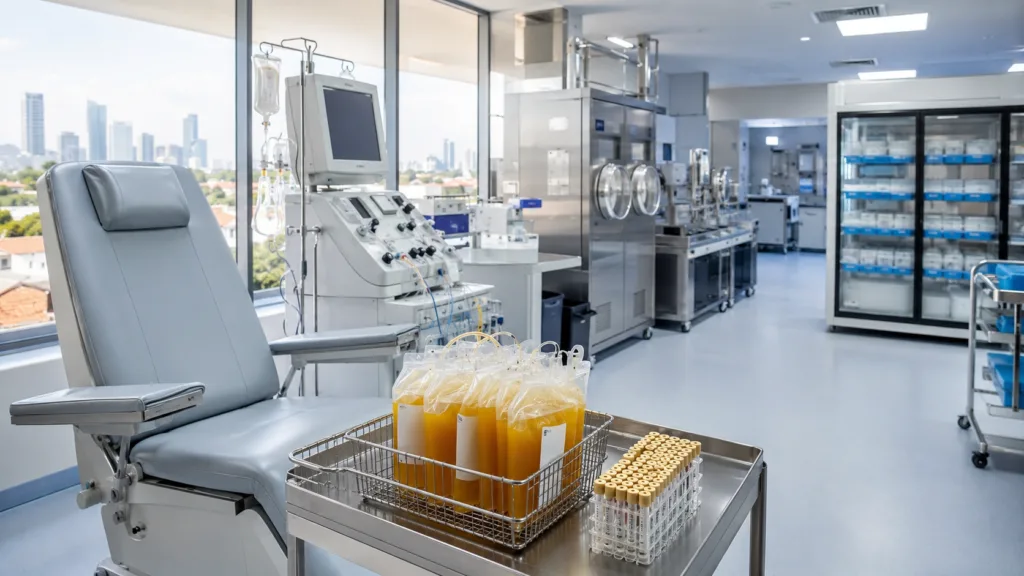
Plasmapheresis differs operationally from a conventional whole-blood donation programme. The procedure separates plasma and returns other blood components to the donor, allowing specialised collection but also requiring trained personnel, validated equipment, donor monitoring, reliable testing and comprehensive recordkeeping. The resulting plasma must retain an auditable chain of identity and quality from the donor chair through storage, shipment, fractionation and final product release.
Indonesia’s regulators have already identified some of the capability gaps involved. Blood collection units supplying plasma for pharmaceutical fractionation must meet good manufacturing practice requirements and develop detailed Plasma Master Files covering the origin, collection, testing and handling of the material. Earlier national programmes found that domestic collection organisations lacked experience preparing these files, prompting training involving the Indonesian Food and Drug Authority, the World Health Organization and international plasma specialists.
The BioLife pilot can help close that gap through operating procedures, training and technology transfer. Yet international processes cannot simply be copied without local adaptation. Donor recruitment, public understanding, collection-centre locations, transportation conditions and the regulatory treatment of donor incentives can all influence participation. Takeda and the Indonesian Government will need a model that is scientifically rigorous, socially trusted and financially sustainable after the initial investment period ends.
Can overseas fractionation improve Indonesian access before local production becomes viable?
Using Takeda’s established manufacturing network offers a potentially faster route to finished medicines than waiting for a new Indonesian plant to be designed, financed, constructed, validated and approved. Plasma manufacturing facilities are complex biological production assets. Building the physical plant is only one stage, followed by equipment qualification, process validation, regulatory inspection and the gradual establishment of reliable commercial output.
The global network could allow Indonesian plasma to enter production while domestic collection volumes are still developing. It may also give the pilot access to processes already used for different protein fractions, improving the potential yield from collected plasma. Fractionation economics generally become stronger when a manufacturer can recover several commercially useful proteins rather than relying on a single finished product.
However, the agreement does not yet disclose how much plasma the pilot is expected to collect, which products will be returned to Indonesia, how domestic priority will operate during periods of global scarcity or how prices will be determined. Those omissions are understandable at the pilot stage, but they will eventually decide whether the programme changes medicine access or primarily expands Takeda’s international donor base.
The manufacturing cycle creates another constraint. Plasma can take many months to pass from donation through testing, pooling, fractionation, purification, viral safety steps, quality release and distribution. A centre opening in 2027 will not translate into immediate finished-product availability. The earliest years are more likely to demonstrate collection quality and operational feasibility than deliver a large reduction in Indonesia’s import bill.
Why is a potential Takeda manufacturing plant still an option rather than a committed project?
Takeda Pharmaceutical Company Limited will assess the feasibility and regulatory requirements for a plasma-derived therapy manufacturing facility that could serve Indonesia and other markets. No site, capacity, product portfolio, capital budget, construction date or ownership structure has been announced. The $30 million figure therefore should not be interpreted as funding for a finished fractionation plant.
A positive investment decision will depend partly on whether the donation network generates enough consistently qualified plasma. Large fractionation facilities need dependable throughput to support their specialised equipment, quality systems and extensive fixed costs. If domestic collection volumes remain uneven, Takeda could find it more efficient to continue using established international plants even if the strategic case for Indonesian manufacturing remains attractive.
The competitive landscape will matter as well. Indonesia is already supporting other local fractionation investments, including SK Plasma Core Indonesia. Multiple programmes could strengthen national resilience by diversifying expertise and capacity, but they may also compete for the same pool of qualified donors and healthcare personnel unless collection targets and industrial roles are coordinated.
Takeda will also have to weigh the experience of its other capacity projects. The pharmaceutical manufacturer has been expanding its global plasma infrastructure, although rising construction and labour costs previously led it to reassess the scope and schedule of a major manufacturing project in Osaka. That experience reinforces why the Indonesian facility remains subject to a formal feasibility process. Plasma plants are strategically valuable, but they are not cheap, quick or forgiving assets to build.
How will diagnosis, reimbursement and hospital procurement determine the clinical impact?
A larger supply of plasma-derived medicines does not automatically create access for patients. Indonesia must also identify people with primary immunodeficiencies, bleeding disorders and other eligible conditions, ensure that clinicians recognise those conditions and establish pathways that move diagnosed patients into appropriate specialist care. Underdiagnosis can suppress visible demand even when the underlying clinical need is substantial.
Hospital procurement and reimbursement will be equally important. Immunoglobulin treatment can represent a significant recurring cost, while albumin and clotting products are often purchased through institutional or government channels. If reimbursement rules, tender budgets or hospital formularies do not expand alongside supply, locally connected production may improve availability without making treatment affordable to everyone who qualifies.
The product mix will also shape the value of the partnership. Indonesia’s needs are unlikely to be identical across intravenous immunoglobulin, subcutaneous immunoglobulin, albumin and clotting factors. The government and Takeda will need demand forecasts based on credible diagnosis rates, clinical practice and procurement data rather than broad population assumptions.
Training therefore needs to extend beyond collection-centre employees and laboratory technicians. Haematologists, immunologists, pharmacists, transfusion specialists, procurement teams and regulators will all influence whether the programme delivers measurable improvements. Useful indicators will include shorter medicine shortages, more diagnosed patients receiving treatment, reduced emergency procurement and greater predictability of hospital supply.
What does the Indonesia plasma investment mean for Takeda’s strategy and shares?
Plasma-derived therapies are already a material commercial franchise for Takeda Pharmaceutical Company Limited. The business generated 517.4 billion yen in revenue during the first half of fiscal 2025, with immunoglobulin demand remaining resilient on a constant-currency basis. Expanding the donor base and developing additional collection markets therefore supports an established growth platform rather than an experimental diversification.
The Indonesian pilot is modest relative to Takeda’s global revenue and capital programme. It is unlikely to change near-term earnings expectations, particularly because meaningful collection is not due to begin until 2027 and local manufacturing has not been approved. Its strategic value lies in creating an option on a large emerging market, widening geographic access to plasma and testing whether Southeast Asia can become a meaningful contributor to the global supply chain.
Takeda’s American depositary shares closed at $16.56 on July 10, before the announcement became available to United States investors. The shares had declined by approximately 1.3% over the preceding five trading sessions but remained about 4.7% higher over one month, within a 52-week range of $12.99 to $18.90. Tokyo-listed shares closed at 5,318 yen on July 13, down about 0.8% for the session.
That market performance does not establish a direct investor reaction to the Indonesian agreement. The announcement is better classified as a long-term capacity and market-access signal than a near-term stock catalyst. Investors are likely to reserve judgement until Takeda discloses collection targets, operating economics, product flows and a decision on whether to build the Indonesian manufacturing facility.
Which milestones will show whether Indonesia can become an ASEAN plasma medicines hub?
The first practical test will be whether Takeda opens the initial BioLife Plasma Services centre during 2027 as planned. The next will involve donor recruitment, qualified collection volumes, regulatory compliance and the ability to transport plasma into Takeda’s manufacturing network without quality failures or prolonged delays. Those operating metrics will reveal more than the number of memoranda, licences or planned locations.
A later decision to construct an Indonesian plant would mark a much larger commitment, but it should not be treated as the only measure of success. A reliable collection system connected to validated international fractionation could still improve access and build domestic expertise. Conversely, a new factory without sufficient qualified plasma, reimbursement support or clinical demand would risk becoming an expensive symbol rather than a resilient healthcare asset.
Takeda and Indonesia have established a credible starting structure: a licence, defined initial investment, two-year pilot, named collection network and scheduled first opening. The unanswered questions concern scale, economics and measurable patient access. The initiative becomes genuinely consequential when Indonesia can show that more locally collected plasma is returning as affordable, consistently available medicine for its own health system.