
Concord Technologies has released an American Hospital Association Market Scan Trailblazer report examining whether artificial intelligence can improve healthcare interoperability and create more efficient patient workflows. The report, titled “Applying AI to Achieve Interoperability and a Smarter Patient Workflow,” draws on research, industry interviews and a 2026 survey of 73 hospital leaders.
Its headline finding is that 64% of respondents believe artificial intelligence can accelerate interoperability across the healthcare ecosystem, while 9% disagree. That result suggests hospitals are increasingly considering artificial intelligence as a practical layer for processing and routing information, particularly when patient data arrives as unstructured documents rather than clean, standardized electronic records.
The finding should nevertheless be treated as directional rather than definitive. The survey involved a limited sample and was not designed to represent every United States hospital or health system. The report was also sponsored by Concord Technologies and includes the company’s own interoperability platform, making it a useful industry document but not an independent comparative assessment of competing technologies.
Why is healthcare AI increasingly focused on messy incoming documents rather than replacing data standards?
The most important argument in the Concord Technologies report is not that artificial intelligence can replace Fast Healthcare Interoperability Resources, Health Level Seven or other established data exchange standards. It is that standards alone have not eliminated the operational problem created when information reaches a hospital in inconsistent, incomplete or unstructured formats.
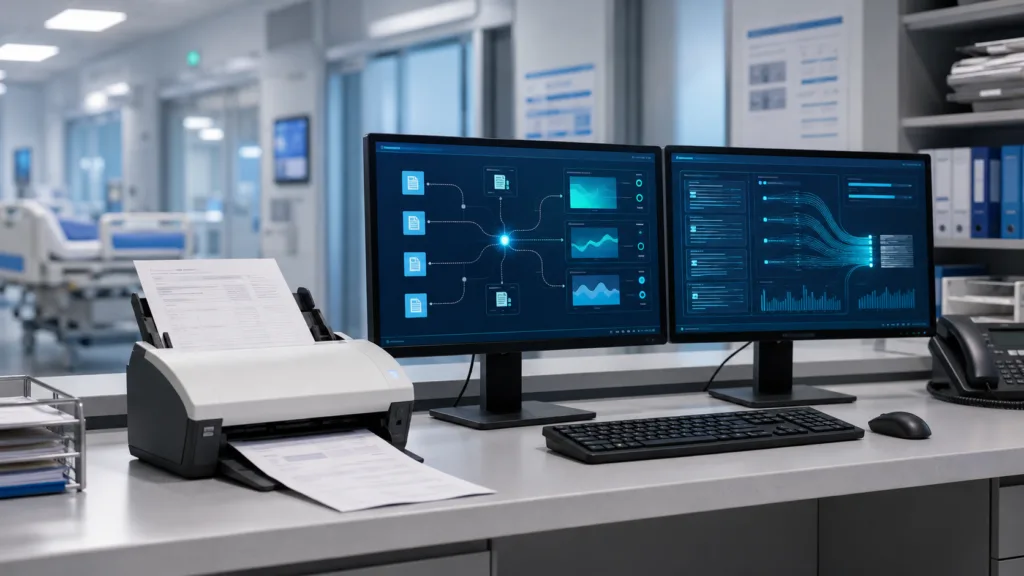
Healthcare organizations continue to receive clinical notes, laboratory results, referrals, prescriptions, prior-authorization documents and patient records through a mixture of electronic health record interfaces, secure messages, scanned documents, emails and faxes. Even when the underlying information is clinically valuable, employees may need to open the document, identify the patient, locate important fields, enter data into another application and route the record to the appropriate team.
Artificial intelligence can potentially reduce that manual work by recognizing document types, extracting patient identifiers, medical record numbers, diagnostic codes and test orders, and then sending the structured information into an electronic health record or workflow application. This is a narrower and more immediately commercial use of artificial intelligence than autonomous clinical decision-making, but it may be easier for hospitals to validate and scale.
The technology therefore operates as a bridge between the way information actually arrives and the structured environment in which hospitals want it to function. That distinction matters because an artificial intelligence model may make unstructured information usable without resolving every disagreement over how standards are implemented across different vendors and provider networks.
Artificial intelligence should not become an excuse to neglect standards. A model that extracts information still needs a reliable destination, an agreed data definition and an auditable method for handling exceptions. The more credible proposition is that artificial intelligence can complement standards by reducing the manual translation work surrounding them.
What does the 64% hospital sentiment finding reveal, and what does it leave unproven?
The 64% result indicates that hospital leaders increasingly see artificial intelligence as part of their interoperability strategy. It does not establish that 64% of hospitals have deployed such systems, achieved measurable savings or are ready to automate sensitive information flows without human review.
That distinction is essential. Executive enthusiasm can influence budgets and pilot programs, but production-level interoperability depends on data quality, system integration, staff adoption, security controls and the reliability of the specific model being used. A hospital may believe artificial intelligence will accelerate interoperability while remaining several years away from allowing it to process information without routine intervention.
The report also references academic evidence supporting the technical potential of large language models. In an experiment involving 3,671 clinical text snippets, FHIR-GPT achieved an exact-match rate exceeding 90% and improved the performance of existing natural-language processing pipelines across several medication-related data fields.
That is an encouraging technical result, but it should not be interpreted as a universal 90% accuracy guarantee for hospital artificial intelligence deployments. An exact-match result within a defined research dataset does not automatically predict performance across handwritten notes, low-quality scans, unfamiliar document templates, multiple languages, unusual abbreviations or patient records containing contradictory information.
The evidence is strongest when artificial intelligence is assigned a tightly defined task and its output can be compared with a known answer. Reliability becomes harder to establish when the model must infer clinical meaning, reconcile conflicting records or initiate actions affecting patient care. Hospital buyers will consequently need use-case-specific validation rather than broad assurances about model accuracy.
Why does the WakeMed case study make workflow economics the real test for Concord Connect?
WakeMed provides the report’s most commercially relevant example. The Raleigh, North Carolina-based nonprofit health system operates 973 beds, employs more than 12,800 people and manages a contact center that handles calls, appointments, patient-record transfers and more than one million incoming faxes every month.
WakeMed is using Concord Connect and Concord Cloud Fax to modernize those operations. The platform includes application programming interfaces, electronic health record connectors and artificial intelligence tools designed to move information into Epic and other downstream systems with fewer manual steps.
The scale of the fax workload makes the potential return easy to understand. Even a small reduction in the time required to classify, review and enter information could release thousands of staff hours across a year. Faster document processing could also help prevent referral backlogs, reduce call transfers and place clinically relevant information in front of care teams sooner.
However, the Concord-specific benefits described in the case study are largely prospective. WakeMed anticipates that automation will reduce processing time and help the health system scale without adding staff at the same rate as incoming data volumes. The report does not yet provide a completed before-and-after evaluation showing Concord Connect’s effect on processing costs, error rates, referral completion or patient waiting times.
This makes the next phase important. Hospital procurement teams will want evidence showing how many documents are processed without intervention, how frequently employees must correct extracted fields, whether patient-matching errors occur and how the platform performs when document quality deteriorates.
Successful automation should also improve the entire workflow rather than simply moving the bottleneck. Saving time during document intake has limited value if the information subsequently enters an understaffed work queue or requires another team to repeat the verification process.
Can artificial intelligence reduce administrative burdens without creating new clinical and compliance risks?
The report sensibly supports a human-in-the-loop approach, particularly when artificial intelligence output may influence care decisions. Under this model, the technology extracts, summarizes or recommends, while an authorized employee reviews the output and retains control over the resulting action.
That approach offers a reasonable entry point, but its economics depend on how much review remains necessary. If employees must compare every extracted field with the original document, automation may shift the work rather than eliminate it. If review is removed too quickly, an incorrectly matched patient, omitted allergy or misread medication could create a far more serious problem than an administrative delay.
Hospitals will need to establish different validation thresholds for different data. A scheduling request may tolerate a workflow in which low-confidence records are diverted to an exception queue. Medication information, diagnostic findings and urgent referrals require tighter controls because the consequences of an incorrect extraction can be considerably greater.
Privacy and security controls also remain central. Provider organizations need to understand where protected health information is processed, whether it is retained for model training, who can access it and how every automated action is logged. They also need procedures for monitoring model drift, investigating errors and withdrawing an artificial intelligence function if its performance deteriorates.
Interoperability is not merely the ability to move information between two systems. The information must remain accurate, attributable, secure and connected to the correct patient. Artificial intelligence that increases data movement without protecting those qualities could create faster but less trustworthy workflows.
Why will legacy systems and organizational readiness remain barriers even as AI capabilities improve?
The survey respondents identified vendor or technology limitations, legacy systems, staffing constraints, cultural resistance, costs and regulatory requirements as major barriers to interoperability. Organizational alignment, technical expertise, data quality, budgets and compliance were also cited as challenges to adopting artificial intelligence.
These findings weaken the idea that a more capable model can solve interoperability by itself. Artificial intelligence still needs access to incoming information, integration with existing systems, reliable patient identity management, routing rules, exception handling and an operating team capable of monitoring the workflow.
Legacy infrastructure can make each of those requirements harder. Hospitals may operate multiple electronic health records inherited through acquisitions, department-specific applications and older interfaces that cannot easily support modern automation. Adding artificial intelligence on top of that environment may improve particular processes, but it can also introduce another technology layer that must be maintained.
Staff acceptance is equally important. North Shore Community Health reportedly required approximately six to eight months to build confidence in its artificial intelligence-supported referral workflow. Support increased after employees saw reductions in the calls and emails needed to complete referrals and prescriptions.
That experience suggests adoption is driven less by executive presentations than by visible relief from frustrating daily work. Small pilots, phased deployments and clear communication about how employee responsibilities will change are likely to produce stronger results than organization-wide launches based primarily on technological enthusiasm.
How could the report strengthen Concord Technologies in the healthcare data exchange market?
Concord Technologies processes more than four billion pages of protected information annually, giving it an established position at the point where healthcare documents enter an organization. That intake layer is commercially significant because fax has shown remarkable resistance to retirement, while newer digital channels have added to the number of formats hospitals must manage.
Concord Connect is positioned as a unified intake and interoperability platform capable of receiving information, extracting relevant data and routing it into electronic health records and back-office systems. This creates an opportunity for Concord Technologies to expand from secure document exchange into higher-value workflow automation.
The strategy could be attractive to hospitals that want to modernize existing information flows without replacing their core electronic health record. It also allows Concord Technologies to build on infrastructure already used for document exchange and add artificial intelligence where the volume of repetitive processing provides a visible business case.
Competition will be substantial. Electronic health record vendors, cloud providers, intelligent document-processing companies and healthcare integration specialists are all pursuing portions of the same opportunity. Concord Technologies will therefore need to demonstrate that its healthcare experience produces better extraction accuracy, easier deployment and more dependable exception handling than broader automation platforms.
The report improves the company’s visibility and connects Concord Technologies with a major hospital industry organization, but independent production evidence will matter more than thought leadership. Provider buyers are likely to demand validated metrics, customer references and transparent information about how models are trained and monitored.
What should hospitals watch as AI-driven interoperability moves from pilot projects into production?
The most useful next evidence will come from scaled deployments. WakeMed’s project could become an important test if it reports measurable changes in processing time, document backlogs, patient-matching accuracy, contact-center performance and employee workload after implementing Concord Technologies’ platform.
Hospitals should also look beyond headline automation rates. A system that automatically processes 90% of documents may still create unacceptable risk if the remaining errors cluster around urgent or clinically complex records. Performance should be evaluated by document type, department, patient population and consequence of failure.
Another important measure will be whether artificial intelligence shortens the time between receiving information and acting on it. Faster extraction is valuable, but the patient benefit comes from quicker scheduling, completed referrals, fewer missed prescriptions, better care coordination and more complete information at the point of treatment.
The Concord Technologies report presents a credible near-term role for artificial intelligence as a translation, triage and workflow layer. It does not prove that artificial intelligence has cracked healthcare interoperability, and its limited, vendor-sponsored evidence should temper the headline optimism.
What it does show is that the industry’s interoperability debate is moving beyond standards compliance and toward operational execution. If Concord Technologies and other vendors can transform unstructured information into trustworthy, actionable data at production scale, artificial intelligence may not replace the healthcare interoperability architecture. It could finally make that architecture work more effectively where hospitals feel the friction most.