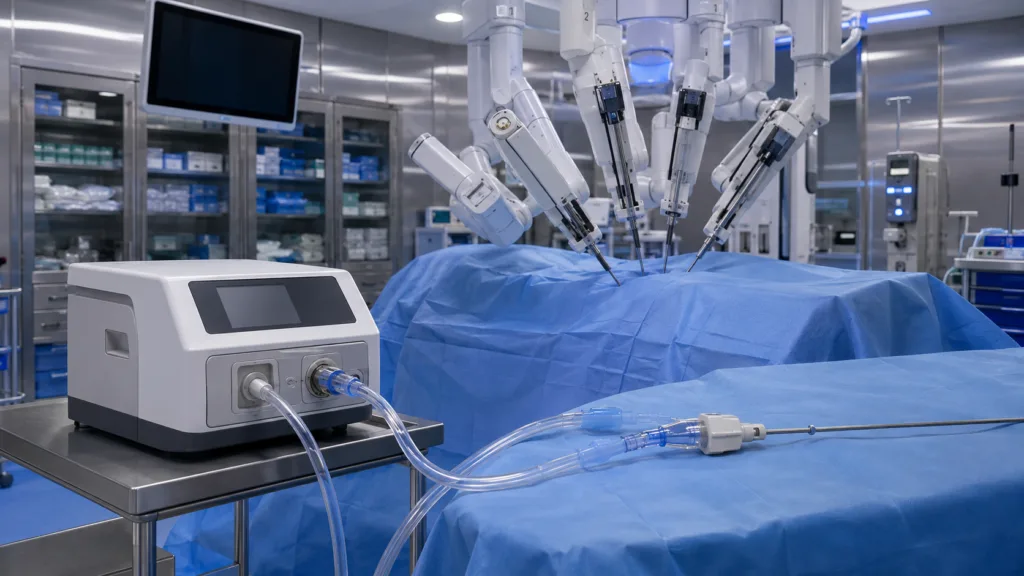
CONMED Corporation (NYSE: CNMD) has expanded the indicated use of its FDA-cleared AirSeal Robotic Solution to include the 8 mm hex cannula used with Intuitive Surgical’s da Vinci 5 robotic platform. The update extends the system beyond its existing compatibility with Intuitive Surgical’s 8 mm round cannulas, giving AirSeal an indicated configuration across the da Vinci X, da Vinci Xi and da Vinci 5 platforms.
The announcement is best understood as a device compatibility and workflow expansion rather than a new clinical efficacy claim. CONMED Corporation said the update was supported by extensive engineering and technical compatibility testing conducted with Intuitive Surgical, but it did not disclose new patient outcome data specifically involving the da Vinci 5 hex cannula.
That distinction matters. For hospitals investing in fifth-generation robotic surgery infrastructure, formally documented compatibility can determine whether an established insufflation and smoke evacuation system remains usable as operating rooms transition to a new robotic platform. For CONMED Corporation, the expansion protects AirSeal’s relevance within an important surgical ecosystem while creating an opportunity to place more capital systems and generate recurring demand for procedure-specific consumables.
Why does compatibility with the da Vinci 5 hex cannula matter to robotic surgery programs?
The AirSeal Robotic Solution is designed to maintain pneumoperitoneum, the gas-filled working space required during laparoscopic and robotic procedures, while continuously evacuating surgical smoke. The robotic configuration integrates AirSeal functionality through a cannula cap and bifurcated filtered tubing, allowing the technology to operate through the robotic port without requiring a separate AirSeal accessory port.
In practical terms, that can simplify the physical arrangement around the operating table. Robotic procedures already involve the surgical system, patient cart, instruments, vision equipment and several members of the operating-room team. Removing the need for another dedicated access port may help reduce equipment congestion and preserve access for the assistant surgeon, although the value will vary by procedure and institutional technique.
Compatibility became commercially important as Intuitive Surgical began deploying the da Vinci 5 platform following its U.S. Food and Drug Administration 510(k) clearance in March 2024. Hospitals moving from da Vinci X or da Vinci Xi systems need to know whether existing complementary products can be transferred into the new workflow without compromising device labelling, setup or performance.
The addition of the 8 mm hex cannula therefore closes a potential compatibility gap for CONMED Corporation. AirSeal was already indicated for use with Intuitive Surgical’s 8 mm round cannulas. Supporting both round and hex configurations allows CONMED Corporation to present AirSeal as a broader solution across the current da Vinci portfolio rather than as a product tied mainly to earlier platform architecture.
The expansion does not mean every hospital using da Vinci 5 will automatically adopt AirSeal. Robotic surgery programs typically standardise insufflation equipment through surgeon preference, value-analysis review, purchasing contracts, staff training and comparisons with competing systems. Documented compatibility is the admission ticket. Procurement approval and routine use remain the tougher part of the show.
What does the expanded indication establish, and what does it leave unproven?
In medical-device reporting, the word “indication” can be misunderstood as evidence of a newly demonstrated therapeutic benefit. Here, the central change concerns the compatible cannula configuration through which the FDA-cleared system can be used.
CONMED Corporation said the expanded indication was supported by engineering and technical compatibility testing conducted in collaboration with Intuitive Surgical. Such testing can evaluate whether the components connect correctly, maintain their intended functions and perform within specified operating parameters. It does not, by itself, demonstrate that use with the hex cannula reduces complications, postoperative pain, procedure time or hospital costs.
The announcement did not describe a new clinical trial comparing AirSeal through a da Vinci 5 hex cannula with AirSeal through a round cannula or with another insufflation platform. It also did not disclose a separate patient population, surgical specialty or new disease-specific indication arising from the change.
Hospitals will consequently need to separate two evidence questions. The first is whether AirSeal functions compatibly with the da Vinci 5 hex cannula. CONMED Corporation said its engineering work supports that conclusion. The second is whether using AirSeal produces clinically or economically meaningful advantages in particular da Vinci 5 procedures. That question depends on the wider clinical evidence, individual procedure type, insufflation pressure, comparator technology and local surgical practice.
Patrick J. Beyer, president and chief executive officer of CONMED Corporation, indicated that the collaboration with Intuitive Surgical was intended to give surgeons and hospitals clearer compatibility information. That emphasis is commercially sensible because hospitals are unlikely to introduce a complementary device into a robotic workflow when the compatibility status is uncertain or communicated only informally.
How strong is the evidence supporting AirSeal in low-pressure robotic surgery?
AirSeal has a larger clinical evidence base than the newly announced compatibility update alone might suggest, but the literature must be interpreted by procedure and study design. CONMED Corporation refers to more than 40 clinical studies involving AirSeal and low-pressure insufflation. Published research has examined respiratory parameters, surgical visibility, postoperative pain, subcutaneous emphysema, procedure duration and recovery-related outcomes.
A systematic review of AirSeal in robotic urologic surgery included 10 studies involving 1,765 patients. It reported improvements in several respiratory measures and identified studies suggesting lower complication rates with low-pressure pneumoperitoneum. However, the studies differed in procedure type, design, comparator, insufflation pressure and outcome definitions, limiting the extent to which the findings can be generalised across all robotic operations.
A 2024 randomised study involving 62 patients undergoing retroperitoneal robot-assisted partial nephrectomy found a lower rate of subcutaneous emphysema in the AirSeal group than in the conventional-insufflation group. The AirSeal arm also recorded differences in carbon dioxide measures, lens-cleaning frequency and certain postoperative pain assessments. Hospitalisation costs were higher in the AirSeal group, and the study was conducted at a single centre by an experienced surgical team, making broader cost and implementation conclusions premature.
More recent evidence is also entering the discussion. At the Society of Robotic Surgery 2026 Annual Meeting, Professor Nikhil Vasdev is scheduled to present findings from a prospective randomised trial involving 40 patients with localised prostate cancer who underwent robotic prostatectomy at an insufflation pressure of 8 mmHg.
The study compared AirSeal with Stryker Corporation’s PneumoClear Insufflator and reported fewer significant intraoperative nociceptive events per recorded hour in the AirSeal group. It also reported shorter procedure and console times and lower blood loss. The results were published in JUI Compass in May 2026.
These findings add clinical context but do not serve as direct validation of the new hex-cannula configuration. The prostatectomy study was small, focused on one procedure and measured nociceptive activity using an artificial intelligence-enabled device. Larger multicentre studies would be needed to determine whether the reported differences remain consistent across hospitals, surgical specialties and operator experience levels.
Could da Vinci 5 compatibility strengthen CONMED Corporation’s recurring-revenue model?
The strategic value of the announcement lies in preserving AirSeal’s access to a growing robotic surgery workflow. AirSeal combines a capital platform with procedure-related components, including filtered tubing and cannula-cap products. Greater compatibility can therefore support both equipment placement and recurring consumable utilisation.
The commercial opportunity will depend on the pace of da Vinci 5 installations and the number of procedures performed on those systems. It will also depend on whether hospitals treat AirSeal as a preferred component of their robotic programme or continue using existing insufflation alternatives.
Capital purchasing is only one layer of the adoption process. Hospitals must assess consumable cost per procedure, staff setup time, equipment servicing, storage requirements, compatibility documentation and whether any proposed clinical or operational savings can be reproduced locally. A product that performs well technically can still face slow adoption if it requires a new purchasing contract, changes established workflows or adds costs that are not offset elsewhere.
CONMED Corporation has not provided an incremental revenue forecast linked to the expanded indication. It also does not separately disclose AirSeal Robotic Solution revenue, making it difficult to calculate how much additional sales potential the hex-cannula configuration creates.
The update nevertheless aligns closely with management’s stated investment priorities. After reporting first-quarter 2026 results, CONMED Corporation said it was concentrating resources on higher-growth and higher-margin areas including minimally invasive surgery, smoke evacuation and orthopaedic soft-tissue repair. AirSeal sits directly within the first two of those priorities.
First-quarter sales were $317 million, down 1.3% from the previous year on a reported basis, partly because of CONMED Corporation’s exit from selected gastroenterology products. Management raised its 2026 organic constant-currency growth guidance, excluding gastroenterology sales, to between 5% and 6.5%. Reported full-year revenue was projected at between $1.35 billion and $1.375 billion.
The AirSeal expansion does not materially change that guidance on its own. Its significance is more likely to emerge through utilisation trends, general-surgery growth, capital placements and recurring sales over several quarters.
Why is CONMED Corporation’s stock sentiment being shaped by more than AirSeal?
CONMED Corporation shares closed at $41.88 on July 21, down 3.6% for the session, before indicating a modest premarket recovery following the AirSeal announcement. The company had a market capitalisation of about $1.26 billion, while its shares remained within a 52-week range of $31.44 to $56.64.
Recent trading has been unusually volatile. The stock gained approximately 26% over three sessions earlier in July after reports suggested CONMED Corporation was considering strategic alternatives following acquisition interest. The company declined to comment on what it characterised as unsubstantiated transaction speculation.
That background makes it difficult to interpret any short-term movement following the AirSeal update as a clean investor verdict on the product expansion. Merger speculation, earnings expectations and broader small-cap medical-device sentiment are likely to exert greater immediate influence.
The next substantial financial test comes on July 29, when CONMED Corporation is scheduled to report second-quarter 2026 results. Investors will be looking for evidence that underlying growth in minimally invasive surgery and other prioritised categories is offsetting the planned gastroenterology exit.
For AirSeal, the most informative future disclosures would include adoption by da Vinci 5 hospitals, changes in robotic procedure utilisation, capital placements, consumable growth and any measurable contribution to the General Surgery segment. Compatibility has now been established in the company’s product communication. The remaining test is whether hospitals translate that expanded label into routine use, repeat orders and durable revenue.