Ultromics has disclosed an American Heart Association AI Assessment Lab impact report suggesting that its EchoGo Heart Failure software could identify heart failure with preserved ejection fraction, or HFpEF, an average of 263 days earlier than standard diagnostic practice among patients whose diagnosis would otherwise be delayed. The July 22 report used retrospective real-world data and health economic modeling to estimate the possible clinical and financial consequences of deploying the United States Food and Drug Administration-cleared diagnostic aid across routine echocardiography workflows.
The headline results are substantial, but their evidence level requires careful interpretation. The assessment projected that earlier identification and treatment could prevent 477 deaths per 10,000 patients over five years while reducing hospital admissions, readmissions and emergency department visits. Those outcomes were generated by a model, however, rather than observed in a prospective study in which patients were managed with and without EchoGo Heart Failure.
That distinction does not make the report unimportant. It shifts its practical purpose. The analysis gives hospitals a structured business and clinical case for evaluating EchoGo, but it does not establish that installing the software will automatically produce the projected survival or cost benefits.
What does the 263-day advantage reveal about EchoGo’s potential role in HFpEF diagnosis?
HFpEF is particularly difficult to identify because patients can have heart failure despite retaining a left ventricular ejection fraction of at least 50%. Symptoms such as breathlessness, exercise intolerance, fatigue and swelling can overlap with obesity, lung disease, atrial fibrillation and other conditions, while resting echocardiographic findings may not provide a simple yes-or-no answer.
The assessment divided patients into early-detection and missed-detection cohorts using electronic health record information. Early detection was defined around an incidental HFpEF diagnosis within 90 days of an index transthoracic echocardiogram. The missed-detection group included patients who were not diagnosed within that period but were subsequently identified as having probable HFpEF after EchoGo was applied retrospectively.
Within that framework, the missed-detection cohort could potentially have been identified 263 days earlier had the algorithm been available at the index echocardiogram. The report also found earlier use of several heart failure therapies among patients whose conditions were recognized sooner, including sodium-glucose cotransporter 2 inhibitors, mineralocorticoid receptor antagonists and angiotensin receptor-neprilysin inhibitors.
The result supports a clinically credible proposition: useful disease signals may already be present in an echocardiogram months before the diagnosis becomes explicit in the medical record. It does not prove that every algorithm-positive patient would have received a confirmed diagnosis, started appropriate treatment or experienced a better outcome at that earlier date.
Why are the projected survival and hospital reductions more uncertain than the diagnostic finding?
For every 10,000 patients modeled over five years, the report projected 477 fewer deaths, 406 fewer hospital admissions, 501 fewer readmissions and 564 fewer emergency department visits. These are the figures most likely to attract attention from health system executives and payers, but they sit further down the chain of assumptions than the retrospective detection analysis.
The economic model assumed that identifying HFpEF before clinical decompensation would bring forward guideline-directed treatment and reduce subsequent acute care use. It used a Markov-based structure with 30-day cycles over five years, incorporating transition probabilities, healthcare utilization, mortality, treatment costs and quality-adjusted life years. Five thousand simulations were used to examine uncertainty, with the intervention judged cost-effective in 66% of simulations at a willingness-to-pay threshold of $150,000 per quality-adjusted life year.
These projections should therefore be read as an estimate of what might happen if earlier algorithmic identification leads to appropriate clinical confirmation, treatment and follow-up. They are not a measurement of what did happen after EchoGo-guided care.
A prospective implementation study would need to track whether algorithm alerts change physician decisions, how many suspected cases are confirmed, how quickly treatment begins and whether hospitalization or mortality differs from a comparable control pathway. That is the evidence capable of turning a compelling model into a demonstrated clinical-utility claim.
How does EchoGo Heart Failure work within the product’s cleared indication?
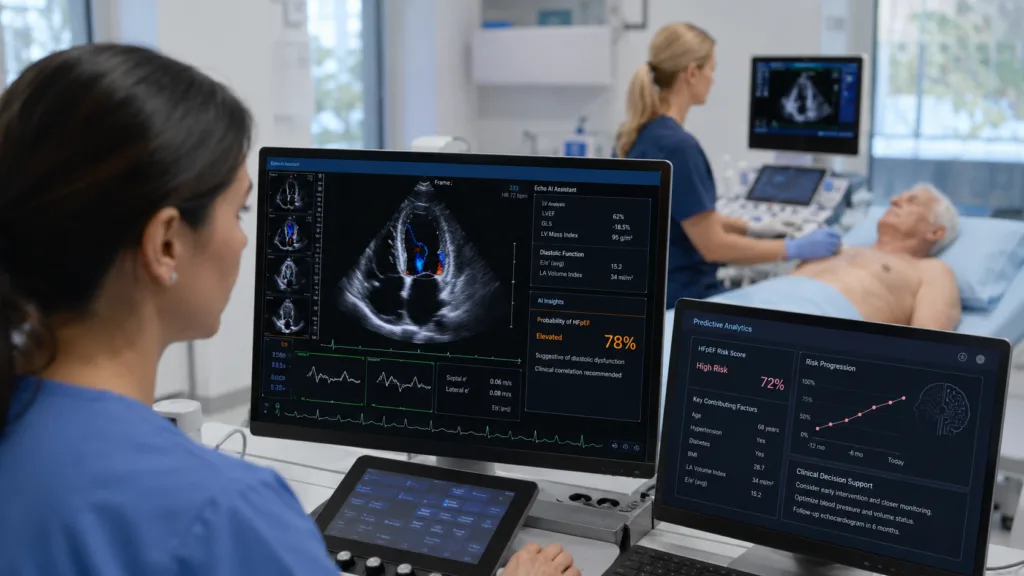
EchoGo Heart Failure 2.0 is a prescription-only, automated machine learning decision-support system. It analyzes a non-contrast, two-dimensional apical four-chamber echocardiographic video containing at least one complete cardiac cycle. The input must have been assessed as showing an ejection fraction of at least 50%.
The software produces a classification suggesting the presence or absence of HFpEF and an EchoGo Score ranging from zero to 100%. The score is interpreted against a predetermined decision threshold and displayed with a comparative population analysis.
Crucially, the device is an adjunctive diagnostic aid. It is indicated for adults over 25 undergoing routine functional cardiovascular assessment or evaluation for suspected heart failure. The final diagnosis remains the responsibility of the interpreting clinician and must incorporate the patient’s presentation, medical history and other diagnostic findings.
The United States Food and Drug Administration cleared the original EchoGo Heart Failure through the 510(k) pathway in 2022 and cleared version 2.0 in 2024. The latter incorporated the probability score, additional integration options and a model trained on more data. Describing the product as FDA-cleared, rather than approved, is important because the 510(k) pathway established substantial equivalence to a predicate device.
In the regulatory testing dataset for version 2.0, the algorithm was evaluated retrospectively across 1,578 patients from multiple sites in five United States states. Excluding scans that produced no classification, the device showed 90.3% sensitivity and 86.1% specificity. When the 116 unclassified studies were included, sensitivity was 84.9% and specificity was 78.6%.
That difference illustrates why operational performance matters. An algorithm’s reported accuracy can depend on how technically unsuitable or unclassified scans are handled, and real-world users will encounter image-quality variation that may not resemble a controlled validation dataset.
Could EchoGo’s workflow design make hospital adoption easier than other diagnostic technologies?
EchoGo has a potentially useful implementation advantage because it works with an echocardiographic view already captured during routine care. Ultromics describes the platform as vendor-neutral and cloud-based, with results returned through existing picture archiving and communication systems. It does not require hospitals to purchase a new imaging modality or add a separate patient procedure.
This lowers one barrier, but software integration is not the entire adoption equation. Health systems must establish which examinations will be analyzed, how algorithm-positive results will be communicated, which clinician owns the follow-up decision and what additional testing is required before HFpEF is confirmed.
Hospitals will also need to monitor false positives, false negatives, unclassified scans and performance across local demographic groups. A system that detects more suspected cases can create additional demand for specialist consultations, biomarker testing, exercise testing or invasive hemodynamic assessment. Those consequences may be clinically valuable, but they still consume capacity.
The impact report acknowledged that it did not incorporate several institution-specific considerations, including adoption expenses, model-monitoring frameworks, long-term maintenance, system replacement and bottlenecks created by additional incidental findings.
What do the financial projections mean for hospitals considering EchoGo adoption?
The report estimated that a representative health system performing approximately 70,000 transthoracic echocardiograms annually could generate about $1.9 million in additional revenue over five years. It also projected approximately $1,800 in savings per patient from both health system and payer perspectives.
The model assumed that roughly 46,000 of those annual scans would involve patients without an existing heart failure diagnosis. It estimated an 18% incidence of HFpEF among the screened population and included reimbursement assumptions connected to Category III Current Procedural Terminology code 0932T.
The positive budget projection depends heavily on local payer mix, reimbursement, algorithm pricing, eligible scan volume and successful clinical follow-up. A national model cannot reproduce the contracting conditions, staffing costs or downstream capacity of every hospital.
The report also stated that specificity and the downstream cost of false-positive results were not incorporated into the payer-focused economic model. This could overestimate net benefit because patients incorrectly flagged as suggestive of HFpEF may undergo additional testing or consultation.
For hospital procurement committees, the $1.9 million figure should be treated as a scenario for local validation, not a guaranteed return. A credible purchasing decision would require the institution to rerun the analysis using its own echocardiography volume, payer contracts, HFpEF prevalence, referral patterns and cost of diagnostic follow-up.
Does the subgroup analysis show that EchoGo can reduce disparities in HFpEF diagnosis?
Ultromics said the assessment indicated a higher likelihood of benefit among younger and non-white patients. The report linked missed diagnoses among non-white patients with greater hospitalization and readmission rates, creating a potentially stronger cost-effectiveness case for earlier identification.
This is an important hypothesis because diagnostic criteria and normal imaging ranges have historically been influenced by populations that do not fully reflect the diversity of patients receiving cardiovascular care. A tool that consistently identifies disease signals across demographic groups could help reduce some recognition gaps.
The current analysis is not sufficient to establish that EchoGo reduces health disparities. Because of lower numbers in individual demographic groups, the report combined Asian, Black, Hispanic, multiracial, other and unknown categories into a broad non-white population. That approach may support an exploratory economic analysis, but it can conceal meaningful differences in algorithm performance and baseline clinical risk.
Prospective studies should report sensitivity, specificity, false-positive rates, unclassified scans, treatment initiation and outcomes separately across adequately represented demographic groups. Equity cannot be demonstrated solely by showing that a model predicts greater benefit in a pooled subgroup.
Why does the American Heart Association relationship require transparent interpretation?
The assessment was conducted through the American Heart Association AI Assessment Lab, powered by Dandelion Health, using an independently curated real-world dataset and a standardized methodology. The lab is intended to help healthcare organizations evaluate the clinical, operational and financial implications of cardiovascular artificial intelligence technologies.
The report itself states that it is informational and does not represent an American Heart Association endorsement, certification, validation or regulatory approval. It also says the assessment should not be interpreted as confirmation that the association verified the algorithm’s accuracy, fairness or compliance with clinical and ethical standards.
Separately, American Heart Association Ventures previously invested in Ultromics. The release disclosed that relationship and said the AI Assessment Lab operates independently of the venture fund. Transparent disclosure matters because purchasers need to understand both the institutional connection and the limits of what the report represents.
For Ultromics, the assessment adds a meaningful third-party analysis to an evidence package that already includes regulatory clearance and technical validation. The decisive next step is prospective clinical-utility evidence showing that EchoGo-guided workflows consistently produce earlier confirmed diagnoses, appropriate treatment changes and better patient outcomes without creating excessive false-positive investigations. Until then, the report makes the commercial and clinical case for evaluation considerably stronger, but it does not close the evidence loop.