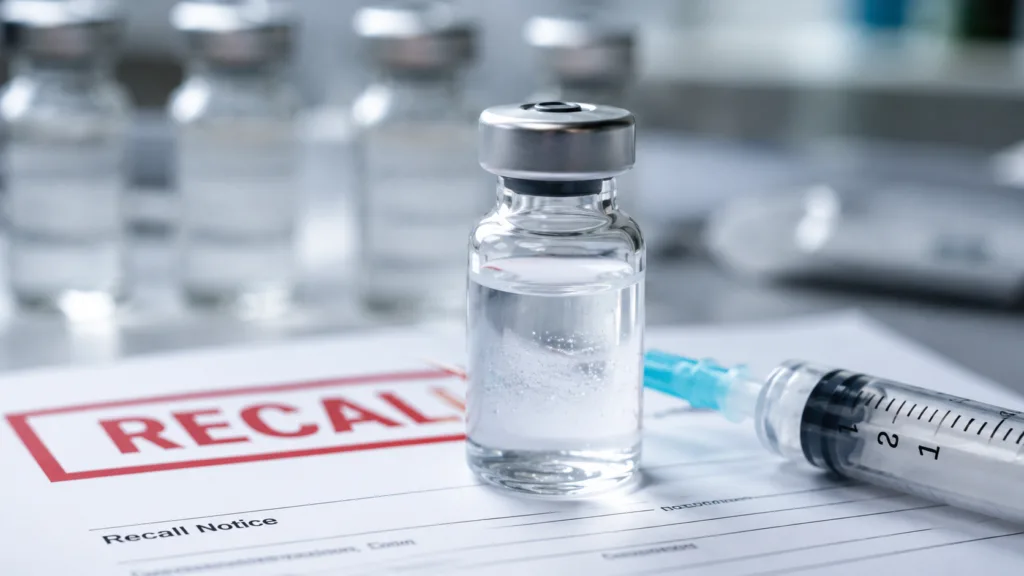
American Regent, Inc. has initiated a voluntary nationwide recall of one lot of Papaverine Hydrochloride Injection, USP, 60 mg/2 mL after visible particulate matter was identified as glass and/or paraformaldehyde. The consumer-level recall covers lot 25202, which was distributed in the United States beginning September 30, 2025 and carries an expiration date of November 30, 2026.
The company said it had received no reports of adverse events associated with the affected lot as of its July 24, 2026 announcement. However, American Regent’s risk assessment warned that particulate matter administered through an injectable product could cause local irritation or swelling and, if particles entered the circulation, could potentially block blood vessels supplying the heart, lungs or brain, resulting in complications including stroke or death.
The narrow, single-lot scope is reassuring compared with a product-wide or multi-batch withdrawal, but it does not make the issue operationally minor. Intravenous products bypass several of the body’s natural protective barriers, making the identity, size, number and distribution of contaminating particles important to the risk assessment. The central industry question is therefore not simply whether one lot has been removed, but whether American Regent’s investigation can demonstrate that the defect was isolated and that unaffected production remains adequately controlled.
Which Papaverine Hydrochloride Injection vials are included in the American Regent recall?
The recalled product is Papaverine Hydrochloride Injection, USP, supplied at a concentration of 30 mg/mL in a 2 mL single-dose vial, providing a total of 60 mg per vial. The affected carton bears National Drug Code 0517-4002-25 and contains 25 single-dose vials. Only lot 25202 was identified in the recall announcement.
That product-level precision matters because healthcare systems frequently hold medicines from multiple lots, manufacturers or distributors in the same pharmacy inventory. The recall notice does not state that every American Regent papaverine vial is affected, and it should not be interpreted as a withdrawal of all papaverine hydrochloride injection products. Inventory control must therefore be based on the complete combination of product name, National Drug Code and lot number rather than the generic drug name alone.
American Regent said distributors and customers were being notified by letter and that arrangements were being made for the return, replacement or crediting of affected inventory. Distributors, retailers and healthcare facilities holding the recalled lot were instructed to stop using it and either return it to the place of purchase or discard it in accordance with the applicable process.
Although the announcement described the action as a consumer-level recall, the product is a prescription intravenous medicine intended to be administered by or under the direction of a physician. In practical terms, the recall’s downstream reach means hospitals, clinics, pharmacies, distributors and any other recipients must determine whether lot 25202 remains in stock, has been transferred elsewhere or has already been used.
Why are visible particles in an intravenous drug treated as a significant quality defect?
Visible particulate contamination is a longstanding concern in injectable manufacturing because particles can originate from several sources, including glass containers, elastomeric components, manufacturing equipment, formulation precipitates or foreign material introduced during production. United States Pharmacopeia General Chapter 790 defines particulate matter as extraneous, mobile, undissolved material unintentionally present in injectable solutions and specifically identifies glass among the possible particle types.
The United States Food and Drug Administration has similarly said that visible particles in injectable products can jeopardize patient safety. Its draft industry guidance describes particulate control as a lifecycle responsibility involving product development, manufacturing controls, visual inspection, particle identification, investigation and corrective action. The agency has also cautioned that merely meeting a compendial inspection standard may not, by itself, satisfy all current good manufacturing practice obligations.
American Regent’s announcement is notable because it identified the material as glass and/or paraformaldehyde rather than reporting an unidentified particle. Glass contamination can be associated with damage, breakage, component interaction or the shedding of thin fragments from the internal surface of a vial, although the company has not disclosed the source in this case. FDA manufacturing guidance has previously described the potential for intravenous glass fragments to contribute to embolic, thrombotic and other vascular events.
Paraformaldehyde introduces a different quality question because it is not an intended component of the marketed formulation listed in the product label. The disclosed formulation contains papaverine hydrochloride with edetate disodium, sodium citrate, citric acid monohydrate and water for injection. American Regent has not publicly explained how the contaminant was identified, whether glass and paraformaldehyde were found in the same vial, or whether the wording “and/or” reflects uncertainty across multiple samples.
Those unanswered questions should not be filled with speculation about the manufacturing source. They do, however, define the scope of the investigation likely required to establish whether the event originated from vial handling, container integrity, equipment, cleaning processes, laboratory material, environmental contamination or another production-stage failure.
What does the absence of reported adverse events reveal about the recall’s actual risk?
American Regent’s statement that it had received no adverse-event reports connected with the recalled lot is an important factual limitation. It means the company had not identified a reported injury associated with the lot when the announcement was issued, not that contaminated units were necessarily administered without consequence or that every distributed vial contained visible particles.
Recall risk statements are designed to describe medically plausible outcomes associated with the defect, including severe outcomes that may be unlikely. They are not findings that those outcomes occurred. The mention of vascular blockage, stroke or death should therefore be reported seriously but proportionately, without converting a potential hazard into evidence of confirmed patient harm.
The exposure picture remains incomplete because American Regent did not disclose the number of vials or cartons distributed, the number remaining in commerce, the number examined during the investigation or the frequency with which particles were detected. It also did not state whether the problem was discovered through a customer complaint, routine retention-sample testing, stability monitoring, visual inspection or another quality-control process.
These details could materially change the interpretation of the event. A single damaged vial discovered through a complaint presents a different manufacturing signal from repeated findings across retention samples, even though both could justify a lot recall. Until more information becomes available, the most accurate conclusion is that American Regent identified a potentially serious defect, limited its public recall to one lot and reported no associated adverse events.
How will hospital pharmacies and distributors manage the papaverine recall operationally?
For hospital and pharmacy operations, the immediate challenge is traceability. Facilities must identify whether National Drug Code 0517-4002-25, lot 25202 is present in central pharmacy inventory, automated dispensing locations, procedure areas, emergency stock, satellite pharmacies or stock transferred to affiliated sites.
The distribution date creates a relatively long look-back period because the recalled lot entered nationwide distribution on September 30, 2025, almost ten months before the recall announcement. Some of the product may already have been administered, while remaining units could be dispersed across multiple storage locations. The November 30, 2026 expiration date also means the affected stock could still appear usable unless the lot-level recall information is checked.
Healthcare organisations will also need to document quarantine, return or disposal activity and reconcile the recalled quantity against purchasing and administration records. Where inventory has been further distributed, the recall communication must follow the product downstream. These actions are routine components of pharmaceutical recall management, but their effectiveness depends on accurate lot capture within procurement, inventory and medication-use systems.
The company has provided separate channels for customer service, pharmacovigilance, product-quality complaints and medical information. It has also directed adverse reactions and quality concerns to the FDA MedWatch reporting programme.
The recall notice included language advising affected users to stop using the recalled product and contact a healthcare provider. For industry coverage, that instruction should remain attributed to American Regent rather than expanded into independent medical advice. Clinical decisions concerning patients who may have received the product remain the responsibility of qualified healthcare professionals.
Why is the product’s unapproved drug status relevant to the regulatory context?
American Regent’s papaverine product page states that the drug is not FDA approved. DailyMed categorises the presentation as an “unapproved drug other” and carries a disclaimer that FDA has not found the product safe and effective and has not approved its labeling. The listed marketing start date for the American Regent National Drug Code is September 1, 1995.
This status is distinct from the recall itself. American Regent did not say the withdrawal was initiated because of the product’s regulatory category, labeling status or therapeutic use. The stated reason was the discovery of visible particulate matter in one lot.
Nevertheless, the distinction is important for accurate reporting because the product should not be described as an FDA-approved papaverine injection. It is a marketed prescription product listed in DailyMed, but its status does not correspond to approval under a modern new drug application supported by an FDA-reviewed safety and efficacy package.
The recalled presentation is labeled for intravenous administration. The labeling describes papaverine as a smooth-muscle relaxant used in conditions involving vascular or visceral smooth-muscle spasm, although the current recall concerns product quality rather than a newly identified pharmacological or indication-related risk.
Could the American Regent recall affect the availability of papaverine injection?
The announcement did not declare a shortage, suspend the entire product line or identify additional affected lots. DailyMed lists papaverine hydrochloride injection products associated with several packagers, including American Regent, Nexus Pharmaceuticals, Oryza Pharmaceuticals and BPI Labs, indicating that more than one labeled source exists in the United States market.
That does not guarantee that equivalent inventory is immediately available in every channel. Hospital access depends on wholesaler stock, contracting arrangements, presentation requirements, purchasing approvals and the availability of unaffected American Regent lots or alternatives from other suppliers.
The commercial impact will therefore depend on the quantity of lot 25202 still in circulation and whether American Regent can continue supplying unaffected production. A recall limited to one lot may be absorbed without widespread disruption, but purchasers will watch for product-availability notices, allocation changes or expansion of the recall.
No quantity in commerce was included in the announcement, making it impossible to estimate the proportion of American Regent’s papaverine supply affected. The company’s broader role as a provider of hospital injectables also makes containment and supply communication important beyond the direct financial value of one older generic product. American Regent is a member of the Daiichi Sankyo Group and operates a portfolio that includes multisource and branded hospital injectables.
What information will determine whether this remains an isolated single-lot recall?
The most important next development will be the outcome of the root-cause investigation. Regulators, healthcare buyers and quality professionals will want to know whether the particles came from the vial, closure system, filling process, production equipment, cleaning controls, laboratory handling or another source.
They will also watch whether testing of retained samples and neighbouring batches supports the current one-lot boundary. If evidence points to a component or process used across multiple lots, the recall could be expanded. If the defect can be traced to an isolated event with negative findings elsewhere, the single-lot scope may remain unchanged.
The July 24 announcement did not provide an FDA recall classification, an FDA-determined cause or a detailed corrective and preventive action plan. It stated that the recall was voluntary and being conducted with the knowledge of the United States Food and Drug Administration.
That distinction should be preserved. The notice describes a company-initiated voluntary recall rather than an FDA order, while FDA knowledge indicates regulatory awareness and oversight of the action. A later enforcement record may provide additional information on classification, distribution quantity, cause and recall status.
For American Regent, the decisive quality test is now broader than recovering lot 25202. The company must establish that it understands how glass and/or paraformaldehyde entered the affected product, demonstrate that other lots are not exposed to the same failure mode and maintain sufficient supply communication for hospitals that rely on injectable medicines.
The absence of reported adverse events and the recall’s single-lot scope prevent the announcement from being characterised as evidence of widespread patient harm. At the same time, the intravenous route and the identified particulate materials justify a serious response. Whether the episode closes as a contained batch defect or develops into a larger manufacturing issue will depend on the investigation, regulatory classification and any subsequent expansion or product-availability update.