EndoQuest Robotics, Inc. has completed enrollment in the PARADIGM Trial after investigators performed 50 robotic endoscopic submucosal dissection procedures across 49 subjects using the company’s Endoluminal Surgical System. The privately held medical device developer reported preliminary results including a 100% en bloc resection rate, a 95.8% R0 resection rate and no device-related bleeding or perforations identified in the available dataset as of July 18, 2026.
The completion of enrollment moves EndoQuest Robotics into a more consequential stage of the programme. The company must now complete follow-up, verify the data, finalise its statistical analysis and determine whether the evidence package is sufficiently robust to support its planned De Novo Classification Request to the United States Food and Drug Administration.
The Endoluminal Surgical System remains investigational, has not been cleared by the United States Food and Drug Administration and is not commercially available in the United States. The preliminary PARADIGM figures therefore represent an encouraging clinical development milestone rather than a regulatory decision, demonstrated commercial product or established standard of care.
What does completing 50 robotic ESD procedures establish for EndoQuest’s Endoluminal Surgical System?
PARADIGM, formally known as the Prospective Assessment of a Robotic Assisted Device in Gastrointestinal Medicine study, is evaluating the Endoluminal Surgical System in patients undergoing endoscopic submucosal dissection for selected lesions in the rectum and sigmoid colon. It is a prospective, multicentre, open-label clinical investigation without a randomised control group.
Procedures were performed by six investigators at five United States institutions. The investigator group included three colorectal surgeons and three gastroenterologists, giving the study a degree of cross-specialty participation that is relevant to the platform’s eventual clinical positioning.
Participating institutions included HCA Healthcare in Houston, Mayo Clinic in Scottsdale, Cleveland Clinic in Cleveland, AdventHealth in Orlando and Baylor St. Luke’s Medical Center in Houston. These are experienced clinical centres, which strengthens procedural oversight and data quality but also means the outcomes may not automatically predict performance at hospitals with less experience in complex therapeutic endoscopy.
The registered study population includes adults with benign rectal or sigmoid colon lesions considered suitable for standard endoscopic submucosal dissection. Eligible lesions can measure up to seven centimetres and occupy up to 75% of the colorectal circumference. Lesions showing characteristics that suggest invasive carcinoma are excluded from the planned treatment population.
Those criteria matter when interpreting the preliminary results. PARADIGM is not evaluating the system across every colorectal lesion, every anatomical location or every level of cancer complexity. The eventual authorised indication, should the United States Food and Drug Administration grant the De Novo request, could remain closely aligned with the population and procedures actually studied.
Enrollment completion also does not mean that every endpoint is final. PARADIGM assesses safety and effectiveness during the procedure, at discharge and through follow-up on Days 7 and 30. Certain subjects whose pathology is upstaged to cancer, or whose resection does not meet defined histological criteria, may undergo longer follow-up to assess outcomes including local recurrence, disease-free survival and overall survival.
The company’s immediate task is therefore to convert a promising procedural dataset into a complete and internally consistent clinical study report.
Why are the preliminary en bloc and R0 resection rates important but not yet definitive?
EndoQuest Robotics reported that all 50 procedures achieved en bloc resection, meaning that the target lesion was removed in one piece rather than through fragmented removal. En bloc resection is clinically important because it can support more reliable pathological examination of the lesion and its margins.
The company also reported a preliminary R0 resection rate of 95.8%. R0 resection generally means that microscopic examination found no residual lesion at the lateral or deep margins of the removed specimen. It is a more demanding measure than procedural completion because it incorporates pathological confirmation rather than relying only on whether the operator removed the lesion in a single piece.
PARADIGM’s registered primary effectiveness endpoint is the en bloc resection rate. Its primary safety measure assesses the proportion of subjects free from device-related bleeding and perforation complications through Day 30. R0 resection and conversion-free completion are secondary outcomes.
The company reported a 100% conversion-free rate, suggesting that investigators had not needed to switch to another technique to complete the intended resections. It also said no device-related bleeding or perforations had been reported in the preliminary dataset.
The wording “device-related” is important. It does not necessarily mean that no bleeding, perforation or other adverse event of any kind occurred. Final reporting will need to describe all procedure-related and device-related events, the methods used to determine causality, event severity, timing, treatment and whether complications affected hospitalisation or subsequent care.
The results were also preliminary and subject to ongoing follow-up, verification and database review. Until the database is locked and the prespecified analysis is complete, individual case classifications, endpoint denominators or pathology determinations may change.
Historical studies of colorectal endoscopic submucosal dissection provide useful context but cannot serve as a direct comparator. A systematic review of Western clinical experience reported pooled en bloc and R0 resection rates below the preliminary PARADIGM figures, while also documenting perforation and bleeding risks. However, differences in lesion size, location, investigator experience, case selection, pathology methods and procedural technique prevent a valid head-to-head conclusion.
The appropriate interpretation is that PARADIGM has produced a potentially competitive early signal. It has not established that robotic endoscopic submucosal dissection is superior to conventional endoscopic submucosal dissection, endoscopic mucosal resection or surgery.
Could EndoQuest’s flexible robotic system address the learning curve limiting colorectal ESD adoption?
Colorectal endoscopic submucosal dissection can provide one-piece removal of large or complex superficial lesions, but the technique is technically demanding. Operators must create and maintain a submucosal plane while manipulating tissue, controlling bleeding and avoiding damage to the thin colorectal wall.
Published learning-curve studies indicate that meaningful case experience, structured mentorship and prior advanced endoscopy expertise may be required before operators achieve consistent procedural efficiency. Some investigations have reported improvements after several dozen cases, although the number required varies considerably according to lesion complexity and the operator’s previous experience.
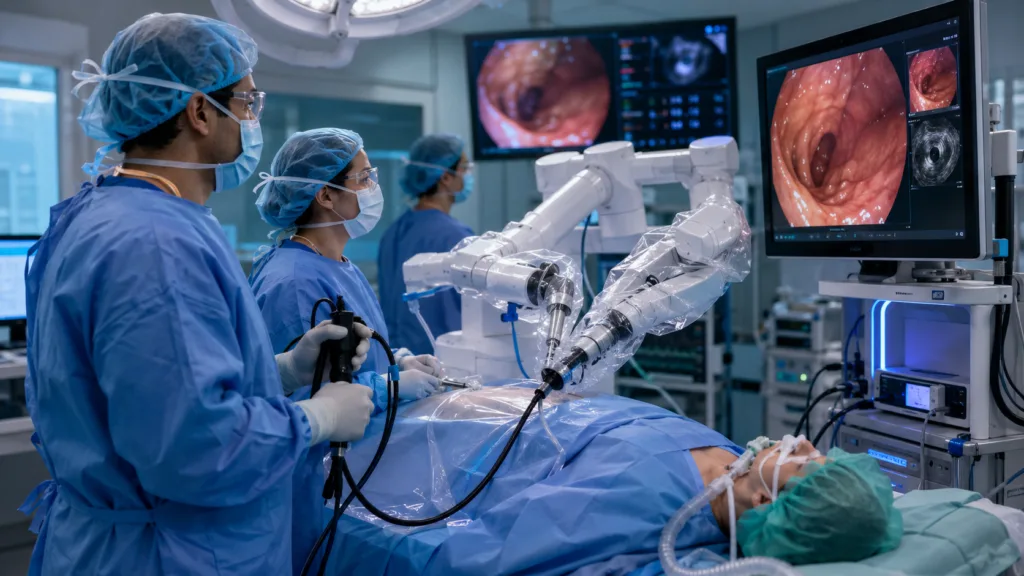
The Endoluminal Surgical System is intended to provide flexible access combined with robotically controlled instruments capable of tissue manipulation and dissection. Its architecture is designed to give the operator bimanual control within the gastrointestinal tract, potentially bringing surgical-style traction and countertraction to procedures performed through a natural orifice.
That capability could address one of the persistent limitations of conventional endoscopy. Standard flexible endoscopic instruments often move in relation to the endoscope and may provide less independent control than laparoscopic or robotic surgical instruments. A platform that stabilises the operating field and permits coordinated two-handed manipulation could make complex dissections more controllable.
PARADIGM’s use by six investigators from two different medical specialties is therefore notable. Successful procedures were not confined to a single inventor, lead investigator or specialty group. This reduces, but does not eliminate, the possibility that the findings reflect one exceptionally experienced operator.
The study does not yet establish that the system shortens the learning curve. That claim would require operator-level information showing how performance changed across successive cases, together with procedure times, dissection speeds, lesion complexity, instrument exchanges and the amount of support required from the company or trial team.
Training will remain a major commercial consideration. Hospitals will need to know how many supervised procedures are required, whether surgeons and gastroenterologists follow the same credentialing pathway, how competency is assessed and whether users can maintain proficiency with the procedure volumes available at their institutions.
The platform’s adoption prospects will depend partly on whether it can make technically demanding endoluminal surgery more reproducible, rather than merely helping already expert clinicians achieve strong outcomes at specialist centres.
What will the FDA examine in EndoQuest’s planned De Novo Classification Request?
The PARADIGM Trial is being conducted under an Investigational Device Exemption. An Investigational Device Exemption permits an investigational medical device to be used in a clinical study to collect safety and effectiveness evidence. It is not permission to market the device.
EndoQuest Robotics intends to use the PARADIGM results in a De Novo Classification Request. The De Novo pathway is generally used for novel medical devices considered to present low-to-moderate risk when there is no legally marketed predicate device suitable for a conventional 510(k) substantial-equivalence review.
A granted De Novo request would create a new device classification and establish the regulatory controls considered necessary to provide reasonable assurance of safety and effectiveness. The resulting device could subsequently serve as a predicate for certain future 510(k) submissions involving similar technologies.
The clinical results will be central, but the United States Food and Drug Administration review will extend beyond resection percentages. The agency may examine device reliability, software performance, instrument durability, biocompatibility, sterilisation, electrical safety, human factors, labelling, training controls and the company’s methods for detecting and reporting device failures.
For a robotic surgical system, usability evidence may be particularly important. The regulator will need to understand how operators respond to restricted movement, instrument conflicts, visual obstruction, loss of control, emergency withdrawal or conversion to another procedure. The review may also assess how the system communicates faults and whether users can recover safely from foreseeable failures.
The planned indication will shape the strength of evidence required. A narrowly defined use in endoscopic submucosal dissection of selected rectal and sigmoid colon lesions would be more closely supported by PARADIGM than a broad claim covering upper gastrointestinal procedures, full-thickness surgery, malignant lesions or other anatomical locations.
EndoQuest Robotics has not disclosed a confirmed date for its De Novo submission. Data verification, statistical analysis and completion of required clinical follow-up are expected to precede filing.
Why would hospital adoption depend on economics and workflow after regulatory authorisation?
A successful De Novo decision would remove a major regulatory barrier, but it would not guarantee rapid hospital adoption. Surgical robotics platforms require a broader implementation case than many single-use medical devices.
Hospitals must evaluate the acquisition cost, installation requirements, room configuration, instrument supply, maintenance arrangements, service response times and expected procedure volumes. Procurement committees will also assess whether the system requires dedicated infrastructure or competes for space and capital with established surgical robots and advanced endoscopy equipment.
Procedure economics could become decisive. EndoQuest Robotics will need to demonstrate whether the system reduces procedure time, lowers complication-related costs, shortens hospital stays, prevents recurrence, avoids surgery or expands the number of lesions that can be treated endoscopically.
A strong en bloc resection rate may support the clinical argument, but procurement teams usually require a measurable financial and operational benefit. A technically successful system that adds substantial setup time, disposable costs or staffing requirements could face resistance even when clinicians value its dexterity.
Reimbursement will also require careful positioning. Existing payment pathways may cover the underlying endoscopic procedure rather than provide additional reimbursement specifically for robotic assistance. Hospitals could therefore be asked to absorb the incremental technology cost unless improved outcomes, higher throughput or avoided surgical expenditure offset the difference.
The likely users add another layer of complexity. EndoQuest’s system sits at the intersection of gastroenterology and surgery. Institutions will need to decide which department owns the platform, which specialists may operate it and how revenue, scheduling and service responsibilities are allocated.
The involvement of both colorectal surgeons and gastroenterologists in PARADIGM may ultimately strengthen the commercial proposition, but multidisciplinary adoption can also complicate purchasing and credentialing decisions.
How does the PARADIGM milestone position EndoQuest within flexible surgical robotics?
Flexible endoluminal robotics is emerging as a distinct segment within medical robotics. Its commercial thesis is that some gastrointestinal lesions and other conditions could be treated through natural orifices using platforms that combine flexible navigation with the dexterity associated with robotic surgery.
The approach differs from conventional rigid robotic surgery, which typically requires external incisions and access ports. It also differs from standard therapeutic endoscopy by offering independently controlled instruments intended to improve tissue manipulation, traction and precision.
Several academic groups and medical technology developers are investigating robotic endoscopic platforms, but much of the field remains in preclinical, feasibility or early clinical development. Completing enrollment in a multicentre United States pivotal study gives EndoQuest Robotics a comparatively mature clinical evidence package within this developing category.
The company raised additional Series D financing in 2025 to support PARADIGM, its United States regulatory pathway, upper gastrointestinal feasibility work and advanced visualisation programmes. It has also discussed integrating newer computing and visualisation capabilities into future generations of the platform.
Those development programmes could broaden the long-term opportunity, but they should be separated from the current regulatory case. PARADIGM is focused on defined colorectal procedures. Success in that indication would not independently validate upper gastrointestinal surgery, autonomous functions or artificial intelligence-supported applications.
EndoQuest Robotics must therefore balance platform ambition with regulatory discipline. Establishing one credible and commercially workable indication may be more valuable than pursuing multiple potential uses before the core system has completed review.
What milestones will determine whether PARADIGM becomes a commercial inflection point?
The first milestone is completion of the 30-day follow-up required for the primary safety assessment. EndoQuest Robotics must then verify the clinical records, reconcile pathology findings, classify adverse events, lock the database and complete the final statistical analysis.
Publication or detailed scientific presentation of the complete dataset would provide clinicians with information that is not available from the preliminary percentages alone. Important details include lesion characteristics, procedure duration, investigator-level outcomes, learning effects, hospital stays, adverse-event severity, conversion criteria and the reasons that some resections did not meet the R0 definition.
The next regulatory milestone will be submission and acceptance of the De Novo Classification Request. Acceptance would indicate that the application is sufficiently complete for substantive review, but it would not predict whether the request will ultimately be granted.
During review, the United States Food and Drug Administration could request additional analyses, testing, labelling changes, manufacturing information or clinical clarification. The timing and scope of those interactions will influence the company’s ability to prepare manufacturing, training and commercial infrastructure.
EndoQuest Robotics will also need to show that it can produce systems and instruments consistently under medical device quality requirements. A robotic platform’s commercial performance depends on manufacturing yield, component availability, instrument reliability, technical support and the ability to service installed systems without disrupting scheduled procedures.
PARADIGM has moved the Endoluminal Surgical System beyond an early feasibility narrative. The study has generated preliminary multicentre evidence suggesting that complex colorectal lesions can be removed with high procedural and histological success using the investigational platform.
The decisive test now changes from whether investigators can perform robotic endoscopic submucosal dissection to whether the complete evidence can withstand regulatory review and support a practical hospital adoption model. Final safety data, the precise authorised indication, operator training requirements and procedure economics will determine whether the encouraging PARADIGM results become the foundation of a viable new surgical robotics category.