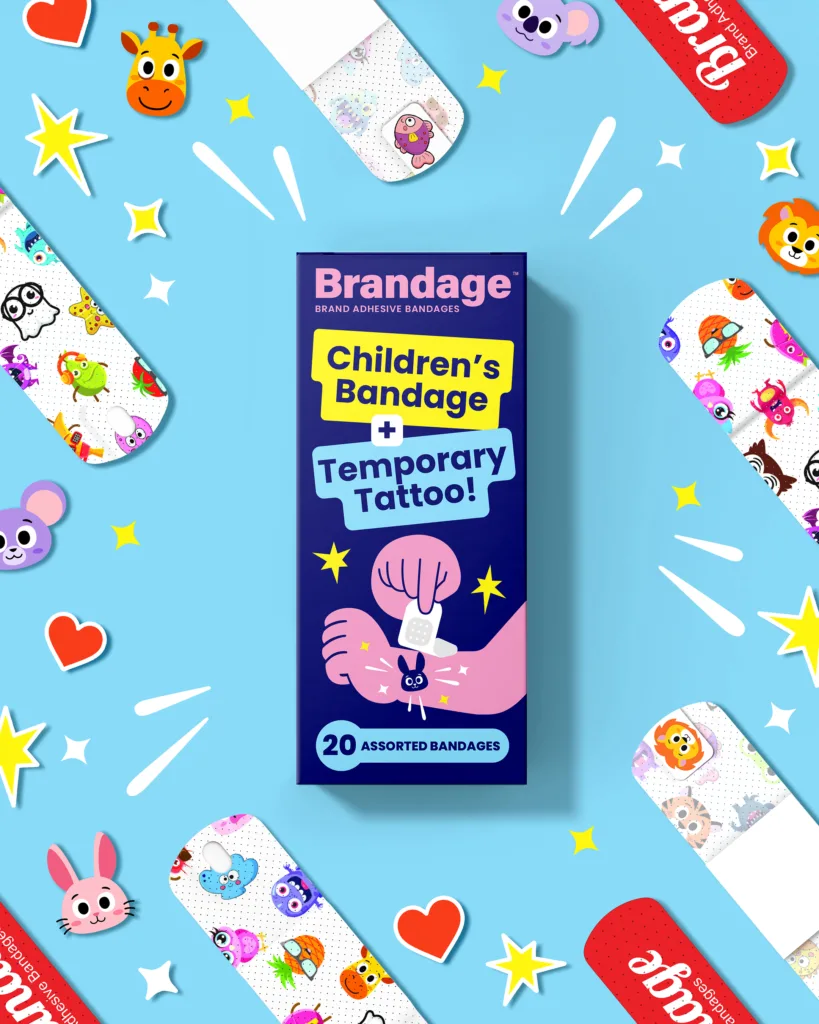
Antix LLC plans to present its Brandage children’s adhesive bandages to wholesale buyers at ASD Market Week in Las Vegas from August 25 to August 27, 2026. The product combines a conventional sterile adhesive bandage with a moisture-activated temporary tattoo that transfers to the child’s skin during removal, positioning the normally disliked peeling process as a reward rather than simply another uncomfortable stage of wound care.
The event should be understood as a wholesale expansion milestone rather than Brandage’s first appearance in the consumer market. Brandage had already received a National Parenting Product Award in 2023 and has been offered through the company’s direct-to-consumer website, while ASD Market Week’s exhibitor directory now lists the product among its baby and children’s merchandise participants. Antix is therefore using the Las Vegas show to test whether an idea that has generated interest among parents can translate into retail orders, shelf space and repeat commercial demand.
The product’s central proposition is easy to communicate. When the bandage is ready to be removed, a parent or caregiver presses a wet paper towel over the tattoo area for about 30 seconds. The water softens the adhesive while activating the image transfer, leaving the temporary tattoo on the skin when the bandage is peeled away. Antix says this process can make removal less intimidating and encourage children to accept wound coverings more readily, although the materials reviewed do not include comparative clinical evidence measuring pain, anxiety, wearing time, wound outcomes or infection rates.
Why is Antix LLC using ASD Market Week to move Brandage beyond online novelty sales?
ASD Market Week gives Antix access to a different commercial audience from the parents who purchase directly through an online store. The event describes itself as a major United States wholesale merchandise show and is scheduled to bring buyers and vendors together across more than 19 product categories at the Las Vegas Convention Center. Brandage is listed in the baby and children’s product directory, creating an opportunity to reach independent retailers, pharmacies, gift stores, toy sellers, convenience operators and other merchants looking for differentiated consumer products.
That wholesale setting is important because Brandage is not competing only as a wound-covering product. It is also being presented as a child-focused experience, a small reward item and a potentially giftable addition to family first-aid purchases. This positioning may help the product avoid a direct price-only comparison with commodity adhesive bandages, but it also means retailers will evaluate it through the standards applied to novelty and impulse merchandise. Packaging visibility, demonstration simplicity, reorder rates and the speed at which parents understand the tattoo-transfer mechanism may matter as much as conventional clinical or technical differentiation.
The company’s direct sales pricing reinforces that premium positioning. At the time of review, the Brandage website listed a single box at $9.95, with discounts for multiple boxes. A detailed product page describes a 20-bandage package containing 10 regular-sized bandages with the tattoo-transfer feature and 10 smaller bandages without it. The resulting value proposition depends heavily on whether parents view the temporary tattoo as a meaningful benefit rather than a short-lived novelty.
How does the Brandage temporary tattoo mechanism change the bandage-removal experience?
Brandage is built around a behavioural design idea rather than a new therapeutic mechanism. The bandage still performs the familiar role of covering a minor wound, while the tattoo introduces anticipation at the point of removal. Instead of treating peeling as the unpleasant conclusion to the process, the product attempts to give children a reason to cooperate with it.
This may be commercially useful because children’s first-aid products often rely on colours, characters and decorative designs to reduce fear. Brandage extends that concept by allowing part of the visual experience to remain after the bandage is removed. The child does not merely choose a decorated wound covering; the removal itself activates the reward.
The distinction matters, but it should not be overstated clinically. Antix says the addition may help reduce removal-related anxiety and discomfort, yet no controlled study was presented comparing Brandage with standard adhesive bandages. The announcement also does not establish that children keep the bandages on longer, experience less pain or achieve better wound outcomes. The product’s near-term evidence is therefore best characterised as consumer feedback and design plausibility rather than demonstrated clinical utility.
The 2023 National Parenting Product Award provides some evidence that families understood and liked the concept. Evaluators described children as being more willing to wear the product because they expected a temporary tattoo at removal. Those observations are useful for early product validation, but they are testimonials from a consumer product evaluation rather than a prospective clinical study or independently measured adherence assessment.
What does the United States regulatory framework mean for the Brandage bandage and tattoo combination?
Medical adhesive tape and adhesive bandages generally fall within Class I under United States Food and Drug Administration regulation 21 CFR 880.5240. The relevant adhesive tape and bandage product category is ordinarily exempt from the 510(k) premarket-notification process, although manufacturers remain responsible for applicable general controls, establishment requirements, device listing, labeling, quality and other regulatory obligations. The classification should therefore not be described as an FDA approval of Brandage or as evidence that the product performs better than other bandages.
The temporary tattoo component adds a separate regulatory consideration. Antix describes its tattoos as being made in the United States with cosmetic-grade inks and as FDA-compliant. That language is a company representation and is not the same as the FDA approving the finished temporary tattoo product.
The FDA explains that cosmetics generally do not require premarket approval, apart from requirements applying to colour additives. Temporary tattoo products must use colours permitted for their intended application, comply with relevant restrictions and carry required ingredient information when sold at retail. The agency has also received reports of reactions to some decal-type temporary tattoos, meaning compliance language should not be interpreted as a guarantee that no user could experience irritation or sensitivity.
For Antix, clear labeling will be particularly important because the product sits at the intersection of a medical device and a cosmetic-style reward. Retail packaging will need to distinguish the wound-covering function from the decorative tattoo, explain the water-transfer procedure and identify any age, use or skin-contact precautions. Retailers may also seek documentation showing that the inks, adhesives and other skin-contact materials meet the applicable requirements for their stated uses.
Which manufacturing and safety questions could influence retailer confidence in Brandage?
Antix says the product is sterile, is not made with natural latex and undergoes final converting and assembly in Northern California. The company’s current website indicates that the underlying bandage materials are made in China, the temporary tattoo materials are produced in the United States, and final design, engineering and manufacturing activities take place in California. This is a more precise description than treating the entire product as exclusively manufactured in Concord.
The website also says Antix uses a gas-free sterilisation process. However, it does not identify the sterilisation modality or disclose validation information in the public product materials reviewed. That absence does not indicate a quality problem, but wholesale buyers, pharmacy chains and larger retail organisations may request more detailed specifications before committing to volume purchases.
Commercial scale will create another operational test. Brandage currently offers more than 100 tattoo characters across the wider product line, according to Antix, and plans additional glow-in-the-dark, metallic, limited-edition and tween-focused designs. A growing design catalogue may strengthen consumer interest, but it can also increase inventory complexity, packaging variation, production forecasting and quality-control requirements.
Glow-in-the-dark products could require especially careful formulation review. United States rules restrict which colour additives may be used for particular cosmetic applications, and a planned design concept should not be treated as commercially ready until its ingredients, intended use and labeling have been assessed. The company has not yet disclosed launch dates, formulations or retail commitments for these future variants.
Can Brandage create repeat demand in a crowded and price-sensitive first-aid category?
Brandage’s strongest commercial advantage is that its differentiating feature can be demonstrated within seconds. A buyer does not need a lengthy technical presentation to understand the concept of wetting a bandage, removing it and revealing a tattoo. This clarity is valuable at a high-volume wholesale show where small brands compete for limited attention.
The challenge is converting that initial reaction into sustained purchasing. Novelty can secure a trial order, but repeat demand requires parents to believe the bandage performs reliably, transfers the tattoo consistently and justifies its price. Incomplete tattoo transfer, premature bandage detachment or unclear instructions could weaken the experience on which the entire premium proposition depends. Antix’s own frequently asked questions emphasise the need for sufficient water, pressure and a 30-second application period, showing that correct technique affects whether the feature works as intended.
Merchandising will also shape performance. Brandage could fit within conventional first-aid shelves, children’s healthcare sections, travel kits, gift assortments or checkout displays. Each location attracts a different buyer mindset. A pharmacy shopper may prioritise wound protection and skin compatibility, while a gift or toy customer may respond more strongly to the tattoo designs. The company will need packaging that presents both functions without making the medical purpose appear secondary.
Retailers are also likely to examine wholesale margin, minimum order quantities, replenishment lead times, return rates and liability documentation. None of those commercial terms was disclosed in the announcement. ASD Market Week can generate buyer conversations, but a trade-show appearance alone does not establish national distribution.
What would demonstrate that the ASD Market Week debut has become a meaningful commercial milestone?
The most credible evidence would be confirmed retail placements, purchase orders, distributor relationships or measurable growth in store availability following the August event. Antix has said Brandage is being introduced to retailers nationwide, but it has not named retail customers, disclosed order volumes or provided revenue expectations. The difference between buyer interest and durable distribution will therefore become clearer only after the show.
The founder’s broader product-development background may help Antix navigate those discussions. Steven Friedman previously sold patents and related assets for smartphone-integrated autoinjector technology to Sempresto Inc. in November 2025. That transaction demonstrates experience creating medical-technology intellectual property, although Brandage faces a different commercial task involving consumer packaging, high-volume production and retail replenishment rather than development of a prescription rescue-drug platform.
Brandage has a memorable mechanism and a clearly identifiable childhood problem to address. Its next test is less about proving that the idea attracts attention and more about demonstrating dependable product performance, acceptable retail economics and repeated household purchasing. ASD Market Week gives Antix a credible platform for that transition, but the decisive milestone will come when wholesale enthusiasm becomes visible, sustained distribution.