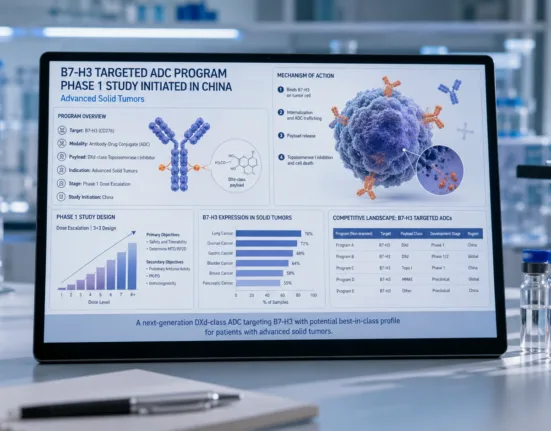
Bio-Thera Solutions, Ltd. (Shanghai Stock Exchange: 688177) has dosed the first patient in a Phase 1 clinical study of BAT8013, an investigational antibody-drug conjugate targeting CD25 in patients with advanced solid tumors. The multicentre, open-label dose-escalation study is designed primarily to assess safety and tolerability, identify a maximum tolerated dose and select a recommended Phase 2 dose.
The July 23, 2026 milestone moves BAT8013 from regulatory clearance into human testing only a little more than two months after China’s National Medical Products Administration authorised a monotherapy trial. The programme is registered as CTR20262253, while Bio-Thera’s regulatory filing identified CXSL2600298 as the clinical application number and confirmed that the current approval covers BAT8013 as a single agent in advanced or metastatic solid tumors.
First-patient dosing is therefore an execution milestone rather than evidence that BAT8013 works in cancer patients. Bio-Thera has not disclosed human safety, pharmacokinetic, biomarker or efficacy data for the candidate. The investment and clinical significance will depend on whether BAT8013 can exploit high CD25 expression within the tumor microenvironment without causing unacceptable damage to immune cells outside the tumor.
Why is BAT8013’s first-patient milestone important without being evidence of clinical benefit?
The practical significance of the announcement is that Bio-Thera can now test a relatively unusual solid-tumor strategy in humans. Instead of directing an antibody-drug conjugate only at a protein expressed by malignant cells, BAT8013 is also intended to attack regulatory T cells, commonly known as Tregs, that may suppress antitumor immune responses inside the tumor microenvironment.
This creates a proposed dual mechanism. BAT8013 may directly kill CD25-positive tumor cells where they are present, while depletion of CD25-high Tregs could reduce local immune suppression and allow effector immune cells to function more effectively. Such an approach could eventually support combinations with checkpoint inhibitors, particularly in tumors where Treg infiltration contributes to resistance against programmed cell death protein 1 or programmed death-ligand 1 therapies.
The concept has substantial biological logic, but the evidence supporting BAT8013 itself remains preclinical. Bio-Thera reported that laboratory and animal studies showed antitumor activity, systemic stability and activity when BAT8013 was combined with its programmed cell death protein 1 antibody BAT1308. Those findings justify clinical evaluation, but they cannot determine the dose, safety profile or therapeutic activity that will emerge in patients.
The first useful clinical readout may not be a tumor-response percentage. Investigators will initially need to establish how BAT8013 behaves in circulation, how much unconjugated payload is released, whether intratumoral Tregs are depleted, whether peripheral immune-cell populations are preserved and whether repeated dosing is feasible. A tolerable dose that produces measurable biological activity would be a more meaningful early achievement than isolated responses in a small and heterogeneous Phase 1 population.

How is Bio-Thera designing BAT8013 to attack tumor Tregs and CD25-positive cancer cells?
BAT8013 combines Bio-Thera’s anti-CD25 antibody with a cleavable linker and an exatecan payload. After binding to CD25 on the cell surface, the ADC is intended to enter the cell through receptor-mediated internalisation. The linker is then cleaved in the lysosomal environment, releasing exatecan, a topoisomerase I inhibitor that can produce DNA damage and trigger cell death.
Bio-Thera has described the linker as systemically stable and the payload as membrane-permeable. That permeability is intended to produce a bystander effect, allowing released payload to affect nearby cells rather than limiting activity to the initially targeted CD25-positive cell. The same feature could be useful in heterogeneous tumors, but it also means that linker stability and local payload distribution will be important components of the safety assessment.
Exatecan and related topoisomerase I inhibitor payloads have become important components of newer ADC platforms because they can provide potent intracellular activity and bystander killing. Preclinical research involving exatecan-based ADCs has shown that linker design, drug-to-antibody ratio, hydrophobicity and payload permeability can materially change pharmacokinetics and antitumor activity. Those platform characteristics cannot be assumed to transfer automatically to BAT8013, but they explain why the trial will need to measure both intact ADC exposure and released payload.
BAT8013’s proposed mechanism is more complicated than that of an ADC aimed exclusively at tumor cells. Its immune effect will depend on where CD25 is expressed, which immune-cell populations internalise the drug, how long Treg depletion lasts and whether immune activation produces useful tumor control or unacceptable inflammation. Dose selection will consequently require more than identifying the highest dose patients can tolerate.
Why will CD25 selectivity be the central biological test in the Phase 1 study?
CD25 is the alpha subunit of the high-affinity interleukin-2 receptor. It is strongly expressed by many regulatory T cells, particularly activated Tregs within tumors, but it can also appear on activated effector T cells, activated B cells and certain malignant hematologic cells. This overlap creates both the opportunity and the central risk of CD25-targeted therapy.
Research has shown that intratumoral Tregs can weaken antitumor immunity and that selective depletion of these cells may improve responses to immune checkpoint blockade. Preclinical CD25-targeted ADC experiments have produced tumor regression in animal models, including when combined with programmed cell death protein 1 blockade. Other studies have found that CD25-high effector Tregs may contribute to resistance in cancers such as triple-negative breast cancer.
However, earlier anti-CD25 approaches have demonstrated why target selection alone is insufficient. Some antibodies blocked interleukin-2 signalling on effector T cells while attempting to remove Tregs, potentially weakening the immune response they were meant to restore. More recent experimental antibodies have been engineered to preserve interleukin-2 signalling or preferentially bind CD25-high intratumoral Tregs, but these designs still require clinical validation.
Bio-Thera has not publicly detailed whether the BAT8013 antibody interferes with interleukin-2 binding, its binding affinity across different CD25 expression levels or the degree to which it distinguishes tumor Tregs from activated peripheral immune cells. These are not minor technical details. They could determine whether BAT8013 achieves useful immune remodelling, produces broad immune-cell depletion or reaches a toxicity ceiling before sufficient intratumoral activity is obtained.
The Phase 1 study will therefore be more informative if pharmacodynamic assessments extend beyond standard blood counts. Changes in circulating and intratumoral Tregs, effector T-cell numbers, effector-to-Treg ratios, cytokines and tumor immune signatures could help establish whether BAT8013 is producing the intended biological effect. Without such evidence, it may be difficult to separate direct payload-mediated tumor killing from immune-mediated activity.
What does the BAT8013 trial design reveal about dose selection and future development?
Bio-Thera has described the study as a multicentre, open-label Phase 1 trial evaluating safety, tolerability, pharmacokinetics and preliminary efficacy. Its key dose-escalation objectives include determining the maximum tolerated dose and the recommended Phase 2 dose in patients with advanced solid tumors.
A broad advanced-solid-tumor population is common during first-in-human oncology development, but it creates analytical limitations. Patients may differ substantially in tumor type, prior treatment exposure, baseline immune function, CD25 expression, Treg infiltration and sensitivity to topoisomerase I inhibition. Early responses can generate hypotheses, although they will not establish which tumor types or biomarkers should define a later registration strategy.
Patient-selection work may become particularly important for BAT8013. Direct activity against CD25-positive tumor cells would require reliable measurement of tumor-cell CD25 expression, while the immune-depletion hypothesis may depend more heavily on the abundance and phenotype of CD25-high Tregs. These are related but different biological propositions, and they may identify different patient groups.
The trial must also determine whether maximum tolerated dose is the most useful basis for development. Immune-modulating agents and ADCs can sometimes reach a biologically active exposure below the highest tolerable level. Bio-Thera will need to integrate pharmacokinetics, target engagement, Treg depletion, payload-related toxicity and preliminary tumor activity when selecting a Phase 2 dose.
Combination development is an obvious longer-term possibility because Bio-Thera reported stronger preclinical activity when BAT8013 was paired with BAT1308. Yet combination trials should not be treated as inevitable. A clinically workable monotherapy dose, a comprehensible safety profile and evidence of the intended immune effect would normally be needed before the risk of adding another immune agent could be assessed responsibly.
How does BAT8013 fit within the emerging field of CD25-directed cancer therapies?
CD25 is not an untested oncology target, although its development history is mixed. Camidanlumab tesirine, a CD25-directed ADC carrying a pyrrolobenzodiazepine payload, demonstrated substantial antitumor activity in relapsed or refractory classical Hodgkin lymphoma. A Phase 2 study reported a 70.1% overall response rate, but the programme was constrained by significant safety problems, including treatment discontinuations and neurologic immune-related events.
That experience shows that CD25-directed ADCs can produce clinical activity, particularly when the malignant cell itself expresses CD25. It does not predict BAT8013’s performance in solid tumors, where Bio-Thera is attempting to exploit both immune-cell depletion and possible direct tumor-cell targeting. BAT8013 also uses a different antibody, linker and payload, making any direct efficacy or safety comparison unreliable.
Other developers are pursuing more selective designs. PF-08046032, for example, has been described preclinically as an affinity-detuned CD25 ADC intended to favour CD25-high intratumoral Tregs over lower-expression cells. Non-ADC programmes have explored Fc optimisation, interleukin-2-sparing antibodies and bispecific targeting to increase intratumoral selectivity. The competition is therefore not simply about who reaches CD25 first, but who can achieve the most useful separation between tumor immune modulation and systemic immune toxicity.
BAT8013’s exatecan payload may differentiate it from earlier CD25 ADCs, but it introduces its own development questions. Bio-Thera must demonstrate that the payload can produce an effective bystander response without excessive systemic exposure and that Treg depletion does not create a safety burden that prevents combination therapy. Those questions can only be resolved through dose-escalation data and longer follow-up.
What does BAT8013 add to Bio-Thera Solutions’ broader oncology strategy?
BAT8013 extends an oncology portfolio that already includes ADCs targeting folate receptor alpha, Trop2, HER2 and other tumor-associated antigens, alongside bispecific antibodies and immune-oncology candidates. Bio-Thera has previously moved HER2-targeted BAT8010 and Trop2-targeted BAT8008 into early clinical development, while its pipeline also includes BAT7111, a programmed cell death protein 1 and 4-1BB bispecific antibody, and BAT7205, a programmed death-ligand 1 and interleukin-15 fusion programme.
This matters because BAT8013 is not an isolated bet. Bio-Thera is trying to build a repeatable ADC platform while using revenue and partnerships from its biosimilar operations to support innovative research. Its experience with multiple topoisomerase I inhibitor ADCs may provide shared capabilities in linker chemistry, analytical testing, manufacturing and clinical pharmacology.
The challenge is portfolio concentration and capital allocation. Advancing several ADCs simultaneously can create scientific diversification, but each candidate requires manufacturing, toxicology, biomarker work and increasingly expensive clinical trials. BAT8013 will have to compete internally for capital against programmes that have already produced human data or entered expansion studies.
Its strategic value may increase if the trial validates Bio-Thera’s ability to target immune cells with its ADC platform rather than only tumor-associated antigens. Conversely, failure to achieve selective Treg depletion would narrow the platform’s apparent utility even if the company’s more conventional ADC programmes remain viable.
How are Bio-Thera Solutions shares and financials shaping investor expectations?
Bio-Thera is commercially established but continues to operate with the financial profile of a research-intensive biotechnology company. Revenue increased 25.8% to approximately CNY 935.2 million in 2025, while the net loss attributable to shareholders narrowed to about CNY 331.9 million. Research and development expenses were approximately CNY 800.2 million, equivalent to more than 85% of annual revenue.
The investment burden increased during the first quarter of 2026. Revenue rose 21.8% year over year to CNY 251.6 million, but the attributable net loss widened to CNY 151.8 million. Research and development expenditure increased 44.8% to CNY 260.9 million and exceeded quarterly revenue, reflecting the cost of advancing a large clinical pipeline.
Bio-Thera shares closed at CNY 16.66 on July 24, down 2.9% for the session following the announcement. The stock had declined approximately 5.6% from its July 17 close and around 2.7% from June 24, while its disclosed 52-week range extended from CNY 15.57 to CNY 36.32. The movement does not establish that investors sold specifically because of BAT8013, particularly because early trial initiation is usually less valuation-sensitive than clinical data.
Market sentiment appears to classify BAT8013 as a long-duration pipeline signal rather than a near-term financial catalyst. First-patient dosing adds an asset to the clinical portfolio, but it does not materially reduce clinical risk. Investor interest is more likely to change when Bio-Thera discloses tolerability, pharmacodynamic evidence, dose selection or a defined expansion strategy.
Which milestones will determine whether BAT8013 advances beyond an early pipeline signal?
The first decisive test will be whether Bio-Thera can escalate BAT8013 to exposures that produce measurable target engagement without dose-limiting immune or payload-related toxicity. Safety findings will need to be interpreted alongside intact ADC pharmacokinetics, free-payload exposure, treatment interruptions and the duration of any immune-cell changes.
The second test will involve biological selectivity. Evidence that BAT8013 reduces intratumoral CD25-high Tregs while preserving sufficient peripheral and tumor-reactive effector T-cell function would strengthen the programme’s underlying thesis. Broad depletion without corresponding immune activation would make the mechanism less convincing, even if the drug remains technically tolerable.
The third test will be patient selection. Bio-Thera will need to determine whether activity is concentrated in tumors with CD25-positive malignant cells, tumors with high Treg infiltration or another biomarker-defined group. A broad solid-tumor label may be useful for dose escalation, but later development will require a more precise clinical proposition.
Finally, any combination strategy must be justified by human data rather than the attractiveness of the immunological theory. BAT8013 could become a differentiated component of Bio-Thera’s oncology portfolio if it establishes a workable therapeutic window and shows that CD25-directed Treg depletion can enhance antitumor immunity. Until those data emerge, the Phase 1 trial should be viewed as a carefully designed test of that hypothesis, not confirmation that the hypothesis has succeeded.