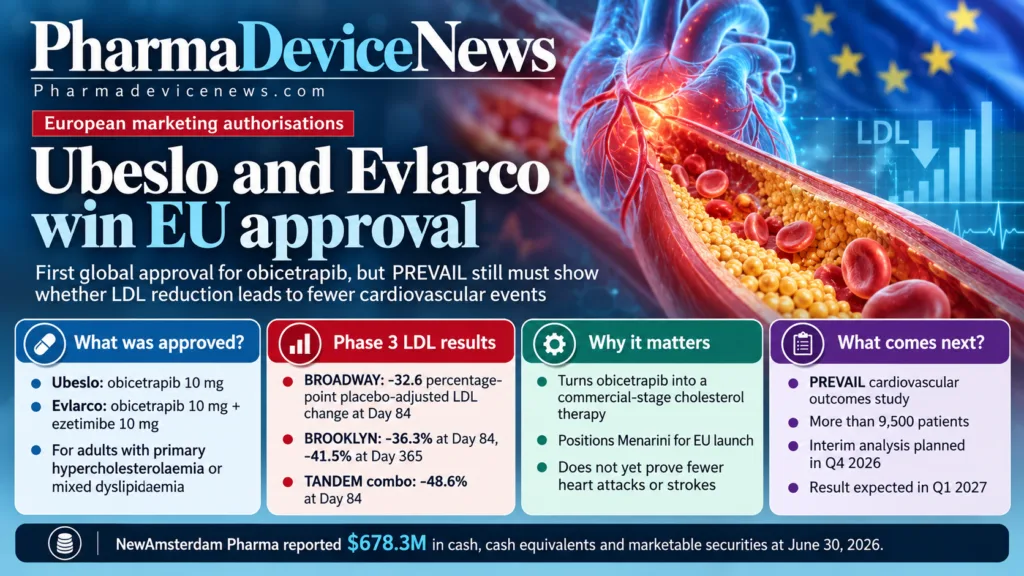
NewAmsterdam Pharma Company N.V. (Nasdaq: NAMS) and Menarini Group have received European Commission marketing authorisations for Ubeslo, containing 10 mg of obicetrapib, and Evlarco, a fixed-dose combination of 10 mg obicetrapib and 10 mg ezetimibe, for adults with primary hypercholesterolaemia or mixed dyslipidaemia. The September 21 decision represents the first regulatory approval of obicetrapib worldwide and moves a once-daily oral cholesteryl ester transfer protein inhibitor from late-stage development into commercial medicine.
The authorisations extend across European Union member states as well as Iceland, Liechtenstein and Norway. Menarini Group holds exclusive European commercialisation rights and is responsible for regulatory and commercial activities in the region, while NewAmsterdam Pharma Company N.V. is entitled to tiered royalties and additional milestone payments under the partnership.
Approval gives NewAmsterdam Pharma Company N.V. something that previous developers of CETP inhibitors struggled to achieve: a product from the class that has made it through regulatory review and onto the path toward routine clinical use. That historical significance, however, should not be confused with proof that obicetrapib reduces heart attacks, strokes or cardiovascular deaths. Its current European authorisations are built principally around LDL cholesterol reduction, while the more than 9,500-patient PREVAIL cardiovascular outcomes trial remains underway.
That distinction makes this more than another European cholesterol approval. Ubeslo has established the regulatory case for obicetrapib as an LDL-lowering medicine, but PREVAIL will determine whether the programme can answer the question that has shadowed CETP inhibition for more than two decades.
What exactly has Europe approved for Ubeslo and the Evlarco fixed-dose combination?
Ubeslo is authorised for adults with primary hypercholesterolaemia, including heterozygous familial and non-familial disease, or mixed dyslipidaemia as an adjunct to diet. It can be used with a statin, or a statin plus other lipid-lowering therapies, when patients cannot reach LDL cholesterol goals on the maximum tolerated statin dose. It may also be used alone or with other lipid-lowering medicines in adults who cannot tolerate statins or for whom statins are contraindicated.
Evlarco has a narrower role built around the combination of obicetrapib and ezetimibe. It can be used with a statin in patients whose LDL cholesterol remains inadequately controlled despite the maximum tolerated statin dose plus ezetimibe. It can also be used without a statin in appropriate statin-intolerant patients whose LDL cholesterol remains above goal on ezetimibe alone, as well as in patients already taking obicetrapib and ezetimibe separately.
The distinction matters commercially because the two products address different points in the treatment pathway. Ubeslo allows clinicians to add the CETP inhibitor without automatically adding ezetimibe, while Evlarco packages two non-statin mechanisms into a single daily tablet for patients requiring more intensive oral LDL lowering.
European Medicines Agency documents identify hypertension, dizziness, headache, diarrhoea and abdominal pain among the most common adverse effects associated with the products. The authorisations also carry normal post-marketing pharmacovigilance and risk-management obligations rather than closing the evidence programme at approval.
More unusually, NewAmsterdam Pharma Company N.V. disclosed in a U.S. Securities and Exchange Commission filing that European regulators require a post-authorisation efficacy study and have specified submission of final results from PREVAIL. Europe has therefore allowed obicetrapib into the market while keeping its cardiovascular-outcomes programme directly connected to the product’s post-approval evidence package.
How strong is the Phase 3 evidence behind obicetrapib’s LDL cholesterol reduction?
The European programme rests substantially on BROADWAY, BROOKLYN and TANDEM, which examined obicetrapib either by itself or together with ezetimibe in patients requiring further LDL cholesterol reduction despite existing therapy.
BROADWAY provides the largest published Phase 3 dataset. The randomised, placebo-controlled trial enrolled 2,530 patients with atherosclerotic cardiovascular disease or heterozygous familial hypercholesterolaemia who were receiving maximally tolerated lipid-lowering therapy. Participants were assigned in a two-to-one ratio to obicetrapib 10 mg once daily or placebo.
At day 84, mean LDL cholesterol had fallen 29.9% from baseline in the obicetrapib group, compared with an increase of 2.7% in the placebo group. The resulting placebo-adjusted difference was 32.6 percentage points and was statistically significant. Adverse-event incidence was reported as broadly similar between the groups in the published analysis.
BROOKLYN focused specifically on 354 adults with heterozygous familial hypercholesterolaemia whose LDL cholesterol remained insufficiently controlled despite maximally tolerated lipid-lowering treatment. NewAmsterdam Pharma Company N.V. reported a placebo-adjusted least-squares mean LDL reduction of 36.3% at day 84, with the difference reaching 41.5% at day 365.
Those results are relevant because familial hypercholesterolaemia can leave patients with persistently elevated LDL cholesterol even after multiple therapies have been layered together. For these patients, an additional oral mechanism capable of producing a material incremental reduction could have clinical utility even before considering the separate question of cardiovascular outcomes.
TANDEM tested the fixed-dose obicetrapib and ezetimibe combination. NewAmsterdam Pharma Company N.V. reported a placebo-adjusted least-squares mean LDL reduction of 48.6% at day 84 with the combination, while the trial also demonstrated statistically significant reductions compared with ezetimibe alone and obicetrapib alone.
The result explains the strategic rationale for Evlarco. Instead of positioning obicetrapib only as one more tablet to be added to a complex lipid regimen, Menarini Group can offer two complementary oral mechanisms in one fixed-dose medicine for selected patients requiring additional LDL reduction.
Why is obicetrapib’s approval especially significant after earlier CETP drug failures?
Cholesteryl ester transfer protein inhibition has one of cardiovascular drug development’s more complicated histories. Earlier programmes produced striking changes in lipid biomarkers but repeatedly struggled to translate those changes into safe and convincing cardiovascular benefit.
Torcetrapib was abandoned after off-target toxicity and excess cardiovascular risk emerged. Large programmes involving dalcetrapib and evacetrapib were stopped for futility. Anacetrapib eventually demonstrated a modest reduction in major vascular events, but its developer did not pursue regulatory approval, in part because of concerns including prolonged accumulation of the compound in adipose tissue.
Obicetrapib has therefore arrived after the industry learned that simply producing a dramatic rise in HDL cholesterol is not enough. The contemporary development case is centred much more heavily on reductions in atherogenic lipoproteins, including LDL cholesterol and apolipoprotein B, rather than treating HDL elevation itself as evidence of clinical benefit.
That change in emphasis is important when interpreting the European approval. Regulators have accepted that the Phase 3 LDL-lowering evidence supports treatment of hypercholesterolaemia and mixed dyslipidaemia in the authorised populations. They have not declared the historical cardiovascular-outcomes question settled.
This is why PREVAIL has become the programme’s defining experiment. Successful commercialisation of Ubeslo can begin without waiting for that answer, but the long-term strategic value of obicetrapib could look very different depending on whether the cardiovascular outcomes trial eventually demonstrates a meaningful reduction in major adverse cardiovascular events.
Why could PREVAIL matter more to NewAmsterdam Pharma than the European approval itself?
PREVAIL enrolled more than 9,500 patients with a history of atherosclerotic cardiovascular disease whose LDL cholesterol remained inadequately controlled despite maximally tolerated lipid-lowering therapy. The Phase 3 cardiovascular outcomes study is evaluating whether adding obicetrapib can reduce major adverse cardiovascular events rather than merely improve laboratory measures.
NewAmsterdam Pharma Company N.V. has planned an interim analysis for the fourth quarter of 2026, with the result expected during the first quarter of 2027. If the trial does not stop early for efficacy, the company has indicated that completion could extend to the end of 2027.
That timeline creates an unusual commercial sequence. Obicetrapib can begin building a European market based on an established LDL-lowering indication before investors, physicians and payers have the definitive PREVAIL result. Commercial uptake and clinical-outcomes evidence will therefore develop partly in parallel.
A positive cardiovascular outcome would strengthen the argument that obicetrapib offers more than additional biomarker control and could broaden the product’s relevance in crowded treatment algorithms. A neutral result would not automatically erase the LDL-lowering indication, but it could make differentiation substantially more difficult when clinicians already have statins, ezetimibe, PCSK9-directed therapies, inclisiran, bempedoic acid and combination strategies available.
The requirement to submit final PREVAIL data as part of the European post-authorisation evidence package reinforces just how important the study remains. Ubeslo has passed one regulatory test. PREVAIL addresses a different and potentially more commercially consequential one.
Can an oral CETP inhibitor compete with established non-statin cholesterol medicines?
Obicetrapib’s most obvious practical advantage is its route of administration. Ubeslo is a once-daily oral tablet, as is the Evlarco combination. That gives Menarini Group an opportunity to compete for patients who require substantial additional LDL lowering but may prefer an oral treatment before moving to, or adding, injectable therapies.
Convenience alone will not determine adoption. Ezetimibe is inexpensive and deeply established, while injectable PCSK9 inhibitors can produce large LDL reductions and have cardiovascular outcomes evidence. Inclisiran provides infrequent dosing, and bempedoic acid offers another oral mechanism with cardiovascular outcomes data in statin-intolerant patients.
The competitive question is therefore not simply whether obicetrapib lowers LDL cholesterol. Phase 3 evidence already establishes that it does. The question is where clinicians place another oral therapy in increasingly crowded treatment sequences and whether reimbursement authorities judge its incremental LDL reduction, convenience and eventual outcomes evidence sufficient to justify broad use.
Evlarco may have a particularly interesting positioning opportunity because it can intensify oral therapy without requiring patients to manage two separate tablets. Fixed-dose combinations can simplify treatment, although better convenience should not automatically be assumed to generate better adherence or improved cardiovascular outcomes without supporting evidence.
Menarini Group’s existing European commercial infrastructure should help with market access, physician engagement and country-by-country launch execution. The harder challenge will be reimbursement because European pricing and access decisions are made across multiple national systems and can result in different launch timing, restrictions and treatment positioning even after central marketing authorisation.
What does the Menarini deal mean financially for NewAmsterdam Pharma after approval?
Menarini Group holds exclusive rights to commercialise obicetrapib in Europe and is responsible for regional regulatory interactions and commercialisation. NewAmsterdam Pharma Company N.V. retains an economic interest through tiered royalties ranging from the low double-digit percentages into the mid-twenties on net sales within Menarini’s territory.
The agreement also provides for up to an additional €833 million in clinical, regulatory and commercial milestone payments. That figure represents potential future payments linked to specified achievements and should not be treated as cash already earned.
The European Commission authorisations themselves trigger milestone payments in the mid-teens of millions of euros, according to NewAmsterdam Pharma Company N.V.’s regulatory filing. That gives the approval an immediate financial consequence even before meaningful product sales begin.
NewAmsterdam Pharma Company N.V. was also well financed heading into the launch period. The company reported $678.3 million in cash, cash equivalents and marketable securities at June 30, 2026, giving it substantial resources to continue the broader obicetrapib development programme while Menarini Group carries European commercial responsibilities.
That division of labour reduces the need for NewAmsterdam Pharma Company N.V. to construct a full pan-European sales organisation from scratch. It also means, however, that the biotechnology company’s European economics depend on Menarini Group’s launch execution, reimbursement progress and eventual net sales rather than NewAmsterdam directly controlling every commercial lever.
Why has NewAmsterdam Pharma stock reacted modestly despite its first product approval?
NewAmsterdam Pharma Company N.V. shares closed at $22.58 on September 21, the session in which the European approval was announced, up about 0.4%. The stock subsequently closed at $23.32 on September 22 before ending September 24 at $22.74, leaving the company with a market capitalisation of roughly $2.7 billion.
The shares were only around 1% higher over the five trading sessions ending September 24, while they had fallen roughly 15% from the August 24 close. At $22.74, the stock was also much closer to the bottom than the top of its recent 52-week range of approximately $21.02 to $42.21.
That relatively restrained reaction does not mean the approval lacks strategic significance. The European decision had been substantially de-risked after the European Medicines Agency’s Committee for Medicinal Products for Human Use issued a positive recommendation in July, giving investors considerable advance notice that a favourable Commission decision could follow.
Market attention can now migrate toward catalysts with greater uncertainty and potentially greater valuation impact. PREVAIL is the obvious one, while the company is also advancing REMBRANDT, which is studying effects of the obicetrapib and ezetimibe combination on coronary plaque characteristics, and RUBENS in patients with type 2 diabetes or metabolic syndrome.
For NewAmsterdam Pharma Company N.V., September’s approval changes the company from one built entirely around the promise of a late-stage asset into one whose lead programme has crossed into regulated commercial medicine. The next phase is considerably harder to measure. Menarini Group must turn European authorisation into reimbursement and prescriptions, while PREVAIL must determine whether obicetrapib’s substantial LDL reductions can be connected to the cardiovascular outcomes that ultimately matter most.