Evoworks Bio has been selected for a six-month BioTools Innovator VANGUARD development, evaluation and validation project backed by the Biomedical Advanced Research and Development Authority to test its EvoNode cell-culture platform for rapid production of antibody biologics. The Cambridge, Massachusetts company will work with Kemp Proteins and Rockland Immunochemicals, using representative monoclonal antibody-producing cell lines to assess scale-up performance, process transferability and production outcomes under non-dilutive funding of up to $200,000.
The project forms part of a $1 million 2026 VANGUARD funding round announced by BioTools Innovator on June 24, 2026. Evoworks Bio, one of five selected companies from more than 175 submitted proposals, disclosed further details of the collaboration on July 23.
The award is modest when compared with the capital required to establish regulated biologics manufacturing capacity. Its strategic value lies elsewhere. The programme gives Evoworks Bio an opportunity to generate structured performance data with experienced protein-development partners and demonstrate whether EvoNode can reproduce a cell-culture process across multiple connected vessels without requiring the extensive redevelopment commonly associated with moving from laboratory flasks into larger bioreactors.
That is an important technical question, but it remains an open one. The project is an early validation exercise, not evidence that EvoNode has achieved commercial manufacturing readiness, good manufacturing practice qualification or regulatory acceptance for producing clinical material.
Why does the BARDA-backed VANGUARD project matter beyond its relatively small funding award?
BioTools Innovator VANGUARD is the enabling-technologies hub within the wider Biomedical Advanced Research and Development Authority Accelerator Network. Its role is to identify early-stage tools that could strengthen the development, evaluation and production of medical countermeasures needed during pandemics, infectious-disease outbreaks and other public-health emergencies.
The programme provides proof-of-concept funding, technical mentorship and access to specialists rather than purchasing finished products from participating companies. That distinction matters because selection demonstrates interest in a technology’s potential, but it does not certify that the technology works as claimed or guarantee a subsequent government contract.
For Evoworks Bio, the award should therefore be understood as a technical de-risking opportunity. The company will be able to test EvoNode against real antibody-production workflows, identify limitations and build a data package that may be more useful to future customers and investors than an internally generated demonstration.
Non-dilutive funding also allows the privately held company to advance the platform without surrendering equity. However, an award of up to $200,000 is unlikely to finance the broader engineering, quality-system development, automation, consumable manufacturing and commercial infrastructure required for widespread adoption. Successful completion could support the next financing or partnership discussion, but it will not eliminate the need for substantially more capital.
How is the EvoNode platform intended to bridge laboratory development and larger biologics batches?
Biologics processes frequently begin in shake flasks or small cell-culture vessels before being transferred into larger stirred-tank bioreactors. That transition is rarely a simple change in volume. Mixing, oxygen transfer, carbon dioxide removal, nutrient distribution, shear forces and temperature control can change as the vessel becomes larger.
Those changes can affect cell growth, productivity and product quality. In antibody manufacturing, developers may need to examine not only how much protein is produced, but also whether the molecule retains the required aggregation profile, glycosylation pattern, charge distribution, potency and stability.
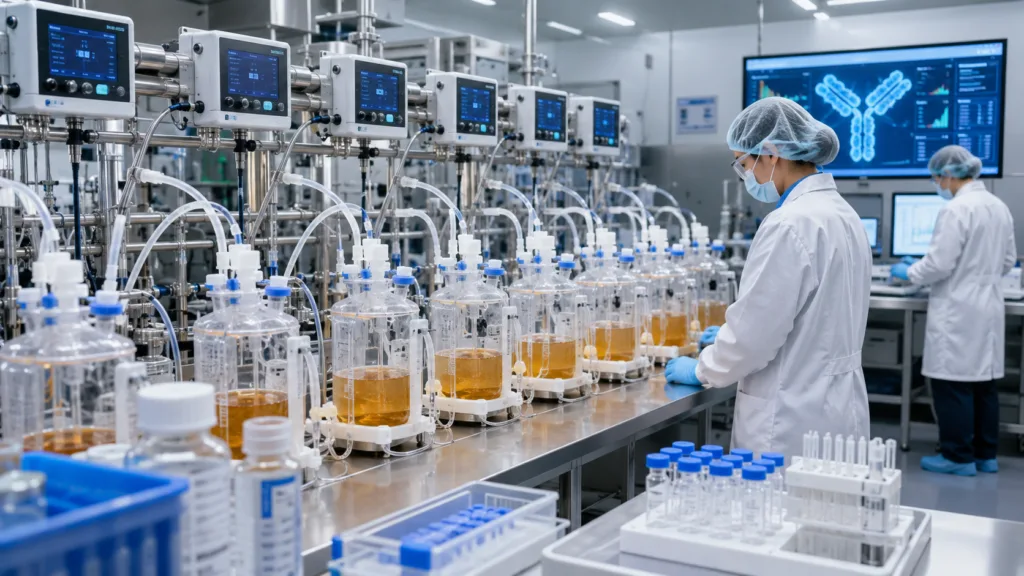
Evoworks Bio is approaching the scale-up problem through modular replication. Its single-use EvoNode vessel has a published working volume of approximately 250 millilitres to 550 millilitres. Multiple vessels can be connected into an array supplied through common filling and feeding infrastructure, allowing a process developed in one vessel to be repeated across a larger number of nominally identical vessels.
In practical terms, the architecture resembles numbering-up rather than conventional scaling-up. Instead of making one vessel progressively larger, the user adds more smaller vessels operating under similar conditions. Evoworks Bio says its configurations can move from experimental volumes into batches of 10 litres or more, with a planned LabRack configuration extending the concept to as much as 100 litres.
The theoretical advantage is that the physical environment inside each vessel changes less dramatically as production volume increases. If the process established in one EvoNode can be reproduced consistently across an array, developers may avoid part of the re-optimisation required when moving between substantially different vessel geometries.
The trade-off is that numbering-up creates its own engineering and operational questions. A larger number of vessels means more connections, more components, additional sampling points and a greater need to prove that each node receives comparable inoculum, media, oxygen and feed conditions.
What will Evoworks Bio, Kemp Proteins and Rockland Immunochemicals test during the project?
Evoworks Bio plans to produce and validate a panel of antibodies using the EvoNode platform. Rockland Immunochemicals will provide representative monoclonal antibody-producing cell lines, while Kemp Proteins will contribute protein-development, stable-cell-line and process-optimisation experience.
The collaboration has been structured to test more than whether cells remain viable inside the vessel. According to the project description, the partners will evaluate scale-up performance, process transferability and production outcomes. Those categories should enable comparisons between small-scale conditions and larger EvoNode arrays, although detailed protocols, acceptance criteria and analytical endpoints have not been publicly disclosed.
A meaningful assessment would need to examine whether connected EvoNodes maintain consistent cell density, viability, metabolite profiles and protein yield. For monoclonal antibodies, the partners would also be expected to determine whether material collected from different nodes shows comparable quality characteristics.
Process transferability may prove especially important. A platform can perform well when operated by its developer but still struggle when placed in another organisation’s laboratory, where equipment, operators, raw materials and routine practices differ. Kemp Proteins’ participation could help establish whether EvoNode can be integrated into established protein-development workflows rather than remaining dependent on Evoworks Bio personnel.
Rockland Immunochemicals adds another layer of relevance because it has longstanding antibody-development and manufacturing operations. Its cell lines can provide practical test cases rather than an artificially simplified laboratory demonstration.
Still, the project appears focused on selected antibody models. Positive findings would not automatically establish that EvoNode can support every recombinant protein, vaccine antigen, bispecific antibody or other complex biologic. Different molecules and cell lines can create substantially different oxygen, nutrient, expression and purification requirements.
Why could modular biologics production be valuable during a public-health emergency?
Public-health emergencies can create sudden demand for diagnostic antibodies, vaccine components, therapeutic proteins and laboratory reagents. Traditional manufacturing expansion may require new equipment, engineering work, process transfer, facility modifications and lengthy qualification activities.
A modular system that fits within existing laboratory infrastructure could potentially give research organisations, diagnostic developers and smaller manufacturers greater flexibility. Capacity could be added through additional disposable vessels rather than waiting for a large bioreactor installation.
That approach may be particularly relevant during the earlier stages of an emergency, when the required biologic is still being developed and demand remains uncertain. Organisations may need more material than laboratory flasks can provide but may not yet be ready to commit to a conventional manufacturing train.
Modularity could also support geographically distributed production. Instead of concentrating all output at one large site, compatible systems could theoretically be installed across several laboratories or regional facilities.
However, physical portability does not automatically create manufacturing readiness. Emergency-response production still requires trained personnel, qualified raw materials, validated analytical methods, reliable consumable supplies, contamination controls and documented procedures. For products intended for human use, manufacturers must also operate within the relevant regulatory and good manufacturing practice framework.
The EvoNode project is therefore best viewed as a test of one part of the preparedness problem. It may address how cell-culture capacity can be expanded, but it does not independently solve purification, formulation, fill-and-finish, quality release or distribution.
What technical questions must EvoNode answer before biologics manufacturers can trust the platform?
The first challenge is demonstrating consistency across individual nodes. A common filling system may reduce variability at the start of a run, but each vessel must still maintain sufficiently comparable environmental conditions throughout production.
Differences in gas exchange, evaporation, feed timing or incubator position could create node-to-node variability. Even small differences may become meaningful when the material is pooled into a larger batch.
The second challenge is monitoring and control. Evoworks Bio offers optional sensors for parameters including pH, dissolved oxygen and dissolved carbon dioxide. Customers will need evidence that the monitoring system is accurate, reliable and capable of detecting deviations before they affect an entire batch.
The third challenge is contamination management. Single-use vessels can eliminate cleaning validation between runs and reduce the possibility of residue carrying over from a previous process. At the same time, connecting many disposable units introduces more tubing, connectors, valves and manipulation steps that must preserve sterility.
Consumable availability will be another commercial consideration. A platform built around proprietary disposable vessels can generate recurring revenue for the supplier, but customers will assess whether the consumables can be manufactured consistently, stocked in sufficient quantities and supplied during an emergency.
Regulated users will also examine documentation. Equipment specifications, material certificates, extractables and leachables data, software controls, calibration procedures, installation qualification and operational qualification may matter as much as headline production speed.
The VANGUARD project is unlikely to answer every one of these questions within six months. It can nevertheless establish whether the core biological and engineering assumptions are strong enough to justify larger studies.
Could diagnostic antibody production provide Evoworks Bio with its clearest commercial entry point?
Evoworks Bio currently presents EvoNode to diagnostic antibody developers, contract research organisations and contract development and manufacturing organisations working with transient expression or specialised protein-production processes.
Diagnostic antibodies may offer a practical initial market because production volumes can be smaller than those required for widely used therapeutic monoclonal antibodies. Developers may also value flexible batch sizes when demand is uncertain or when an antibody supports a specialised assay.
For smaller organisations, avoiding a large bioreactor purchase could be attractive. A system that works inside existing incubators and biosafety cabinets may reduce the infrastructure threshold for establishing internal protein-production capability.
The commercial argument will still depend on measurable economics. Customers are likely to compare EvoNode with shake flasks, wave bioreactors, stirred-tank systems, outsourced production and other parallelised cell-culture platforms. The relevant calculation will include labour, disposables, equipment utilisation, failure risk, yield and cost per usable gram of protein.
Evoworks Bio has said that it is targeting substantial reductions in scale-up costs and timelines. Those remain company expectations rather than independently established outcomes. The VANGUARD collaboration could begin converting those expectations into comparative performance data.
What would successful completion mean for Evoworks Bio’s next development stage?
A successful six-month project would not by itself establish EvoNode as a replacement for conventional bioreactors. It could, however, give Evoworks Bio a more credible foundation for customer pilots, strategic partnerships and additional non-dilutive or private financing.
The most valuable outcome would be a transparent dataset showing how performance changes when a process moves from one vessel to a connected array. Evidence covering yield, reproducibility, protein quality, operator requirements and process deviations would allow prospective users to judge the platform on more than its engineering concept.
The company will also need to define where EvoNode competes and where it complements established equipment. The near-term opportunity may be strongest in process development, diagnostic supply, preclinical material and specialised biologics production rather than high-volume commercial therapeutic manufacturing.
For the Biomedical Advanced Research and Development Authority, the project offers a relatively low-cost way to examine whether modular cell-culture tools could improve national response capacity. For Evoworks Bio, it is a tightly scoped but potentially consequential test.
The next milestone is not simply the completion of antibody runs. It is whether Evoworks Bio, Kemp Proteins and Rockland Immunochemicals can show that multiple EvoNodes behave like a reproducible production system rather than a collection of connected laboratory vessels. That distinction will determine whether the platform advances from an interesting scale-up concept to a technology that biologics developers are prepared to validate inside their own operations.