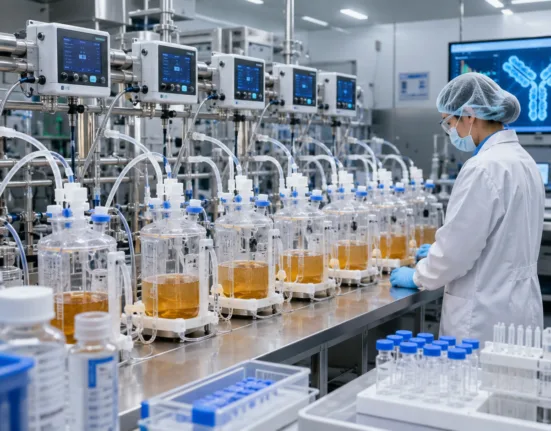
Velico Medical has reported first-in-human results showing that Frontline On Demand Plasma, a spray-dried plasma product designed for rapid reconstitution outside conventional blood banks, was tolerated at escalating doses in 24 healthy volunteers. The Phase 1 study advances a transfusion platform intended for traumatic haemorrhage in ambulances, military environments, rural hospitals and disaster-response settings where frozen plasma may be unavailable or impractical.
Why the first human Frontline On Demand Plasma study matters without proving trauma benefit
The study represents an important transition from laboratory characterisation into human evaluation. Frontline On Demand Plasma is intended to deliver the clotting proteins and other biological components of plasma without requiring the frozen storage, thawing equipment and blood-bank infrastructure associated with conventional products.
That objective addresses a persistent gap in trauma medicine. Patients with severe blood loss can deteriorate rapidly before reaching a trauma centre, but plasma is difficult to place in ambulances, helicopters or remote clinics because conventional units must remain frozen or be thawed and used within a restricted period. A shelf-stable product that can be reconstituted within minutes could allow transfusion to begin closer to the point of injury.
The Phase 1 trial supports continued development because escalating doses were tolerated and treatment-emergent adverse events occurred at similar frequencies with the spray-dried product and standard plasma. No thromboembolic events were recorded, and laboratory changes in coagulation were not considered clinically significant.
The evidence remains preliminary because the participants were healthy volunteers rather than patients experiencing uncontrolled bleeding, shock or traumatic coagulopathy. The trial was designed primarily to evaluate tolerability and biological comparability, not whether Frontline On Demand Plasma saves lives or improves trauma outcomes.
A safety profile observed in 24 carefully screened adults cannot exclude uncommon transfusion reactions, respiratory complications, circulatory overload, immune responses or risks that may emerge in critically injured patients receiving several blood products simultaneously. The study clears an early development hurdle, but it does not establish clinical effectiveness.
What the dose-escalation design reveals about safety and what it leaves unresolved
Participants were divided across sequential cohorts receiving increasing amounts of reconstituted spray-dried plasma. The doses progressed from approximately 200 millilitres to 400 millilitres and eventually 800 millilitres, allowing investigators to examine whether larger volumes produced new safety signals.
The highest-dose cohort included a randomized, double-blind crossover comparison between Frontline On Demand Plasma and PF24, a conventional plasma product frozen within 24 hours of collection. Each volunteer received both products at different times, creating a direct within-person comparison while reducing some variability associated with differences between participants.
The crossover design strengthens the initial safety assessment because the same individuals served as their own comparators. It also enabled investigators to compare coagulation measures, protein preservation and adverse-event patterns after equivalent volumes of the two plasma products.
However, the plasma was autologous, meaning participants received plasma derived from their own earlier collection. That approach was appropriate for a first-in-human study because it reduced the possibility of incompatibility and immune reactions unrelated to the spray-drying process.
Emergency transfusion would normally involve allogeneic plasma collected from another donor. Real-world use therefore introduces variables that the study was not designed to examine, including donor-recipient compatibility, antibody-mediated reactions, infectious-disease screening, variation between donor units and interactions with red blood cells, platelets or whole blood.
The trial also evaluated stable volunteers under controlled conditions. Trauma patients may be hypothermic, acidotic, hypotensive and actively bleeding, with damaged organs and abnormal coagulation. A product tolerated by healthy adults must still demonstrate that it performs safely when infused rapidly into physiologically unstable patients.
How spray-dried plasma could remove one of emergency transfusion’s biggest logistical barriers
Traditional plasma is generally stored frozen to preserve clotting factors and extend its usable life. Before administration, the unit must be retrieved, correctly identified, thawed and prepared by trained personnel. These requirements are manageable inside a hospital but difficult in an ambulance, rural clinic, disaster zone or military environment.
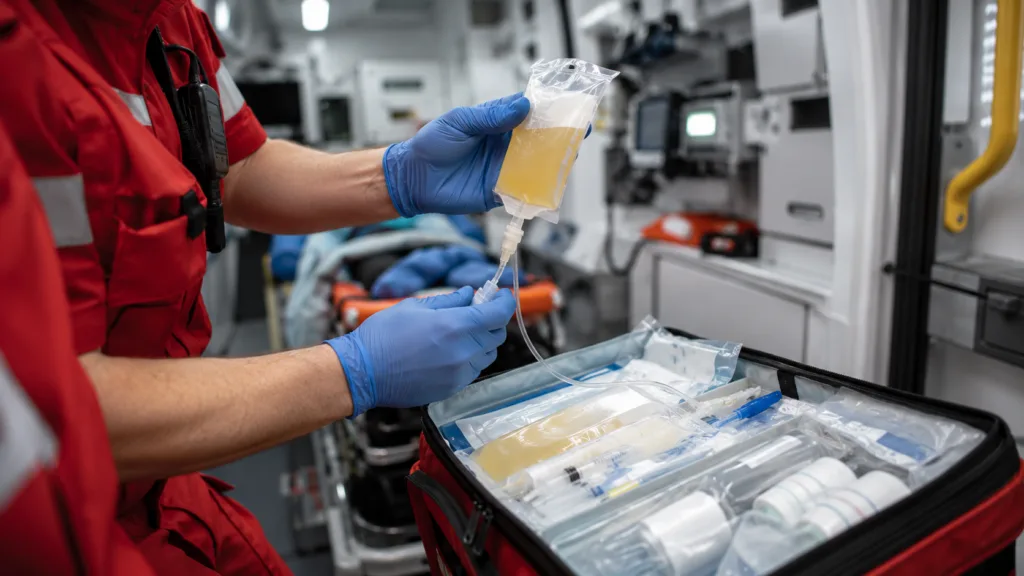
Some emergency medical systems carry previously thawed plasma, but this creates inventory and wastage challenges. A unit must be used within its approved post-thaw period, while unpredictable trauma volumes can leave services discarding expensive blood components that were never needed.
Frontline On Demand Plasma is designed to remain stable without a frozen cold chain and to be reconstituted using sterile water. Velico Medical has reported reconstitution within approximately three minutes, potentially allowing trained personnel to prepare plasma while treating a patient at the scene or during transport.
Removing the frozen-storage requirement could change where plasma is positioned. Units could potentially be placed in ground ambulances, medical helicopters, rural emergency departments, disaster-response vehicles and military medical kits without the freezer capacity required for standard plasma.
The operational advantage becomes more important when transport to definitive care takes longer. In urban settings with short ambulance journeys, the benefit of beginning plasma transfusion several minutes earlier may be limited. In rural regions, maritime operations, conflict zones or mass-casualty incidents, the time saved could be clinically meaningful.
Shelf stability alone does not guarantee readiness. Emergency teams must carry sterile water, transfusion tubing, compatibility information and equipment needed to reconstitute and administer the product correctly. Storage temperatures, vibration, humidity and packaging durability must also remain controlled across real-world conditions that may be harsher than a laboratory stability study.
Why the evidence supporting prehospital plasma is promising but not consistent across trauma systems
The clinical rationale for dried plasma depends on evidence that earlier plasma administration improves outcomes. Several trauma studies have suggested that plasma given before hospital arrival may help stabilise coagulation and reduce mortality in selected patients at risk of haemorrhagic shock.
The PAMPer trial found a survival benefit when thawed plasma was administered during air medical transport. Later analyses suggested that the advantage was most apparent when transport times exceeded approximately 20 minutes, supporting the argument that plasma becomes more valuable when definitive trauma care is not immediately available.
Other studies have produced less favourable results. The COMBAT trial, conducted in an urban ground-ambulance environment, did not demonstrate the same mortality improvement. Differences in transport duration, injury severity, patient selection, transfusion protocols and time to hospital care may explain part of the inconsistency.
Systematic reviews have consequently reached cautious conclusions. Prehospital plasma appears feasible and may benefit particular trauma populations, but evidence has not established a uniform mortality advantage across every emergency medical system.
This uncertainty matters for Frontline On Demand Plasma. The product could solve a storage and access problem without resolving the clinical question of which patients should receive plasma before hospital arrival. Broad deployment without precise eligibility criteria could expose patients to transfusion risks without delivering meaningful benefit.
Future studies will need to identify the situations in which early plasma has the greatest value. These may include prolonged transport, traumatic brain injury, severe blunt trauma, suspected coagulopathy, military injury and settings where balanced blood-component resuscitation cannot otherwise begin promptly.
How well preserved clotting proteins must translate into reliable haemostatic performance
Spray drying subjects plasma proteins to physical and chemical stresses that can change their structure or activity. The manufacturing process must remove sufficient moisture for stable storage while preserving the proteins responsible for coagulation, vascular integrity and immune function.
Laboratory work supporting Frontline On Demand Plasma has shown that many coagulation factors remain within clinically acceptable ranges after processing and reconstitution. The first human study also found that minor differences in coagulation measurements did not create an obvious clinical safety signal in healthy volunteers.
Some protein activity may still be reduced relative to fresh or frozen plasma. Von Willebrand factor activity is particularly sensitive to processing because large molecular structures can be affected by the forces involved in spray drying.
A measurable reduction does not automatically make the product ineffective. Plasma contains multiple interacting proteins, and trauma resuscitation may not require every factor to remain identical to its level before drying. The relevant question is whether the reconstituted product restores coagulation sufficiently in a bleeding patient.
That question cannot be answered through healthy-volunteer safety testing alone. Clinical development must measure correction of trauma-induced coagulopathy, blood-product consumption, time to haemorrhage control, organ failure and survival.
Lot-to-lot consistency will also be critical. A product produced across regional blood centres must deliver comparable potency regardless of the manufacturing site, donor source, machine operator or environmental conditions. Variability acceptable for an early study could become a major regulatory concern when thousands of emergency units are distributed nationally.
Why Velico’s decentralized manufacturing model creates opportunity and quality-control risk
Velico Medical is developing Frontline On Demand Plasma as more than a centrally manufactured pharmaceutical product. Its model involves placing spray-drying systems within regional blood centres, allowing existing transfusion networks to convert locally collected plasma into dried units.
The approach could strengthen national self-sufficiency. Blood centres already manage donor recruitment, collection, infectious-disease testing, blood grouping, component production and distribution. Adding dried-plasma manufacturing could use established infrastructure while reducing dependence on a small number of overseas suppliers.
Decentralized production may also support emergency stockpiles. Governments could manufacture and rotate dried-plasma inventories for disaster preparedness, military readiness, rural healthcare and mass-casualty response.
The same model makes regulatory oversight more complicated. Manufacturing a biological product at multiple regional sites requires strict control of equipment calibration, environmental conditions, operator training, raw materials, process validation and release testing.
A failure at one blood centre could affect product potency or safety even when the underlying technology performs correctly elsewhere. Regulators may therefore need to assess both the Frontline On Demand Plasma product and the manufacturing device used to produce it.
Velico Medical will need a quality system capable of delivering pharmaceutical-level consistency through organisations whose existing operations may differ. The commercial value of local production depends on making decentralisation reproducible rather than merely possible.
Why the regulatory pathway is more complex than approval of a conventional medical device
Frontline On Demand Plasma combines a human blood product with a proprietary manufacturing and reconstitution system. Its regulatory pathway must therefore address the safety and effectiveness of the plasma as well as the performance of the equipment used to produce it.
United States Food and Drug Administration guidance for dried plasma covers input plasma, donor testing, manufacturing controls, product characterisation, packaging, reconstitution, clinical studies and device submissions. Meeting these requirements is more demanding than demonstrating that a single machine performs a mechanical function.
The product remains investigational and has not received routine United States or European approval. Existing dried-plasma access in the United States has largely involved emergency authorisations for military use of products manufactured outside the country.
These emergency pathways demonstrate demand but do not establish a straightforward precedent for broad civilian approval. A commercially licensed product for ambulances and hospitals would require a more comprehensive evidence and manufacturing package.
Regulators must determine whether healthy-volunteer data and laboratory comparability are sufficient to support initial use or whether studies in bleeding patients are necessary before approval. Ethical and practical challenges make randomized trauma trials difficult because treatment decisions occur rapidly and informed consent may not be possible.
Postmarket surveillance would remain essential even after approval. Rare transfusion reactions may become visible only after thousands of units are administered, particularly across diverse emergency environments.
How dried plasma must compete with whole blood and other evolving trauma strategies
Frontline On Demand Plasma is entering a trauma-care environment in which low-titre group O whole blood has gained renewed attention. Whole blood provides red blood cells, plasma and platelets in one product, making it attractive for early balanced resuscitation.
Plasma alone does not carry oxygen and cannot replace red blood cells in a patient with massive blood loss. Its principal role is to restore volume and coagulation proteins while other blood components address anaemia and platelet depletion.
Some emergency systems may therefore prioritise whole blood rather than adding a separate dried-plasma product. However, whole blood also requires controlled storage, donor management and frequent inventory rotation, which can be difficult for low-volume or remote services.
Dried plasma may be most useful where carrying whole blood is impractical, where plasma can supplement red blood cells already available, or where a stable product is needed for prolonged deployment. It could also support treatment during disasters when conventional blood supply chains are disrupted.
Existing freeze-dried plasma products provide another competitive benchmark. European military and civilian systems have accumulated experience with lyophilised plasma, while United States military teams have received restricted access through emergency authorisations.
Velico Medical’s differentiation rests partly on spray drying, rapid reconstitution and regional production. The platform must eventually demonstrate that these advantages produce reliable supply, acceptable cost and clinical performance comparable to established alternatives.
What emergency services and military adopters need before Frontline On Demand Plasma scales
Emergency medical services will need clear protocols identifying which patients qualify, who may administer the product and how compatibility should be managed. Personnel must be trained to reconstitute plasma under pressure without introducing contamination, dilution errors or treatment delays.
The packaging must remain usable in darkness, extreme weather, moving vehicles and high-stress environments. Instructions that appear straightforward inside a clinic may become harder to follow during a roadside resuscitation or combat evacuation.
Economic evidence will also influence adoption. Dried plasma may cost more per unit than conventional plasma, but lower wastage, reduced freezer requirements and improved readiness could offset some of that premium.
Hospitals and governments will want to know the full cost of manufacturing equipment, disposable components, quality testing, staff training, maintenance and regulatory compliance. A clinically useful product may still struggle commercially if local production proves too expensive for smaller blood centres.
Military adoption could progress faster because the logistical need is more obvious and central procurement can support specialised deployment. Civilian use may expand gradually through air medical services, rural systems and high-risk regions before reaching ordinary urban ambulances.
What the next clinical studies must prove before dried plasma changes emergency care
The immediate development priority is to confirm safety in a larger and more diverse population. Trials must determine whether allogeneic Frontline On Demand Plasma produces transfusion reactions at rates comparable to conventional plasma.
Studies in bleeding patients will then need to measure outcomes beyond laboratory coagulation values. Relevant endpoints include blood-product consumption, time to haemorrhage control, organ dysfunction, survival and the speed with which balanced resuscitation begins.
Investigators must also evaluate real-world reconstitution. A product that works reliably in trained study centres must perform equally well when prepared by paramedics, military medics and rural clinicians under difficult conditions.
Shelf-life claims should be tested under temperature cycling, vibration and humidity patterns that reflect transport and field storage. Stability in a controlled room does not necessarily predict performance inside an ambulance, aircraft or military pack.
Frontline On Demand Plasma has passed an important first human test, but its most consequential evidence remains ahead. Velico Medical must prove that the platform preserves the clinical value of plasma, can be manufactured consistently across blood centres and improves care in the environments where conventional plasma is hardest to use.
The opportunity is considerable because the product could move transfusion closer to the moment of injury. The risk is that logistical innovation advances faster than the clinical evidence needed to guide safe and effective deployment.