
Home Control International Limited’s wholly owned subsidiary Orbiva Limited has signed a strategic cooperation memorandum with PT Articura Tech Indonesia to explore localized healthcare artificial intelligence infrastructure and digital health applications in Indonesia. The memorandum was signed on July 23, 2026, and covers potential hospital data systems, home healthcare, remote monitoring, clinical decision support, patient triage, medical-record quality control and healthcare-focused large language models.
The Stock Exchange of Hong Kong-listed company, which trades under stock code 1747, is positioning the agreement as part of its expansion from home-control electronics into connected health and healthcare AI. Orbiva is expected to contribute artificial intelligence, AIoT hardware, healthcare data processing and edge-computing capabilities, while Articura would provide local healthcare deployment experience, hospital-system integration and access to Indonesian clinical networks.
The commercial and clinical maturity of the collaboration remains limited, however. The memorandum establishes a framework for discussions rather than a completed operating contract, and the parties have not disclosed committed spending, revenue arrangements, minimum purchase volumes, hospital deployment schedules or binding investment obligations. No clinical validation data, regulatory authorisations or detailed technical specifications for the proposed products were included in the announcement.
Why is the Orbiva and Articura agreement strategically relevant despite being only an MOU?
The agreement gives Orbiva a potential route into one of Southeast Asia’s largest healthcare markets without requiring Home Control International Limited to build an Indonesian hospital network from scratch. Local implementation capability is particularly important in digital health because software and connected devices must fit national data standards, clinical practices, hospital procurement systems and language requirements.
Articura describes its strategy as the development of a sovereign healthcare AI infrastructure connecting clinical applications, healthcare providers, data systems and locally deployed computing resources. Under the proposed collaboration, the company could become Orbiva’s bridge into hospitals, clinics, academic institutions and government-linked healthcare initiatives.
For Home Control International Limited, the agreement also supports a wider strategic narrative. The company has historically generated most of its business from remote controls and connected devices supplied to telecommunications and consumer-electronics customers. Orbiva was established in September 2025 to expand the group’s capabilities into home health, health monitoring and healthcare services.
Healthcare offers potentially higher-value and more recurring commercial models than conventional electronics manufacturing. Software subscriptions, remote-monitoring services, data infrastructure, maintenance contracts and connected-device ecosystems can create revenue extending beyond the initial hardware sale. None of those models has yet been confirmed for the Articura collaboration, making the memorandum an entry point rather than proof that Orbiva has secured a scalable healthcare business.
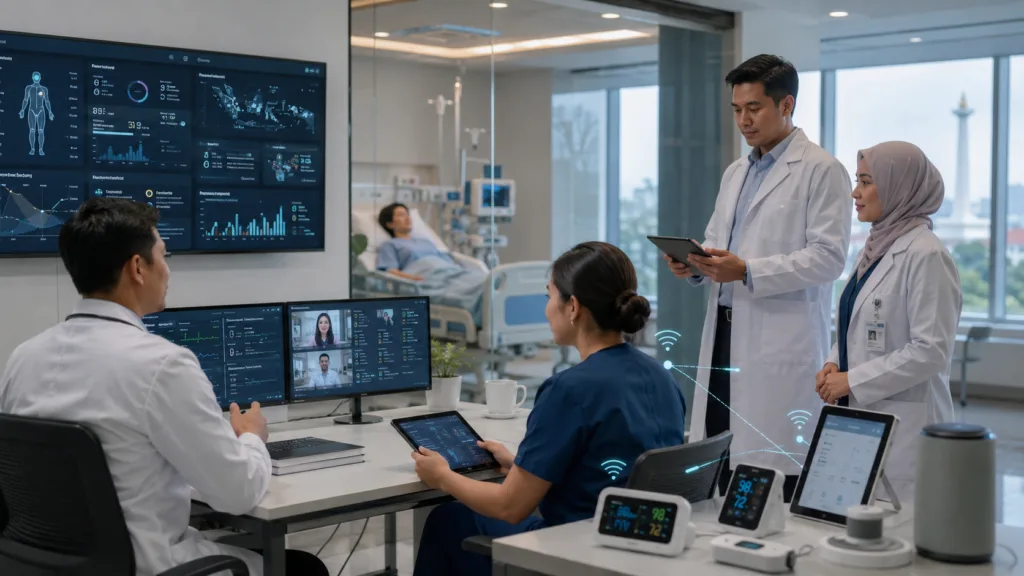
How could localization and data sovereignty determine whether healthcare AI works in Indonesia?
Indonesia’s healthcare digitisation strategy is increasingly centred on SATUSEHAT, the national health-data exchange environment operated by the Ministry of Health. SATUSEHAT is designed to connect hospitals, community health centres, laboratories, pharmacies, insurers, regulators and digital-health providers using standardized interoperability mechanisms.
Third-party platforms seeking to operate within this environment must address technical standards such as Health Level Seven International Fast Healthcare Interoperability Resources, secure application programming interfaces, identity management and controlled access to sensitive patient information. A healthcare AI system that functions as a standalone application but cannot exchange data reliably with local electronic medical records would have limited operational value.
Data location is another central issue. Indonesia treats medical information as sensitive personal data, and its national healthcare infrastructure applies domestic storage and governance requirements to protected health information. Orbiva and Articura have therefore placed data sovereignty, local data processing and edge computing at the centre of their proposed architecture.
Edge computing could allow certain information to be processed within hospitals, clinics or locally controlled infrastructure instead of sending every data point to an overseas cloud environment. That approach may reduce latency and support data-governance objectives, but it does not automatically solve privacy or cybersecurity concerns.
The parties would still need to define who controls the data, which information may be used to train or update models, how patient consent will be obtained, how access will be audited and whether identifiable information can move between institutions. They would also require safeguards covering cyberattacks, unauthorized access, data corruption, model manipulation and failures in connected medical or wellness devices.
What must be validated before AI triage and clinical decision support reach routine care?
The memorandum identifies potentially sensitive clinical applications, including AI-assisted pre-consultation, patient triage, clinical decision support, medical-record improvement and patient follow-up. These functions could influence how clinicians collect information, prioritize patients and interpret potential diagnoses.
The announcement does not disclose the models involved, their training datasets, intended users, clinical specialties or performance measurements. There is also no information about sensitivity, specificity, false-positive rates, false-negative rates, external validation or performance across different demographic and geographic groups.
Those omissions do not mean that the proposed systems will fail. They indicate that the available evidence is insufficient to judge whether the technology can support clinical decisions safely and consistently.
A tool used to summarize a consultation presents a different risk profile from software that recommends a diagnosis or treatment. Similarly, an algorithm helping hospital staff organize follow-up appointments is not equivalent to a system determining whether a patient requires urgent neurological intervention.
Orbiva and Articura will need to define each product’s intended use before its regulatory pathway can be assessed. Products positioned only for general wellness or administrative support may face different requirements from software performing medical-device functions. A clinical decision-support product that materially influences diagnosis or treatment may require formal review, evidence of analytical and clinical performance, risk controls and clear human-oversight procedures.
Clinical validation should also involve Indonesian healthcare settings rather than relying exclusively on data from other countries. Differences in disease prevalence, clinical documentation, prescribing practices, languages, infrastructure and referral patterns can affect model performance. Retrospective testing can provide an early indication of accuracy, but prospective studies in real workflows would offer stronger evidence of whether the system improves care without creating additional errors or administrative burdens.
Can Orbiva convert Home Control’s connected-device experience into regulated healthcare products?
Home Control International Limited brings established capabilities in electronics design, precision controllers, manufacturing and global supply relationships. Those capabilities could support the development of home-monitoring devices, connected sensors and AIoT healthcare hardware.
Healthcare products, however, require more than reliable consumer electronics. Depending on their intended use, connected health devices may need clinical validation, quality-management systems, cybersecurity controls, post-market surveillance and country-specific regulatory clearance.
The announcement said Orbiva had introduced newly developed products for potential pilot testing, trials and validation under the Articura collaboration. It did not identify those products, their measured parameters, intended patient populations or whether they would be marketed as wellness equipment or regulated medical devices.
That distinction will determine the evidence and compliance burden. A consumer device tracking general activity may follow a relatively straightforward route, while a device intended to detect deterioration, monitor a diagnosed condition or inform treatment decisions could face substantially higher validation requirements.
Orbiva must also demonstrate that its hardware can operate reliably within the realities of Indonesian healthcare delivery. Devices deployed across hospitals, clinics and homes may encounter inconsistent connectivity, varying technical support, different levels of digital literacy and challenging maintenance requirements.
A sustainable deployment model would need clear arrangements for installation, staff training, software updates, device replacement, calibration, customer support and cybersecurity monitoring. These operational details frequently determine whether connected-health pilots progress to larger contracts.
Why could Articura’s hospital and academic network accelerate pilots without guaranteeing adoption?
Articura signed separate memoranda with the National Brain Center Hospital, the Faculty of Pharmacy at Universitas Padjadjaran, PT Axis Perifer Sentral and PT Pragati Klinik Medika during the same event. The institutions are expected to contribute neurological expertise, academic research support, specialist-care environments and primary-care experience.
The network could give the collaboration access to varied clinical settings, which is useful when assessing whether an AI system performs consistently across different workflows. A neurological referral centre may provide complex specialist use cases, while primary-care facilities can test whether tools function under higher-volume conditions with fewer specialist resources.
Academic participation could also help the parties design validation protocols, examine model performance and publish evidence. Independent or peer-reviewed research would strengthen the credibility of any future clinical claims, particularly if studies disclose patient populations, reference standards, statistical methods and limitations.
Memoranda with healthcare institutions should not be interpreted as hospital procurement commitments. Institutions may participate in demonstrations, research or evaluations without purchasing the resulting technology. Adoption will depend on whether the systems solve a documented problem, integrate with existing records, reduce rather than increase clinician workload and remain affordable after any pilot funding ends.
Hospitals will also need to understand liability. If an AI recommendation conflicts with a clinician’s judgement or contributes to an error, responsibility must be clearly allocated among the software provider, healthcare institution and treating professional. Human oversight cannot be treated as a small implementation detail when systems are intended to influence patient prioritization or clinical decisions.
What does the proposed National AI Healthcare Lab need to prove beyond demonstrations?
Articura plans to establish a National AI Healthcare Lab bringing together healthcare professionals, researchers, institutions and technology partners. The proposed facility is intended to support demonstrations, application validation, innovation and professional education.
A laboratory of this kind could become a useful testing environment if it establishes transparent evaluation standards and separates product promotion from clinical assessment. Its value will depend on the quality of its datasets, independence of reviewers, access to diverse patient populations and ability to conduct prospective validation in real healthcare environments.
The laboratory would also need a credible governance structure covering ethics review, informed consent, data access, cybersecurity and conflicts of interest. Models should be evaluated not only for average accuracy but also for performance across age groups, sexes, geographic populations and underrepresented communities.
Healthcare AI governance is becoming an increasingly important policy issue in Indonesia. The Ministry of Health has emphasized that AI applications affecting clinical decisions require strong oversight because errors may have direct patient-safety consequences. The government has also been developing broader national rules for responsible artificial intelligence alongside existing ethics guidance and personal-data protections.
This evolving environment creates an opportunity for Articura’s proposed laboratory to contribute evidence and operational standards. It also means that products developed through the collaboration may need to adapt as regulatory expectations become more detailed.
How should investors interpret the pact within Home Control’s healthcare diversification strategy?
Home Control International Limited reported revenue of approximately US$109.4 million for 2025, up 1.8% from the previous year. Profit attributable to owners increased to about US$7.1 million from US$2.5 million, supported by improved margins, automation and cost management.
The company is therefore pursuing healthcare diversification from a profitable operating base rather than depending solely on a speculative development programme. That provides some capacity to invest in product development and partnerships, although investors will need greater disclosure to assess how much capital Orbiva requires and when the healthcare business might become financially material.
Delayed market data placed Home Control shares at approximately HK$3.80 on July 13, 2026. The stock had previously reached a 52-week high of HK$6.20, reflecting significant volatility and elevated expectations surrounding the group’s strategic transition.
The Articura MOU should be viewed as a long-term market-access signal rather than an immediate earnings catalyst. It contains no disclosed contract value, revenue guarantee, binding purchase commitment or commercial launch date. Investors may therefore focus less on the signing ceremony and more on whether the partnership produces measurable milestones.
Those milestones would include named pilot sites, clearly defined products, published validation protocols, regulatory classifications, definitive commercial agreements and evidence that hospitals are willing to pay for the systems after evaluations end.
Which milestones would show the Orbiva and Articura collaboration is becoming commercially real?
The first meaningful development would be the conversion of the memorandum into one or more definitive agreements. These should clarify responsibilities, funding, intellectual-property ownership, data rights, revenue sharing and the commercial relationship between Orbiva, Articura and participating healthcare institutions.
The second would be product-level disclosure. Orbiva needs to explain which devices or software applications will be tested, what they are intended to do and whether they are classified as wellness products, administrative systems or medical technologies.
The third milestone would be clinical and operational validation. Pilot announcements will carry greater significance if they include the number of participating institutions, patient populations, evaluation endpoints, human-oversight procedures and timelines for reporting results.
Interoperability with SATUSEHAT and hospital information systems will be another decisive test. A product that demonstrates strong technical performance but cannot exchange data securely with Indonesia’s healthcare infrastructure is unlikely to achieve broad adoption.
The final commercial test will be whether the collaboration progresses from institution-supported evaluations to repeatable contracts. Hospitals and public-health providers will require evidence that the technology improves documentation, workflow, access or clinical decision-making at a cost that can be supported by operating budgets or reimbursement arrangements.
Orbiva and Articura have identified a credible strategic opportunity at the intersection of connected devices, local data infrastructure and healthcare artificial intelligence. The scale of that opportunity will not be determined by the breadth of the MOU, however. It will be determined by whether the partners can convert a wide-ranging vision into validated products, compliant data systems and financially sustainable deployments across Indonesia’s healthcare network.