
Dopl Technologies has raised $6.3 million in an oversubscribed seed financing led by SpringTide Ventures to advance its remote robotic ultrasound ecosystem toward U.S. Food and Drug Administration clearance. The Bothell, Washington-based medical technology company intends to use the capital for product verification and validation, clinical evaluation, regulatory submission activities and initial pilot deployments.
The financing takes Dopl Technologies’ total funding above $8 million and brings together investors including WRF Capital, Tacoma Venture Fund, HeartX, Transform Health Ventures and Precursor Ventures. The immediate regulatory objective centres on a platform comprising the Traverse remote robotic ultrasound system, the Dopl Connect connectivity and data layer, and SonoFlex, a distributed clinical workforce and workflow-management solution.
The investment gives Dopl Technologies additional runway to move a technically ambitious platform through the medical device development process. It does not, however, establish that the system is ready for routine clinical use. Traverse remains under development and is not commercially available, while the company has disclosed FDA pre-submission engagement and a proposed 510(k) pathway rather than a completed submission or clearance decision.
That distinction is particularly important in a financing story built around a potentially valuable access-to-care proposition. Remote robotic ultrasound could allow a qualified sonographer to manipulate a probe at a distant hospital without travelling to the patient, but the clinical and commercial value will depend on whether Dopl Technologies can reproduce the quality, reliability and safety of conventional scanning across different examinations, body types, network conditions and clinical environments.
Why does this seed round matter more as regulatory runway than as commercial proof?
The $6.3 million round should primarily be interpreted as financing for regulatory and product de-risking. Dopl Technologies has identified product verification, validation, clinical evaluation, FDA activities and an initial market release as the principal uses of the proceeds. These are essential steps, but they sit before broad commercial deployment rather than after it.
A seed round of this size can support focused engineering and regulatory work, particularly when the company is integrating commercially available robotics, ultrasound equipment, haptic controllers and cameras instead of manufacturing every component independently. Nevertheless, a connected medical device combining robotics, imaging, software and remote control can produce a wide validation burden. Mechanical performance, probe force, motion accuracy, image quality, communications reliability, system recovery and operator response to unexpected events may all need to be evaluated under defined conditions.
Dopl Technologies described the round as oversubscribed, indicating strong early-stage investor interest. The company did not disclose its valuation, dilution, planned regulatory submission date or the amount allocated to each development programme. Investor sentiment is therefore encouraging but remains an early confidence signal rather than an independent judgment on the probability of FDA clearance or hospital adoption.
Further capital could ultimately be required to fund manufacturing readiness, quality systems, field support, hospital installations, commercial hiring and post-market activities. The significance of the present round will be determined by the measurable milestones it enables, especially completion of verification and validation, regulatory submission and credible clinical evidence.
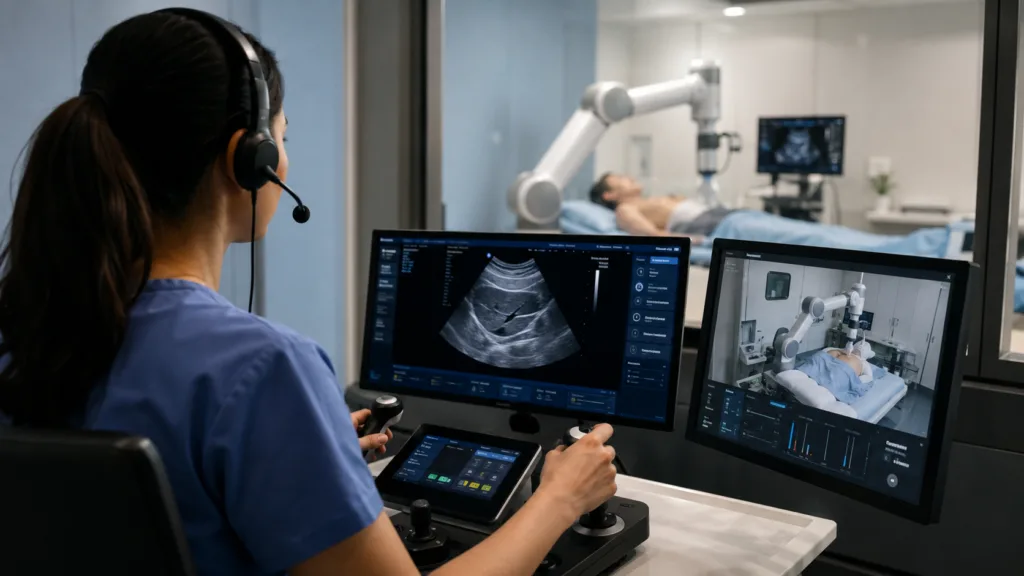
What exactly is Dopl Technologies building across Traverse, Dopl Connect and SonoFlex?
Traverse is intended to let a remotely located sonographer control an ultrasound probe positioned beside the patient. Dopl Technologies says the platform is hardware-agnostic and designed to integrate off-the-shelf robots, ultrasound systems, cameras and haptic controls with existing hospital infrastructure.
Dopl Connect is positioned as the secure communications and data platform supporting that remote interaction, while SonoFlex is intended to coordinate the distributed sonographer workforce and associated clinical workflows. The combined model therefore extends beyond a robotic arm. Dopl Technologies is attempting to build an operating ecosystem connecting the scanning hardware, remote clinician, hospital site, imaging data and staffing process.
This integrated approach could be commercially important. A robot without available sonographers, reliable connectivity or a workable hospital process would not solve the access problem. Conversely, a remote staffing network without safe and precise physical control of the ultrasound probe would remain closer to guided tele-ultrasound than true telerobotic scanning.
The company’s hardware-agnostic strategy may reduce dependence on a single ultrasound manufacturer and make the platform more adaptable to hospitals with existing equipment. It could also introduce compatibility and validation complexity because each supported combination of robot, ultrasound system, camera, controller and software configuration may need careful testing.
The approach is not yet autonomous diagnostic imaging. Dopl Technologies has discussed a longer-term ambition to advance toward autonomous care delivery, but its current regulatory and product focus is remote operation by trained clinical personnel. That human-in-the-loop model is likely to remain central while the company establishes safety, clinical performance and regulatory credibility.
Why is the 510(k) pathway only the first test for remote robotic ultrasound?
Dopl Technologies says it has completed FDA pre-submission engagement and established a 510(k) pathway. A pre-submission interaction can help a developer obtain regulatory feedback on subjects such as intended use, testing plans, clinical evidence and potential predicate devices, but it is not a marketing authorisation and does not predict the outcome of a later submission.
Under the 510(k) process, a sponsor generally seeks to demonstrate that a device is substantially equivalent to a legally marketed predicate. A device cannot be commercially distributed in the United States under that pathway until the FDA issues a substantial-equivalence decision clearing it for the specified intended use. Diagnostic ultrasound systems and transducers are also subject to detailed FDA recommendations concerning performance testing, labelling and submission content.
The eventual scope of the Traverse indication will matter as much as the clearance itself. Dopl Technologies has not publicly detailed which examination types, patient populations, anatomical regions, ultrasound systems or operating environments would be included in an initial submission. A platform cleared for a defined group of examinations should not be assumed to support every form of diagnostic ultrasound.
The company will also need to show that remote manipulation does not introduce unacceptable risks compared with the proposed predicate or conventional workflow. Potential regulatory questions may include the forces applied to the patient, accuracy of remote probe motion, latency, loss of connection, emergency stopping, cybersecurity, image transmission, operator training and the role of personnel physically present with the patient.
FDA clearance would remove a major regulatory barrier, but it would not automatically demonstrate that the system reduces waiting times, improves diagnostic outcomes or produces a financial return for hospitals. Those claims require operational and clinical evidence beyond the substantial-equivalence determination.
What does existing telerobotic ultrasound research say about clinical reliability?
Telerobotic ultrasound is an established research field rather than a concept created by Dopl Technologies. Published studies have shown that robotic systems can allow sonographers or radiologists to conduct examinations from distant locations, particularly in rural or underserved communities. The literature also shows that performance can vary by examination type, patient characteristics, system design and operator experience.
A prospective study involving 401 patients found broadly similar image-quality scores between 5G-based telerobotic abdominal ultrasound and conventional ultrasound, although the robotic examinations took longer and the two methods did not identify every finding in exactly the same patients. Another rural-clinic study reported that 70% of 87 telerobotic examinations were sufficient for diagnosis, with operational challenges involving technical infrastructure, staffing and coordination between sites.
Other published work has identified limits in more complex examinations. A study of remote obstetric ultrasound reported that focused examinations were more consistently adequate than complete second-trimester examinations, which were affected by fetal position, patient body habitus and technological constraints.
These studies support the feasibility of the category, but they do not validate Traverse. Different robotic systems, clinical protocols, communications networks and user interfaces cannot be treated as interchangeable. Dopl Technologies will need product-specific evidence showing how its own platform performs against a suitable reference method.
The funding announcement did not disclose the design, sample size, examination categories, endpoints or results of any Traverse clinical evaluation. Until those data become available, the strongest conclusion is that the wider field provides a credible scientific rationale for further development, while the performance of Dopl Technologies’ system remains to be demonstrated.
How could CareBridge reduce launch friction without validating the robotic platform?
Dopl Technologies is already operating CareBridge, a service that sends travelling sonographers to selected hospitals requiring immediate in-person coverage. The company says the service has reduced patient waiting times by more than 90% in some participating locations and is helping establish relationships with hospitals that may later pilot Traverse after FDA clearance.
CareBridge could give Dopl Technologies an operational advantage by allowing it to study real scheduling problems, examination volumes, hospital workflows and staffing shortages before introducing the robotic platform. It may also create a pathway for recruiting sonographers and identifying hospitals with sufficient demand to support a pilot deployment.
The service could function as a bridge between a traditional staffing business and a technology-enabled delivery model. Hospitals already using CareBridge may be easier to approach because Dopl Technologies will understand their systems, workforce gaps and clinical requirements.
However, the performance of travelling sonographers cannot be treated as evidence that Traverse works. CareBridge currently delivers conventional, in-person ultrasound services. Its waiting-time results reflect staffing intervention, not remote robotic scanning. The company will therefore need to separate CareBridge operating metrics from the clinical performance and economic results of its eventual telerobotic pilots.
Why will human factors, cybersecurity and hospital workflow decide adoption?
A remote robotic ultrasound system creates two simultaneous clinical environments. The sonographer operates from one location, while the patient, robot and local support personnel are situated elsewhere. Safe performance depends on both groups understanding their responsibilities and responding correctly to technical or clinical problems.
Human-factors testing will therefore be central to the regulatory package. The FDA expects device developers to examine how intended users interact with controls, displays, alerts and emergency functions in the intended use environment. For Traverse, this could include the remote sonographer’s control interface, the local operator’s setup tasks, patient positioning and the response to interrupted connectivity or unexpected robot movement.
Professional oversight must also remain clear. The American Institute of Ultrasound in Medicine states that ultrasound examinations should be supervised and interpreted by an appropriately qualified licensed medical provider, with mechanisms for addressing urgent or questionable findings when immediate review is unavailable. A distributed platform will therefore need to complement, rather than bypass, clinical supervision and interpretation requirements.
Cybersecurity presents another significant requirement because Dopl Connect is expected to transmit commands, video, imaging information and other data between sites. FDA requirements for connected medical devices can include vulnerability-management planning, secure development processes, post-market updates and a software bill of materials.
Hospitals will additionally examine network reliability, integration with picture archiving and communication systems, credentialing, privacy, maintenance, cleaning, training, service response and responsibility for local patient support. A technically successful scan is only one part of a sustainable clinical service.
Does a hardware-agnostic model improve scalability or create integration risk?
Dopl Technologies’ use of commercially available components could make deployment less capital-intensive than a fully proprietary imaging system. Hospitals may be able to preserve parts of their existing ultrasound infrastructure, while Dopl Technologies concentrates on robotic control, connectivity, workflow orchestration and remote staffing.
That model could also shorten some development cycles because mature ultrasound hardware and robotic components may already have established performance records. The commercial appeal would be strongest if hospitals can adopt Traverse without replacing functioning imaging equipment or becoming locked into one ultrasound vendor.
The difficulty is that hardware independence can become configuration dependence. Differences in ultrasound consoles, probe designs, robot characteristics, software versions and hospital networks may affect performance. Dopl Technologies will need to define which configurations are supported, how installations are qualified and how software or equipment updates are managed.
Service economics will matter as well. Hospitals will compare Traverse with travelling sonographers, local recruitment, temporary staffing agencies, patient transportation and referral to larger imaging centres. Telerobotic ultrasound may offer its clearest value in hospitals with persistent unmet demand, long travel distances and enough examination volume to justify the equipment, connectivity and service costs.
The company has estimated a large reimbursement opportunity for hospitals if telerobotic imaging scales nationally. That estimate should be treated as an addressable-market projection rather than expected revenue. Actual economics will depend on the examinations completed, payer mix, reimbursement rules, staffing costs, utilisation and whether remote operation improves throughput without compromising diagnostic quality.
What should hospital partners watch after Dopl Technologies’ $6.3m funding round?
The next meaningful milestone will be evidence that the financing has moved Traverse from an engineering programme into a well-defined regulatory product. Greater clarity around the intended use, supported examinations, clinical study design and FDA submission timing would allow hospitals and investors to assess the programme more precisely.
Product-specific clinical results will be especially important. Hospital imaging teams will want to see examination completion rates, image adequacy, agreement with conventional ultrasound, scan duration, technical failure rates, patient experience and performance across different body types and clinical settings.
Pilot deployments after clearance would then need to demonstrate more than technical feasibility. The stronger commercial case would show reduced waiting times, reliable coverage, acceptable utilisation, improved access and manageable implementation costs without creating new burdens for local hospital staff.
Dopl Technologies has built a credible funding syndicate and a differentiated strategy combining robotics, connectivity and workforce management. The $6.3 million round gives the company an opportunity to convert that strategy into regulatory and clinical evidence. Its decisive test will be whether Traverse can consistently deliver diagnostic-quality ultrasound through a remote workflow that hospitals can trust, integrate and afford.