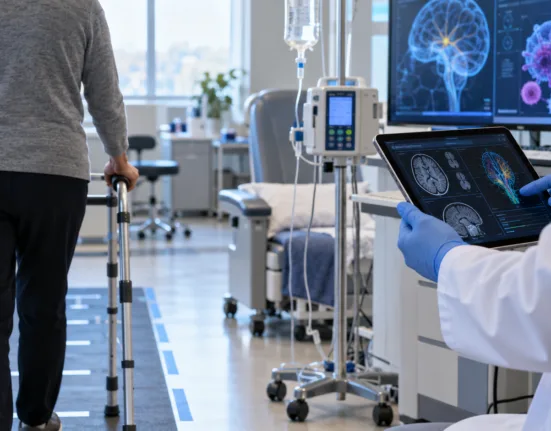
AnX Robotica commercially launched NaviCONNECT on July 26, 2026, introducing a cloud-based platform for managing capsule endoscopy studies, reporting and connectivity across its NaviCam product portfolio. The platform initially integrates with NaviCam SB with ProScan and NaviCam XS, while the company is positioning it as a foundation for additional capsule technologies, enterprise analytics and future artificial intelligence capabilities.
The immediate development is operational rather than clinical. NaviCONNECT does not represent a new capsule, indication or independently demonstrated diagnostic benefit. Instead, it attempts to address the digital infrastructure surrounding capsule endoscopy, including how studies are transferred, assigned, interpreted, reported, updated and retrieved across individual practices and larger health systems.
That distinction matters because capsule endoscopy innovation has increasingly moved beyond the ingestible camera itself. Image quality, capsule dimensions and battery performance remain important, but the commercial usefulness of a modern platform also depends on whether clinicians can handle large video files efficiently, work across locations, integrate reports with existing medical records and use artificial intelligence without creating another isolated software environment.
Why is NaviCONNECT more than a remote access upgrade for capsule endoscopy practices?
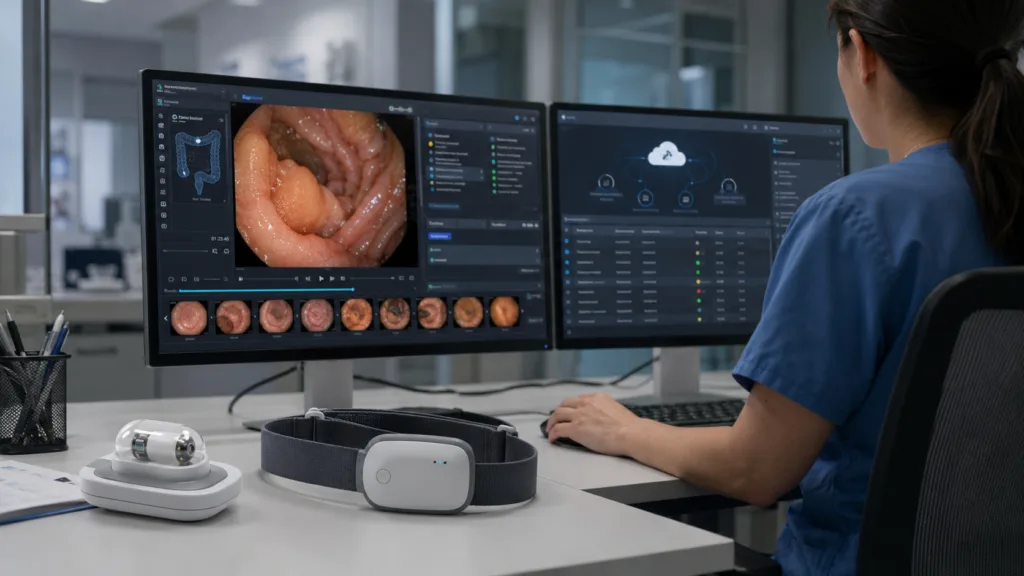
AnX Robotica describes NaviCONNECT as a secure web application accessible through Windows and Mac browsers. The platform offers cloud-based study access, case assignment for multi-site teams, role-based permissions, standardised reporting and exportable documents. It also supports single sign-on, two-factor authentication, granular access controls, electronic medical record integration through application programming interfaces and standard International Classification of Diseases code support.
These capabilities make the launch broader than a basic remote-viewing portal. In a conventional local software model, capsule studies may be transferred from a recorder to a designated workstation, interpreted through software installed at that location and then exported into another clinical or administrative system. That arrangement can work for an individual gastroenterology office, but it becomes harder to manage when a provider operates several clinics, centralises specialist reading or outsources interpretation.
NaviCONNECT is intended to separate study access from a particular workstation. That could allow a capsule to be administered at one location while the resulting study is assigned to an experienced reviewer elsewhere. A health system could also standardise templates, user permissions and reporting across several facilities rather than maintaining different local configurations.
The operational attraction is clear, although actual productivity gains will depend on implementation. A cloud platform can make work accessible from more places, but it does not automatically correct inconsistent clinical protocols, incomplete electronic medical record integration or delays elsewhere in the patient pathway. The value will come from reducing handoffs and duplicate administration, not merely from placing the same software inside a browser.
AnX Robotica also says its smart personal computer agents can support offline capsule pairing and securely buffer raw data when network access is interrupted. This is an important practical feature because capsule acquisition cannot simply stop when a clinic loses internet connectivity. The design therefore attempts to combine cloud accessibility with local resilience rather than making the procedure entirely dependent on uninterrupted broadband.
How does NaviCONNECT extend NaviCam SB and ProScan without changing their clinical roles?
NaviCONNECT initially connects to the NaviCam small-bowel portfolio, including NaviCam SB with ProScan and the smaller NaviCam XS capsule. It is therefore best understood as an infrastructure layer surrounding products and software that already have defined clinical and regulatory roles, rather than as a new diagnostic modality in its own right.
The United States Food and Drug Administration initially cleared the NaviCam Small Bowel Capsule Endoscopy System through the 510(k) pathway for visualisation of the small-bowel mucosa. A subsequent clearance expanded use to adults and children aged two years and older, with the system intended to assist in detecting small-bowel abnormalities.
ProScan has a narrower and carefully defined role. The United States Food and Drug Administration granted De Novo classification to the Class II software in December 2023 as an AI-assisted reading tool for adult capsule studies obtained because of suspected small-bowel bleeding. It can identify images containing suspected lesions and assist with recognising anatomical sections of the gastrointestinal tract, but it is not a stand-alone diagnostic system and does not replace clinician interpretation.
That regulatory boundary continues to apply when ProScan processing is delivered through a cloud environment. Faster access to highlighted images does not mean that an automated result confirms or excludes disease. The regulator specifically noted that a negative output does not rule out small-bowel disease, a positive output does not confirm it and clinicians remain responsible for reviewing the video as clinically appropriate.
NaviCONNECT may make the regulated functionality easier to distribute across an enterprise, but it should not be presented as expanding ProScan into autonomous diagnosis, lesion characterisation or broader gastrointestinal screening. The launch announcement did not disclose a new indication or a separate clinical validation study for the cloud platform.
What does existing ProScan evidence show about efficiency, and what remains uncertain?
The strongest clinical rationale for placing ProScan inside a connected platform is the time required to review capsule endoscopy footage. A capsule may generate tens of thousands of images during its passage through the gastrointestinal tract, creating an interpretation burden that can limit throughput and contribute to reviewer fatigue.
In the prospective multicentre ARTIC study, 133 evaluable patients with suspected small-bowel bleeding were assessed across seven European centres. Mean reading time fell from approximately 33.7 minutes with standard interpretation to 3.8 minutes with AI-assisted interpretation. The study also reported a higher diagnostic yield for lesions considered to have moderate or high bleeding potential in the AI-assisted reading arm, although clinicians retained responsibility for reviewing the output and reaching the final assessment.
The United States Food and Drug Administration nevertheless identified important limitations. ProScan’s stand-alone performance without clinician input was not established in the clinical study. Its internal development data were derived from Asian patients, while the prospective ARTIC evaluation involved a European population, leaving questions about performance across additional populations and clinical environments. The regulator also observed that the ARTIC readers were highly experienced, meaning the effect of possible over-reliance could be different among less experienced users.
Standalone bench evaluation showed high patient-level sensitivity but low patient-level specificity, indicating that false-positive outputs could create additional review work if clinicians relied too heavily on algorithmic flags. The Food and Drug Administration reported patient-level sensitivity of 98% and specificity of 37% in the internal testing dataset, while noting that lesion-level performance remained uncertain.
AnX Robotica is sponsoring the PROCEED post-market study to examine ProScan-assisted reading against conventional interpretation in a new United States dataset. The observational study is expected to enrol 92 adults, with independent and expert readers comparing clinician findings with ProScan-assisted assessments. The registry listed the study as not yet recruiting in its June 8, 2026 update, with completion estimated for September 2028.
NaviCONNECT could make post-market data collection and distributed reading more manageable, but the platform does not remove the underlying evidence requirements. The meaningful clinical question remains whether efficiency can be maintained across different providers, populations and practice settings without missed lesions, excessive false positives or inappropriate dependence on AI-generated selections.
Why will interoperability, cybersecurity and data governance determine hospital adoption?
Cloud access becomes commercially valuable only when the platform can function within the information technology environment of a healthcare organisation. Gastroenterology groups and hospitals must consider identity management, audit controls, electronic medical record connectivity, data retention, network reliability, user provisioning and incident-response procedures before adopting a system that handles capsule images and patient information.
AnX Robotica says NaviCONNECT supports single sign-on, two-factor authentication, role-based access controls and a framework intended to comply with Health Insurance Portability and Accountability Act requirements. The company also describes a reduced local protected health information footprint and provides interfaces for electronic medical record integration and automated report retrieval.
Those features address several common procurement requirements, but hospitals will still conduct their own security and privacy reviews. Compliance depends not only on the vendor’s platform architecture, but also on configuration, contractual arrangements, access policies, endpoint security and how each organisation uses the system.
Software updates are another potential advantage. A cloud-based service can reduce the need to install new versions manually at numerous workstations, which may help AnX Robotica distribute validated improvements more consistently. However, updates affecting regulated image analysis functions require stricter change control than routine administrative enhancements. Hospitals will want clarity on version management, validation, downtime procedures and whether algorithm changes alter the software’s authorised performance or intended use.
Electronic medical record integration could become one of NaviCONNECT’s most important differentiators. A system that merely produces a downloadable report still leaves staff to move information between applications. Deeper integration can reduce duplicate data entry and reporting delays, but it often requires site-specific technical work, interface testing and ongoing support. The availability of an application programming interface is therefore a starting point, not proof of seamless deployment.
Can NaviCONNECT improve capsule endoscopy economics without creating new reimbursement?
NaviCONNECT does not create a new reimbursable clinical procedure. Payment for capsule endoscopy remains tied to the underlying examination, indication, coding rules, payer policy and provider setting. AnX Robotica’s own reimbursement materials distinguish among coding, coverage and payment, recognising that the presence of a procedure code does not guarantee that every payer will cover a particular use.
The platform’s financial case is more likely to rest on operating efficiency. Centralised reading could allow gastroenterology groups to use specialist time across multiple locations, while remote access may reduce dependence on dedicated interpretation workstations. Standardised reporting and electronic medical record integration could also lower administrative effort and shorten the period between capsule retrieval, interpretation and final documentation.
Whether those savings exceed the platform’s cost remains unknown. AnX Robotica did not disclose NaviCONNECT pricing, subscription terms, implementation charges or whether cloud access will be bundled with capsule purchases and software support. Prospective customers will therefore need to compare any recurring fees with anticipated reductions in information technology maintenance, manual administration and reading time.
The recurring commercial relationship may still be strategically important for AnX Robotica. Disposable capsules generate procedure-linked revenue, while cloud software can increase customer retention and connect multiple products to a common digital environment. A practice using NaviCONNECT for study management, ProScan processing, reporting and electronic medical record integration may face higher switching costs than one purchasing capsules without deeper workflow integration.
That does not guarantee adoption. Procurement teams will examine total cost, support commitments, data portability and the ease of retrieving historical studies if a contract ends. Cloud convenience can quickly become cloud captivity when export rights and migration procedures are vague, so enterprise customers are likely to scrutinise those details closely.
Where does NaviCONNECT position AnX Robotica in connected capsule endoscopy?
The strategic significance of NaviCONNECT lies in its potential to connect AnX Robotica’s expanding diagnostic portfolio rather than leaving each device with a separate software pathway. The company already markets small-bowel capsule endoscopy, AI-assisted reading, tethered capsule visualisation, magnetically controlled gastric capsule systems and gastrointestinal motility technology, although availability and regulatory status differ by product and jurisdiction.
A common cloud platform could help AnX Robotica present those offerings as an ecosystem. Case management, user authentication, reporting, analytics and integration could be shared across product lines, while future algorithms could be deployed through the same environment where authorised and appropriately validated.
The competitive challenge is execution. Established capsule endoscopy customers often have existing recorders, interpretation habits, procurement contracts and historical image archives. A technically capable platform must therefore provide enough workflow improvement to justify retraining, integration work and possible migration from another vendor’s environment.
AnX Robotica’s decision to begin with NaviCam SB and NaviCam XS is commercially logical because small-bowel capsule endoscopy already produces large image datasets and carries a substantial reading burden. ProScan gives the cloud platform an immediate AI use case, while multi-site case assignment creates a clear operational proposition for larger gastroenterology groups.
Future AI capabilities should nevertheless be judged individually. A connected architecture makes algorithm deployment possible, but it does not establish clinical validity for new lesion types, patient groups or gastrointestinal regions. Each meaningful expansion will require appropriate validation and, where applicable, regulatory review.
What milestones will show whether NaviCONNECT becomes infrastructure rather than another software layer?
The next test will be measured less by the number of announced features and more by evidence of routine use. Relevant signals will include the number of practices and health systems activated, electronic medical record integrations completed, study turnaround times, system reliability and the extent to which multi-site groups centralise capsule interpretation through NaviCONNECT.
Cybersecurity performance and software change management will also remain central. A cloud platform handling gastrointestinal imaging and patient information must demonstrate that access controls, data transfer, offline buffering and update processes continue to function safely as deployment expands.
The PROCEED post-market study provides a separate but related milestone for the ProScan component. Its findings could clarify how AI assistance performs in United States clinical settings and help clinicians understand the relative contributions of the algorithm and human reader. NaviCONNECT may facilitate delivery of that technology, but stronger post-market evidence will determine how confidently organisations scale it.
NaviCONNECT therefore marks a meaningful commercial and operational step for AnX Robotica, not a new clinical breakthrough. Its success will depend on whether the company can convert cloud access, artificial intelligence processing and enterprise integration into measurable workflow improvement while preserving clinician oversight, regulatory precision and dependable protection of patient data.