RecovryAI has completed patient participation and clinical data collection in a prospective pivotal study evaluating its patient-facing Virtual Care Assistant for people recovering from total hip and total knee replacement procedures. The privately held clinical artificial intelligence developer said the 525-patient, three-centre study generated more than 43,200 conversations between patients and its investigational software, creating the evidence base for a planned United States Food and Drug Administration De Novo submission later in 2026.
The milestone, described as last patient out, does not mean that the study has produced positive pivotal results or that the software is ready for commercial use. RecovryAI must still complete independent physician adjudication, lock the clinical database, conduct its prespecified statistical analysis and assemble a regulatory submission capable of supporting a reasonable assurance of safety and effectiveness.
That distinction matters because the trial’s primary endpoint is based on concordance between the Virtual Care Assistant’s classifications and recommendations and assessments made by experienced orthopaedic surgeons. Agreement with clinicians could establish that the system performs its intended assessment and triage function reliably, but it does not by itself prove that the technology improves recovery, prevents complications, reduces hospital readmissions or lowers the workload carried by clinical teams.
What are the key takeaways from RecovryAI’s pivotal clinical AI milestone?
RecovryAI has moved beyond early product development and small-scale testing into a sizeable, prospective, multisite evaluation conducted under institutional review board oversight. The inclusion of 525 patients, more than 43,200 clinical conversations and three independent physician reviews for each eligible interaction gives the company a substantial adjudicated dataset with which to evaluate the consistency of its clinical reasoning.
The more than 129,000 individual physician assessments expected from the adjudication process could help RecovryAI quantify where its software agrees with surgeons, where it produces unnecessary escalations and where it could fail to identify a potentially abnormal recovery pattern. Those last two categories will be particularly important because a patient-facing system must balance sensitivity to possible complications against the risk of overwhelming care teams with false alarms.
However, no sensitivity, specificity, concordance, false-negative rate, false-positive rate, subgroup performance or safety results have yet been announced. Completion of the patient phase is therefore an operational and regulatory-readiness milestone, not confirmation that the pivotal endpoint has been met.
How does RecovryAI’s Virtual Care Assistant operate during postoperative recovery?
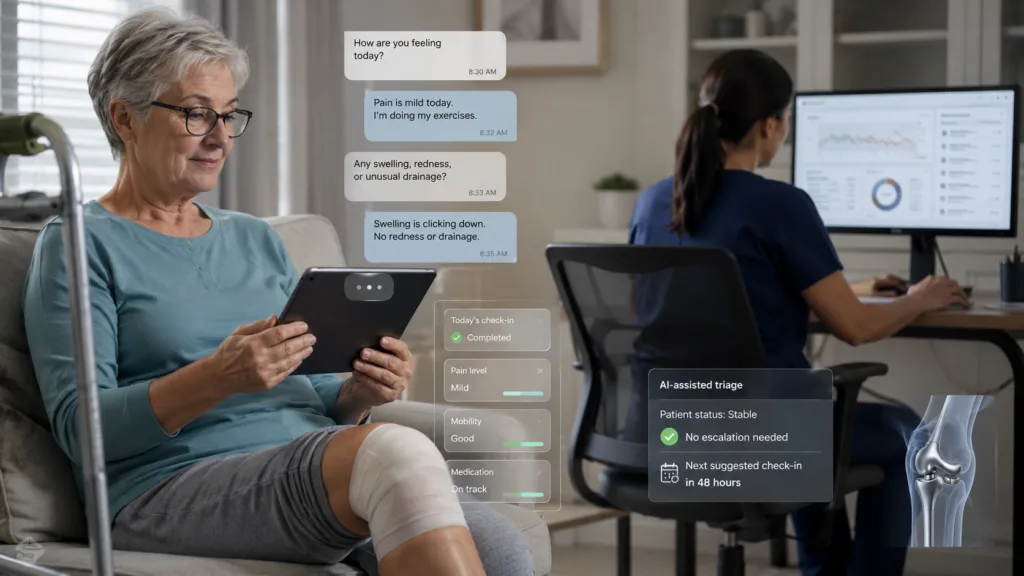
RecovryAI is developing procedure-specific Virtual Care Assistants that are prescribed by physicians and interact directly with patients after discharge. Its first programme is focused on recovery following total hip arthroplasty and total knee arthroplasty, two procedures that increasingly shift postoperative monitoring and communication away from the hospital and into the home.
During a conversation, the investigational software evaluates whether the patient’s reported symptoms and recovery progress appear consistent with the expected postoperative course. It can provide guidance for routine recovery or identify a potential deviation, prepare a clinical synthesis and alert the monitoring care team.
The proposed division of labour is important. RecovryAI is not simply developing an administrative chatbot that schedules appointments or answers general questions. The system is intended to provide patient-specific clinical guidance and make decisions about whether a reported recovery pattern requires escalation.
That function places the product in a more demanding regulatory and clinical category than consumer wellness applications or artificial intelligence tools that only draft notes for clinicians. Errors could influence patient behaviour, delay recognition of complications or create unnecessary urgent-care activity. The company is therefore pursuing the product as regulated Software as a Medical Device rather than launching it as an unregulated communication service.
Why is surgeon concordance central to the pivotal study’s primary endpoint?
RecovryAI said each eligible patient conversation is being presented in blinded form to three independent physicians. The primary analysis will compare the Virtual Care Assistant’s classification and recommended action with the assessments made by the reviewing orthopaedic surgeons.
This design offers several advantages. Using multiple independent reviewers can reduce dependence on one physician’s judgement, while blinding can limit the possibility that reviewers are influenced by knowing how the artificial intelligence classified a case. Tens of thousands of conversations may also expose the system to a broader range of postoperative questions than would be captured by evaluating a small number of predefined clinical scenarios.
Concordance nevertheless has boundaries as an endpoint. Physicians can disagree about the appropriate response to an ambiguous symptom, and the adjudication process must define how disagreement among reviewers will be handled. The final analysis will also need to show whether the prespecified threshold is sufficiently demanding for a system that interacts directly with recovering patients.
The most consequential errors may not be evenly distributed. A high overall agreement rate could coexist with weaker performance in rare but serious situations such as suspected infection, thromboembolic complications, wound problems or unexpected deterioration. Regulators and clinicians will therefore need more than a headline concordance percentage to understand the clinical risk profile.
Performance by scenario, urgency level, patient characteristics and type of recommended action will be important when the full dataset becomes available. The public disclosure does not yet provide that level of detail.
Does the trial demonstrate improved outcomes or reduced clinical workload?
Not yet. The prospective study primarily evaluates whether the Virtual Care Assistant’s clinical classifications and recommendations correspond with physician judgement. It is not described as a randomised trial comparing patient outcomes between artificial intelligence-supported recovery and conventional postoperative care.
RecovryAI has paired the prospective study with a retrospective analysis of 579 additional patients. This brings the total patient population evaluated under the broader protocol to 1,104 and supports a secondary endpoint examining possible effects on workflow and downstream healthcare utilisation.
The retrospective component may provide useful evidence on patterns such as care-team contacts, escalation frequency or use of healthcare services. However, retrospective analyses are more vulnerable to differences in patient selection, practice patterns, documentation and baseline risk than prospectively controlled comparisons.
Even a reduction in phone calls or electronic messages would require careful interpretation. Lower contact volume could represent efficient handling of routine recovery questions, but it would not be beneficial if patients became less likely to report clinically important symptoms. The commercially persuasive result would be evidence that the platform can remove routine workload while maintaining or improving timely escalation of genuine problems.
Health systems will ultimately want to know whether the technology changes measurable operational or clinical outcomes. Relevant questions include whether it reduces avoidable calls, shortens response times, detects concerning recovery patterns earlier, prevents unnecessary emergency visits, supports lower readmission rates or allows the same clinical workforce to oversee a larger postoperative population without weakening care quality.
What does the generated stress-testing dataset add to the clinical evidence package?
The protocol also contains approximately 1,500 generated conversations intended to test the Virtual Care Assistant against uncommon and clinically complex situations that may not appear frequently enough in a 525-patient prospective study.
RecovryAI said these conversations were produced through a controlled-generation framework combining clinical conditions, comorbidities, communication styles and different levels of health literacy. Each generated scenario is reportedly anchored to a real, physician-adjudicated interaction and reviewed for clinical plausibility before being used to evaluate the software.
This approach could help reveal weaknesses in scenarios that are both rare and consequential. It may also allow the company to test combinations of symptoms or communication patterns that were underrepresented in the real-patient dataset.
Generated conversations cannot replace prospective evidence, however. Their usefulness depends on how realistically they represent patient language, incomplete information, uncertainty and unexpected behaviour. A model can appear reliable against scenarios built within the developer’s own testing framework while encountering different failure modes during broader deployment.
The strongest regulatory package would therefore use generated stress testing as a supplement to real clinical conversations rather than as evidence equivalent to independent, real-world patient performance. Transparency about scenario creation, reviewer agreement and the distribution of difficult cases will influence how much weight clinicians place on this component.
Why is RecovryAI using the FDA De Novo pathway for its patient-facing software?
RecovryAI is seeking De Novo classification as a Class II medical device because it is developing a product type for which the company does not expect to rely on an existing legally marketed predicate.
The De Novo pathway allows the United States Food and Drug Administration to classify a novel device presenting low to moderate risk into Class I or Class II when general controls, or general controls combined with special controls, can provide reasonable assurance of safety and effectiveness.
A granted De Novo request would do more than permit RecovryAI to market the product for its authorised intended use. It would establish a new device classification and define the controls applicable to that category. The authorised device could also become a predicate for later products seeking clearance through the 510(k) pathway.
That possibility gives the application wider importance for developers of patient-facing clinical artificial intelligence. The eventual decision could help clarify how the regulator expects companies to validate systems that communicate directly with patients, interpret reported symptoms and recommend whether clinical escalation is required.
RecovryAI has said that the study’s primary endpoint, sample-size methodology and physician-adjudication process were refined through pre-submission interactions with the agency beginning in 2024. The study operated under physician oversight and was classified as a Non-Significant Risk investigation.
FDA interaction can reduce uncertainty about the evidence expected in a submission, but it does not guarantee that the final request will be accepted or granted. The agency will still evaluate the completed evidence package, proposed intended use, software controls, risk mitigations, labelling and post-market requirements.
What does Breakthrough Device Designation mean for the regulatory timeline?
RecovryAI’s lead Virtual Care Assistant has received FDA Breakthrough Device Designation. The programme is intended for eligible devices that may provide more effective treatment or diagnosis for life-threatening or irreversibly debilitating conditions and meet additional statutory criteria.
The designation can give a developer more frequent interaction with the regulator and prioritised review. It does not establish that the device is effective, does not lower the standard for marketing authorisation and does not permit commercial distribution.
For RecovryAI, the practical value may lie in the ability to address novel questions about patient-facing artificial intelligence before filing the De Novo request. These could include the definition of clinically acceptable performance, oversight requirements, management of software updates, controls for inappropriate responses and monitoring after commercial deployment.
The company must also demonstrate that the version tested in the pivotal study is sufficiently representative of the version proposed for marketing. Artificial intelligence systems can change rapidly, but a regulated medical device cannot be altered in ways that invalidate its clinical evidence or introduce unassessed risks.
Which unresolved artificial intelligence risks could shape the FDA assessment?
False negatives represent the most immediate clinical concern. A system that classifies an abnormal recovery as routine could delay escalation to the care team. False positives create a different problem by producing unnecessary alerts, adding workload and reducing clinician trust in the system.
Performance consistency will matter across patients with different ages, comorbidities, communication styles, health literacy levels and digital familiarity. The disclosed study involved three United States orthopaedic centres, which provides multisite evidence but may not reflect the full diversity of hospitals, surgical practices and patient populations that the product could encounter after launch.
The eventual submission will also need to address human oversight, cybersecurity, privacy, interoperability and software lifecycle management. Care teams must understand when an alert is generated, what information supports the recommendation and how responsibility is divided between the software and the supervising clinician.
Model updates present another challenge. Changes intended to improve performance can create new behaviour. RecovryAI will need a controlled process for validating modifications, determining whether regulatory review is required and ensuring that hospital customers know which software version is operating.
What would commercial adoption require after a possible FDA authorization?
Regulatory authorisation would remove a major barrier, but it would not ensure rapid adoption. Orthopaedic practices and health systems would still need to integrate the platform into existing postoperative workflows, define alert responsibilities, train staff and establish escalation protocols.
Procurement teams are likely to examine whether the system works with electronic health records, how it protects patient information, how much clinician time is required to supervise it and whether its operational savings justify implementation costs. Clinical leaders will also want evidence that the platform performs reliably outside the original study centres.
Reimbursement could influence adoption. RecovryAI has positioned its technology as compatible with remote monitoring and value-based postoperative care models, but regulatory authorisation, coding, coverage and payment are separate issues. A billing pathway does not automatically guarantee that every payer will cover the service or that the available payment will support the company’s commercial model.
The software may prove most attractive to high-volume joint-replacement practices facing rising postoperative communication demands. Those practices could gain meaningful capacity if the Virtual Care Assistant resolves routine interactions while directing clinicians toward patients who require human judgement.
The commercial case will weaken quickly, however, if alert volumes remain high, supervision requirements offset labour savings or patients do not engage consistently with the platform. Clinical workflow evidence may therefore become as important as algorithmic performance after the regulatory decision.
What milestones will determine whether the pivotal programme supports a De Novo filing?
The next steps are final physician adjudication, database lock and completion of the prespecified statistical analysis. RecovryAI will then need to disclose whether the primary endpoint was achieved and provide enough detail to evaluate the magnitude and consistency of concordance.
Particular attention should be paid to sensitivity for clinically concerning deviations, false-negative performance, unnecessary escalation rates, physician-reviewer agreement and results across relevant subgroups. Evidence from the retrospective workflow analysis and generated stress-testing dataset will need to be interpreted separately from the prospective primary endpoint.
RecovryAI has targeted a De Novo submission later in 2026, but that remains a company-planned timeline rather than a confirmed regulatory event. Filing the request would begin the next phase of scrutiny rather than complete the regulatory process.
The patient-phase milestone gives RecovryAI a substantial clinical dataset and moves the company closer to testing its proposed model of regulated, physician-prescribed, patient-facing artificial intelligence. The decisive question is now whether the final analysis shows that the system can recognise routine and abnormal recovery patterns with sufficient reliability for direct use in postoperative care, without transferring unacceptable risk or hidden workload to patients and clinicians.