
The United States Food and Drug Administration (FDA) has classified Resmed Ltd.’s correction of certain Astral 100 and Astral 150 ventilators as a Class I recall after a leaking internal component was linked to five serious injuries and the potential for ventilation therapy to stop without warning.
The action covers 168,069 devices distributed worldwide and applies to certain Astral ventilators and replacement printed circuit boards manufactured before October 2024. The FDA describes Class I as its most serious recall category because continued use without correction may create a reasonable probability of serious injury or death.
Patients have nevertheless been told not to stop using an affected ventilator unless instructed by their clinician. Replacement printed circuit boards are in constrained supply, and withdrawing a functioning life-support device before an alternative is available could create a more immediate danger than continuing treatment with strengthened monitoring and emergency precautions.
The contradiction is only apparent. A medical-device recall does not always require removal from the patient’s home or hospital. In this case, the interim response depends on identifying affected main boards, prioritising the most vulnerable patients for inspection, training caregivers to recognize the maximum-volume alarm and ensuring backup ventilation can be started immediately.
Resmed reported five serious injuries and no deaths associated with the problem as of June 23, 2026. The absence of reported deaths does not reduce the seriousness of a failure capable of stopping mechanical ventilation in a patient who cannot breathe independently.
What exactly has been recalled in the Resmed Astral ventilator correction?
The correction involves certain Astral 100 and Astral 150 ventilators manufactured before October 2024, as well as affected printed circuit board assembly spare parts.
The Astral range provides continuous or intermittent mechanical ventilation for patients weighing more than five kilograms. It can support adults and children through invasive ventilation, such as a tracheostomy connection, or non-invasive ventilation delivered through a mask or mouthpiece.
The devices are used in hospitals, long-term care institutions, patients’ homes and portable settings. Their compact design and battery options allow some people with severe respiratory or neuromuscular conditions to live outside intensive-care environments while continuing to receive essential breathing support.
The FDA recall record identifies 168,069 devices in global commerce. Distribution extended across much of the United States and numerous international markets, including India, Australia, Canada, the United Kingdom, Japan and several European, Asian, Middle Eastern and South American countries.
Not every Astral ventilator will contain the defective component. The relevant question is whether the main printed circuit board currently installed in the machine falls within the affected manufacturing population.
A ventilator may have undergone previous servicing or received a replacement board. Its external manufacturing date or original serial number may therefore be insufficient to establish its current status.
Patients should not open the ventilator or attempt to inspect its circuitry. The device provider, hospital biomedical engineering team, authorized service centre or Resmed representative must determine whether the installed board is affected.
How can a leaking supercapacitor cause an Astral ventilator to stop therapy?
The failure begins with an internal electrical component called a supercapacitor. Unlike the main rechargeable battery, a supercapacitor is designed to store and release relatively small amounts of electrical energy rapidly for specific electronic functions.
Resmed found that the component may leak electrolyte as it ages. That material can reach surrounding circuitry on the printed circuit board assembly and damage a charger chip or associated electronic components.
The damaged circuitry can force the ventilator into a fail-safe state. A fail-safe system is normally intended to prevent a malfunctioning device from continuing to operate unpredictably, but entering that state also means the Astral ventilator can no longer provide breathing support.
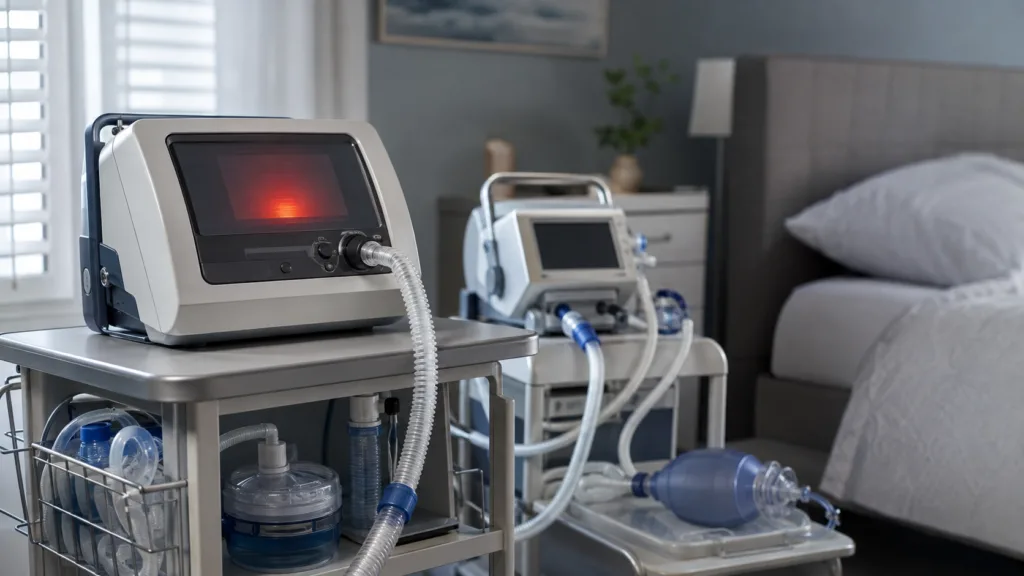
If the failure occurs while treatment is running, ventilation stops and a high-priority alarm sounds at maximum volume. The display may show therapy alarms and a red Safety System Fault screen. Pressing the Vent Stop control can result in the display of System Fault 140.
If the problem develops while the machine is in standby, the maximum-volume alarm may activate without a corresponding message appearing on the screen. Attempting to begin ventilation will fail because the machine cannot start therapy.
The alarm therefore indicates a failure requiring immediate alternative ventilation rather than a condition that can be corrected by adjusting ordinary treatment settings. Silencing the alarm, restarting the machine repeatedly or changing the patient circuit will not repair damaged electronics.
The critical clinical interval begins when therapy stops. A patient with meaningful spontaneous breathing capacity may tolerate a short interruption better than someone entirely dependent on the ventilator, but neither situation should be treated casually.
Why are patients being told to continue using a device under a Class I recall?
Class I describes the potential health consequences of a medical-device problem. It does not mean every affected unit has failed, that every unit will fail or that the device must immediately be removed in all circumstances.
A ventilator-dependent patient needs uninterrupted respiratory support. Taking away the primary machine without installing an appropriate alternative could cause immediate respiratory failure.
The FDA and Resmed have consequently instructed patients to continue using their Astral ventilators unless a treating clinician advises otherwise. An affected device should not be withdrawn until another suitable means of ventilation is ready.
This is a risk-balancing decision. Continued use carries a possibility that the supercapacitor could leak and disable therapy, while premature removal creates a known interruption in respiratory support.
The safest pathway is therefore controlled continuity. The patient continues prescribed ventilation while the provider establishes whether the installed circuit board is affected, assigns a clinical risk category, prepares backup equipment and schedules inspection or repair.
An affected ventilator that becomes inoperable should be removed from service and replaced immediately. Patients and caregivers should not continue attempting to use a machine that has entered the fail-safe state.
The recommendation may feel unsettling because the word recall is commonly associated with returning a product. Medical-device corrections are more complicated when the product is providing continuous life support and substitutes are limited.
Which patients face the greatest danger if an Astral ventilator suddenly stops?
The highest-risk group consists of patients who cannot sustain adequate spontaneous breathing without mechanical support.
This may include selected people with advanced neuromuscular disease, high spinal-cord injuries, severe chest-wall disorders, congenital conditions, chronic respiratory failure or other illnesses that substantially weaken breathing.
Patients receiving invasive ventilation through a tracheostomy can be particularly vulnerable because their clinical condition may leave little reserve after therapy stops. Some non-invasively ventilated patients can also be highly dependent, especially during sleep or acute illness.
Risk is not determined only by the diagnosis. The number of hours of ventilation required each day, the patient’s ability to trigger spontaneous breaths, oxygen requirements, airway-clearance needs and speed of deterioration during previous interruptions all matter.
The care environment is equally important. A patient in a hospital unit with trained staff and another ventilator nearby has a different risk profile from someone sleeping at home with no awake caregiver in the room.
Hearing impairment, caregiver fatigue, background noise and distance from the ventilator can delay alarm recognition. A maximum-volume alarm provides protection only when someone can hear it, understand what it means and initiate the correct response.
Resmed has asked healthcare providers to assess affected patients using a tiered clinical-risk framework. That process is intended to place patients with the lowest respiratory reserve and weakest backup arrangements at the front of the inspection and correction queue.
Why does a backup battery not solve the Resmed Astral failure risk?
The Astral ventilator includes an internal battery and can operate with external power accessories. These systems protect against loss of mains electricity and support portable use.
The present fault is different from an ordinary power outage. Electrolyte leakage can damage the main printed circuit board and cause the device itself to enter an inoperable fail-safe state.
Switching from wall power to an external battery will not restore ventilation if the circuit board can no longer control therapy. A fully charged battery may therefore be available while the ventilator remains unable to deliver a breath.
Patients need access to an alternative means of ventilation, not merely another electricity source for the affected machine. Depending on the prescribed care plan, that may involve a separate ventilator or a manual resuscitator.
A manual resuscitator is an emergency bridge rather than an equivalent long-term replacement. It must be operated repeatedly by someone with appropriate training, connected correctly to the patient interface and used with suitable attention to ventilation rate, pressure and oxygen delivery.
Families should confirm that backup equipment is present, accessible and functioning. Equipment stored in another room, missing a connector, lacking a charged battery or unfamiliar to the caregiver may not provide meaningful protection during an emergency.
The recall transforms backup readiness from a general precaution into an immediate clinical requirement. A checklist completed months earlier is not enough if nobody has recently inspected the equipment or practised the response.
What should patients and caregivers do if the maximum-volume alarm activates?
Caregivers should follow the emergency plan established by the patient’s respiratory-care team rather than improvising a repair.
If the machine stops providing therapy and displays a Safety System Fault or System Fault 140, the immediate priority is maintaining ventilation. The trained caregiver should begin the prescribed alternative ventilation method and obtain urgent clinical assistance.
The alarm should not be treated like a routine mask leak, high-pressure event or temporary circuit-disconnection warning. When this electronic failure occurs, the machine is no longer capable of delivering therapy.
Patients capable of communicating may experience breathlessness, anxiety, reduced airflow or difficulty speaking. Those with limited mobility or communication impairment may be unable to alert someone beyond the ventilator alarm.
Continuous monitoring by trained personnel is particularly important for fully dependent patients. Monitoring does not necessarily mean watching the display every second, but someone capable of acting must be sufficiently close and attentive to respond without dangerous delay.
Caregivers should understand how to disconnect the patient safely from the failed machine, attach the backup system and summon emergency help. Training should account for night-time use, power interruptions, travel and circumstances in which the primary caregiver is unavailable.
After alternative ventilation is established, the affected Astral unit should be removed from use and reported to the equipment provider. It should be inspected by an authorized service centre rather than opened or repaired in the home.
Why can Resmed not replace every affected circuit board immediately?
Resmed has acknowledged that replacement printed circuit boards are significantly constrained. The available inventory is insufficient to correct the entire affected population at once.
That supply limitation explains the phased strategy. Inspections and replacement activity are being prioritized according to clinical risk rather than performed simultaneously across all 168,069 devices.
Circuit-board availability also affects the supply of new Astral ventilators. Healthcare providers have been advised to prioritize alternative ventilator options for newly treated patients because Astral availability may remain restricted.
The shortage creates a difficult operational problem for home medical-equipment providers. They must identify affected units, inspect replacement boards installed during earlier servicing, contact patients, arrange loan equipment and decide which machines can safely remain in use while waiting for parts.
Alternative ventilators are not always interchangeable. Moving a patient to another platform may require new settings, compatible circuits, humidification equipment, alarm configuration and caregiver training.
For highly individualized ventilation, switching devices should be overseen by a respiratory clinician. Similar pressure or volume settings may behave differently across platforms because triggering, leak compensation and alarm systems are not identical.
The correction will therefore take more than shipping circuit boards. It requires a coordinated programme involving inventory tracing, patient assessment, technical servicing, clinical review and updated emergency preparation.
How does the 2026 Astral recall differ from the earlier supercapacitor correction?
The Astral platform was already subject to a Class I correction initiated in 2023 involving degradation of a supercapacitor in devices manufactured from 2013 through 2019.
That earlier problem concerned the Total Power Failure alarm. If the ventilator lost all power, the degrading supercapacitor could cause the alarm to sound for less than two minutes or not sound at all.
The earlier action covered 55,279 devices worldwide, including 16,634 in the United States. Resmed reinforced external-power and backup-ventilation precautions and later directed affected devices to receive a software update.
The current recall involves a related type of component but a different failure pathway. Electrolyte leakage can damage circuitry on the main board, including the charger chip, and force the ventilator into a state where therapy stops or cannot start.
A software update intended to improve alarm behaviour during total power loss does not replace a circuit board damaged by leaking electrolyte. Patients whose ventilators received the earlier update should not assume that their machines are unaffected by the new correction.
The two actions also reinforce a wider reliability question. A component initially associated with alarm degradation has now been implicated in a failure that can interrupt ventilation itself.
That does not prove every historic supercapacitor problem shares one root cause. It does make transparent reporting about component selection, manufacturing periods, inspection findings and long-term failure rates especially important.
Does the Class I designation mean all 168,069 ventilators are dangerous?
The recall population identifies devices that may contain the affected component. It does not mean every machine has developed electrolyte leakage or will enter the fail-safe state.
The reported five serious injuries represent a small number compared with the global quantity in commerce. A crude division of reported injuries by distributed units would nevertheless be misleading because adverse events can be underreported, devices have different ages and usage patterns, and many units may not be actively supporting patients.
The probability of failure may also change over time. Component leakage associated with ageing could produce a different risk in an older, heavily used machine than in a newer device from the same affected manufacturing population.
Severity and frequency must be considered separately. Even a relatively uncommon failure can justify a Class I recall when its consequence is an abrupt loss of ventilation in a dependent patient.
The alarm provides an important protective layer, but it does not eliminate the hazard. Alarm effectiveness depends on the fault producing the expected signal, the caregiver hearing it and alternative ventilation beginning before the patient is harmed.
Five serious injuries also demonstrate that emergency protections did not prevent harm in every reported case. More information about the circumstances of those events would help clinicians understand whether delayed alarm response, missing backup equipment or unusually rapid patient deterioration contributed.
The proper message is neither that every Astral ventilator is about to fail nor that the low reported event count makes the recall unimportant. The affected population needs structured correction because the failure’s clinical consequence is unusually severe.
How could the recall reshape home mechanical ventilation programmes?
Home ventilation moves sophisticated respiratory support away from continuously staffed clinical environments. It can improve independence, reduce hospitalization and allow children and adults to remain with their families.
That model relies on several layers of resilience. The primary ventilator must be reliable, alarms must work, backup equipment must be available, caregivers must be trained and clinical support must be reachable.
The Astral recall tests every one of those layers. A hardware defect may begin inside the machine, but the eventual outcome can depend on whether a household has an awake caregiver, a functioning backup ventilator and a practised emergency response.
Equipment suppliers may need to reassess how frequently they verify backup-device readiness. Simply documenting that a manual resuscitator was delivered may be insufficient when caregivers cannot demonstrate its use.
Remote monitoring may help identify alarms and changes in therapy, but it cannot provide ventilation by itself. Connectivity should support, rather than replace, an immediate physical response at the patient’s location.
Providers may also reconsider single-platform dependence. Maintaining identical primary and backup ventilators simplifies training, but a supply or component problem affecting an entire device family can create simultaneous vulnerability.
The correction highlights an uncomfortable reality of home-based life support. Clinical freedom depends on technical reliability and human preparedness operating together, including during the least convenient moment of the night.
What information should Resmed and regulators disclose as repairs progress?
The first priority is an updated count of injuries, deaths and confirmed device failures. The five-serious-injury figure was current only through June 23 and may change as more devices are inspected.
Providers also need a clearer repair timeline. The phrase phased correction describes the strategy but does not tell a highly dependent patient whether replacement parts will become available in days, weeks or months.
Failure rates should be reported by manufacturing date, component batch, device age and operating hours where possible. This could show whether risk rises predictably over time and help refine prioritization beyond broad clinical categories.
Inspection findings are equally important. Regulators should be able to determine how often affected boards show visible leakage, electronic damage or precursor fault codes before ventilation stops.
The company should clarify whether board replacement is the permanent remedy for every affected machine and whether replacement boards use a redesigned or differently sourced supercapacitor.
Transparency about the five serious injuries would improve prevention, although patient privacy must be protected. Clinicians need to know whether alarms activated, whether a trained caregiver was present and how quickly alternative ventilation began.
The recall should remain open until affected devices have been inspected or corrected and the adequacy of the remedy has been demonstrated. A customer notification alone cannot resolve a component defect in a life-support platform.
What is the most important message for families using an Astral ventilator?
Patients should not discontinue ventilation or return the machine without clinical instructions. The immediate objective is to continue essential therapy while making a possible failure survivable.
Families should contact their equipment provider or clinical team to confirm whether the currently installed main board is affected and where the patient sits within the correction programme.
Every caregiver responsible for the patient should know the meaning of the maximum-volume alarm, the location of backup equipment and the exact steps required if ventilation stops.
The backup system should be checked now rather than after an alarm. Its power supply, tubing, patient connection and any necessary oxygen equipment must be compatible and ready.
Patients who are fully dependent on ventilation require the most urgent review because even a short delay can cause severe injury. They should not be left without monitoring by someone capable of starting alternative support.
For Resmed and the FDA, the central challenge is completing a worldwide hardware correction while replacement boards remain scarce. The Class I designation communicates the potential severity, but risk-tiered servicing and caregiver preparation must carry much of the safety burden until repairs catch up.
The Astral recall is ultimately not a story about one leaking electronic component. It is a test of whether manufacturers, clinicians, equipment suppliers and families can maintain uninterrupted breathing support when a life-sustaining device develops a rare but potentially catastrophic failure.