The United States Food and Drug Administration (FDA) has approved MannKind Corporation’s Furoscix ReadyFlow, a prefilled autoinjector that delivers 80 milligrams of subcutaneous furosemide in about ten seconds for adults experiencing edema associated with chronic heart failure or chronic kidney disease.
The July 24 approval creates a faster alternative to the existing Furoscix On-body Infusor, which delivers the same total furosemide dose over five hours. Patients or caregivers can press the single-use ReadyFlow device against the abdomen and hold it in place until a yellow indicator fills the viewing window, eliminating the need to wear an electronic infusion system for several hours.
Furoscix ReadyFlow is expected to become commercially available in the United States by the end of August 2026. It is intended to help selected patients respond to worsening fluid accumulation outside a hospital, outpatient infusion centre or emergency department.
The FDA decision was supported primarily by pharmacokinetic and pharmacodynamic evidence showing that the concentrated subcutaneous formulation produced similar overall drug exposure, urine output and electrolyte excretion to intravenous furosemide. The pivotal comparison was conducted in healthy volunteers rather than patients experiencing worsening heart failure or kidney disease.
That distinction defines the approval’s promise and its limitation. ReadyFlow has demonstrated intravenous-equivalent furosemide exposure, but the autoinjector has not independently proved that it prevents hospitalization, improves survival or produces better clinical outcomes than intravenous treatment. Those benefits will depend on patient selection, timely use and a care system capable of monitoring what happens after the injection.
What exactly did the FDA approve for adults with heart failure or chronic kidney disease?
Furoscix is indicated for edema in adults with chronic heart failure or chronic kidney disease, including nephrotic syndrome. Edema can appear as swelling in the legs or abdomen, rapid weight gain, congestion and shortness of breath when the body retains more sodium and water than it can eliminate.
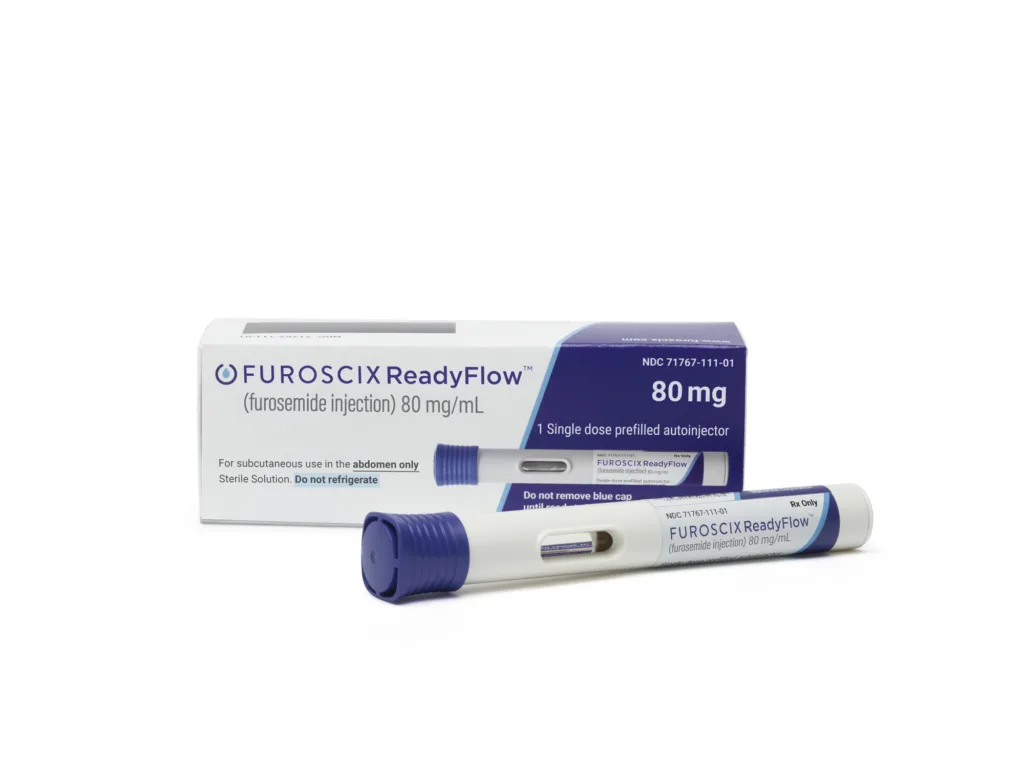
ReadyFlow delivers a fixed 80-milligram dose of furosemide in one millilitre of solution. The medication is injected under the skin of the abdomen using a disposable, spring-driven autoinjector.
The approval was handled as a supplemental new drug application because Furoscix is a drug-device combination centred on an established medicine. It was not a separate medical-device clearance based only on demonstrating substantial equivalence to another autoinjector.
Furosemide has been used for decades as a loop diuretic. The pharmaceutical innovation lies in producing a concentrated formulation that can be administered rapidly under the skin without causing unacceptable pain or tissue injury, while the device innovation makes that formulation suitable for self-administration.
ReadyFlow is approved only for adults. The separate Furoscix On-body Infusor can be used in adults and pediatric patients weighing at least 43 kilograms, although pediatric administration must be performed by a healthcare professional or adult caregiver.
Furoscix is not intended for continuous chronic use. The prescribing information states that it should be replaced with oral diuretic treatment as soon as practical. ReadyFlow is therefore better understood as an episodic intervention for worsening fluid accumulation, not as a new daily maintenance treatment.
How does the ReadyFlow autoinjector differ from the five-hour Furoscix infusor?
The original Furoscix On-body Infusor was approved in 2022 for adults with edema associated with chronic heart failure. Its indication was expanded to chronic kidney disease in 2025 and later to qualifying pediatric patients.
That device uses a prefilled cartridge containing 80 milligrams of furosemide in ten millilitres of solution. It initially delivers 30 milligrams during the first hour and then administers 12.5 milligrams per hour for another four hours.
The patient must attach the battery-powered, microprocessor-controlled infusor to the abdomen and keep it in place throughout the five-hour treatment. Activity must be limited because movement, moisture or loss of adhesion can interrupt administration.
ReadyFlow compresses the same 80-milligram dose into one millilitre. A mechanical spring drives the injection over approximately ten seconds, removing the need for a battery, microprocessor, adhesive patch or prolonged infusion period.
The practical difference is considerable. A patient no longer needs to schedule five relatively inactive hours, monitor an electronic indicator or protect the attached device from water and accidental displacement.
The faster autoinjector does not necessarily eliminate all treatment burden. Patients should remain at home and close to a bathroom because urine production may increase within about an hour and frequent bathroom visits can continue for up to six hours.
ReadyFlow is also a single-use device that must be discarded in a sharps container. Patients need sufficient hand strength, vision and understanding to position it correctly, monitor the viewing window and recognize an incomplete injection.
Why can oral furosemide become unreliable during worsening fluid overload?
Oral loop diuretics are central to the routine management of congestion in heart failure and chronic kidney disease. They are inexpensive, familiar and considerably easier to administer than an injection.
Their effectiveness can become less predictable as fluid overload worsens. Swelling of the intestinal wall may reduce or delay absorption, while impaired blood flow to the digestive tract can further alter how much medicine reaches the circulation.
Furosemide already has variable oral bioavailability under ordinary conditions. A dose that produces adequate urine output during a stable period may become insufficient when congestion intensifies.
Kidney impairment adds another obstacle. Furosemide must reach its site of action within the kidney tubules, and patients with significantly reduced kidney function may require greater diuretic exposure to produce the desired response.
Clinicians often respond by increasing the oral dose or combining different diuretics. When those measures fail, intravenous furosemide may be administered in an emergency department, hospital, infusion centre or specialised outpatient clinic.
Subcutaneous delivery bypasses gastrointestinal absorption. ReadyFlow could therefore occupy the treatment gap between an ineffective oral dose and hospital-based intravenous therapy.
That opportunity depends on recognizing deterioration early. Patients and clinicians need a clear action plan covering weight gain, swelling, breathing difficulty, blood pressure, kidney function and the circumstances in which home treatment is no longer appropriate.
What did the crossover study establish about intravenous-equivalent drug exposure?
The principal ReadyFlow study was an open-label, randomized, two-period crossover investigation involving 21 healthy adults aged between 45 and 80 years. Participants received subcutaneous Furoscix through the autoinjector and intravenous furosemide in different treatment periods.
The intravenous comparator consisted of two 40-milligram bolus doses separated by two hours. This created a total intravenous dose of 80 milligrams against which the single 80-milligram subcutaneous injection could be assessed.
Nineteen participants were included in the pharmacokinetic analysis presented in the approved prescribing information. ReadyFlow achieved relative bioavailability of 107.3%, with a 90% confidence interval from 103.9% to 110.8%.
The median time to maximum concentration was 45 minutes after the subcutaneous injection. Total drug exposure was similar to intravenous administration, although the maximum blood concentration was lower with ReadyFlow.
The autoinjector produced similar diuresis, natriuresis and kaliuresis at six, eight and 12 hours. These measures represent urine production and the urinary elimination of sodium and potassium.
The diuretic effect continued for up to approximately six hours after ReadyFlow administration. This supports the proposition that a rapid subcutaneous injection can produce sustained fluid and electrolyte removal rather than only a short burst of activity.
The study establishes pharmacological comparability. It demonstrates that furosemide reaches the bloodstream and produces the expected renal effects when delivered through the concentrated autoinjector formulation.
It does not establish clinical equivalence across every relevant outcome. Healthy volunteers do not reproduce the impaired kidney function, intestinal edema, low blood pressure, frailty or multiple medicines frequently encountered in people with advanced heart failure or chronic kidney disease.
Does intravenous-equivalent exposure mean ReadyFlow works exactly like hospital treatment?
The term intravenous-equivalent can be easily misunderstood. It refers primarily to overall furosemide exposure and selected pharmacodynamic effects, not to proof that every patient will experience the same symptom relief or clinical outcome.
ReadyFlow produced a lower peak concentration than the two intravenous bolus doses. Lower peak exposure may be beneficial if it reduces concentration-related toxicity, but it also means the shape of the concentration curve is not identical.
A clinician administering intravenous furosemide can adjust the dose, repeat treatment, monitor urine output and obtain immediate laboratory results. ReadyFlow delivers one fixed 80-milligram dose that cannot be adjusted after the injection starts.
Patients with significantly reduced renal function may require additional diuretic treatment. The current product label specifically notes that the fixed dose may not be sufficient for everyone with severe kidney impairment.
Intravenous treatment also occurs in an environment where oxygen levels, blood pressure, kidney function and electrolytes can be assessed rapidly. Home use shifts more responsibility toward the patient, caregiver and remote clinical team.
The evidence therefore supports intravenous-equivalent drug exposure, not interchangeable clinical management. A stable patient experiencing an anticipated episode of moderate fluid accumulation is different from someone with rapidly worsening breathlessness, low oxygen saturation, chest pain, confusion or declining urine production.
ReadyFlow could help prevent escalation when it is used early in an appropriate patient. It should not encourage patients to manage potentially life-threatening deterioration at home without medical assessment.
Can Furoscix ReadyFlow actually reduce emergency visits and hospital admissions?
Avoiding hospital treatment is the most compelling reason to use the autoinjector, but it is not yet a clinical outcome proved specifically for ReadyFlow.
Earlier studies involving the five-hour Furoscix formulation provide supportive evidence for the broader home-based subcutaneous treatment strategy. The AT HOME-HF pilot study evaluated Furoscix against usual care in outpatients with worsening heart-failure congestion.
That small study reported greater early weight loss, improvement in congestion-related symptoms and a numerical reduction in heart-failure hospitalizations. One treatment-related serious adverse event involving dehydration was reported and subsequently resolved.
The FREEDOM-HF investigation compared healthcare use among 24 patients treated with Furoscix with matched patients who received hospital-based care. One Furoscix-treated patient was hospitalized during the following 30 days, and the analysis suggested lower heart-failure-related healthcare costs.
These findings are encouraging but limited. The studies were small, and the cost comparison used matched controls rather than a large randomized population. They also evaluated the five-hour infusion formulation, not the newly approved concentrated autoinjector.
Administration within ten seconds may improve convenience and willingness to use the treatment, but it does not automatically improve decongestion or prevent hospital admission. A more convenient device can even be used too late, too early or by someone whose condition requires a different intervention.
Large prospective studies should compare protocol-guided ReadyFlow use with optimized oral treatment and outpatient intravenous care. Important endpoints would include emergency visits, hospital admissions, kidney injury, electrolyte abnormalities, days alive outside hospital and patient-reported quality of life.
Until those results are available, hospitalization avoidance should be described as the treatment model’s objective rather than an established ReadyFlow outcome.
Which patients could gain the most from a ten-second at-home injection?
The most suitable patients are likely to have recurrent, recognizable episodes of fluid accumulation despite following a prescribed oral diuretic regimen.
They should be medically stable enough for outpatient management, capable of recognizing worsening symptoms and able to contact a clinical team if urine production does not increase or symptoms continue to deteriorate.
Patients recently discharged after treatment for heart failure may represent another important group. Fluid can begin accumulating again during the vulnerable period after hospitalization, and early intervention could potentially prevent a return visit.
Home-health services, heart-failure clinics and nephrology programmes may use ReadyFlow as part of structured treatment pathways. A clinician could prescribe the device in advance and provide specific instructions explaining when it should be used.
The approval does not mean every patient with ankle swelling should receive an autoinjector. Edema can have several causes, and excessive diuretic treatment can be harmful when swelling is not driven by fluid overload responsive to furosemide.
Patients with poor vision, impaired hand function or cognitive difficulties may need caregiver assistance. Those who live alone, have limited bathroom access or cannot communicate rapidly with a healthcare team may require additional support.
The product’s convenience is greatest when it sits inside a defined care plan. Without that structure, shifting treatment into the home could transfer clinical risk without providing the monitoring needed to manage it.
What safety risks accompany rapid subcutaneous furosemide treatment?
Furoscix ReadyFlow carries the established risks of potent loop-diuretic therapy. Excessive diuresis can cause dehydration, reduced circulating blood volume, dizziness, low blood pressure and deterioration in kidney function.
The medication can also produce low potassium, low sodium, low magnesium and other electrolyte disturbances. These abnormalities can contribute to weakness, muscle cramps, confusion and abnormal heart rhythms.
Monitoring may include serum electrolytes, carbon dioxide, blood urea nitrogen, creatinine, glucose and uric acid. The frequency of testing should reflect the patient’s condition, kidney function, other medicines and pattern of ReadyFlow use.
Furosemide has been associated with tinnitus and reversible or irreversible hearing impairment. Risk can increase with high doses, severe kidney impairment or simultaneous use of other medicines capable of damaging hearing.
Rapid urine production can create acute urinary retention in patients with severe bladder-emptying problems, prostate enlargement or urethral narrowing. Producing more urine is not beneficial if the patient cannot pass it safely.
ReadyFlow is contraindicated in patients who produce no urine and in those with hypersensitivity to furosemide or an ingredient in the formulation.
The most common Furoscix adverse effects involve the administration site. These can include redness, bruising, swelling and pain. Concentrating 80 milligrams into a one-millilitre injection improves speed but places the full formulation into a small tissue area.
The effect of substantial subcutaneous edema at the injection site on drug absorption remains unknown. This is relevant because the intended population may already have extensive fluid accumulation.
How could an incomplete injection create a hidden device-related treatment failure?
The ReadyFlow device includes a viewing window with a yellow plunger rod that indicates whether administration has progressed to completion.
The patient removes the cap, holds the device at a 90-degree angle against a clean abdominal site and presses firmly. The device must remain against the skin until the yellow rod stops moving and completely fills the window.
Lifting the autoinjector too early can cause medicine to appear on the skin or spray from the needle. The patient may then receive only part of the intended dose.
An incomplete injection is clinically difficult because the patient may not know exactly how much furosemide entered the body. Using a second autoinjector without instructions could produce excessive dosing, while doing nothing could allow congestion to continue worsening.
The approved instructions tell patients to contact their healthcare provider when the window does not turn completely yellow or when they believe the full dose was not delivered. They should not use another ReadyFlow unless directed to do so.
A lack of increased urination after approximately one hour is another reason to contact the care team. It may indicate incomplete delivery, inadequate response, advanced kidney impairment or a clinical problem requiring reassessment.
Real-world device surveillance should track incomplete injections, user errors, needle-shield problems and difficulty interpreting the indicator window. A ten-second treatment is convenient only when patients can reliably confirm that those ten seconds delivered the entire dose.
Why will home monitoring determine whether ReadyFlow changes clinical practice?
ReadyFlow removes the need for an infusion chair, but it does not remove the need for clinical judgment.
A successful home programme may combine daily weight measurement, symptom assessment, blood-pressure checks and rapid communication with a heart-failure or kidney-care team. Selected patients could also use remote monitoring devices capable of detecting worsening congestion before severe symptoms develop.
The prescribing plan should define the amount of weight gain or swelling that triggers contact with the care team. It should also explain whether the patient can administer ReadyFlow immediately or must first speak with a clinician.
Follow-up is equally important. Clinicians need to know whether urine output increased, body weight declined, breathing improved and dizziness or weakness appeared.
Laboratory testing may be required after treatment, especially in patients with unstable kidney function, previous electrolyte abnormalities or concurrent medicines affecting blood pressure and potassium.
The device could be particularly useful within hospital-at-home and transitional-care programmes because those services already provide structured observation outside conventional inpatient settings.
Its benefit may be harder to reproduce when a prescription is dispensed without adequate training or follow-up. The device moves furosemide administration into the home, but the surrounding care model must move with it.
Could price and insurance coverage limit the autoinjector’s real-world reach?
Generic oral and intravenous furosemide are inexpensive. Furoscix adds the cost of a specialized formulation, single-use delivery device, distribution service and patient-support infrastructure.
Payers will therefore examine whether home administration prevents enough emergency visits, infusion-centre appointments or hospital admissions to justify the product’s cost.
The economic argument is strongest when ReadyFlow replaces a hospital-based encounter. It is less convincing when it is added to treatment without reducing other healthcare use.
Prior authorization may require documentation that oral diuretic treatment has become inadequate or that the patient has recurrent fluid-overload episodes. Coverage criteria could vary across commercial insurers and Medicare plans.
MannKind operates Furoscix Direct to help patients and clinicians navigate insurance coverage, product delivery and possible financial support. The company acquired the original developer, scPharmaceuticals, in October 2025 and integrated Furoscix into its cardiometabolic portfolio.
Distribution must also be reliable because the product works best when patients have it available before congestion becomes severe. Waiting for a prescription to be processed after symptoms have already escalated would weaken the value of an at-home rescue strategy.
Commercial availability by the end of August will begin the practical test. Prescribing volume alone will be less informative than whether patients receive the device early, use it correctly and avoid higher-acuity care.
What evidence would establish ReadyFlow as more than a convenient delivery upgrade?
The first requirement is prospective outcome evidence in adults with worsening heart failure or chronic kidney disease, rather than additional pharmacokinetic comparisons in healthy volunteers.
A credible study should randomize patients to a ReadyFlow-based care pathway or optimized usual care. It should define clear intervention criteria and use the same follow-up intensity in both groups.
Hospitalization and emergency-department use are obvious endpoints, but safety must receive equal attention. Researchers should measure acute kidney injury, electrolyte disturbances, symptomatic low blood pressure, urinary retention and treatment-related falls.
The study should also report incomplete dosing and other device-use failures. A formulation can be pharmacologically reliable while its real-world administration remains inconsistent.
Subgroup analysis will be important. Patients with preserved versus reduced heart pumping function, moderate versus advanced kidney disease and high versus low oral diuretic requirements may respond differently.
Caregiver burden and patient confidence should also be measured. A ten-second injection could be liberating for some patients while creating anxiety for others who feel safer receiving intravenous treatment under supervision.
Longer follow-up must determine whether early home decongestion improves quality of life or merely postpones a hospital visit by several days. It should also show whether repeated episodic use remains effective and safe.
Can Furoscix ReadyFlow genuinely move intravenous-level diuresis out of hospital?
Furoscix ReadyFlow solves a tangible delivery problem. It takes a five-hour subcutaneous infusion and compresses administration into approximately ten seconds without sacrificing overall furosemide exposure or the measured diuretic response.
That is a meaningful engineering and formulation achievement. It could make home-based treatment practical for patients who found the original wearable infusor too time-consuming or cumbersome.
The FDA approval does not establish that the autoinjector can replace every intravenous treatment encounter. Its supporting comparison involved a small group of healthy adults, while the intended population includes people with unstable fluid balance, reduced kidney function and multiple cardiovascular risks.
ReadyFlow will be most valuable when used before congestion becomes an emergency but after oral treatment is no longer providing an adequate response. Identifying that window is primarily a clinical challenge rather than a device function.
The approval has provided MannKind with a faster tool for delivering established therapy. The next step is proving that patients and health systems can use it at the correct moment, monitor the consequences and avoid the hospital care that the device is designed to replace.
Ten seconds may be enough to deliver the medicine. Demonstrating that those ten seconds change the course of worsening heart failure or kidney disease will take longer.