Medtronic has secured an expanded European CE Mark indication for its Affera Mapping and Ablation System with the Sphere-9 catheter, allowing the platform to treat ventricular arrhythmias including ventricular tachycardia and premature ventricular complexes.
The August 6, 2026 regulatory expansion moves Sphere-9 beyond the atrial arrhythmias for which the system was initially commercialized. Medtronic describes Sphere-9 as the first CE-marked large-tip focal catheter that can combine high-definition mapping, pulsed-field ablation and radiofrequency ablation in a single device for ventricular procedures.
That description contains an important qualification. Sphere-9 is not the first catheter used for ventricular ablation, and European authorization does not establish that it is clinically superior to existing radiofrequency systems. Its novelty lies in combining mapping and two ablation energy sources within one catheter while extending that integrated workflow into the ventricles.
The development is nevertheless consequential because ventricular tachycardia remains one of electrophysiology’s most difficult treatment problems. Patients often have damaged hearts, complex scar tissue and implantable defibrillators that can terminate dangerous rhythms without removing the underlying electrical circuit responsible for them.
Early clinical evidence supports further evaluation but remains limited. In an interim United States feasibility dataset involving 40 patients with sustained monomorphic ventricular tachycardia related to a previous heart attack, the clinically relevant arrhythmia could no longer be induced immediately after treatment in all participants. The estimated proportion remaining free from any sustained monomorphic ventricular tachycardia at six months was 65.5%.
Only half of the 40 participants had reached the six-month follow-up point when those interim results were reported. The study was also non-randomized and initially concentrated on ischemic heart disease, creating a substantial gap between promising procedural performance and proof of durable superiority across the broader population now covered by the European indication.
What does the expanded Sphere-9 CE Mark actually authorize?
The expanded CE Mark permits Medtronic to market the Affera system and Sphere-9 catheter in Europe for ventricular arrhythmias, subject to individual-country commercialization, hospital procurement and reimbursement arrangements.
The new indication specifically includes ventricular tachycardia and premature ventricular complexes. Both originate in the heart’s lower chambers, but they represent different clinical problems and should not be treated as interchangeable conditions.
Ventricular tachycardia is a rapid rhythm that can reduce the heart’s ability to pump blood and may deteriorate into ventricular fibrillation or sudden cardiac arrest. It frequently occurs in people with scar tissue left by a previous myocardial infarction, although nonischemic cardiomyopathies can also create ventricular arrhythmia substrates.
Premature ventricular complexes are early beats arising from the ventricles. They are common and may be harmless when infrequent, but a high burden can produce symptoms or contribute to a weakening of the heart muscle in selected patients.
The breadth of the European indication gives electrophysiologists flexibility to use the system across different ventricular procedures. It does not mean the same quantity or quality of clinical evidence exists for every ventricular arrhythmia covered by the label.
Medtronic’s announcement did not disclose a detailed European regulatory evidence dossier, the number of patients whose data supported the expanded indication or separate effectiveness results for premature ventricular complex ablation. Those details will influence how quickly clinicians move from regulatory availability to routine use.
Why is ventricular tachycardia harder to ablate than atrial fibrillation?
Much of the commercial excitement surrounding pulsed-field ablation has developed in atrial fibrillation, where physicians commonly isolate the pulmonary veins to prevent abnormal electrical signals from entering the left atrium.
That procedure is anatomically demanding, but the treatment target is comparatively standardized. Ventricular tachycardia caused by structural heart disease can arise from complicated channels running through or around scar tissue, and the relevant electrical pathway may differ substantially between patients.
The ventricular wall is also much thicker than atrial tissue. A treatment capable of creating an adequate lesion in the atrium may not penetrate deeply enough to interrupt a ventricular circuit buried within the heart muscle.
Some arrhythmogenic tissue is intramural, meaning it lies within the ventricular wall rather than on its inner or outer surface. Other circuits are located near coronary arteries, valves, papillary muscles or the heart’s conduction system, where aggressive ablation could damage an essential structure.
Scar-related ventricular tachycardia can additionally be difficult to map because the arrhythmia may cause dangerously low blood pressure. Physicians cannot always keep the abnormal rhythm running long enough to trace its complete electrical circuit, so they may need to identify and modify likely scar substrates while the patient is in a stable rhythm.
An implantable cardioverter-defibrillator can recognize ventricular tachycardia and deliver rapid pacing or a shock. These interventions can be lifesaving, but repeated shocks are painful and can signal worsening electrical instability. Catheter ablation attempts to reduce the recurrence and burden of ventricular tachycardia rather than merely terminating each episode after it begins.
The challenge for Sphere-9 is therefore greater than transferring an established atrial workflow into a larger chamber. Medtronic must demonstrate that its energy settings can reach clinically important ventricular substrates without exchanging inadequate lesion depth for an unacceptable safety risk.
How does Sphere-9 map and ablate with one catheter?
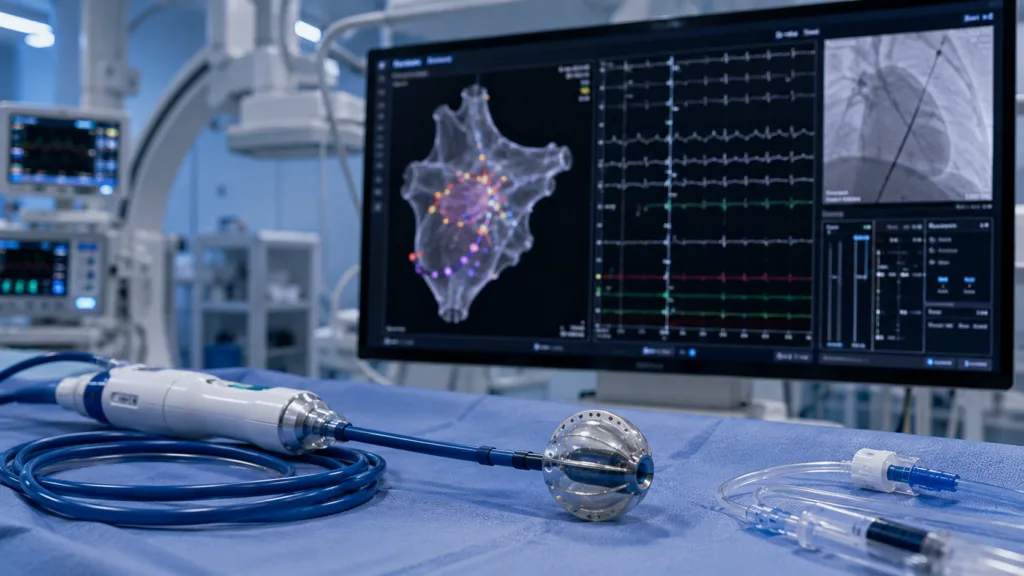
Sphere-9 has a compressible nine-millimetre nitinol lattice tip containing nine miniature mapping electrodes and nine temperature sensors. The tip is designed to conform to tissue while covering a larger surface area than a conventional focal catheter.
The catheter records electrical signals that help physicians construct high-density maps through the Affera system. These maps are used to identify scar boundaries, abnormal electrical pathways and tissue that could support ventricular tachycardia.
Once a target is selected, the operator can deliver either radiofrequency energy or pulsed-field energy through the same catheter. Radiofrequency ablation heats tissue to create a controlled area of permanent injury that blocks the unwanted electrical pathway.
Pulsed-field ablation works differently. Short electrical pulses produce microscopic openings in cell membranes through a process known as electroporation. When the electrical exposure is sufficiently strong, the affected cells cannot recover and die.
Pulsed-field ablation is described as non-thermal because electrical disruption, rather than deliberate heating, is the primary mechanism. That distinction does not mean every application is entirely free from heat or that surrounding structures are automatically protected.
The ability to select between radiofrequency and pulsed-field energy may be especially relevant in complex ventricular procedures. An electrophysiologist could theoretically choose the energy source according to tissue characteristics, lesion location and proximity to vulnerable anatomy.
Sphere-9 can then be used to remap the treated region and determine whether the targeted electrical signals remain present. Removing the need to exchange separate mapping and ablation catheters could shorten parts of the procedure and reduce repeated catheter manipulation.
The real clinical value of this integration must be demonstrated rather than assumed. A faster workflow is valuable only when it produces durable lesion formation, fewer ventricular tachycardia episodes and an acceptable complication rate.
What did the Sphere-9 feasibility study show at six months?
The Sphere-9 Ventricular Tachycardia Early Feasibility Study is a prospective, multicentre, non-randomized investigation of the catheter and Affera system in adults with recurrent, sustained, scar-related monomorphic ventricular tachycardia.
The programme initially enrolled patients with ischemic cardiomyopathy caused by a previous myocardial infarction. Medtronic expanded the feasibility study during 2026 to include people with nonischemic cardiomyopathy, although the interim results highlighted by Medtronic came from the post-myocardial-infarction group.
Among 40 treated participants, investigators reported that the clinically relevant ventricular tachycardia was non-inducible immediately following ablation in every patient. Acute non-inducibility is an encouraging procedural endpoint because it suggests the targeted electrical circuit was interrupted.
It is not the same as long-term freedom from ventricular tachycardia. Tissue can recover, lesion gaps can remain, other circuits can emerge and progressive heart disease can create new arrhythmogenic areas after an apparently successful procedure.
At six months, the interim Kaplan-Meier estimate showed that 65.5% of participants remained free from any sustained monomorphic ventricular tachycardia. Follow-up was still ongoing, and only 20 of the 40 participants had reached the six-month point.
Among the 20 patients with device-derived follow-up information, the median number of ventricular tachycardia episodes detected each month after ablation was zero. A median of zero does not mean every participant remained arrhythmia-free. It indicates that at least half of the evaluated group had no detected monthly episodes at the relevant assessment.
Medtronic reported device-related safety events in two of the 40 patients. The company’s August CE Mark announcement did not provide a detailed breakdown of those events, their severity or whether they produced lasting consequences.
Earlier clinical experience involving 18 heavily treated patients also demonstrated the platform’s potential while illustrating the procedural risks. Investigators achieved non-inducibility in 16 participants, and 78% remained free from ventricular arrhythmia at three months. That experience included a stroke that had resolved by one month and coronary artery spasm during an epicardial application near a coronary vessel, with the spasm resolving after intracoronary nitroglycerin.
Taken together, the results support feasibility rather than final validation. They show that Sphere-9 can map and ablate difficult ventricular substrates and that many treated patients may experience a substantial reduction in arrhythmia burden. They do not yet establish whether Sphere-9 outperforms modern radiofrequency ablation, reduces mortality or prevents more implantable defibrillator shocks over several years.
Why does 100% acute success require cautious interpretation?
A perfect acute non-inducibility result is attention-grabbing, particularly in a population with recurrent ventricular tachycardia. It remains a surrogate measurement taken at the end of a procedure, when the immediate biological effects of ablation are strongest.
The endpoint concerned the clinically relevant ventricular tachycardia rather than necessarily every inducible ventricular rhythm. Patients with structural heart disease may have several potential circuits, and eliminating the rhythm selected as clinically important does not guarantee that another circuit will not become active later.
The study did not randomize patients against an established catheter, medical treatment or another emerging ventricular ablation technology. Differences in patient selection, operator experience, mapping strategy and previous ablation history can materially affect outcomes in a small, single-arm study.
The interim six-month calculation is also based on incomplete follow-up. Kaplan-Meier estimates are commonly used when participants have different lengths of observation, but early results can change as the remaining patients reach the assessment point.
The feasibility evidence has been concentrated on sustained monomorphic ventricular tachycardia associated with myocardial infarction. Nonischemic cardiomyopathy can produce deeper, patchier and more epicardial scar, potentially making the condition even harder to treat through an endocardial catheter.
The European indication additionally covers premature ventricular complexes, but the announcement did not provide a dedicated PVC effectiveness dataset. Physicians will need to distinguish evidence generated in life-threatening scar-mediated ventricular tachycardia from outcomes expected in patients undergoing focal PVC ablation.
What safety questions follow pulsed-field ablation into the ventricles?
Pulsed-field ablation has attracted interest partly because different tissues may have different thresholds for irreversible electroporation. In the atrium, this selectivity may help reduce injury to structures such as the oesophagus or pulmonary veins.
Ventricular anatomy changes the risk calculation. Ventricular targets may be located near coronary arteries, valves, the His-Purkinje conduction system or implanted device leads. The amount of energy needed to reach deeper tissue could also differ from energy settings developed for atrial procedures.
Coronary artery spasm has become a recognized concern when pulsed-field energy is delivered close to a coronary vessel. The resolved spasm observed in early Sphere-9 ventricular experience demonstrates why energy location and coronary proximity require careful planning.
Researchers must also monitor for stroke, cardiac perforation, tamponade, damage to the conduction system and new ventricular arrhythmias caused by the procedure. These are not unique to Sphere-9, but a new waveform and catheter geometry can change the probability or mechanism of particular complications.
Other pulsed-field ablation programmes have drawn attention to haemolysis, microbubble formation and possible cerebral embolic events. The risk can depend on waveform design, the number of applications, catheter contact, blood exposure and procedural technique, making platform-specific evidence more useful than broad assumptions about the entire technology class.
Radiofrequency energy carries a different set of trade-offs, including thermal injury, steam pops, char formation and collateral damage. Sphere-9’s dual-energy capability provides flexibility, but it also requires operators to understand when each modality is appropriate and how risks may accumulate when both are used during one procedure.
European commercial experience will expand the number and diversity of treated patients. Post-market surveillance will be essential for detecting rare complications that a small feasibility trial cannot reliably identify.
How meaningful is the premature ventricular complex indication?
Including premature ventricular complexes broadens Sphere-9’s potential addressable use beyond patients with scar-related ventricular tachycardia. PVC ablation can be considered when premature beats are highly symptomatic, resistant to medication or frequent enough to contribute to left ventricular dysfunction.
These procedures are often focal, with physicians mapping the site from which the early beat originates. That could suit an integrated catheter capable of recording high-density signals, delivering energy and immediately checking whether the abnormal activity has disappeared.
The clinical threshold for adoption may nevertheless be different. Patients undergoing ventricular tachycardia ablation may face recurrent defibrillator shocks or a life-threatening rhythm, while many people with PVCs have a less urgent risk profile.
A new device used in comparatively stable PVC patients must therefore offer a particularly convincing balance of safety, procedural efficiency and durable suppression. A technology appropriate for a critically ill ventricular tachycardia patient is not automatically the preferred choice for every symptomatic PVC case.
Medtronic has not publicly disclosed separate recurrence rates, procedural times or safety outcomes for PVC treatment within the announcement. Dedicated data will be important if the company wants the broader European indication to translate into routine PVC use rather than remaining primarily a regulatory option.
Could one-catheter treatment change hospital adoption?
Cardiac ablation normally requires several components, including an electroanatomic mapping platform, diagnostic catheters, an ablation catheter, energy generators and supporting software. Each catheter exchange adds time and introduces another workflow step.
Sphere-9 is intended to map, ablate and validate without replacing the main catheter. For hospitals performing large numbers of electrophysiology procedures, even modest reductions in laboratory time could increase scheduling capacity and improve the utilization of specialised staff.
The economic benefit will depend on the complete procedure rather than catheter speed alone. Ventricular tachycardia ablation can require anaesthesia, haemodynamic support, intracardiac imaging, coronary assessment or epicardial access, all of which may outweigh time saved by avoiding an exchange.
Adoption also requires investment in the Affera platform, compatible generators, software, inventory and clinician training. Hospitals already using Affera for atrial fibrillation may have a more straightforward path than centres committed to another manufacturer’s mapping ecosystem.
Medtronic completed its acquisition of Affera in 2022, gaining a mapping and navigation platform alongside the dual-energy catheter. The ventricular indication strengthens the strategic logic of that transaction by allowing the same technology ecosystem to address a wider range of arrhythmias.
The expansion could also deepen platform loyalty. Once an electrophysiology laboratory trains its team, integrates a mapping system and establishes purchasing arrangements, moving individual cases to another platform can become operationally inconvenient.
That commercial advantage still depends on clinical confidence. Experienced ventricular tachycardia centres will examine lesion depth, mapping quality, catheter stability, safety near coronary arteries and long-term recurrence before changing an established workflow.
How does Sphere-9 compare with emerging VT technologies?
Conventional irrigated radiofrequency catheters remain central to ventricular tachycardia ablation. Their strengths include long clinical experience, familiar workflows and adjustable energy delivery, while limitations can include insufficient lesion depth and thermal injury near sensitive anatomy.
Sphere-9’s differentiating feature is not pulsed-field energy alone. Field Medical is also developing its FieldForce system specifically for ventricular pulsed-field ablation and has received United States breakthrough device status.
Adagio Medical is pursuing a different approach through its vCLAS ultra-low-temperature ablation system. That platform is intended to create deep lesions using extremely low temperatures and is being evaluated in the FULCRUM-VT programme across ischemic and nonischemic cardiomyopathy.
These competing programmes reflect the same unresolved problem: existing surface-based radiofrequency ablation does not consistently reach every deep or complex ventricular substrate. Device developers are approaching that limitation through high-voltage pulsed fields, dual-energy catheters, ultra-low-temperature ablation and other lesion-delivery strategies.
Sphere-9 currently has a European regulatory advantage as the first CE-marked catheter in its specific all-in-one, large-tip, dual-energy ventricular category. That status should not be interpreted as proof that it produces deeper lesions or better long-term outcomes than every competing system.
The eventual competitive hierarchy will depend on freedom from recurrent ventricular tachycardia, reduction in defibrillator shocks, safety, procedure time, compatibility with mapping workflows and performance in nonischemic disease. First-mover status opens the hospital door, but durable clinical evidence decides whether the device stays in the room.
Is Sphere-9 approved for ventricular tachycardia in the United States?
Sphere-9 is already approved in the United States for selected atrial arrhythmias, including drug-refractory recurrent symptomatic persistent atrial fibrillation. Its current United States authorization does not include ventricular tachycardia.
The United States Food and Drug Administration granted Sphere-9 breakthrough device designation for ventricular use in April 2026. The designation is intended to facilitate interaction with the regulator and potentially accelerate development and review for technologies addressing serious conditions.
Breakthrough designation is not marketing approval. It does not confirm effectiveness, guarantee a favourable decision or allow routine United States commercialization for ventricular tachycardia.
Medtronic said in its August announcement that enrolment in the Sphere VT pivotal trial was underway. A public trial record updated on July 30 still listed the study as not yet recruiting, suggesting the registry may not have reflected the latest site activity when the company issued its release.
The pivotal study is designed to enrol an estimated 260 adults in a prospective, multicentre, single-arm investigation. Participants must have recurrent sustained monomorphic ventricular tachycardia associated with a prior myocardial infarction and an implanted defibrillator or cardiac resynchronization defibrillator.
The study excludes ventricular tachycardia caused by nonischemic cardiomyopathy, even though the earlier feasibility programme has been expanded to study that population. This will make the pivotal evidence more defined but may leave unanswered questions about a clinically important group with difficult-to-reach substrates.
Primary completion is estimated for March 2028, with overall study completion expected in September 2028. Those dates show that a United States ventricular indication remains a development programme rather than an imminent regulatory formality.
What must the Sphere VT pivotal study prove?
The pivotal study must first reproduce the strong acute performance reported in the smaller feasibility programme across more physicians and treatment centres. Results generated by highly experienced early investigators do not always transfer unchanged into broader practice.
Durable outcomes will be more important than immediate non-inducibility. The study must show that patients experience a meaningful reduction in sustained ventricular tachycardia, defibrillator therapies and recurrent hospital care over follow-up.
Safety must be evaluated with enough participants to better characterize events such as stroke, perforation, coronary injury, conduction-system damage and complications associated with pulsed-field or combined-energy delivery.
The single-arm design will remain a limitation because every participant receives Sphere-9 treatment. Without direct randomization against a contemporary radiofrequency catheter, comparisons may depend on prespecified performance targets, historical evidence and the consistency of results across participating centres.
Procedure-level information could become commercially decisive. Electrophysiologists and hospitals will want to know how often operators use pulsed-field energy, radiofrequency energy or both, whether catheter exchanges are genuinely reduced and whether the technology shortens total laboratory time.
Medtronic must also clarify which patients benefit most. Outcomes may differ according to scar location, ventricular function, previous ablation, ventricular tachycardia burden and the number of electrical circuits present before treatment.
Can Sphere-9 move pulsed-field ablation beyond atrial fibrillation?
The expanded CE Mark gives Medtronic a meaningful lead in one of the most demanding areas of cardiac electrophysiology. Sphere-9 is no longer simply an atrial fibrillation catheter being experimentally tested in the ventricle. It now has a European indication covering ventricular tachycardia and premature ventricular complexes.
The supporting evidence offers a credible reason for interest. Acute non-inducibility was achieved across the 40-patient interim cohort, ventricular tachycardia burden fell substantially for many patients and approximately two-thirds were estimated to remain free from sustained monomorphic ventricular tachycardia at six months.
Those findings are not yet definitive. Follow-up was incomplete, the study lacked a control group and most of the reported evidence came from patients with scar caused by a previous myocardial infarction. Separate clinical detail supporting the PVC indication also remains limited in the public domain.
Sphere-9’s most persuasive feature may be its flexibility. Physicians can map, treat with pulsed-field or radiofrequency energy and reassess the result using one catheter, potentially adapting the procedure to anatomy rather than forcing every lesion through one energy modality.
Europe will now provide the first larger commercial test of that proposition. Real-world evidence must show whether the integrated workflow reduces procedure complexity while maintaining durable rhythm control and acceptable safety across different centres.
If those results hold and the pivotal United States study confirms the benefit, Sphere-9 could help establish ventricular ablation as the next important expansion market for pulsed-field technology. For now, the CE Mark is an important regulatory and engineering milestone, while the central clinical question remains open: can dual-energy ablation consistently reach the ventricular scar that existing treatments too often leave behind?