Nipro Corporation has launched the ELISIO-HX dialyzer across the United States after receiving 510(k) clearance from the United States Food and Drug Administration, introducing a new option for expanded hemodialysis that can operate through existing dialysis machines and established clinical workflows. The single-use dialyzer uses a medium cut-off, super high-flux membrane intended to remove a broader range of middle molecules than conventional high-flux hemodialysis while limiting the loss of albumin, an essential circulating protein.
The commercial launch was announced on August 4, 2026, one week after the regulatory clearance became effective on July 28. Nipro Corporation said ELISIO-HX would be made available to dialysis providers nationwide through its United States subsidiary, Nipro Medical Corporation. The company is positioning the device as a practical route to expanded hemodialysis because clinics can introduce it without purchasing dedicated hemodiafiltration systems, fundamentally altering treatment schedules or extensively retraining clinical staff.
That operational simplicity may prove as important as the membrane technology. Dialysis providers routinely evaluate new equipment against clinical benefit, treatment complexity, staff workload, supply reliability and reimbursement. A dialyzer that fits existing infrastructure has a lower adoption barrier than a therapy requiring additional machines, replacement-fluid preparation or major changes in water-treatment capability.
However, the clinical significance of ELISIO-HX will depend on more than its ability to remove additional molecules from the blood. Published studies suggest that medium cut-off membranes improve the clearance of several larger uremic toxins, but evidence that these biochemical changes consistently reduce hospitalisation, cardiovascular events, symptoms or mortality remains incomplete. Nipro Corporation must therefore convert a technically attractive clearance profile into measurable benefits that matter to patients, nephrologists and dialysis operators.
What is the Nipro ELISIO-HX dialyzer and what did the FDA clear?
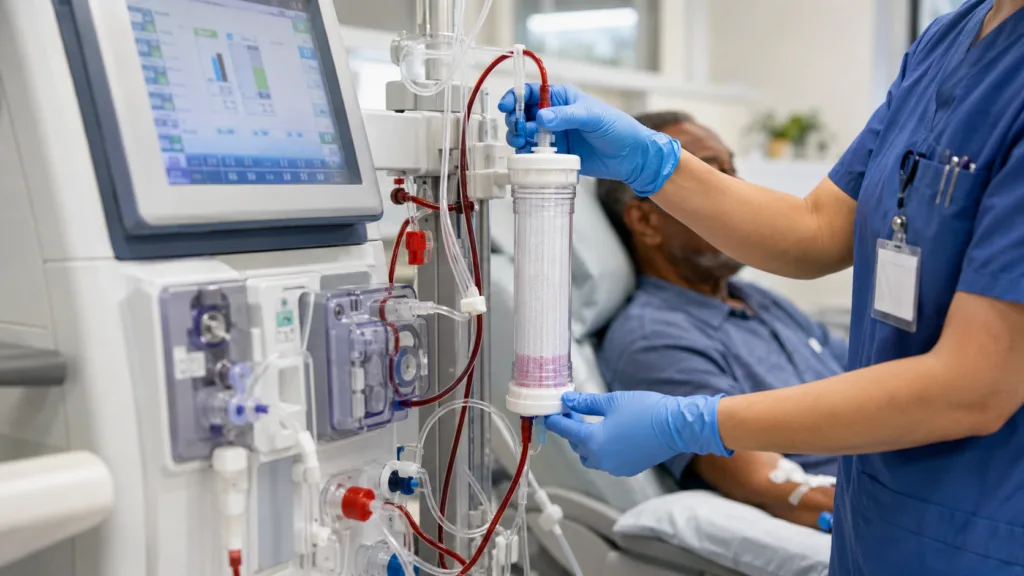
ELISIO-HX is a high-permeability, medium cut-off hemodialyzer designed to function as an artificial kidney during treatment for renal failure. Blood passes through thousands of hollow membrane fibres inside the cartridge, allowing waste products and excess fluid to move across the membrane into the dialysis solution before the treated blood is returned to the patient.
The Food and Drug Administration’s 510(k) pathway requires a manufacturer to demonstrate that a device is substantially equivalent to an appropriate legally marketed predicate device. Clearance permits commercial distribution for the authorised intended use, but it should not be described as the same as the premarket approval applied to certain higher-risk devices. The regulator maintains separate databases for cleared and approved medical devices.
Nipro Corporation describes ELISIO-HX as the enabling technology for what it calls HDs, meaning hemodialysis powered by a super high-flux membrane. The approach falls within the broader category of expanded hemodialysis, commonly known as HDx, in which a membrane with enhanced permeability is used to remove middle and larger middle molecules that conventional dialysis may clear less efficiently.
The company has not publicly disclosed the commercial price, expected number of initial United States installations, supply agreements or revenue contribution from the launch. It has also not announced that DaVita or another major dialysis operator has committed to a network-wide conversion. Comments from a DaVita medical executive in the launch announcement indicated clinical interest in expanding treatment choice, but they did not amount to a purchasing or deployment agreement.
How does ELISIO-HX remove larger middle molecules during dialysis?
Traditional hemodialysis is highly effective at removing small water-soluble substances such as urea and creatinine. Healthy kidneys, however, clear a much wider range of molecules, including larger compounds that can accumulate when kidney function is lost.
These retained compounds include beta-2 microglobulin, myoglobin, inflammatory mediators and free light chains. They vary considerably in size, biological function and association with disease. Some have been linked to chronic inflammation, cardiovascular complications, malnutrition, neurological symptoms and dialysis-related amyloidosis, although removing an individual biomarker does not automatically establish that a treatment will improve a clinical outcome.
The ELISIO-HX membrane is made from polyethersulfone and uses a tightly controlled pore structure. The pores are engineered to allow a broader range of larger solutes to pass while retaining most albumin, which has a molecular size close to the upper boundary of the substances targeted by medium cut-off membranes.
This selectivity is technically difficult. Making membrane pores too restrictive may prevent the removal of clinically relevant middle molecules. Making them excessively permeable can increase albumin loss, potentially worsening nutritional status in patients who may already face protein-energy wasting.
Nipro Corporation argues that its membrane achieves a sharp separation between larger uremic toxins and albumin. The launch announcement said the design was intended to extend middle-molecule clearance while preserving albumin levels. That proposition is supported by small published comparisons, but United States providers will need to evaluate performance under routine treatment conditions and across a more diverse patient population.
What did Nipro’s United States ELISIO-HX clinical study evaluate?
Nipro Medical Corporation sponsored a completed United States premarket study involving 22 adults receiving in-centre hemodialysis. Participants first underwent a baseline treatment using the company’s established ELISIO-H high-flux dialyzer and were then treated with ELISIO-HX three times each week for 12 weeks. The study was conducted at a DaVita clinical research site in Norfolk, Virginia.
The primary safety objective was to determine whether pre-dialysis albumin levels were adversely affected after switching to ELISIO-HX. The primary performance objective assessed whether the device improved the reduction of lambda free light chains, a larger middle-molecule marker that is more difficult to clear through conventional high-flux dialysis membranes.
The study also monitored several proteins and nutritional indicators, including coagulation factors, protein C, vitamin A and normalised protein catabolic rate. These measurements were relevant because a highly permeable membrane could theoretically remove beneficial proteins alongside unwanted toxins.
The trial began in September 2025 and reached completion in February 2026. Detailed results were not displayed on the ClinicalTrials.gov record reviewed for this article, meaning the public information available from the study registry primarily describes the design and endpoints rather than the complete numerical findings supporting clearance.
Nipro Corporation’s regulatory success indicates that the Food and Drug Administration accepted the company’s overall evidence for substantial equivalence and the cleared use. Nevertheless, peer-reviewed publication of the United States study would give nephrologists and procurement teams a clearer basis for assessing albumin retention, middle-molecule removal and variability among patients.
What does published research show about the ELISIO-HX dialyzer?
A prospective study published in Blood Purification evaluated ELISIO-HX in 18 patients and compared it with conventional high-flux hemodialysis, another medium cut-off dialyzer and post-dilution hemodiafiltration. Each participant underwent treatment under five different dialysis configurations, allowing investigators to compare the removal of small, middle and larger molecules.
The researchers found no material difference among the modalities for small-molecule clearance. Expanded hemodialysis and hemodiafiltration were more effective than conventional high-flux hemodialysis for middle and larger molecules. ELISIO-HX produced overall removal performance similar to the comparator medium cut-off dialyzer, exceeded the high-flux dialyzers and came close to, although remained below, the performance of post-dilution hemodiafiltration.
Albumin loss during expanded hemodialysis and hemodiafiltration ranged from approximately 1.5 grams to 2.5 grams per treatment in that small study, compared with less than one gram for the high-flux dialyzers. Investigators concluded that ELISIO-HX demonstrated good tolerance and represented an upgrade over Nipro Corporation’s previous high-flux dialyzer.
A separate randomised comparison assessed ELISIO-HX against Baxter International’s Theranova medium cut-off dialyzer. ELISIO-HX produced slightly lower removal of some molecules, including beta-2 microglobulin and myoglobin, while its performance differed by molecule for the free light chains measured. ELISIO-HX was associated with substantially less albumin loss than Theranova in that trial, highlighting the trade-off between membrane permeability and retention of beneficial proteins.
These studies support the device’s biochemical performance, but their limited participant numbers and short treatment periods prevent firm conclusions about survival, cardiovascular events, hospitalisation or long-term quality of life.
How is expanded hemodialysis different from conventional high-flux dialysis?
Conventional high-flux hemodialysis uses more permeable membranes than older low-flux systems and can remove small molecules and some smaller middle molecules efficiently. Its performance declines as molecular size increases, leaving certain larger compounds less effectively cleared.
Expanded hemodialysis uses a medium cut-off membrane with a permeability profile extending closer to the molecular weight of albumin. Internal filtration and backfiltration within the dialyzer increase the movement of larger solutes across the membrane without requiring an external replacement-fluid circuit.
This allows expanded hemodialysis to run on a conventional dialysis machine, which is the central commercial argument behind ELISIO-HX. A clinic may be able to substitute the dialyzer cartridge while retaining its existing treatment stations, water system, staffing model and session schedule.
The ease of substitution could support adoption in clinics where online hemodiafiltration is not available. Hemodiafiltration combines diffusion and convection and can provide strong middle-molecule clearance, but it generally requires compatible equipment, large quantities of sterile substitution fluid and suitable vascular access and blood-flow conditions.
Nipro Corporation said ELISIO-HX could be considered for patients with vascular-access limitations or other factors that make high-volume therapies more difficult. The company has not claimed that the device should replace hemodiafiltration in every suitable patient, and comparative treatment decisions will remain the responsibility of nephrologists.
Could better middle-molecule clearance improve outcomes for dialysis patients?
The scientific rationale is credible. Patients with kidney failure retain a complex mixture of toxins that healthy kidneys would normally remove, and conventional adequacy measurements focus heavily on urea, a small molecule that may not represent the complete burden of uraemia.
Reviews and meta-analyses have generally found that expanded hemodialysis improves the removal of middle and larger middle molecules compared with high-flux hemodialysis. Some studies have reported favourable changes in inflammatory markers, itching, physical functioning or other patient-reported measures. Results have not been uniform, however, and many investigations have been small or relatively short.
A 2025 randomised trial involving a different medium cut-off dialyzer found that expanded hemodialysis slowed the decline in residual kidney function over 12 months compared with high-flux dialysis among patients beginning long-term hemodialysis. It also improved the removal of several middle molecules and inflammatory markers. Hospitalisation and mortality did not differ between the groups.
Those findings cannot automatically be transferred to ELISIO-HX because membrane designs and treatment populations differ. They nevertheless strengthen the argument that expanded hemodialysis deserves larger, longer clinical trials focused on patient outcomes rather than clearance ratios alone.
The distinction is crucial for interpreting Nipro Corporation’s launch. ELISIO-HX can reasonably be described as improving the removal profile of selected larger molecules. It should not yet be presented as proven to extend life, prevent cardiovascular events or reduce hospital admissions.
Why could existing dialysis infrastructure become ELISIO-HX’s biggest advantage?
Medical-device adoption frequently depends on workflow economics as much as engineering. United States dialysis clinics operate high-volume treatment schedules with tightly managed staffing, supply and reimbursement models. Even a clinically promising technology can struggle if it requires extensive capital expenditure or disrupts treatment capacity.
ELISIO-HX is a consumable dialyzer rather than a new dialysis machine. Nipro Corporation’s ability to supply the cartridge at scale and integrate it into established purchasing systems could therefore accelerate evaluation by providers. The company said it is drawing on experience in Japan, Europe and Latin America, where ELISIO-HX has already been used in routine care.
A compatible cartridge could also allow providers to introduce expanded hemodialysis selectively. Clinics might initially use it for patients with persistent symptoms, elevated middle-molecule markers or other clinical considerations rather than converting every treatment station immediately.
Cost will remain decisive. Nipro Corporation has not disclosed whether ELISIO-HX will carry a premium over conventional high-flux dialyzers or how that cost would be absorbed under existing dialysis reimbursement. Providers will assess whether any additional expense is justified by improved clearance, patient experience or downstream utilisation.
Supply continuity will be another factor. Dialysis is repetitive and life-sustaining, meaning providers require dependable deliveries and cannot tolerate frequent product interruptions. Nipro Corporation has presented its global manufacturing and supply capabilities as a competitive advantage, but real-world United States availability will become clearer as commercial orders scale.
What are the principal clinical and commercial risks facing ELISIO-HX?
The first risk is an evidence gap between surrogate performance and patient benefit. The device may remove more lambda free light chains or other middle molecules without producing a detectable improvement in symptoms, hospitalisation or survival.
The second risk involves albumin. Medium cut-off membranes are designed to operate near the molecular boundary separating target toxins from essential proteins. Even modest albumin losses could become clinically relevant over repeated treatments in patients with poor nutrition, inflammation or other causes of low serum albumin.
The third risk is competitive differentiation. Baxter International’s Theranova platform has helped establish expanded hemodialysis in multiple markets, while Fresenius Medical Care and other dialysis-device manufacturers offer advanced high-flux and hemodiafiltration technologies. Nipro Corporation must demonstrate where ELISIO-HX offers the strongest balance of clearance, albumin retention, price and supply reliability.
Provider conservatism may also slow uptake. Dialysis organisations generally require clinical protocols, formulary review, staff education and internal performance monitoring before adopting a new dialyzer broadly. Regulatory clearance opens the market, but it does not guarantee immediate substitution.
Finally, nephrologists may reasonably wait for publication of the United States premarket study and additional post-market experience. Greater transparency around the 22-patient study would help clinicians understand which patients were treated, how much lambda free light-chain removal improved and whether albumin remained stable over the 12-week period.
ELISIO-HX is a practical device launch, but outcomes evidence must catch up
The strongest aspect of ELISIO-HX is not that it introduces an entirely new theory of dialysis. Medium cut-off membranes and expanded hemodialysis are already recognised approaches. The significance lies in Nipro Corporation bringing another cleared device into the United States market with a design intended to fit conventional infrastructure.
That could broaden competition and give nephrologists more flexibility in balancing toxin removal with albumin retention. Published comparisons suggest ELISIO-HX may provide a different selectivity profile from existing medium cut-off membranes, potentially accepting lower removal of certain molecules in exchange for reduced albumin loss.
The device’s commercial proposition is therefore credible. It potentially offers a higher-performance membrane without requiring clinics to rebuild the engine around it. In a resource-intensive dialysis system, that is no small advantage.
Clinical restraint is still necessary. Better filtration is not automatically better health. The dialysis field has repeatedly learned that improving a laboratory measure does not always produce the expected reduction in mortality or major complications.
Nipro Corporation’s next challenge is to support the launch with transparent United States clinical data, post-market surveillance and longer-term studies examining symptoms, nutritional status, hospitalisation and quality of life. Evidence showing which patients benefit most would be particularly valuable because a targeted adoption strategy may be more realistic than assuming every haemodialysis patient requires the same membrane.
ELISIO-HX has cleared its regulatory and commercial starting lines. Its larger test begins inside dialysis clinics, where membrane performance, albumin preservation, workflow compatibility and patient outcomes will determine whether expanded hemodialysis becomes a broader United States standard or remains a specialised treatment choice.