Wearable devices are approaching a critical transition in pharmaceutical development as regulators, drug companies and clinical researchers examine whether continuously collected digital measurements can become dependable evidence of treatment benefit. The United States Food and Drug Administration is accepting applications until August 20, 2026, for research examining digital health technologies in drug development, while an August 27 public workshop will focus specifically on the statistical challenges surrounding digitally derived clinical-trial endpoints.
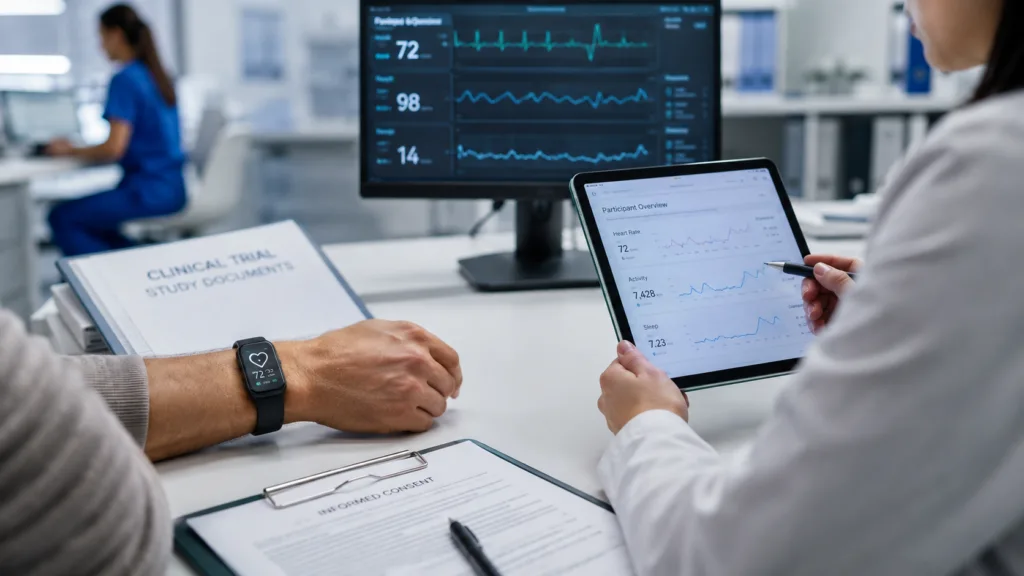
The regulatory attention reflects a wider shift in how sponsors measure patients. Traditional trials frequently rely on periodic clinic visits, questionnaires and controlled tests that provide only brief snapshots of a participant’s condition. Wearable sensors can instead record movement, sleep, heart rhythm, respiratory patterns, temperature and other physiological or behavioural signals repeatedly while patients go about their normal lives.
That abundance of information does not automatically create better evidence. A device may generate millions of observations while still failing to measure an outcome that patients consider meaningful. Algorithms may change during a study, participants may stop wearing the device, wireless connections may fail and measurements validated in healthy adults may perform differently in children, older patients or people with impaired movement.
The next phase of wearable adoption will therefore be defined less by how much data a sensor can collect and more by whether sponsors can establish a defensible chain connecting the sensor, the algorithm, the derived measurement, the clinical endpoint and the treatment effect. This is the difference between an attractive technology demonstration and a measurement capable of influencing a drug approval decision.
Why are wearable devices becoming more important in pharmaceutical clinical trials?
Wearable technologies can capture physiological and behavioural information at frequencies that would be impossible through conventional site visits. Depending on the device, sponsors may be able to observe daily activity, gait, sleep disruption, tremor, coughing, heart rate, oxygen saturation or changes in physical endurance over weeks or months.
The Food and Drug Administration has identified continuous or frequent measurement, remote data collection and the ability to record clinical features that cannot easily be captured during traditional visits as potential advantages of digital health technologies. The agency’s current programme covers wearable, implanted, ingested and environmental technologies used to collect information directly from trial participants.
For patients, remote monitoring could reduce the number of journeys to research centres and make participation possible for people living far from major hospitals. It could also capture periods when symptoms worsen between scheduled visits, creating a more complete picture of disease variability.
For sponsors, wearable-derived measurements may increase the number of observations available for analysis and potentially reveal treatment effects sooner than episodic assessments. A drug intended to preserve mobility, for example, might be evaluated through changes in everyday walking patterns rather than relying exclusively on a short test performed under supervision every few months.
A major 2026 review in Nature Reviews Drug Discovery concluded that wearables are increasingly being integrated into interventional drug trials because they can support continuous, remote and participant-friendly monitoring. The review also identified evolving regulatory expectations and emerging sensing technologies as central to whether digital biomarkers become more influential in drug development.
What is the difference between wearable data and a digital clinical endpoint?
Raw wearable data are not usually a clinical endpoint. An accelerometer may capture changes in movement along three axes thousands of times each second, but those signals require processing before they can be interpreted as steps, walking speed, activity intensity or another clinically understandable measure.
A digital biomarker is a measurement derived from digital technology that reflects a biological process, physiological condition or response to treatment. A digitally derived endpoint goes further by defining how that measurement will be used to evaluate a clinical question within a trial.
This distinction matters because a sponsor cannot simply distribute consumer smartwatches, extract a convenient metric and assume that regulators will accept the result. The selected measurement must be appropriate for the disease, population, treatment mechanism and intended role in the study.
A sleep measure that is adequate for exploratory research may not be sufficiently validated to serve as the primary endpoint in a registration trial. Similarly, a device capable of estimating walking speed in healthy adults may not perform accurately among people using mobility aids or patients with irregular gait caused by a neurological disorder.
The clinical meaning of a change must also be established. A statistically significant increase in daily steps may look favourable, but regulators and clinicians still need to understand whether the difference represents a meaningful improvement in independence, fatigue, symptom burden or quality of life.
How does the FDA expect sponsors to validate wearable technologies?
The Food and Drug Administration’s guidance on digital health technologies for remote data acquisition says a technology should be fit for its intended purpose. The level of verification and validation should be sufficient to support the device’s proposed use and the interpretation of the information it produces.
Verification asks whether the technology measures and processes signals as its specifications claim. Validation examines whether the resulting measurement appropriately assesses the clinical event or characteristic relevant to the investigation.
For a wearable gait sensor, verification could involve confirming the accuracy of its accelerometer, timing system and data-transfer process. Validation would require evidence that the algorithm correctly translates those signals into a clinically meaningful measure of walking performance in the intended patient population.
Sponsors must also consider the full technical system rather than the wearable alone. Smartphones, operating systems, wireless networks, cloud platforms and data-processing software may all affect whether information is captured completely and consistently. The FDA guidance notes that supporting technologies should be adequate for the functions required in the clinical investigation.
This creates a substantial operational obligation. A sponsor may need to document device versions, firmware, algorithm configurations, smartphone compatibility and data-flow controls throughout a multi-year trial. A seemingly routine software update could alter signal processing and create a measurement discontinuity between participants enrolled at different times.
Early regulatory engagement is therefore becoming more important. The Food and Drug Administration encourages sponsors considering digital health technologies or decentralised trial methods to contact the agency before their development plans become difficult to change.
Why is Duchenne muscular dystrophy an important example for digital endpoints?
Duchenne muscular dystrophy has become a leading example of how wearable-derived measurements can move from exploratory research toward regulatory acceptance. The European Medicines Agency has qualified stride velocity 95th centile as a clinical outcome assessment for ambulatory patients with Duchenne muscular dystrophy.
The measure represents the fastest five percent of strides recorded during normal daily activity. It is designed to capture a patient’s best spontaneous walking performance outside a clinic rather than performance during a single supervised assessment.
The endpoint initially gained qualification for use as a secondary endpoint and was subsequently accepted as a primary endpoint in studies involving ambulatory patients aged four years and older. Research supporting the measure found that it could detect deterioration in walking ability over shorter intervals than some conventional functional assessments.
The significance extends beyond Duchenne muscular dystrophy. The qualification showed that regulators are willing to accept measurements derived from continuous real-world monitoring when sponsors provide sufficient evidence concerning analytical validity, clinical meaning and statistical performance.
It also demonstrates how demanding the process can be. The successful endpoint was not simply a step-counting feature already available on a commercial watch. It required disease-specific research, controlled comparisons, longitudinal data and a clear definition of what aspect of patient function the measurement represented.
What statistical problems do continuously collected trial data create?
Wearable devices can produce enormous datasets, but repeated measurements are not independent observations. Thousands of readings from one participant do not necessarily provide the same evidentiary value as measurements from thousands of different participants.
Researchers must decide how raw signals will be converted into daily, weekly or monthly summaries. They must prespecify whether the analysis will use averages, maximum values, variability, time above a threshold or another feature. Choosing an analytical approach after viewing treatment-group differences could introduce bias.
Missing data present another major challenge. A participant may remove a sensor because it is uncomfortable, forget to charge it, travel without it or stop using it during a period of illness. Those gaps may not occur randomly. Patients experiencing worsening symptoms may be less likely to comply with wearable use, meaning missing data could conceal clinically important deterioration.
Sponsors must distinguish between genuine inactivity and absence of recording. A device showing no movement might indicate that a patient remained in bed, that the battery failed or that the wearable was left on a table.
The Food and Drug Administration’s August 2026 workshop will examine statistical methods, data standards and analytical approaches for digitally derived endpoints. The inclusion of continuous glucose-monitoring data in the programme illustrates the need for common technical specifications capable of supporting regulatory submissions, device-performance assessments and reproducible analyses.
Could consumer smartwatches be used in pivotal drug trials?
Consumer devices offer attractive advantages because patients may already know how to use them and manufacturers can produce them at scale. They may also cost less than specialised research equipment and support familiar smartphone interfaces.
However, a product designed for wellness tracking is not automatically appropriate for regulatory evidence. Consumer-device algorithms may be proprietary, and manufacturers can update them to improve the customer experience without preserving compatibility with an earlier research version.
Hardware components may also change between product generations. A trial that takes several years could begin with one sensor configuration and end after the manufacturer has introduced replacement models with different performance characteristics.
Bring-your-own-device strategies create additional variation because participants may use different watch models, phone operating systems and software versions. Providing an identical research device to every participant improves standardisation but increases logistics, training, replacement and technical-support costs.
The regulatory status of the device itself is only one part of the assessment. A wearable does not necessarily need to have been cleared as a medical device for every research use, but the sponsor must still show that the measurement is fit for its intended role in the clinical trial. The evidentiary requirement becomes more demanding when the measurement contributes directly to an efficacy or safety endpoint.
How could wearable devices make clinical trials more inclusive?
Remote data collection can reduce dependence on major academic centres and may allow people in rural or underserved areas to participate with fewer site visits. The Food and Drug Administration has said digital health technologies may make research participation more convenient and increase opportunities for individuals to enrol.
The same technology can create new exclusions. Participants may lack reliable internet access, compatible smartphones, private space for data transmission or confidence in using digital systems. Language, disability, age and health literacy can influence whether instructions are understood and devices are worn correctly.
Physical design also matters. A wrist-worn sensor may not be suitable for someone with a skin disorder, tremor or limited hand function. A wearable requiring daily charging may be difficult for people with cognitive impairment, while adhesives used by sensor patches may cause irritation.
Algorithms trained predominantly on healthy or demographically narrow populations can perform differently in the patients most likely to need treatment. Sensor accuracy may vary with movement pattern, body characteristics, skin properties and the location at which the device is worn.
Clinical-trial sponsors must therefore evaluate usability in the intended population rather than assuming that commercial popularity proves universal accessibility. Providing devices, connectivity, technical support and alternative collection methods may be necessary to prevent digital trials from excluding the very patients they are intended to reach.
What do wearables mean for pharmaceutical companies, CROs and device developers?
For pharmaceutical companies, digital endpoints offer an opportunity to distinguish treatments through outcomes that are difficult to measure during clinic visits. A therapy for Parkinson’s disease could potentially be assessed through tremor, gait and daily movement, while an oncology programme might examine activity decline or recovery between treatment cycles.
Contract research organisations are likely to expand services covering device deployment, technical support, remote monitoring, data engineering and digital-endpoint validation. The operational complexity could create new revenue opportunities, but it also introduces responsibility for technology failures and data-quality problems.
Wearable manufacturers may find that success in clinical research requires a different commercial model from consumer electronics. Sponsors need stable hardware, controlled software versions, access to raw or minimally processed data, transparent algorithms and long-term technical support.
Device companies that cannot guarantee version continuity may struggle to support pivotal trials. In contrast, manufacturers able to provide validated measurement systems, regulatory documentation and secure data infrastructure could become strategic partners in drug development rather than simple equipment suppliers.
The economic value may ultimately concentrate around the measurement rather than the physical sensor. Hardware can become interchangeable, while a validated disease-specific algorithm and regulatory-qualified endpoint may be difficult for competitors to reproduce.
Could digital endpoints shorten clinical trials or reduce development costs?
Wearables may improve efficiency, but claims that they will automatically make trials faster or cheaper should be treated cautiously. Continuous measurements can increase statistical sensitivity, potentially allowing researchers to detect change with fewer participants or over shorter follow-up periods.
Those benefits depend on the endpoint’s variability, treatment effect and relationship to clinical outcomes. A noisy or poorly validated digital measure could increase uncertainty and force a sponsor to run additional studies.
Technology expenses can also be substantial. Sponsors may need to purchase devices, operate help desks, replace lost equipment, validate software, store large datasets and monitor compliance. Specialist statistical and regulatory expertise adds further cost.
The strongest economic case may arise when a wearable solves a specific measurement problem that conventional trials cannot address efficiently. Rare diseases with small patient populations, slowly progressing neurological disorders and conditions characterised by episodic symptoms could be particularly suitable.
A digital endpoint may also have value as a supportive or exploratory measure before it becomes a pivotal endpoint. Sponsors can use early trials to establish feasibility, understand missingness, compare the digital measure with conventional assessments and determine whether it is sensitive to treatment-related change.
What risks could prevent wearable-derived endpoints from gaining wider acceptance?
The largest risk is that technology development moves faster than clinical validation. Device companies can release new sensors within months, while establishing that a measurement predicts a meaningful health outcome can require years.
Cybersecurity and privacy are also central concerns because wearables may collect continuous information about movement, location, sleep and physiology. Data must remain protected during transmission, storage, analysis and long-term retention.
Excessive monitoring could increase participant burden rather than reduce it. Patients may become anxious about being watched continuously or frustrated by reminders, charging requirements and technical problems. Compliance may deteriorate when a study treats the device as invisible infrastructure instead of an intervention requiring patient effort.
Another risk is endpoint proliferation. A single wearable can generate dozens of possible measurements, creating opportunities to search retrospectively for favourable differences. Regulators will expect sponsors to define key endpoints and statistical methods before unblinded analysis.
Finally, a digital measurement can be analytically accurate without being clinically important. The industry’s enthusiasm will endure only if wearable-derived changes help explain how patients feel, function or survive.
Expert view: Wearables will not replace clinical judgement, but they could expose what clinic visits miss
Wearable devices are unlikely to eliminate conventional clinical assessments. Laboratory testing, imaging, physician examination and patient-reported outcomes will remain essential because no single sensor can capture the full effect of a treatment.
Their greatest value is complementary. A clinic visit can provide a controlled and clinically detailed assessment, while a wearable can reveal what happens during the remaining days and nights when the patient is outside the research centre.
The regulatory direction in 2026 is encouraging but disciplined. The Food and Drug Administration is funding research, holding workshops and developing internal expertise around digital health technologies, yet its emphasis remains on fit-for-purpose validation, data standards and clinically meaningful endpoints.
This suggests that the winners will not necessarily be the companies producing the most sophisticated sensors. They will be the organisations that can explain exactly what their technology measures, how accurately it measures it, why that measurement matters to patients and how missing or inconsistent data will be handled.
Wearables could eventually change trial design by replacing isolated snapshots with continuous evidence of daily function. Before that promise can be realised, sponsors must resist the temptation to confuse data volume with clinical value.
The smartwatch may be the visible part of the system, but the true medical product is the validated measurement created behind it. That is what regulators will assess, what pharmaceutical companies will need to defend and what patients will ultimately rely on when digital evidence helps determine whether a new treatment reaches the market.